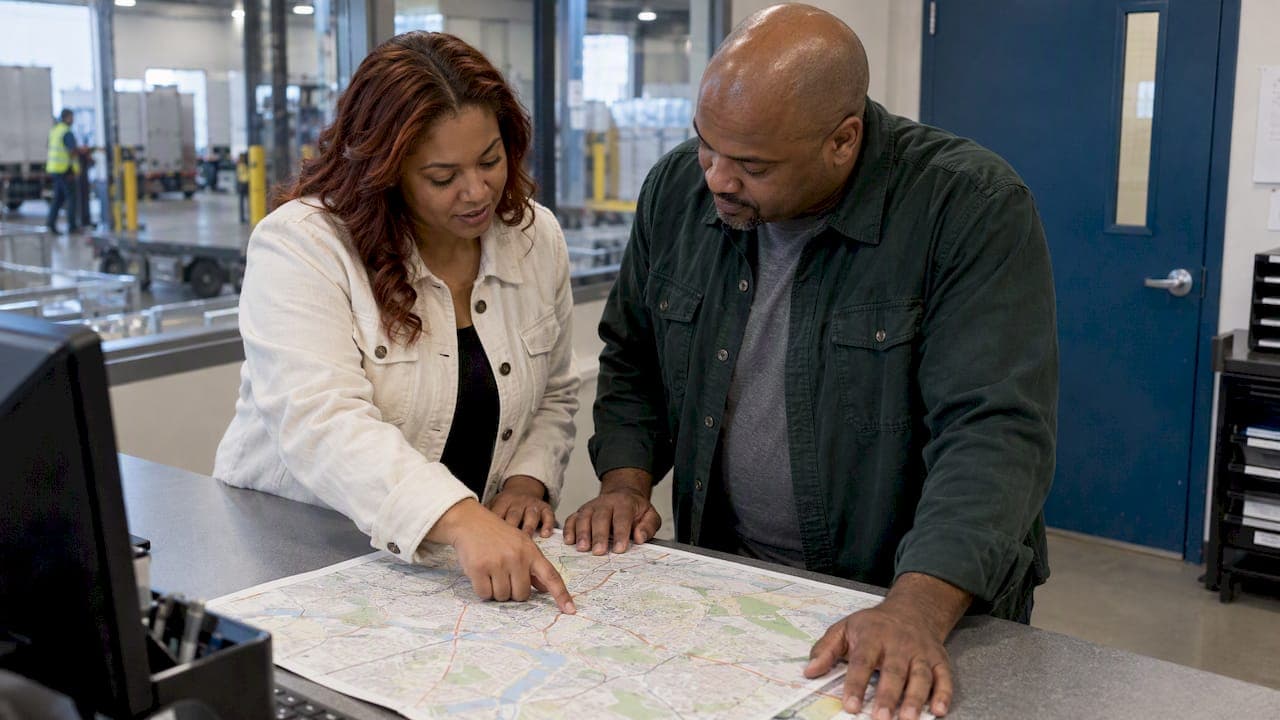
A driver hiring radius is the area you recruit from, measured around the terminal or reporting location where a driver starts work. To set one, start with the commute a driver will accept for that role (about 20 to 30 minutes for pickup and delivery), convert it into a map area using real roads, then check the result against your applicant data and widen or narrow it. This guide shows how to do that for pickup and delivery, CDL-A solo, CDL-A team, and linehaul roles, and what drivers should check when they read a radius in a job post.
TL;DR
- Base the radius on drive time and real roads, not a straight-line circle or a ZIP code boundary.
- Pickup and delivery roles need the tightest radius. Linehaul and CDL-A roles can draw from much farther, because the work pattern is different.
- Check your numbers after 30 days: applications that drop off after the commute question mean the radius is too wide, and too few applicants means it is too narrow.
- Drivers should confirm the reporting location, the commute, and the actual work area before they apply to any job that states a radius.
- Keep "hiring radius" separate from "route radius" and from regulatory distance limits such as the 150 air-mile short-haul exception.
Table of Contents
- What a driver hiring radius means
- Why a straight-line circle is the wrong starting point
- Choose a starting radius by commute time
- How the radius differs by role
- Account for local conditions
- Check whether your radius is working
- Write the radius into the job post
- What drivers should check before applying
- Our perspective
- Post your openings where FedEx drivers search
- FAQ
- Sources
What a driver hiring radius means
Three different distances get called a "radius" in trucking. Mixing them up causes most of the mismatches between drivers and Service Providers.
| Term | What it measures | Who uses it |
|---|---|---|
| Hiring radius | How far from the terminal you recruit or accept applicants | Recruiters, job boards |
| Job-search radius | How far from home a driver is willing to look | Drivers |
| Work or route radius | Where the driver operates once on the clock | Dispatch, compliance |
A hiring radius is a recruiting decision. It does not say where a driver will drive. A driver can live 15 miles from a terminal and run a route 100 miles away, or live 40 miles away and run a short local route.
The work radius has regulatory meaning in some cases. Under the federal short-haul exception, a driver who operates within a 150 air-mile radius of the normal work reporting location and stays within a 14-hour duty period is exempt from certain logging requirements. FMCSA's 2020 final rule extended that limit from 100 to 150 air miles. That is a rule about how the driver works, not about where you may recruit. Keep the two numbers apart in your job posts.
Why a straight-line circle is the wrong starting point
Most tools draw a circle around a point. Straight-line mileage ignores traffic and physical geography, so a candidate 10 miles away across a river or a congested corridor can have a longer commute than one 18 miles away on a highway. Candidates who see that commute often reject the job.
A better method is to base the area on actual commuting patterns, employee locations, and transportation corridors rather than ZIP code lines. In practice:
- Open a map and set your terminal address as the center.
- Use a drive-time tool to draw the 20, 30, and 45 minute areas at the hours your drivers start, not at midday.
- Mark the highways and transit lines that carry drivers to you.
- Note the towns inside each area that have a driver pool and the ones that do not.
- Choose the drive-time area as your radius, then describe it in miles for job posts.
Choose a starting radius by commute time
You need a benchmark for what drivers tolerate. The U.S. Census Bureau reports that the average one-way commute in 2019 was 27.6 minutes, and 9.8% of commuters traveled an hour or more. Workers who drove alone averaged 26.4 minutes. Those are all-worker figures, not driver-specific, so treat them as a ceiling for a typical commute and not as a target.
For operational and hourly roles, one recruitment marketing firm recommends a 20 to 30 minute maximum commute and an 8 to 12 mile radius. That is a reasonable first guess for pickup and delivery in a dense metro area. It is a starting point, not a rule. Rural areas, early start times, and low transit access all change it, which is why the next sections matter.

How the radius differs by role
The role decides how far a driver will travel to start work. Drivers weigh a daily commute differently from a weekly or occasional one.
Pickup and delivery
These drivers go to the terminal or station every working day, often before sunrise. Keep the radius tight: start near the 20 to 30 minute area and expand in steps. Early shift times matter more than distance, because public transit rarely runs at 4 a.m. Our guide to hiring pickup and delivery drivers locally covers local sourcing in more detail.
CDL-A solo
CDL-A solo drivers tend to run longer lanes and may start from a terminal on a fixed schedule. The reporting location still matters if they return home nightly, so the radius can be wider than for pickup and delivery, but state the home-time pattern in the post. Local truck driving work is often defined by a delivery zone: one large carrier's local-driving page describes freight moved within a defined radius, such as 200 miles, to allow daily home time. Use that as an example of how the work area and the home-time promise connect, not as a hiring standard.
CDL-A team
Team drivers share a truck and cover long distances, so the commute to the terminal happens only at the start and end of a run. A team can come from a much larger area, even from several states, as long as the pair can reach the pickup point. Here the radius is less about commute and more about where the two drivers live relative to each other and to the dispatch point.
Linehaul
Linehaul runs move freight between terminals on set schedules. Drivers may be willing to travel farther to reach a stable, predictable lane, especially for a night shift they can plan around. If you are filling these seats, see our guide on hiring linehaul drivers fast.
Starting points at a glance
| Role | Commute pattern | Suggested starting area | Widen when |
|---|---|---|---|
| Pickup and delivery | Daily, early start | 20 to 30 minutes | Applicants are under target after 2 weeks |
| CDL-A solo | Daily or weekly, by lane | 30 to 60 minutes | Qualified CDL-A pool is thin locally |
| CDL-A team | Start and end of run | Multi-county or regional | Pairs cannot be matched locally |
| Linehaul | Fixed schedule between terminals | 30 to 60 minutes | Night or weekend seats stay open |
These are working assumptions to test, not published standards. Your own applicant data should overrule them.
Account for local conditions
Commute time is only part of it. The radius should also reflect public transportation access and local labor-market factors such as industry concentration, unemployment rates, demographics, and wage expectations.
Urban areas
Dense areas hold many drivers but also traffic and competing employers. A small radius can still produce plenty of applicants. Widening it brings in people with long, slow commutes who are likely to leave.
Rural areas
In a rural market, a 20-minute area may contain only a handful of qualified drivers. Widen the radius, offer clear start times, and explain the commute honestly. We cover this in rural driver recruiting for FedEx Service Providers.
Estimating the available pool
Before you commit to a radius, estimate how many drivers it can hold:
- Compare nearby ZIP codes by unemployment rates, population and demographic trends, and labor-pool dynamics.
- Look for lower-cost labor pools instead of recruiting only from the nearest major city.
- Check the wage you offer against the market. The Bureau of Labor Statistics reports a national median hourly wage of $23.01 for light truck or delivery services drivers and $29.00 for heavy and tractor-trailer drivers as of 2025. A radius that spans a high-wage metro and a low-wage town will pull applicants toward the higher-paying one.
- Keep the national picture in mind: BLS preliminary data show truck transportation employed 1.4731 million people in September 2026. The supply exists, but it is spread unevenly. For background, see why trucking has a driver shortage.
Check whether your radius is working
Set the radius, then measure it. Two signals matter most: commute-related application drop-off and hiring yield. Broad radii can waste spend on candidates who find the commute unmanageable.
Track these for each opening, every 2 to 4 weeks:
- Applications per posting. Very few means the area is too narrow or the pay is off.
- Drop-off after contact. If candidates go quiet once you share the terminal address, the radius is too wide.
- Interview show rate. Low show rates from the outer edge of the area point to commute problems.
- Hires and 90-day retention by distance band. Group hires into 0 to 10, 10 to 20, and 20+ miles. If the outer band quits sooner, pull the radius in.
- Time to fill. Our time to hire guide explains how to shorten it without skipping compliance steps.
Use your own records to see where proven demand comes from. One marketing firm suggests using CRM records and sales logs rather than search-interest data when considering expansion. For a Service Provider, the equivalent is your applicant tracking history: where did your best drivers live?
When to adjust
- Widen by 5 to 10 minutes when you have a steady flow of qualified drivers at the edge of your area and too few overall.
- Narrow when edge-of-area hires leave early or never show up.
- Split the radius by role. Use a tight area for pickup and delivery and a wider one for CDL-A seats at the same terminal.
- Change one variable at a time. If you change radius, pay, and post time together, you cannot tell what worked. Posting time is its own variable: see the best time to post trucking jobs.
Write the radius into the job post
A clear post prevents wasted applications. Include:
- The terminal or reporting address, or at least the city and ZIP code.
- The start time and typical shift length.
- Where the driver works after reporting, stated separately from where they report.
- Home-time expectations for CDL-A roles.
- Whether you will consider applicants outside the stated area.
Our driver job description template has fields for these items. Keep messages to applicants short and specific; candidate messaging can also confirm the commute before an interview.
What drivers should check before applying
If you are a driver reading a post that says "within 25 miles," confirm three things first.
- Reporting location. Where do you physically start each shift? Get the exact address and compare it with your home using a map app at your real start time.
- Commute. Time the drive at the hour you would leave, including traffic. A short distance can be a long drive.
- Actual work area. Ask where you will drive after reporting, how far from the terminal, and when you get home. For CDL-A roles, ask whether the route is local, regional, or over-the-road.
Also ask whether the radius is a requirement or a preference. Our article on confirming the terminal hiring radius lists the questions to ask before you apply.
Our perspective
We built UCEP around one fact: FedEx Service Providers hire at the terminal level, and a driver's decision usually comes down to whether the job is reachable. That is why we do not treat a radius as a single number. It is a combination of terminal, role, shift, and commute.

We see two common mistakes. The first is setting the radius too wide to get more applicants, which increases applications but not hires. The second is hiding the reporting location until late in the process, so the driver finds out about the commute after they have already invested time.
Our advice is to state the terminal clearly, pick a drive-time area by role, and review your results monthly. On UCEP, drivers can use filtered job search, terminal directories, and employer research tools to check where a job starts before applying. Service Providers can use targeted driver alerts and a built-in applicant tracking system to see where applicants come from.
— Aaron
Post your openings where FedEx drivers search
UCEP is a job board built only for Service Providers contracted with FedEx. You can list pickup and delivery, CDL-A solo, CDL-A team, and linehaul roles and manage applicants in one place. New recruiters can start with a complimentary trial listing, and the Standard Monthly Plan is $99 per month. See the details on our pricing page.
Drivers can browse current FedEx driver jobs and filter by role. If you also want to use alerts to reach drivers as soon as you post, read about the role of job alerts in recruiting.
FAQ
What is a good hiring radius for pickup and delivery drivers?
Start with a drive time of 20 to 30 minutes from the terminal, which is roughly 8 to 12 miles in a dense area. Test it for two to four weeks and widen in 5 to 10 minute steps if qualified applicants are scarce. Rural markets usually need a larger area.
Is a hiring radius the same as the 150 air-mile short-haul rule?
No. The 150 air-mile limit is a federal hours-of-service exception that applies to how far a driver operates from the normal work reporting location. A hiring radius is where you recruit applicants. They can be different numbers for the same job.
How do I know my radius is too wide?
Look for applicants who stop responding after learning the terminal location, low interview show rates from the outer area, and new hires from the farthest band who leave early. Those patterns suggest the commute is the problem. Pull the radius in and compare results.
Should CDL-A team roles use the same radius as local roles?
Usually not. Team drivers commute to the terminal only at the start and end of a run, so they can come from a much wider area. The key question is whether both drivers can reach the pickup point.
Sources
- Summary of Hours of Service Regulations (FMCSA)
- U.S. Department of Transportation Modernizes Hours of Service Rules
- Travel Time to Work in the United States: 2019 (U.S. Census Bureau)
- Truck Transportation: NAICS 484 (U.S. Bureau of Labor Statistics)
- Local Truck Driving Jobs (Drive J.B. Hunt)
- Radius Targeting in Job Distribution (Leadstars)
- Geographic Targeting Strategies That Maximize Local Talent (Dstribute)
- What is a Labor Market Analysis? (Route Consultant)
- Which Nearby Cities Should Your Service Business Target (WSI)