
Hiring linehaul drivers fast is defined as placing qualified CDL-A candidates into active routes within days, not weeks, through targeted sourcing, rapid compliance verification, and clear communication. Linehaul driving refers to long-distance freight movement between terminals or distribution hubs, typically requiring CDL-A licensure, DOT medical certification, and FMCSA compliance. Specialized CDL staffing partners typically place qualified drivers within 7–14 days, with urgent needs filled in under 72 hours. That benchmark sets the standard your recruitment process should match. This guide gives logistics managers and operations directors a direct, step-by-step path to meet it.
What tools and prerequisites do you need to hire linehaul drivers fast?
Fast linehaul driver recruitment starts before you post a single job. You need the right compliance infrastructure and technology in place before candidates enter your pipeline.
Compliance prerequisites
Every linehaul candidate requires verification of three core credentials: a valid CDL-A license, a current DOT medical card, and a clean Motor Vehicle Record (MVR). FMCSA regulations require a pre-employment drug screen and a PSP (Pre-employment Screening Program) inquiry. Skipping or delaying any of these steps creates legal exposure and slows onboarding. Running these checks in parallel, rather than sequentially, cuts verification time significantly.
Technology tools that accelerate hiring
Technology-enabled recruiting systems allow you to post to multiple job boards simultaneously, screen applicants against insurance and compliance rules automatically, and send follow-up notices without manual effort. That automation removes the bottlenecks that cause most hiring delays. An applicant tracking system (ATS) built for trucking keeps candidate records organized and flags incomplete documentation immediately.

Niche job boards focused on CDL drivers outperform general platforms for linehaul roles. Targeted job boards deliver higher-quality applicants because the audience is already pre-qualified by interest and license type. Posting on a general employment site generates volume but not relevance.
| Tool or Check | Purpose | Time Saved |
|---|---|---|
| CDL-A and MVR verification software | Confirms license validity and driving history | Up to 2 days vs. manual checks |
| DOT medical card database lookup | Confirms current medical certification | Same-day vs. 1–2 days |
| ATS with trucking-specific filters | Screens unqualified applicants automatically | Reduces review time by hours |
| Niche CDL job boards | Targets pre-qualified driver candidates | Faster applicant flow |
| Automated follow-up messaging | Keeps candidates engaged without manual outreach | Prevents drop-off |
Key requirements before you post:
- CDL-A license verification process ready
- DOT medical card check workflow established
- FMCSA PSP inquiry account active
- Pre-employment drug screen vendor contracted
- ATS or recruiting software configured for trucking roles
How do you expedite linehaul driver hiring from sourcing to onboarding?
A structured process is the single biggest factor separating fleets that fill seats in 72 hours from those that wait three weeks. Each step below has a realistic time target attached.
-
Post to niche CDL job boards (Day 1). List the role on platforms built for CDL drivers, including Ucep if you are a FedEx Service Provider. Include pay range, route type, home time schedule, and equipment details. Competitive pay and clear home time are the two factors drivers cite most when choosing between offers.
-
Activate a specialized staffing partner (Day 1). Contact a CDL-focused staffing agency simultaneously. Pre-screened, MVR-verified candidates can arrive within 48 hours through a qualified staffing partner. This parallel track doubles your candidate flow without doubling your workload.
-
Pre-screen applicants within 4 hours of application (Day 1–2). Call or text every applicant within four hours of submission. Lead response time is more predictive of recruiting success than lead volume. A driver who applies at 8:00 AM and hears nothing by noon is likely talking to another carrier by 2:00 PM.
-
Conduct a structured phone screen (Day 2). Ask five questions: CDL-A class and expiration date, DOT medical card status, years of linehaul experience, availability date, and preferred home time frequency. This takes 10 minutes and eliminates unqualified candidates before you invest in a full interview.
-
Run compliance checks in parallel (Day 2–3). Order the MVR, PSP report, and drug screen simultaneously. Do not wait for one to complete before ordering the next. Most MVR results return within 24 hours.
-
Extend a verbal offer with written confirmation (Day 3–4). State pay, route, schedule, and start date clearly. Send a written offer letter the same day. Vague terms cause candidates to stall or withdraw.
-
Complete orientation and first-day deployment (Day 5–7). Prepare orientation materials in advance. Assign a point of contact for the new driver's first week. Fleets that provide structured onboarding support retain new hires at higher rates.
Pro Tip: Schedule your drug screen vendor to accept walk-ins Monday through Saturday. Requiring an appointment on a weekday adds 24–48 hours to your timeline for no operational reason.
What mistakes slow down linehaul driver recruitment?
Most hiring delays are self-inflicted. The problems below appear in nearly every slow-hire situation.
- Sequential compliance checks. Running background checks one at a time adds 3–5 days. Order all checks on the same day.
- Slow initial contact. Administrative delays allow competing carriers to hire candidates before you finish your internal review. Contact every applicant within four hours.
- Vague job postings. Listings that omit pay range, home time, or route type generate low-quality applications and high drop-off rates. Unclear job terms cause candidates to lose interest before the first call.
- Too many approval layers. Requiring three managers to approve an offer letter adds days. Designate one decision-maker for driver offers.
- Relying on a single sourcing channel. Posting to one job board and waiting is not a recruitment strategy. Use at least three channels simultaneously: a niche CDL board, a staffing partner, and an employee referral program.
- No candidate communication between steps. Silence kills applications. Send a text or email after every stage to confirm next steps and timing.
"Driver recruitment is a logistical race where the first clear, credible offer wins the candidate. Fleets that focus on lead response time over lead volume consistently fill seats faster."
Pro Tip: Pre-build your offer letter template with blank fields for pay rate, start date, and route. When a candidate clears compliance, you can send a complete offer in under five minutes.
Competing fleets move fast. The fastest-hiring fleets win candidates by minimizing administrative delays and automating outreach. If your process requires a candidate to wait 48 hours for a callback, you are losing qualified drivers to carriers with faster systems.
How do you build a driver pipeline for ongoing fast hiring?
Reactive hiring, posting a job only when a seat opens, is the most expensive way to recruit. A proactive pipeline cuts your time-to-hire on every future opening.
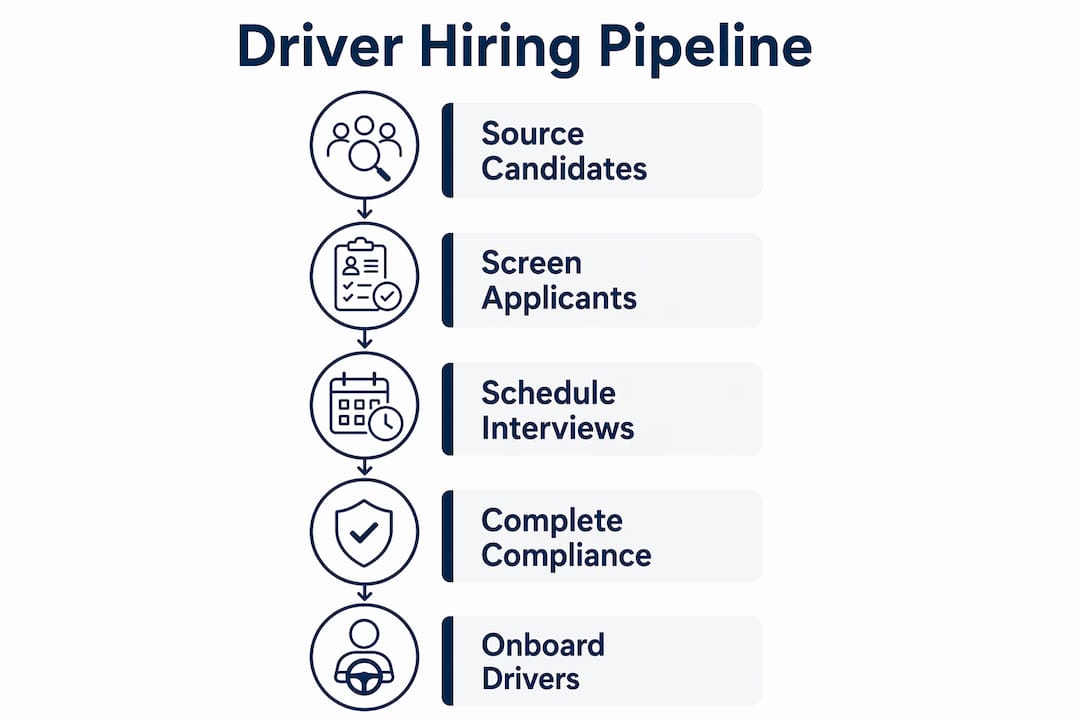
Maintaining a talent pipeline through staffing partners and referral programs reduces urgent hiring timelines and improves fleet uptime. The difference between reactive and proactive recruiting is not just speed. It is cost, quality, and operational stability.
| Factor | Reactive hiring | Proactive pipeline |
|---|---|---|
| Time to fill an open seat | 14–30 days | 3–7 days |
| Candidate quality | Variable | Pre-screened |
| Cost per hire | Higher due to urgency | Lower with established relationships |
| Fleet downtime risk | High | Low |
| Compliance readiness | Rushed | Verified in advance |
Three practices build a reliable driver pipeline:
Referral programs. Drivers know other drivers. A structured referral bonus of $500–$1,000 per successful hire generates warm candidates who already understand the work. Referred drivers also tend to stay longer.
Ongoing staffing partner relationships. Specialized staffing services that pre-qualify drivers based on medical, MVR, and DOT compliance reduce orientation time significantly. Maintain an active relationship with at least one CDL-focused partner so they know your requirements before you call with an urgent need.
Candidate nurturing. Keep a list of qualified candidates who were not hired due to timing. Contact them every 60–90 days. A driver who was unavailable in march may be ready in june. An ATS with tagging and reminder functions handles this automatically.
Data analytics add another layer. Track your average time-to-fill, source of hire, and offer acceptance rate by channel. Those three metrics tell you exactly where your pipeline is leaking and where to invest more recruiting resources.
Key Takeaways
Fast linehaul driver hiring requires parallel compliance checks, sub-four-hour candidate contact, and at least three simultaneous sourcing channels to consistently fill seats within 7 days.
| Point | Details |
|---|---|
| Speed benchmark | Qualified linehaul drivers can be placed in 7–14 days, or under 72 hours for urgent needs. |
| Parallel compliance checks | Run MVR, PSP, and drug screen simultaneously to cut 3–5 days from your timeline. |
| Contact speed matters | Reach every applicant within four hours to prevent competing carriers from hiring them first. |
| Proactive pipeline | A maintained talent pool cuts time-to-fill from 14–30 days down to 3–7 days. |
| Clear job terms | Listings with pay, home time, and route details reduce candidate drop-off and improve offer acceptance. |
What I've learned about hiring linehaul drivers quickly
The biggest mistake I see logistics managers make is treating driver recruitment like a standard corporate hire. It is not. Drivers evaluate your offer in real time, often while sitting in a truck stop with three other offers on their phone. The window to win them is measured in hours, not days.
Speed matters, but it cannot come at the cost of compliance. A driver who skips a DOT medical check or has an undisclosed MVR violation creates liability that far outweighs the cost of a delayed hire. The fleets that get this right run compliance checks fast, not loose. They use technology to automate the paperwork and reserve human judgment for the decision itself.
The other thing I would tell any operations director: invest in your first week. Drivers who receive clear communication, a named point of contact, and a structured first route assignment stay longer. Retention is the best recruiting strategy you have. Every driver you keep is one you do not have to replace.
Platforms like Ucep, built specifically for FedEx Service Providers, remove a layer of noise from the search. When your sourcing channel already filters for the right license class and contract type, your team spends less time screening and more time hiring.
— Aaron
Ucep makes finding qualified linehaul drivers straightforward
Ucep is a dedicated job board and recruiting platform built exclusively for Service Providers contracted with FedEx. If you need to fill linehaul, CDL-A team, CDL-A solo, or pickup and delivery roles, Ucep connects you directly with drivers who are already looking for FedEx-related opportunities.
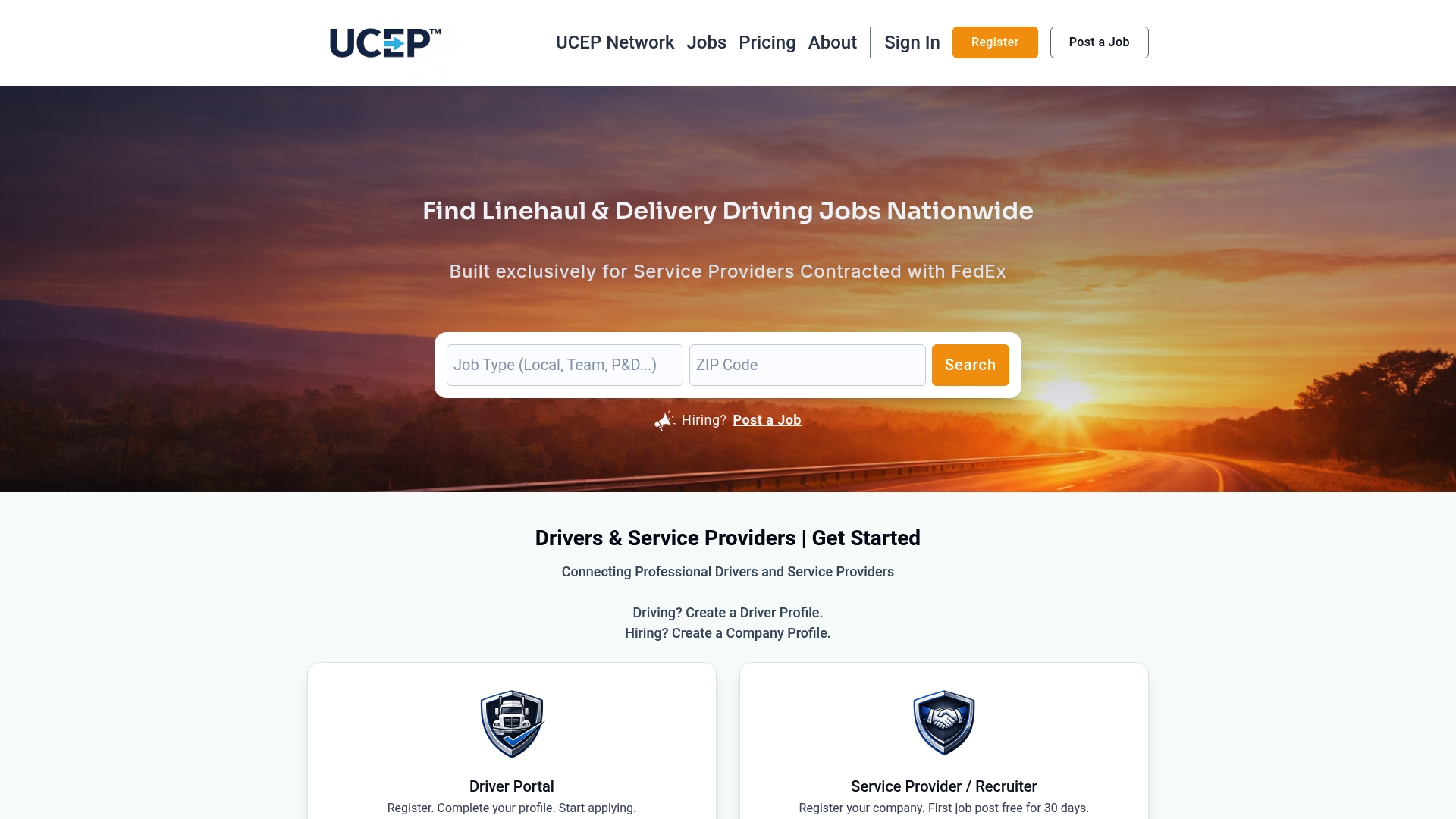
You do not have to sort through unqualified applicants from general job boards. Ucep's focused platform means every driver who sees your listing is already in the right segment. Post your open linehaul roles and find qualified drivers through a platform built for exactly this type of hire. For questions about how the platform works, visit the Ucep Q&A page.
FAQ
How fast can you realistically hire a linehaul driver?
Specialized CDL staffing partners deliver initial candidates in under 72 hours and complete placements within 7–14 days. Your internal process speed determines whether you hit the faster or slower end of that range.
What credentials must a linehaul driver have before starting?
A linehaul driver must hold a valid CDL-A license, a current DOT medical card, and a clean MVR. FMCSA regulations also require a pre-employment drug screen and a PSP inquiry before the driver operates commercially.
Why do candidates drop out during the hiring process?
Slow response times and unclear job terms are the two leading causes of candidate drop-off. Contacting applicants within four hours and providing complete pay and schedule details in the job posting reduces withdrawal rates significantly.
What is the difference between reactive and proactive driver recruiting?
Reactive recruiting fills seats only after they open, typically taking 14–30 days. Proactive recruiting maintains a pre-screened talent pipeline, cutting time-to-fill to 3–7 days and reducing fleet downtime.
Does posting on niche CDL job boards actually speed up hiring?
Niche CDL job boards deliver higher-quality applicants than general platforms because the audience is already filtered by license type and job interest. That pre-qualification reduces the time your team spends screening unqualified candidates.