
A competitive, straightforward CDL hire runs from application to start in under two weeks, and the best carriers do it in under two weeks. The single biggest lever is contacting every applicant within 60 minutes and running compliance checks in parallel instead of one after another. Offers should go out within 48 hours. Federal requirements still apply at every step, and some of them cannot be shortcut no matter how fast your team moves.
TL;DR:
- Responding to applicants within two hours and extending offers within 48 hours can triple the speed of filling open truck driving positions.
- Completing essential compliance checks in parallel rather than sequence reduces hiring time to under two weeks while maintaining legal requirements.
- Keep all stages of pre-employment checks, such as drug tests and safety history requests, on schedule to avoid delaying first dispatch.
- Monitoring key metrics like time-to-first-contact and application-to-orientation rate helps identify bottlenecks and improve overall process speed.
- Automating outreach, giving recruiters authority to extend offers, and pre-booking physical and road test slots are proven ways to accelerate hiring without sacrificing compliance.
Table of Contents
- What Is a Good Time-to-Hire Benchmark for Trucking?
- What Does a Compliance-Ready Hiring Timeline Look Like?
- How Do You Speed Up Each Hiring Stage Without Cutting Corners?
- Which Metrics Actually Tell You Where Hiring Is Slow?
- Where Do Trucking Hires Actually Get Stuck?
- How Does UCEP Help Service Providers Hire Faster?
- What Hiring Teams Get Wrong About Speed
- Post a Job and Start Cutting Your Hiring Timeline
- Sources
- FAQ
What Is a Good Time-to-Hire Benchmark for Trucking?
"Good" has a shape, and it starts within minutes, not days. First contact with an applicant should happen in under 60 minutes; top performers do it in under 15. A phone screen should follow the same day. A conditional offer should go out within 48 hours of that screen, and for straightforward hires, the gap between offer and orientation start should be under two weeks.
Line those milestones up and you get a full cycle that competitive carriers finish in under two weeks, and many best performers do it in under ten days, according to benchmarking data from Hire Master. Compare that to the industry norm. Carriers relying on traditional recruiting methods, batch outreach, and manual paperwork routinely see 30 to 45 days from application to start.
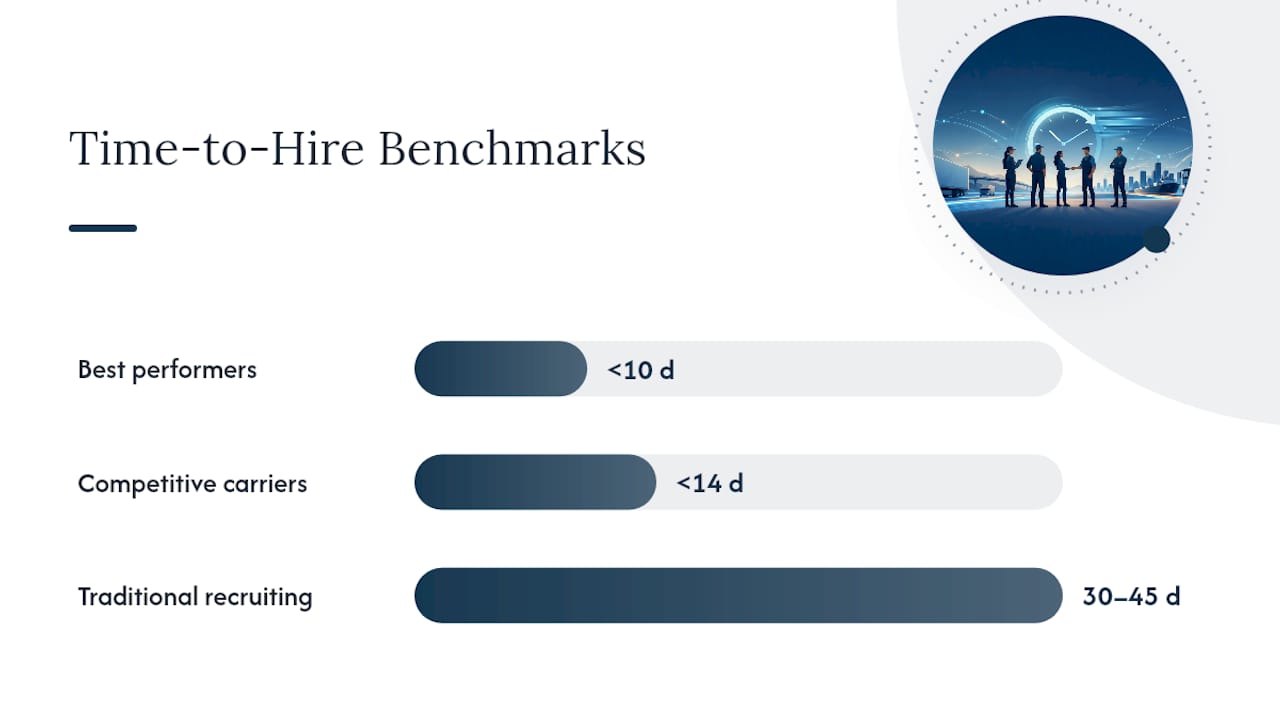
The gap between those two numbers is not about compliance. It is about response speed. Drivers do not apply to one carrier and wait. They apply to several at once, and the first company to make real contact usually wins the hire. Tenstreet's analysis found that carriers responding within five minutes see meaningfully higher hiring rates than those who take hours, and that hiring rates drop off sharply once a cycle stretches past 10 to 15 days.
The 48-hour rule: Carriers who respond within two hours and extend an offer within 48 hours fill open seats roughly three times faster than carriers running a 5 to 7 day process.
What Does a Compliance-Ready Hiring Timeline Look Like?
Speed only counts if it holds up under a DOT audit. Federal Motor Carrier Safety Administration rules under Part 391 dictate a fixed sequence of checks, and a few of them are legally non-negotiable before a driver's first dispatch.
Here is the order those checks actually need to run in:
- Application received. Start the clock. This timestamp becomes your baseline for every other metric.
- Phone screen and conditional offer. Best-in-class carriers complete this the same day, often within hours of application.
- FMCSA Drug & Alcohol Clearinghouse query and consent. Required before a driver performs any safety-sensitive function. This cannot be skipped or backdated.
- DOT pre-employment drug test with a verified negative result. Also mandatory before first dispatch, not just before the offer.
- DOT physical and medical certificate. Must be current and on file before the driver operates a commercial motor vehicle.
- Motor vehicle record (MVR) pull. Confirms license status and violation history.
- Previous-employer safety history request. FMCSA requires carriers to request the past three years of safety performance history from prior DOT-regulated employers.
- Road test or valid equivalent. Confirms operational competency.
- I-9 verification and onboarding paperwork. Governed by Department of Labor recordkeeping standards and must be completed within the standard federal window.
Steps 3 through 5 must be closed out before first dispatch, full stop. MVR, previous-employer history, and paperwork can often run in parallel with the physical and drug screen rather than after them, which is where most of your time savings live.
One catch trips up a lot of teams: the 30-day rule on previous-employer responses. FMCSA gives former employers up to 30 days to respond to a safety history request. Do not simply let the file sit open with no record of the effort.
How Do You Speed Up Each Hiring Stage Without Cutting Corners?
Every stage above has a compliant way to move faster. None of it involves skipping a step. It involves doing steps at the same time instead of in sequence, and removing the manual lag between them.
Contact applicants in under 60 seconds. An automated text triggered the moment an application lands beats a next-day phone call every time. Ninety-three percent of drivers say they prefer text to voicemail, so meet them where they already are. Follow the text with an offer for a same-day, 15-minute qualification call.
Trigger checks the second the phone screen passes. MVR, Clearinghouse query, and background vendor requests should fire simultaneously, not one after the other. Running them in parallel instead of in a straight line is what turns a two-week process into a one-week process.

Move documents and offers to mobile. Mobile-friendly applications, e-signature offer letters, and rapid-return screening vendors cut the friction that causes applicants to drop out mid-process, an issue Tenstreet's leadership has flagged as a top cause of abandonment.
Give frontline recruiters the authority to extend conditional offers. If every offer has to wait for a manager's sign-off, you have added a bottleneck that has nothing to do with compliance.
- Staff recruiter coverage around when drivers actually apply, including evenings and weekends.
- Use a structured qualification script so no recruiter skips a disqualifying question, then has to circle back.
- Pre-book DOT physical and road test slots in blocks so a passed screen does not sit waiting for an open appointment.
Structured, fast-moving workflows like these are covered in more detail in this breakdown of recruiter workflow changes for trucking fleets, and similar candidate-experience principles show up in research on reducing friction in security-sector recruiting, where instant outreach produces the same lift.
Pro Tip: Paying a premium for a rapid-return MVR or background vendor almost always pencils out. A truck sitting idle for a week costs far more than the extra few dollars per check.
Which Metrics Actually Tell You Where Hiring Is Slow?
You cannot fix what you are not measuring, and most trucking hiring teams track the wrong number: total time-to-hire, with no visibility into which stage is actually dragging.
Track these instead, and pull them from ATS timestamps and vendor service-level agreements, not from memory:
- Time-to-first-contact: minutes from application to first outreach. Target under 60 minutes.
- Time-to-phone-screen: should happen same day.
- Time-to-offer: target under 48 hours from screen completion.
- Offer-acceptance rate: tells you whether your offer process, not your sourcing, is the problem.
- Application-to-orientation rate: the real end-to-end number. Target under 14 days for a straightforward hire.
- Cost-per-hire: rises fast when trucks sit empty, so weigh it against lost revenue, not just recruiting spend.
Watch these weekly, not monthly. A slippage in time-to-offer that goes unnoticed for a month can quietly stretch your entire funnel. More detail on building this kind of dashboard is available in this guide to trucking recruiting metrics.
Where Do Trucking Hires Actually Get Stuck?
Three bottlenecks account for most of the delay in a typical trucking hiring process, and none of them require slower compliance to fix.
- Slow MVR and background vendor turnaround. If your vendor takes three or four days to return a report, switch vendors or pay for an expedited service-level agreement. The math almost always favors speed.
- Unresponsive previous employers. Document every contact attempt with dates and method. When the 30-day window lapses without a response, follow your compliance counsel's process for proceeding, and never leave the file undocumented.
- Recruiters buried in manual outreach. If applicants sit for hours before anyone calls, the fix isn't more recruiters. It's automated first contact so a human only steps in once a candidate is warm.
Run this quick audit before you change anything: pull your last 20 completed hires, timestamp every stage from application to start, and highlight any gap longer than 24 hours. Patterns show up fast, and usually point to one vendor, one shift gap in coverage, or one manual approval step. Common process errors that create exactly this kind of drag are cataloged in this guide to mistakes hiring CDL drivers.
Pro Tip: Have someone on your team apply through your own job posting once a quarter. Tenstreet's own audits of carrier hiring flows found that internal teams are consistently surprised by how much friction the applicant actually experiences.
How Does UCEP Help Service Providers Hire Faster?
A platform was built specifically for the compliance and speed problem FedEx-contracted Service Providers deal with every hiring cycle. It is a job board narrowed to one purpose: connecting Service Providers with drivers qualified for linehaul, CDL-A team, CDL-A solo, and pickup and delivery roles, to avoid sorting through applicants who don't fit FedEx-related work.
Speed comes from workflow, not just listings:
- Targeted driver alerts put your open roles in front of qualified drivers the moment they're posted, rather than waiting on general job board traffic.
- A built-in applicant tracking system keeps every application timestamped, so time-to-first-contact and time-to-offer are visible without a separate spreadsheet.
- Employer and terminal directories let drivers research your operation before they apply, which cuts down on screens that end in a mismatch.
Onboarding-stage delays get their own attention in this 90-day driver onboarding checklist, and linehaul-specific hiring tactics are covered in this guide to hiring linehaul drivers fast.
What Hiring Teams Get Wrong About Speed
Most trucking hiring guides treat speed and compliance as opposing forces, one traded off against the other. That framing is wrong, and the data backs up why: nearly every hour lost in a typical 30 to 45 day hiring cycle comes from waiting, not from the legally required checks themselves. A Clearinghouse query takes minutes to run. A drug screen result can return same day. What actually eats the calendar is a recruiter who doesn't call back until tomorrow, an MVR vendor that batches requests overnight, or a previous employer's request sitting in a queue nobody is tracking.
The fix isn't cutting steps. It's refusing to let any step wait its turn when it doesn't have to. Carriers who treat every Part 391 requirement as something to run in parallel, not in sequence, consistently land in that 7 to 10 day range while their competitors sit at six weeks doing the exact same legal work slower.
If there's one number to obsess over first, it's time-to-first-contact. Everything downstream depends on catching a driver before a competing carrier does, and 60 minutes is the difference between a candidate who's still available and one who already signed somewhere else.
— Aaron
Post a Job and Start Cutting Your Hiring Timeline
If your team is still contacting applicants a day or two after they apply, that gap is likely your biggest source of lost hires, not your compliance process. The platform is built for FedEx-contracted Service Providers who need qualified drivers fast: targeted CDL-A, linehaul, and pickup and delivery listings, a built-in applicant tracking system, and driver alerts that put postings in front of the right candidates before competing carriers do.
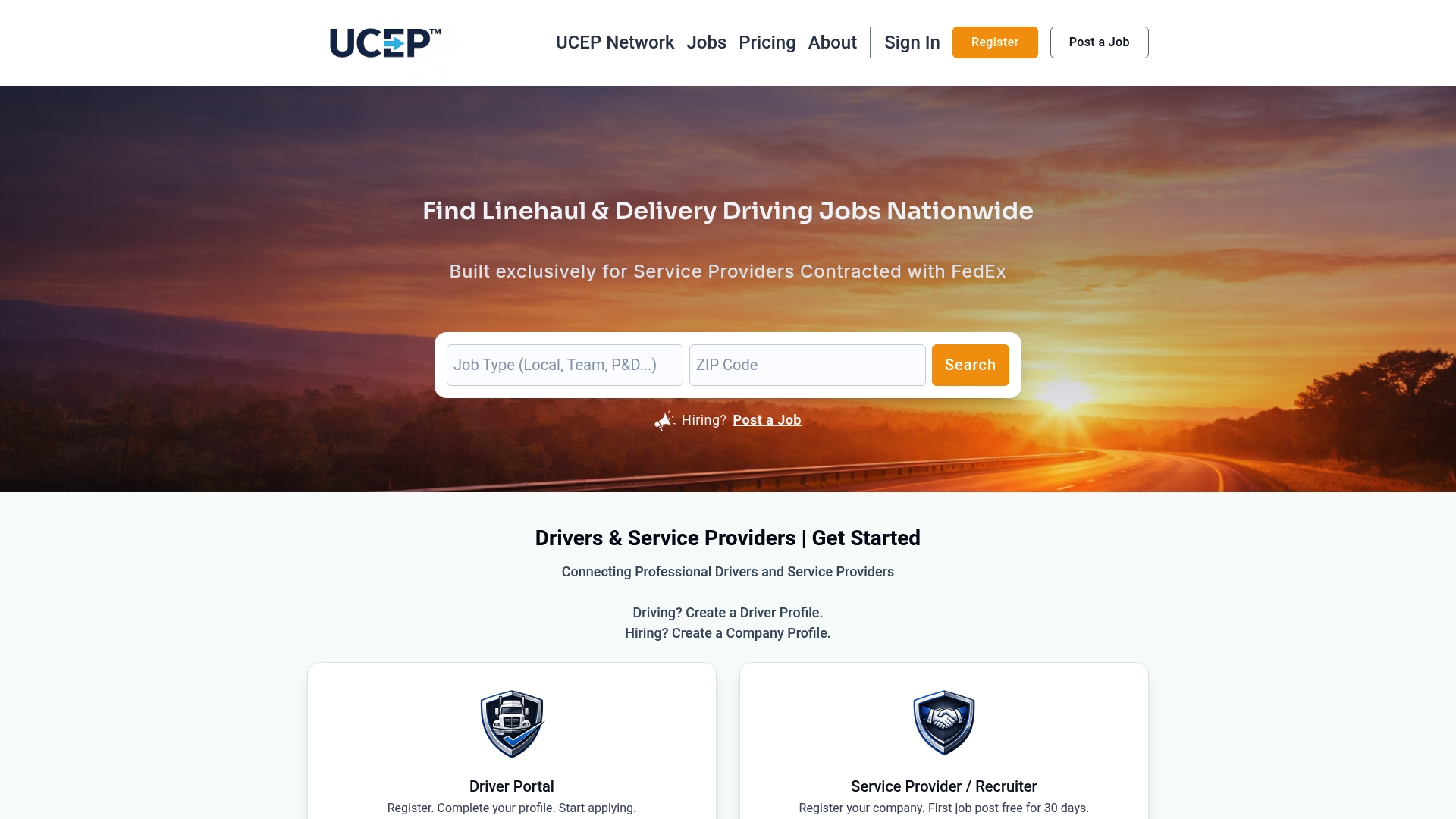
Browse the companies hiring drivers directory to see how current listings are structured, check service provider reviews to see how your reputation shows up to applicants, and post your next opening today to start closing that first-contact gap.
Sources
- Speed-to-Hire in Driver Recruiting: The 48-Hour Rule (CDL Agency)
- Tenstreet reveals how carriers can cut ad spend and increase speed-to-hire
- How long should it take to hire a CDL driver? A benchmarking guide
FAQ
What Is the 70/30 Rule in Hiring?
Applied practically, it means fixing your response time usually delivers a bigger return than buying more leads.
What Does the 7/3 Rule Mean in Trucking?
The 7/3 rule commonly cited among fleet recruiters suggests aiming for a full hiring cycle of around 7 days for straightforward candidates, with no more than 3 days lost to any single compliance or vendor step. It's a rule of thumb, not a federal standard, and definitions vary between carriers.
What Is the Easiest Way to Get Hired by a Trucking Company?
Drivers get hired fastest by carriers, or platforms like UCEP, that make first contact within an hour of application and run background, MVR, and Clearinghouse checks at the same time instead of one after another. Applicants with a clean MVR and no recent safety history gaps move through fastest.
What Is the Hardest Month to Get Hired in Trucking?
Hiring typically slows in the weeks around major holidays and in January, when freight volume dips and many carriers pause active recruiting. Peak hiring activity tends to pick back up as freight demand rises heading into spring and again before the fall shipping season.