
Open the Driver Qualification File before you do anything else, and run a Clearinghouse pre-employment query the same day. From there, complete the pre-employment drug test, pull the MVRs and prior-employer checks, verify the DOT medical certificate, conduct the road test, and assemble the DQF in that order before the driver's first dispatch. Budget 3 to 5 business days for the full sequence.
TL;DR:
- Running the Clearinghouse pre-employment query before dispatch is critical, and it must be completed on the same day as the drug test to avoid delays.
- Incomplete or expired medical certificates, missing MVRs, and skipped Clearinghouse consent are the top audit deficiencies that should be tracked and verified daily.
- Implementing a structured 90-day onboarding program with milestones at 30, 60, and 90 days reduces early driver turnover and ensures ongoing compliance.
- Digital tools that enable parallel tasking and timestamped signatures can cut onboarding time by several days and improve audit readiness.
- Prioritizing clear communication, mentorship, and health resources during the first weeks significantly increases driver retention beyond mere legal compliance.
Table of Contents
- Building a Driver Onboarding Checklist That Actually Holds Up
- Driver Qualification File: Required Documents and the Order That Matters
- Pre-Arrival Checklist: Make Day 1 About the Driver, Not Paperwork
- Day 1 and Week 1: The Human Touches That Prevent Early Churn
- 30/60/90-Day Milestones: What to Review and When to Act
- Using Technology to Speed the Driver Onboarding Process
- Staying Audit-Ready: Routine Checks and Common Pitfalls
- The Regulatory and Practitioner Basis for This Checklist
- Compliance Training During Onboarding: What to Cover and When
- Mentoring and Support in the First Weeks on the Job
- Insurance Requirements and Liability Coverage for New Drivers
- Communication Protocols and Escalation Procedures
- Health and Wellness Resources for New Drivers
- What I'd Fix First If I Ran Your Onboarding Program
- Where to Go Next for the Full Regulatory Text
- Sources
Building a Driver Onboarding Checklist That Actually Holds Up
A driver onboarding checklist is not a formality you complete to satisfy an audit. It's the mechanism that keeps a carrier operating legally and keeps drivers from walking after 60 days. Both risks are real, and both cost money.
Failing to meet 49 CFR Part 391 exposes you to out-of-service orders, CSA score damage, and fines during a compliance review. Auditors don't grade on effort. A DQF missing one signature or one expired medical certificate counts as a violation, regardless of how complete the rest of the file is.
The retention side of the equation is just as expensive. Structured 90-day onboarding programs that include pre-arrival setup, a real Day 1 experience, and recurring milestone reviews cut early turnover roughly in half compared to carriers that treat onboarding as a single-day paperwork event, according to SHRM. Small fleets, where one lost driver can mean a truck sitting idle for weeks, feel that math immediately.
Pro Tip: Treat your driver onboarding workflow as a 90-day retention program with a compliance checkpoint on Day 1, not a compliance checklist with a retention afterthought.
A well-built driver onboarding process does three things at once:
- Satisfies every requirement in 49 CFR Part 391 before the driver touches a truck.
- Gives the driver a reason to stay past the first paycheck.
- Produces a paper trail that survives an FMCSA audit without scrambling.
Get those three right, and the rest of this checklist is execution detail.
Driver Qualification File: Required Documents and the Order That Matters
The Driver Qualification File is the backbone of your new driver training checklist, and auditors check it in a specific order. Skipping ahead, say, running the road test before the Clearinghouse query clears, creates a compliance gap even if every document eventually lands in the file.
Here's the sequence the FMCSA's own DQF checklist is built around, and the one regulators expect to see documented:
- Signed employment application. Must cover a 3-year work history with no gaps. This document triggers your 30-day compliance clock, so date it accurately.
- Clearinghouse pre-employment query. Required before dispatch. The driver must provide consent, and the query result gets filed with a timestamp.
- Pre-employment drug test. Negative result required before the driver operates a commercial motor vehicle. This is almost always your rate-limiting step, since lab turnaround varies by provider.
- Prior employer safety history checks. Cover the previous 3 years for DOT-regulated employers. Document every contact attempt, even the ones that go unanswered.
- Road test or CDL copy in lieu of one. Document the evaluator's name, date, and route or attach the equivalent CDL documentation.
- DQF assembly and retention. File everything with dated sign-offs showing who completed each step and when.
The signed application starts a 30-day compliance clock. Everything else in the file needs to be complete before that window closes, and an incomplete file at day 31 is a violation on its own, separate from whatever caused the delay.
Three failure points show up repeatedly in real audits. Missing or expired medical certificates top the list, often because nobody tracked the expiration date after the initial hire. Incomplete MVRs come second, usually a missing state or a gap year nobody caught. Missing Clearinghouse queries round out the top three, frequently because a carrier ran the query late or skipped the consent step entirely.
The fix for all three is the same: build a dated checklist with sign-offs into the DQF itself, showing exactly who verified what and when, alongside copies of the returned MVRs and Clearinghouse results as dated file items. For medical certificate specifics, our DOT medical exam requirements checklist breaks down examiner verification in more detail.
Pre-Arrival Checklist: Make Day 1 About the Driver, Not Paperwork
If Day 1 is spent chasing signatures, you've already lost momentum. The best driver onboarding checklist front-loads every administrative task so the driver's first day on-site is about the truck, the route, and the team, not a stack of forms.
Before the driver arrives, confirm these items are done:
- Truck assigned, ELD paired and tested, and the driver's device login verified in advance.
- Fuel card activated and PIN delivered securely.
- CDL copy, medical card, MVRs, Clearinghouse consent, and drug-screen results all filed and complete.
- First load or route planned and staged, not decided the morning the driver shows up.
- Emergency contact list, pay schedule with a sample paycheck breakdown, and account logins (payroll portal, ELD app, dispatch system) ready to hand over.
Pro Tip: Send login credentials and the pay schedule breakdown by email 48 hours before start date. Drivers who see the numbers in writing before Day 1 ask fewer questions and trust the offer more.
A rushed pre-arrival phase is where good hires quietly become bad first impressions. Our guide on onboarding new CDL drivers quickly covers equipment provisioning timelines in more depth if your fleet runs a tight turnaround between offer and start date.
Day 1 and Week 1: The Human Touches That Prevent Early Churn
Compliance gets a driver legally on the road. It doesn't make them want to stay. That part of the driver onboarding workflow depends on what happens in the first seven days, and it's almost entirely about communication.
- Start with a live welcome call, not an email. Restate pay rate, home-time expectations, and route type out loud. Drivers who leave in the first 90 days most often cite a mismatch between what they were told and what they experienced.
- Walk the equipment together. A supervised equipment walkthrough paired with a documented pre-trip inspection does double duty: it trains the driver and creates a dated record that the carrier fulfilled its training obligation.
- Check in daily, briefly. A 3 to 5 minute call or text each day during Week 1 catches small frustrations before they become resignation letters. Make the check-in structured: ask about the truck, the route, and pay questions specifically.
- Give drivers a clear escalation path. Name the person to call if dispatch, pay, or equipment issues come up after hours. Ambiguity here is where new drivers quietly disengage.
Pro Tip: Assign the same person to make the welcome call and run the Week 1 check-ins. A new driver who has to explain their situation to a different voice every day feels like a file number, not a hire.
Practitioner guidance backs this up directly: onboarding done well is a retention lever as much as a compliance step, and live engagement in the first days often decides whether a driver stays past the trial period.
30/60/90-Day Milestones: What to Review and When to Act
A driver onboarding checklist that stops at Week 1 misses where most early turnover actually happens. Structured 30/60/90 reviews, backed by industry data on new driver retention, catch problems while they're still fixable.
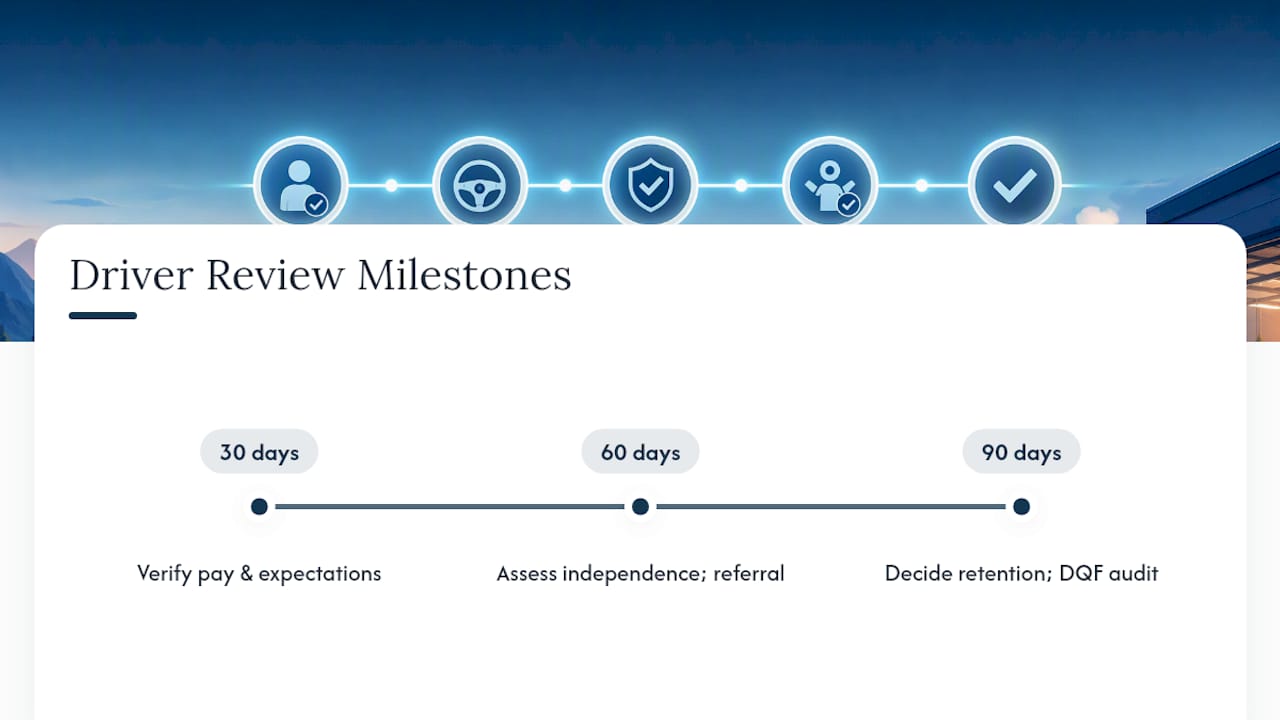
At 30 days, verify pay accuracy against what was promised at hire, not just what the system generated. Confirm the driver's expectations still match reality on routes, home time, and equipment. Document the conversation, even if it's informal; a dated note showing you checked in matters if a dispute comes up later.
At 60 days, assess independence. Is the driver handling routes, paperwork, and communication without hand-holding? This is also the point to introduce a referral program if you have one; drivers who feel settled by day 60 are your best recruiting asset for the next hire.
At 90 days, make a retention decision explicitly rather than letting the moment pass. That could mean a completion bonus, a clear promotion or route-upgrade path, or, if performance is lagging, a documented remedial plan with specific milestones. This is also the point to run a final DQF audit, confirming every document from the original checklist is still current and correctly filed.
Fleets that document these three checkpoints see meaningfully lower first-90-day departures than those relying on informal check-ins alone, largely because problems get named and addressed instead of left to fester. For more on what typically goes wrong in that window, see our breakdown of first-year CDL driver challenges.
Using Technology to Speed the Driver Onboarding Process
Manual, paper-based onboarding is where compliance gaps hide. A single source-of-truth portal, where the DQF, Clearinghouse results, MVRs, and signed consents all live in one place, prevents the piecemeal document problem that makes audits painful.
Practical sequencing matters here. Run the Clearinghouse query first, since it's a hard prerequisite for dispatch. While waiting on MVR turnaround, start the drug test chain-of-custody process in parallel rather than in sequence. Digital consent forms can go out the moment an offer is accepted, well before the driver's first day.
Look for these baseline features in any digital onboarding tool or applicant portal:
- Timestamped digital signatures on every DQF document.
- File versioning, so an updated MVR or medical card doesn't overwrite the audit trail.
- Built-in Clearinghouse query logging with the consent record attached.
- Centralized storage that lets a compliance manager pull a complete DQF in minutes, not a scavenger hunt across email threads and filing cabinets.
Parallelizing tasks this way, rather than running the checklist as a strict waterfall, is one of the most consistent time-savers practitioners report, often cutting real calendar days off the standard 3 to 5 day timeline.
Staying Audit-Ready: Routine Checks and Common Pitfalls
Audit readiness isn't a once-a-year scramble. It's a routine you run monthly, so nothing expires unnoticed between full DQF reviews.
Build these checks into a recurring calendar:
- Monthly scan for medical certificate expiration dates across your active driver roster.
- Annual MVR pulls scheduled and tracked, not left to memory.
- Annual Clearinghouse queries completed and logged for every active driver, separate from the pre-employment query.
- Documented good-faith attempts for prior-employer verification, including dates and methods of contact, even when the employer never responds.
| Common Deficiency | Why It Happens | Fix |
|---|---|---|
| Expired medical certificate | No expiration tracking system | Monthly automated expiration scan |
| Incomplete MVR history | Missing a state or a year | Checklist requiring all states of residence for 3 years |
| Missing Clearinghouse query | Skipped consent step | Require consent at application, query same day |
| No prior-employer verification record | Employer non-response undocumented | Log every contact attempt with date and method |
Remediation is straightforward once the gap is identified: pull the missing document immediately, note the correction date in the file, and keep the original deficiency record rather than deleting it. Auditors respond better to a documented fix than a file that looks suspiciously clean. Our guide on common hiring mistakes covers several of these gaps from the hiring side, before they ever reach the DQF stage.
The Regulatory and Practitioner Basis for This Checklist
This checklist is built directly on 49 CFR Part 391, the FMCSA's own Driver Qualification File checklist, and 49 CFR §382 Clearinghouse query rules, cross-referenced against operational guidance from fleet retention practitioners.
Beyond the regulatory text, three practices show up repeatedly in real-world guidance:
- Video verification of CDL and medical documents for remote hires, creating proof of visual inspection rather than a photo submission.
- Parallel tasking of MVR pulls, drug test chain-of-custody, and digital sign-offs to compress the onboarding calendar.
- Structured 30/60/90 milestone reviews as a retention mechanism, not just a compliance formality.
Ucep works from this same regulatory foundation when connecting Service Providers with qualified CDL-A and pickup-and-delivery drivers, since a hiring platform is only as useful as the compliance process behind it.
Compliance Training During Onboarding: What to Cover and When
Compliance training belongs in Week 1, not buried in an employee handbook nobody reads. New drivers need to understand hours-of-service rules, ELD operation specific to your fleet's device, and the company's own safety policies before their first solo dispatch.
Structure this training around three layers. First, federal requirements: hours-of-service limits, inspection obligations, and drug and alcohol policy under the FMCSA Clearinghouse framework. Second, company-specific policy: your accident reporting procedure, your customer service standards if drivers interact with FedEx-related recipients, and your equipment care expectations. Third, role-specific training tied to the actual route type, whether that's linehaul, team driving, or pickup and delivery.
Document every training session with a signed acknowledgment, dated and filed alongside the DQF materials, not as a separate loose record. If a compliance review or an incident investigation ever asks whether a driver received specific safety training, a signed and dated acknowledgment is the difference between a quick answer and a liability exposure.
Keep training practical rather than exhaustive. A driver who sits through eight hours of policy review on Day 1 retains almost none of it. Spread training across the first week, tied to actual tasks: cover hours-of-service the day before the driver's first solo run, not in an orientation slideshow three days earlier when it has no immediate application.
Mentoring and Support in the First Weeks on the Job
A new driver paired with an experienced mentor during the first 30 to 60 days is significantly less likely to quit out of confusion or isolation. Mentoring programs work best when they're structured, not just a vague "ask around if you have questions" policy.

Assign a specific mentor, ideally someone running a similar route type, before the new driver's first day. Give the mentor a defined role: available by phone during the new driver's shifts for the first two weeks, checking in proactively rather than waiting to be asked. Mentors should know they're being evaluated on their new hire's early performance too, which keeps the relationship from becoming a formality.
Support extends beyond a single mentor. Peer groups, whether informal driver meetups at a terminal or a messaging channel for new hires, give drivers a place to ask questions they might not feel comfortable raising with a manager. Isolation is one of the quieter reasons drivers leave in the first 90 days, particularly for solo long-haul roles where days can pass without meaningful in-person contact.
Track mentorship completion the same way you track compliance milestones. If a mentor relationship fizzles out after week one, that's a signal worth catching at the 30-day review rather than discovering at the 90-day exit interview.
Insurance Requirements and Liability Coverage for New Drivers
New drivers need to understand what coverage protects them, and what doesn't, before their first load. Commercial auto liability insurance covers damage and injury the driver causes to others while operating company equipment, but drivers should know the specific limits your fleet carries and how cargo insurance factors in if they're hauling high-value freight.
Workers' compensation coverage, required in most states for employees, differs meaningfully from occupational accident coverage often used for independent contractors. If your fleet or the Service Providers you work with classify drivers as contractors, walk through exactly what that means for medical coverage after an on-the-job injury, since this is a frequent point of confusion and frustration for new hires.
Physical damage coverage on the equipment itself, and any deductible the driver might be responsible for in an at-fault incident, should be explained plainly during onboarding rather than left in fine print. A driver who doesn't understand liability exposure until after an incident is a driver who feels blindsided, and that erodes trust fast.
Document that this coverage overview happened, with a signed acknowledgment, the same way you document safety training. It protects both the carrier and the driver if a coverage question comes up later.
Communication Protocols and Escalation Procedures
New drivers need one clear answer to a simple question: who do I call, and when? Ambiguity here creates the kind of frustration that shows up in exit interviews as "nobody had my back."
Define three tiers of contact from Day 1. Routine questions, pay, scheduling, minor equipment issues, go to a specific point of contact, usually a dispatcher or onboarding coordinator, during business hours. Urgent but non-emergency issues, a breakdown, a delayed delivery, a route conflict, need a named after-hours contact with a phone number the driver actually has saved before their first solo run. True emergencies, accidents, medical issues, follow a separate protocol that should be posted in the cab, not buried in an employee portal.
Put these contacts in writing during the pre-arrival phase, not verbally on Day 1 when the driver is absorbing a dozen other things. A laminated card in the truck with escalation contacts by tier is a small, low-cost step that removes guesswork during an actual crisis.
Review this protocol at the 30-day check-in specifically. Ask the driver directly whether they've had to use it, and whether it worked. A communication plan that looks clean on paper sometimes breaks down in practice, and the only way to know is to ask.
Health and Wellness Resources for New Drivers
Long-haul and linehaul driving carries real physical and mental health demands, and onboarding is the right moment to introduce whatever resources your fleet or your insurance plan actually offers, rather than leaving drivers to discover them on their own months later.
Cover the basics plainly: what health insurance is available and when it activates, whether an Employee Assistance Program exists for mental health or family support, and any wellness incentives tied to health screenings or fitness. If your fleet partners with truck stop chains offering driver health clinics or discounted gym access, mention it during Week 1, not as an afterthought.
Sleep and fatigue management deserve specific attention given hours-of-service rules and the physical toll of irregular schedules. A brief, practical conversation about managing rest breaks and recognizing fatigue symptoms does more good than a generic wellness pamphlet nobody opens.
Isolation and mental health, particularly for solo long-haul drivers, are worth naming directly rather than assuming drivers will raise concerns unprompted. If your mentoring program or Week 1 check-ins reveal a driver struggling with the lifestyle adjustment, having a known resource to point to, even something as simple as an EAP phone number, matters more than it might seem during the initial hiring conversation.
What I'd Fix First If I Ran Your Onboarding Program
If I had to pick one change with the highest return, it's this: require Clearinghouse consent at the application stage and run the pre-employment query the same day, not after the drug test clears or the MVRs come back. Most delays I see in onboarding timelines trace back to treating the Clearinghouse step as something to handle "when there's time," rather than the first domino in the sequence.
The second change costs almost nothing and fixes a real fraud and compliance gap: live video verification of CDL and medical documents for remote hires. A photo of a document proves nothing about whether it's current or genuine. A short video call where the driver holds the physical card up does.
— Aaron
Where to Go Next for the Full Regulatory Text
Start with the FMCSA's 49 CFR Part 391 regulation and the official DQF checklist PDF for the exact document requirements. Pair those with SHRM's onboarding retention research for the business case, and browse active driver listings on Ucep when you're ready to fill the seats this checklist is meant to keep full.