
The most common driver retention mistakes are: treating pay as the only lever, losing drivers in the first 90 days, neglecting equipment quality, poor dispatcher communication, punitive technology deployments, rushed training, no visible career path, and ignoring driver wellbeing. Fix these in priority order: first, make pay predictable and accurate; second, implement structured 30/60/90 onboarding check-ins; third, set a fast maintenance-response standard; fourth, train dispatchers on communication and conflict resolution.
A nationwide survey of more than 1,100 commercial drivers by Platform Science found that broken promises, unclear pay structures, poor communication, and technology problems rank alongside pay as reasons drivers leave — and each departure costs a fleet an estimated $13,000 in replacement costs. That figure alone makes the business case for fixing these mistakes before they compound.
Track three metrics from day one:
- First 90-day turnover rate — your clearest early-warning signal
- Settlement accuracy rate — percentage of pay statements with zero disputes
- Time-to-repair — average hours from a maintenance ticket to a resolved truck
Key Takeaways
Fixing the most common driver retention mistakes requires addressing pay predictability, early-stage onboarding, equipment reliability, dispatcher communication, and driver wellbeing — in that order, with measurable KPIs at each step.
| Point | Details |
|---|---|
| Pay predictability beats CPM | Accurate, on-time settlements and a guaranteed weekly minimum reduce trust erosion faster than a CPM increase. |
| First 90 days are highest risk | Structured 30/60/90 check-ins and mentor assignment can reduce early-stage turnover significantly in some implementations. |
| Equipment response time matters | A 24-hour maximum time-to-repair standard for grounded trucks signals respect for driver earnings and time. |
| Tech must support, not surveil | Pilot new tools with a driver cohort, train before measuring, and pair telematics alerts with coaching conversations. |
| Ucep reduces recruiting mismatch | Transparent SP profiles and driver reviews on Ucep help fleets hire drivers who fit the role — lowering 90-day churn. |
Table of Contents
- 1. Treating pay as the only retention lever
- 2. Losing drivers in the first 30–90 days because onboarding is a paperwork event
- 3. Neglecting equipment quality and the cab environment
- 4. Poor communication and weak dispatcher-driver relationships
- 5. Using technology only as a surveillance tool
- 6. Rushing drivers into routes without ongoing training
- 7. Lacking career paths, recognition, and meaningful rewards
- 8. Ignoring driver wellbeing, boredom, isolation, and mental health
- 9. Skipping the operational audit before launching retention programs
- What I've seen work in real fleets
- Targeted recruiting reduces churn before it starts
- Sources
1. Treating pay as the only retention lever
Raising cents-per-mile gets attention during recruiting. It rarely keeps drivers long-term. What actually erodes trust is unpredictability: a settlement that arrives late, a detention event that goes uncompensated, or a pay statement no driver can decode.
The net-economics view of compensation reframes this clearly. A driver earning a competitive CPM but absorbing unpaid downtime, fuel cost surprises, and payment delays may take home less than a driver at a lower CPM with a guaranteed weekly minimum and clean settlements. Perceived pay, not headline pay, drives the stay-or-leave decision.
Concrete fixes:
- Set a guaranteed minimum weekly pay floor so drivers can plan household budgets
- Publish transparent, itemized pay statements that show miles, detention, layover, and deductions separately
- Establish a written detention and layover pay policy and enforce it consistently
- Audit settlement accuracy monthly; flag any week with a dispute rate above 2%
- Pay on time, every time — late settlements trigger job searches faster than almost any other event
Pro Tip: Run a quarterly net-economics audit: take a sample of 10 driver settlements and calculate actual take-home after fuel card charges, downtime days, and any payment lag. Compare that figure to your advertised CPM. If the gap is wide, drivers already know it — and they're talking.
Metrics to monitor: settlement accuracy rate, payroll dispute rate, and guaranteed-week uptake. For more on competitive compensation design for FedEx Service Providers, the Ucep blog covers structure and benchmarks in detail.
2. Losing drivers in the first 30–90 days because onboarding is a paperwork event
Early-stage churn is the most expensive and most preventable retention problem in trucking. The first 90 days are highest-risk because mismatches between what recruiting promised and what operations delivers surface immediately: wrong equipment, different miles, home time that doesn't match the offer.
The mechanism is simple: problems get surfaced before they become resignation decisions.
30/60/90 check-in template:
- Day 30 (Recruiter): Did the role match what was described? Are miles, home time, and equipment as promised? Any unresolved issues from orientation?
- Day 60 (Mentor + Operations): How is the dispatcher relationship? Any equipment or route concerns? Is the driver getting the support they need?
- Day 90 (Operations Manager): Overall satisfaction score (1–10). What would make this driver stay for 12 months? Any systemic issues to escalate?
| Promise Category | What to Verify at Day 30 | Owner |
|---|---|---|
| Miles per week | Actual vs. offered miles | Operations |
| Home time | Days home vs. recruiting offer | Dispatch |
| Equipment | Truck age, condition, assigned unit | Maintenance |
| Pay structure | First two settlements reviewed | Payroll |
| Mentor assigned | Named mentor confirmed | Recruiter |
Track: percentage of new hires who reach 90 days, promise-fulfillment rate, and new-hire satisfaction score from the Day 90 check-in. Review common CDL hiring mistakes to align recruiting promises with what operations can actually deliver.
3. Neglecting equipment quality and the cab environment
A driver who spends 60+ hours a week in a truck that breaks down, runs hot, or lacks basic comfort will leave. Equipment problems aren't just an inconvenience — they cut into earnings through downtime and signal to drivers that the company doesn't respect their time.

Reliable trucks, functioning in-cab technology, and reasonable comfort are baseline expectations, not perks. Fleets that treat maintenance as a cost center rather than a retention tool consistently see higher turnover among experienced drivers who have options.
Operational fixes:
- Set a preventive maintenance cadence (every 15,000–25,000 miles depending on spec) and document compliance
- Establish a 24-hour maximum response standard for maintenance tickets that ground a truck
- Define a minimum truck-age policy for assigned units (many experienced drivers will not accept trucks older than 5–7 years without a premium)
- Stock in-cab amenities that reduce fatigue: quality mattresses, functioning HVAC, reliable inverters, and in-cab entertainment access
Pro Tip: Prioritize repairs that restore driver earnings first. A broken refrigerator is an inconvenience; a faulty APU in summer heat is a health and safety issue that will cost you the driver. Triage maintenance tickets by driver-income impact, not just mechanical severity.
| Maintenance KPI | Target | Flag Threshold |
|---|---|---|
| Time-to-repair (grounded truck) | Under 24 hours | Over 48 hours |
| PM compliance rate | 95 | Below 90% |
| Repeat repair rate (same issue) | Under 5% | Over 10% |
4. Poor communication and weak dispatcher-driver relationships
Dispatcher relationships are one of the most cited reasons drivers leave — and one of the least measured. A dispatcher who is slow to respond, dismissive of concerns, or inconsistent in load assignments creates daily friction that compounds into a resignation.

One-way communication (dispatch to driver, no feedback loop) is the most common pattern in fleets with high turnover. Drivers who feel unheard don't file complaints — they find another job.
Fixes to implement:
- Set a maximum dispatcher response time standard (15–30 minutes during business hours) and measure it
- Use a centralized messaging system so driver communications are logged and not lost in personal cell phones
- Create a clear escalation path: driver contacts dispatcher, unresolved issues go to operations manager within 24 hours
- Provide after-hours support contact for drivers on overnight or weekend runs
Dispatcher training outline:
- Active listening and de-escalation techniques (monthly role-play sessions)
- Clear load communication standards (pickup time, delivery window, special instructions confirmed in writing)
- Conflict resolution protocol for load refusals or route disputes
- Empathy training: understanding driver fatigue, HOS constraints, and home-time pressure
Pro Tip: Run a quarterly anonymous dispatcher rating — five questions, five minutes. Drivers rate responsiveness, clarity, and respect. Share aggregate results with dispatchers and tie improvement to performance reviews. The act of asking alone improves scores.
Metrics: average dispatcher response time, driver-reported communication satisfaction (from quarterly survey), and unresolved issue rate (issues not closed within 48 hours).
5. Using technology only as a surveillance tool
When drivers perceive technology as a monitoring system rather than a support tool, it pushes them away. The Platform Science Driver Experience Report found that roughly 52% of drivers say technology influences their decision to stay or leave a fleet. App overload — switching between multiple disconnected tools for ELD, dispatch, navigation, and payroll — adds cognitive burden without adding value.
A coaching-first approach to telematics, where data is used to support drivers rather than penalize them, produces better long-term engagement. Punishment-based policies (automatic write-ups from telematics alerts, no human review) erode trust quickly.
Principles for driver-first tech rollouts:
- Involve a small driver cohort in testing before full deployment; ask them what friction points exist
- Reduce app-switching by integrating tools into a single platform where possible
- Train before you measure: give drivers 30 days to learn a new tool before using its data in performance reviews
- Pair every telematics alert with a coaching conversation, not a written warning
Checklist for evaluating new technology:
- Does it reduce driver administrative time or add to it?
- Can it integrate with existing ELD and dispatch tools?
- Did drivers in the pilot cohort rate it positively?
- Is there a clear support path when the tool fails on the road?
- Does it produce data the driver can also see and use?
Pro Tip: Pilot new tools with 5–10 volunteer drivers for 30 days. Measure perceived impact with a three-question survey before full rollout. If drivers don't see the value, the tool will create friction at scale.
6. Rushing drivers into routes without ongoing training
Initial orientation is not training. Putting a new driver on a route after two days of paperwork and a brief truck walk-around creates safety gaps and satisfaction gaps simultaneously. NHTSA commercial driver resources support training programs that link safety coaching directly to retention outcomes.
Ongoing training matters as much as initial training. Drivers who receive regular coaching report higher job satisfaction and lower incident rates — both of which reduce turnover.
A modular training framework:
- Route-specific orientation (days 1–5): local roads, customer locations, dock procedures
- Technology training (days 6–10): ELD operation, dispatch app, navigation tools
- Safety coaching (ongoing, monthly): review telematics data with driver, identify one improvement area, set a 30-day goal
- Advanced skills (quarterly): backing techniques, hazmat awareness, fuel efficiency
Mentor assignment criteria:
- Assign mentors with 2+ years at the company and a clean safety record
- Limit each mentor to two new drivers at a time
- Measure mentor effectiveness by mentee 90-day retention rate
Track safety incidents per driver per quarter, route acceptance rate (a low rate signals training gaps), and mentor-to-new-hire ratio.
7. Lacking career paths, recognition, and meaningful rewards
Drivers who see no path forward leave for fleets that offer one. Career mobility doesn't require a management track — it requires visible milestones and meaningful acknowledgment of progress.
Career path examples:
- Trainer role: experienced drivers who onboard new hires earn a per-diem or rate bump
- Safety mentor: drivers with clean records for 12+ months lead monthly safety reviews
- Dedicated route assignment: earned after 6 months of on-time performance, offering more predictable home time
- Local route eligibility: available after 12 months, reducing overnight requirements
Recognition tied to measurable achievements works better than generic "driver of the month" programs. Specific, timely recognition — a bonus tied to 90 days without an incident, a public acknowledgment of a perfect delivery week — lands more effectively than annual awards.
| Milestone | Recognition | Reward |
|---|---|---|
| 90-day tenure | Manager call + team announcement | $100 bonus or gift card |
| 6-month clean safety record | Safety mentor eligibility | Rate bump or route preference |
| 1-year anniversary | Dedicated route consideration | Paid day off + letter of recognition |
| Trainer certification | Trainer per-diem | $25/day while training new hire |
8. Ignoring driver wellbeing, boredom, isolation, and mental health
Long-haul and regional drivers face occupational health risks that go beyond physical fatigue. NIOSH research documents musculoskeletal strain from prolonged sitting, along with elevated rates of stress and social isolation among commercial truck drivers. These factors affect both safety and retention — a driver managing chronic pain or loneliness is more likely to leave and more likely to be involved in an incident.
Operational fixes:
- Build predictable home time into scheduling wherever FMCSA hours-of-service rules allow; unpredictable home time is one of the fastest trust-breakers
- Provide access to in-cab entertainment — SiriusXM Road Dog and similar services reduce boredom on long runs and are low-cost relative to their retention value
- Offer telehealth access and at least one mental health resource (an EAP or a driver-specific support line)
- Conduct a brief quarterly wellbeing survey (five questions covering sleep, stress, physical comfort, and home-time satisfaction)
| Wellbeing Area | Operational Fix | Metric |
|---|---|---|
| Physical ergonomics | Quality mattress, lumbar support, ergonomic seat | Driver comfort score (quarterly survey) |
| Mental health | EAP access, telehealth, peer support contact | EAP utilization rate |
| Isolation/boredom | In-cab entertainment, regular dispatcher check-ins | Boredom/isolation score (survey) |
| Home time | Predictable scheduling, HOS-compliant planning | Home-time fulfillment rate |
9. Skipping the operational audit before launching retention programs
Most retention programs fail not because the ideas are wrong but because they're applied without diagnosing where the actual losses are happening. A structured audit tells you which mistakes are costing you the most drivers right now.
Industry experts recommend two-tier feedback loops: local issues (equipment, dispatch) handled at the depot level, systemic issues (pay structure, scheduling policy) escalated to senior management. Closing the loop — telling drivers what changed because of their feedback — is what builds trust. Surveys without follow-through erode trust faster than no survey at all.
Operational audit table:
| Area | What to Measure | Flag Threshold | Owner |
|---|---|---|---|
| Payroll | Settlement accuracy rate | Below 95% | Payroll Manager |
| Onboarding | % new hires reaching 90 days | Below 60% | Recruiter |
| Maintenance | Average time-to-repair | Over 48 hours | Fleet Manager |
| Dispatch | Driver communication satisfaction | Below 7/10 | Operations Manager |
| Technology | App satisfaction score | Below 6/10 | IT / Operations |
30/60/90 action timeline:
- Days 1–30: Run the audit. Pull payroll dispute data, 90-day turnover rate, and maintenance ticket close times. Identify the two highest-impact problem areas.
- Days 31–60: Implement the two priority fixes. Launch 30/60/90 check-ins for all new hires. Train dispatchers on communication standards.
- Days 61–90: Measure change. Compare 90-day retention rate, settlement accuracy, and dispatcher satisfaction scores to baseline. Report results to drivers who participated in surveys.
The CEVA Logistics two-tier feedback model demonstrates this in practice: local managers handle day-to-day complaints within 48 hours, while systemic patterns (recurring equipment failures, scheduling conflicts) escalate weekly to operations leadership. Drivers see responses to their feedback within days, not quarters.
What I've seen work in real fleets
The fleets that reduce turnover fastest share one trait: they fix the basics before adding programs. Pay accuracy, onboarding check-ins, and maintenance response time are unglamorous. They don't make for a good press release. But they're what drivers talk about when they decide whether to stay.
The 30/60/90 check-in is the single highest-leverage intervention for early-stage churn. It costs nothing except a 15-minute conversation at three points in a driver's first quarter. Fleets that implement it consistently report that most resignation decisions are made in the first 45 days — and that a single check-in at day 30 catches the majority of fixable problems before they become departures.
Technology is where fleets most often overcorrect. Adding a new app to solve a communication problem, without removing an old one, increases cognitive load and frustration. The right question before any tech deployment is: does this reduce the driver's administrative burden, or does it add to it?
Recognition programs work when they're specific and timely. A $100 bonus tied to 90 days of clean performance, delivered the week it's earned, outperforms an annual "driver of the year" award that most drivers don't believe they'll win.
Targeted recruiting reduces churn before it starts
Retention problems often begin at the recruiting stage. When a driver accepts a role based on inaccurate job descriptions, inflated mile estimates, or vague home-time promises, the mismatch surfaces within 30 days — and the fleet absorbs the full $13,000 replacement cost.
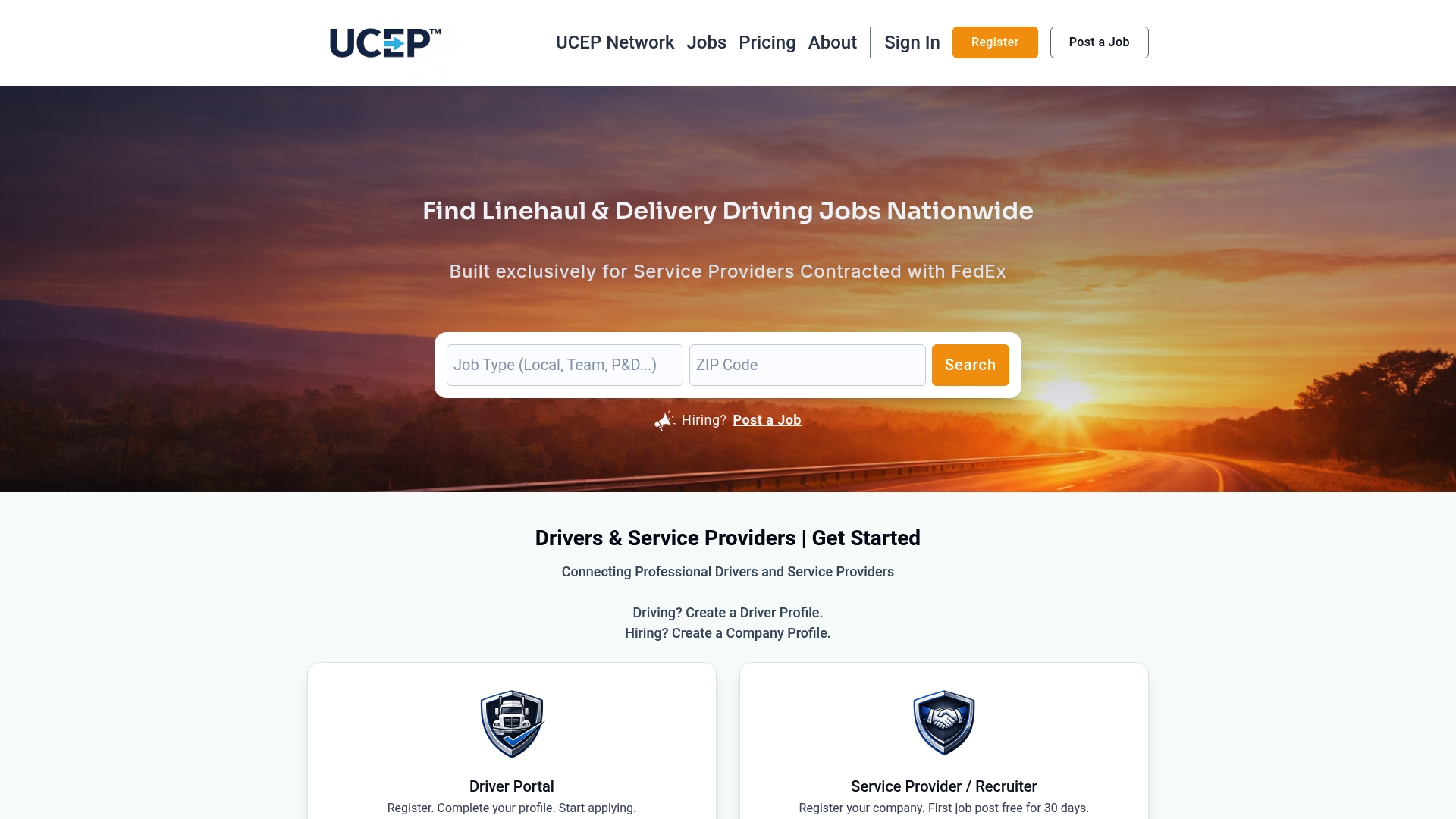
Ucep is built specifically for FedEx Service Providers who need to hire qualified CDL-A and pickup-and-delivery drivers with accurate role expectations from the start. Transparent company profiles and service-provider reviews on Ucep give candidates a clear picture of what working for a specific SP looks like — reducing the misaligned hires that drive early turnover. Drivers who apply through Ucep have already self-selected based on role type, location, and company reputation. That fit reduces 90-day churn and lowers your cost-per-hire. Browse companies currently hiring drivers on Ucep, or list your open roles to reach drivers who are actively looking for FedEx-related opportunities nationwide.
Sources
- Platform Science Unveils Landmark Driver Experience Report on Pay, Technology, and Retention
- Fmcsa
- Cdc
- Driver retention starts listening
- SambaSafety blog: driver retention strategies guide