
Driver experience is one of the most direct levers you have for improving on-time delivery, reducing turnover costs, and protecting your FedEx contract performance. A nationwide survey of 1,100+ drivers by Platform Science found that 52% of drivers say technology influences their decision to stay or leave, and industry estimates put replacement cost at roughly $13,000 per driver. The operational case is clear: when drivers feel supported, they perform better and are more likely to remain with their employer.
TL;DR
- Engaged drivers report delays early, protect customer relationships, and reduce re-deliveries.
- Driver shortfall could reach 160,000 by 2030 (ATA projection), making retention a strategic priority now.
- Piece-rate incentives can increase productivity but also raise safety risks if not balanced with non-monetary supports.
- Quick levers: transparent pay, consistent route assignments, and consolidated driver technology.
- Ucep is a dedicated hiring platform for FedEx service providers looking to source and retain qualified drivers.
Table of Contents
- How driver experience changes your operational outcomes
- Why incentive design can create the wrong behaviors
- Concrete changes you can make to improve driver experience
- What recruiters should change in screening and onboarding
- Which KPIs tell you whether driver experience is working
- A simple ROI case for improving driver experience
- Key Takeaways
- What experienced recruiters actually watch for
- Ucep helps FedEx service providers hire qualified drivers
- Useful sources and further reading
How driver experience changes your operational outcomes
Driver experience shapes every measurable service outcome you report to FedEx: on-time percentage, damage and loss rates, and first-time delivery success. Engaged drivers communicate proactively, flag delays before they cascade, and treat each stop as a customer interaction rather than a transaction. Disengaged drivers do the opposite, and the cost shows up in re-delivery attempts, customer complaints, and dispatcher firefighting.
Stat to watch: Industry estimates place driver replacement cost at roughly $13,000 per churn event. Multiply that by your annual turnover count and the financial case for investing in driver experience becomes immediate.
Operational friction compounds the problem. When drivers juggle multiple apps, unclear schedules, and unresponsive support, preventable disruptions increase and issue-resolution cycles lengthen before a driver ever submits a resignation.
Immediate service effects to monitor:
- On-time delivery rate drops when drivers are uncertain about route assignments or vehicle readiness.
- Damage and loss incidents rise when drivers feel rushed or unsupported at pickup points.
- Re-delivery attempts increase when customer communication breaks down at the door.
- Dispatcher call volume spikes as an early warning sign of driver disengagement.
Why incentive design can create the wrong behaviors
Pay structure is not a neutral variable. A systematic review of 18 studies found that piece-rate and productivity-based pay can increase output but also incentivize unsafe behaviors: speeding, skipping rest breaks, and cutting corners on pre-trip inspections. In a FedEx pickup and delivery context, that trade-off is concrete. A driver paid per stop has a financial reason to rush, and rushed drivers generate more incidents, more complaints, and more liability.
The fix is not to eliminate performance pay. It is to pair it with safety incentives and non-monetary recognition so that speed and safety point in the same direction.
Pro Tip: Cross-reference productivity spikes with safety incident data on a monthly basis. If stop counts jump but incident reports also rise, your pay structure may be creating a perverse incentive. Catch it early before it becomes a pattern.
Concrete changes you can make to improve driver experience
Prioritize these in order of implementation speed.
- Publish transparent pay structures. Drivers who understand exactly how miles, stops, and bonuses are calculated report higher satisfaction and lower early-turnover rates.
- Assign consistent routes. Predictable schedules reduce cognitive load and let drivers build customer familiarity, which directly improves delivery success rates.
- Consolidate driver technology. 53% of drivers say technology makes their job harder, not easier. Audit your app stack and eliminate redundant tools.
- Connect vehicle and maintenance data. Centralizing maintenance records and incident history into one system reduces downtime and gives drivers confidence in their equipment.
- Build rapid-response support. A driver who can reach a dispatcher or ops contact within minutes handles problems at the stop instead of abandoning the attempt.
- Add non-monetary recognition. Safety milestone acknowledgments, peer shoutouts, and clear career pathways cost little and measurably reduce disengagement.
- Create mentored pilot programs. Pair veteran drivers with new hires to validate route changes or tech rollouts before scaling. Veterans transmit tacit knowledge that no onboarding document captures.
Quick wins vs. longer investments:
- Quick (under 30 days): publish pay breakdowns, assign consistent routes, designate a driver support contact.
- Medium (30–90 days): audit and reduce app count, launch a safety recognition program.
- Longer (90+ days): implement connected vehicle data, formalize a mentor program with veteran drivers.
Pro Tip: Before rolling out a new scheduling tool or route change, run a two-week pilot with two or three veteran drivers. Collect both objective data (on-time %) and a brief driver experience score. Scale only what passes both tests.

What recruiters should change in screening and onboarding
Recruiting for driver experience fit starts before the first interview. Use these pickup and delivery hiring criteria to filter candidates early:
- Demonstrated comfort with route-based schedules and predictable start times.
- Prior customer-facing delivery experience (not just driving hours).
- Basic tech aptitude: comfort with a route app and electronic logging.
- Attitude toward feedback: candidates who describe past dispatcher relationships positively tend to stay longer.
Sample behavioral interview questions:
- "Tell me about a time your route changed unexpectedly. How did you handle it?"
- "What does a good day look like for you as a driver? What makes a bad one?"
- "How do you prefer to communicate with dispatch when something goes wrong on a stop?"
- "Have you ever flagged a vehicle issue before a shift? Walk me through what you did."
Onboarding checklist focused on experience:
- Confirm pay structure and schedule in writing on day one.
- Complete a tech orientation with hands-on time in the actual app stack.
- Assign a veteran driver mentor for the first two weeks of route rides.
- Schedule a 30-day check-in to collect driver feedback on tools and route clarity.
- Document any friction points the new hire reports and route them to ops.
Which KPIs tell you whether driver experience is working
| KPI | Formula / Definition | Measurement Cadence |
|---|---|---|
| Driver turnover rate | (Separations ÷ Average headcount) × 100 | Monthly |
| Average tenure | Total months employed ÷ Driver count | Quarterly |
| Cost per replacement | Recruiting + training + lost productivity costs | Per event |
| On-time delivery rate | On-time stops ÷ Total stops × 100 | Weekly |
| First-time delivery rate | Successful first attempts ÷ Total deliveries × 100 | Weekly |
| Safety incident rate | Incidents ÷ Total miles driven | Monthly |
| Driver tech friction score | Self-reported 1–5 scale survey | Quarterly |
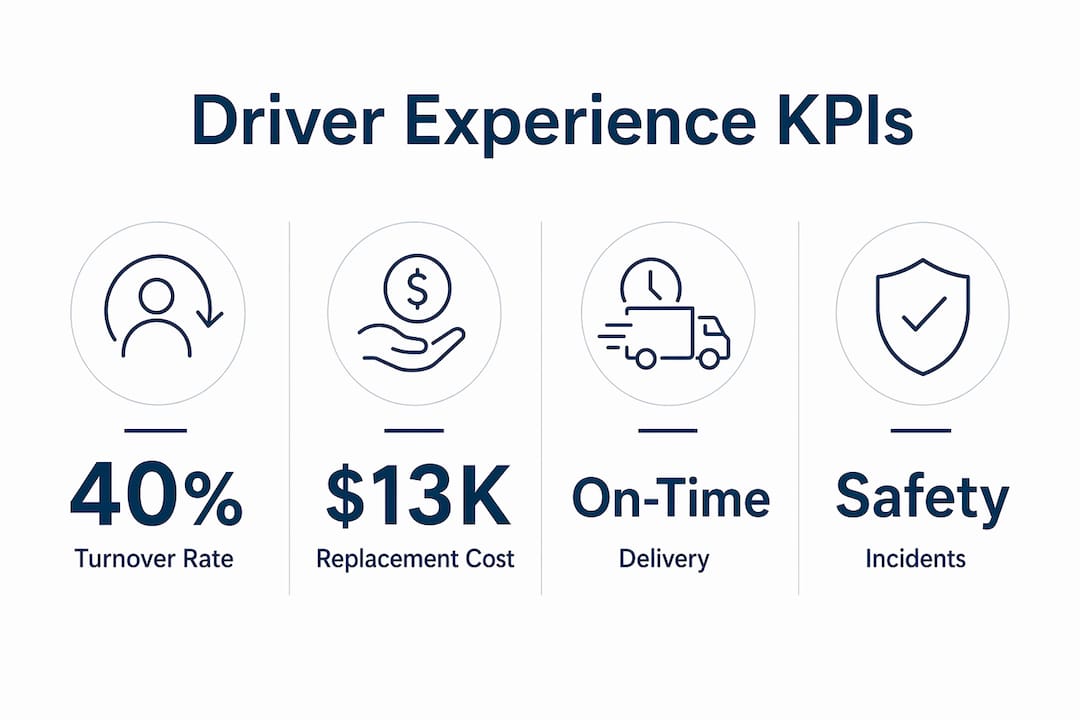
Platform Science's driver experience benchmarks cover pay transparency, tech usability, communication quality, and safety perception, giving you a ready-made framework to track progress over time.
Calculation example: If your turnover rate is 40% on a 20-driver fleet, you replace 8 drivers per year. At $13,000 per replacement, annual churn cost equals $104,000. Reducing turnover to 25% saves roughly $19,500 per year in direct replacement costs alone, before counting productivity losses.
A simple ROI case for improving driver experience
Assumptions:
- Fleet size: 20 drivers.
- Current annual turnover: 40% (8 replacements per year).
- Replacement cost per driver: $13,000 (industry estimate).
- Target turnover after interventions: 25% (5 replacements per year).
- Intervention costs: $2,000 for tech consolidation, $1,500 for a recognition program, $500 for mentor program setup. Total one-time: $4,000.
Calculation:
- Current annual churn cost: 8 × $13,000 = $104,000.
- Post-intervention churn cost: 5 × $13,000 = $65,000.
- Annual savings: $39,000.
- Net first-year benefit: $39,000 minus $4,000 = $35,000.
Swap in your actual headcount, turnover rate, and local recruiting costs to get a number specific to your operation. The structure holds at almost any fleet size.
Key Takeaways
Driver experience directly determines on-time delivery rates, safety incident frequency, and annual turnover costs for FedEx service providers, making it the highest-return operational lever available to hiring and ops teams.
| Point | Details |
|---|---|
| Turnover cost is quantifiable | At ~$13,000 per replacement, reducing churn from 40% to 25% on a 20-driver fleet saves roughly $35,000 in year one. |
| Tech friction drives exits | 52% of drivers say technology influences their decision to stay; auditing and consolidating your app stack is a fast, low-cost fix. |
| Incentive design has safety risk | Piece-rate pay can raise productivity and incident rates simultaneously; pair it with safety incentives to avoid perverse outcomes. |
| Veteran mentors reduce early churn | Pairing new hires with experienced drivers for the first two weeks cuts early-turnover and transfers route knowledge faster than documentation alone. |
| Ucep supports FedEx hiring | Ucep's platform connects FedEx service providers with pre-qualified driver candidates across linehaul, CDL-A, and pickup and delivery roles. |
What experienced recruiters actually watch for
When I screen driver candidates for FedEx contract roles, the first thing I listen for is how they describe their last dispatcher relationship. Candidates who say "I just drove my route and went home" are a yellow flag. Drivers who mention calling in early about a delay, flagging a vehicle issue before a shift, or asking for route clarity are the ones who stay past 90 days and become the mentors your next hire needs. The operational data backs this up: veteran drivers who stay engaged past five years are your most credible internal coaches, but complacency is a real risk at that tenure mark. Keep them involved in pilots and recognition programs, or you lose the institutional knowledge that no job posting can replace.
Ucep helps FedEx service providers hire qualified drivers
FedEx service providers who need qualified drivers for pickup and delivery, CDL-A solo, CDL-A team, or linehaul roles can use Ucep to reach a candidate pool built specifically for this market. Every listing on Ucep targets drivers who are actively seeking FedEx-related opportunities, which means less time filtering unqualified applicants and more time evaluating fit.
Ucep also gives you access to service provider reviews so you can see how other contractors rate the hiring process and use that social proof to attract stronger candidates. The Ucep Network connects you with hiring guides, role-specific resources, and a directory of active opportunities. Start by posting your open role and reviewing the hiring guides for the role type you need most.
Useful sources and further reading
External research and industry reports:
- Platform Science Driver Experience Report: nationwide survey of 1,100+ drivers covering pay, technology, retention, and the ATA's projected 160,000-driver shortfall by 2030.
- Systematic review on incentive schemes and driver safety: 18-study review showing how piece-rate pay affects both productivity and unsafe behavior.
- Holman: why driver experience matters in fleet strategy: operational framework for centralizing maintenance, incident data, and driver workflows.
- ShipWithShaker: happy drivers and customer service: explains how driver support converts drivers into proactive service advocates.
- Netradyne: nurturing company champions: covers veteran-driver mentoring, complacency risk, and long-term retention strategies.
Ucep hiring guides:
- Pickup and delivery driver hiring tips: practical screening and engagement tactics for service providers.
- Solo vs. team driver hiring differences: helps recruiters tailor onboarding by role type.
- How to hire linehaul drivers fast: sourcing and screening strategies adaptable to any FedEx contract role.
Recommended
- What It Takes to Succeed as a Team Driver for Service Providers Contracted with FedEx | UCEP Meta description - United Contractor Employment Portal
- Common FedEx Contractor Staffing Challenges in 2026
- Why team drivers share driving duties: A fleet guide
- FedEx ISP Model Explained for Service Providers