
FedEx contractor staffing challenges are defined by three persistent problems: labor shortages, high driver turnover, and payroll compliance failures that directly reduce delivery capacity and profitability. These are not isolated issues. 72% of FedEx contractors report negative business impacts from labor shortages, with 65% experiencing schedule delays and 44% turning down new work entirely. That data reflects a workforce crisis, not a temporary hiring gap. Understanding the common FedEx contractor staffing challenges in detail is the first step toward building a workforce that holds up under real operational pressure.
1. How labor shortages disrupt FedEx contractor workforce stability
Labor shortages are the single biggest threat to FedEx contractor operations in 2026. The qualified driver pool is shrinking due to retirement, increased competition from other delivery networks, and a limited pipeline of CDL-licensed candidates entering the workforce.

The operational consequences are measurable. Staffing shortages force FedEx to reroute over 600,000 packages daily across its Ground network. That volume creates intense pressure on contractors who are already running lean crews.
Common causes of labor shortages specific to FedEx contractors include:
- Retirement of experienced drivers without enough new CDL holders to replace them
- Competition from other delivery networks offering signing bonuses and flexible schedules
- Geographic mismatches between available drivers and contractor service areas
- High physical and scheduling demands that reduce the applicant pool
- Limited awareness of FedEx contractor opportunities among qualified candidates
The result is a cycle where contractors spend more time managing gaps than growing their routes. Proactive workforce planning that uses driver commute distance and turnover risk data is more effective than reactive hiring for maintaining stability.
Pro Tip: Build a standing pipeline of pre-screened driver candidates before a vacancy opens. Treat recruiting as an ongoing operation, not a response to an empty seat.
2. High driver turnover and its cost to FedEx contractor operations
High attrition is the second major contractor workforce challenge, and it compounds the labor shortage problem directly. The average annual attrition rate in related industries runs close to 20%, which means contractors must hire roughly 125 drivers to maintain a net workforce of 100.
This creates what experienced contractors call a treadmill effect. Every new hire requires onboarding, route training, and a ramp-up period before they reach full productivity. When turnover is constant, the training burden never ends and service quality suffers.
The downstream costs are significant:
- Overtime expenses increase as remaining drivers cover open routes
- Training costs repeat with every replacement hire
- Service consistency drops, which affects contractor performance scores
- Management time shifts from operations to recruiting and onboarding
Retention practices that work focus on more than pay. Career development and culture-building outperform simple wage increases for long-term driver stability. Contractors who offer clear advancement paths, consistent scheduling, and respectful management see lower turnover than those who compete only on hourly rates.
Understanding what it takes to succeed as a team driver also helps contractors set realistic expectations during hiring, which reduces early-stage attrition.
Pro Tip: Conduct brief exit interviews with every departing driver. The patterns you find in those conversations will tell you more about your retention problems than any survey.
3. Payroll compliance complexities and their hidden costs
Payroll errors are a leading but underreported cause of driver dissatisfaction and contractor legal exposure. FedEx contractors frequently mismanage payroll elements like 6th-day bonuses and overtime calculations, which drives attrition and creates costly compliance penalties.
These are not minor administrative errors. They directly affect driver paychecks, and drivers notice. A single paycheck discrepancy can push a driver to leave for a competitor.
Common payroll mistakes FedEx contractors make include:
- Failing to calculate 6th-day bonus pay correctly in multi-CSA operations
- Misclassifying overtime hours, especially during peak delivery seasons
- Inconsistent pay periods that create confusion and distrust among drivers
- Incorrect tax withholding that results in penalties during audits
- Not documenting payroll decisions, which creates legal exposure during disputes
The legal risk extends beyond payroll accuracy. Federal courts scrutinize operational control that blurs contractor independence, raising joint-employer classification risks for FedEx ISPs. Contractors who exercise excessive control over driver scheduling, discipline, and work methods face greater legal exposure.
Maintaining clear documentation of autonomous hiring and discipline decisions is not optional. It is a legal protection that every contractor should treat as standard practice.
Pro Tip: Run a quarterly payroll audit against your CSA agreements. Catching a 6th-day bonus error before a driver raises it saves both money and the relationship.
4. FedEx 2.0 operational changes and their staffing impact
FedEx Network 2.0 has added a new layer of complexity to contractor workforce management. FedEx 2.0 operational changes require contractors to implement more sophisticated manager-level oversight, bonus programs, and communication workflows to meet updated service expectations.
This shift means that staffing is no longer just about filling driver seats. Contractors now need middle-management capacity, structured communication chains, and performance tracking systems that did not exist at smaller operational scales.
The staffing implications of FedEx 2.0 include the need to hire or develop lead drivers who can manage route-level decisions, build bonus structures that align driver behavior with new service metrics, and create communication workflows that keep drivers informed about operational changes. Contractors who understand the FedEx Network 2.0 pressures are better positioned to staff for them proactively rather than scrambling after service failures.
The contractors who adapt fastest are those who treat FedEx 2.0 not as a burden but as a signal to professionalize their workforce management.
5. Effective staffing and retention strategies for FedEx contractors
The most effective approach to managing contractor workforce challenges combines predictive workforce planning with structured retention programs. Reactive hiring, where you post a job only after a driver leaves, consistently produces worse outcomes than maintaining an active candidate pipeline.
Here is how the two approaches compare across key dimensions:
| Approach | Speed to fill | Cost per hire | Retention impact | Operational risk |
|---|---|---|---|---|
| Reactive hiring | Slow (2–4 weeks) | High | Low | High |
| Proactive pipeline | Fast (under 1 week) | Lower | Higher | Low |
| Niche job boards | Fast | Moderate | Higher | Low |
| General job boards | Moderate | High | Low | Moderate |
Niche recruiting platforms built for FedEx contractors produce better candidate quality because applicants already understand the operational context. Targeted job boards deliver better ROI for service providers hiring drivers compared to general platforms where FedEx-specific roles compete with unrelated postings.
Retention strategies that work at the contractor level include:
- Offering route consistency so drivers can plan their personal schedules
- Creating a lead driver or route supervisor track for experienced staff
- Providing structured onboarding that sets clear performance expectations
- Reducing commute distances through route assignment adjustments
- Recognizing tenure with milestone bonuses tied to service anniversaries
Fleet size and location shape which strategies matter most. A contractor running 15 vans in a dense urban market faces different retention pressures than one running 40 trucks across rural routes. Matching your strategy to your operational reality produces better results than copying a generic retention template.
Key takeaways
Solving FedEx contractor staffing challenges requires proactive workforce planning, payroll accuracy, and retention programs built around career development, not just compensation.
| Point | Details |
|---|---|
| Labor shortages are structural | 72% of contractors face negative impacts; build a standing candidate pipeline before vacancies open. |
| Turnover compounds costs | A 20% attrition rate means hiring 125 drivers to keep 100; exit interviews reveal the real causes. |
| Payroll errors drive attrition | Miscalculated 6th-day bonuses and overtime errors push drivers out and create legal exposure. |
| FedEx 2.0 raises the bar | New operational complexity requires manager-level oversight and structured bonus programs. |
| Proactive hiring outperforms reactive | Niche platforms and predictive planning reduce time-to-fill and improve candidate quality. |
What I've learned about staffing FedEx contractor operations
The contractors who struggle most with staffing are the ones who treat hiring as a problem to solve once. They post a job, fill the seat, and move on until the next driver leaves. That cycle never ends, and it gets more expensive every time.
The contractors who build stable workforces think about hiring the way they think about route planning. It is a permanent operational function, not a crisis response. They track which drivers are at risk of leaving before those drivers say anything. They know their commute data. They know which routes burn people out fastest.
What surprises most staffing managers is how much payroll accuracy matters to retention. Drivers talk to each other. A single paycheck error spreads through a crew faster than any management announcement. Getting payroll right is not just a compliance issue. It is a trust issue, and trust is harder to rebuild than a route.
The legal side also deserves more attention than most contractors give it. Maintaining genuine autonomy over hiring and discipline is not bureaucratic caution. It is the difference between operating as an independent contractor and facing joint-employer liability. That distinction has real financial consequences.
My honest view is that the contractors who will thrive through FedEx 2.0 are the ones investing in their management layer now, not just their driver count. A well-managed team of 20 drivers outperforms a poorly managed team of 30 every time.
— Aaron
How Ucep supports FedEx contractors with driver recruitment
Ucep is a recruiting platform built exclusively for FedEx Service Providers. It connects contractors with qualified drivers for linehaul, CDL-A team, CDL-A solo, and pickup and delivery roles, all in one focused place.
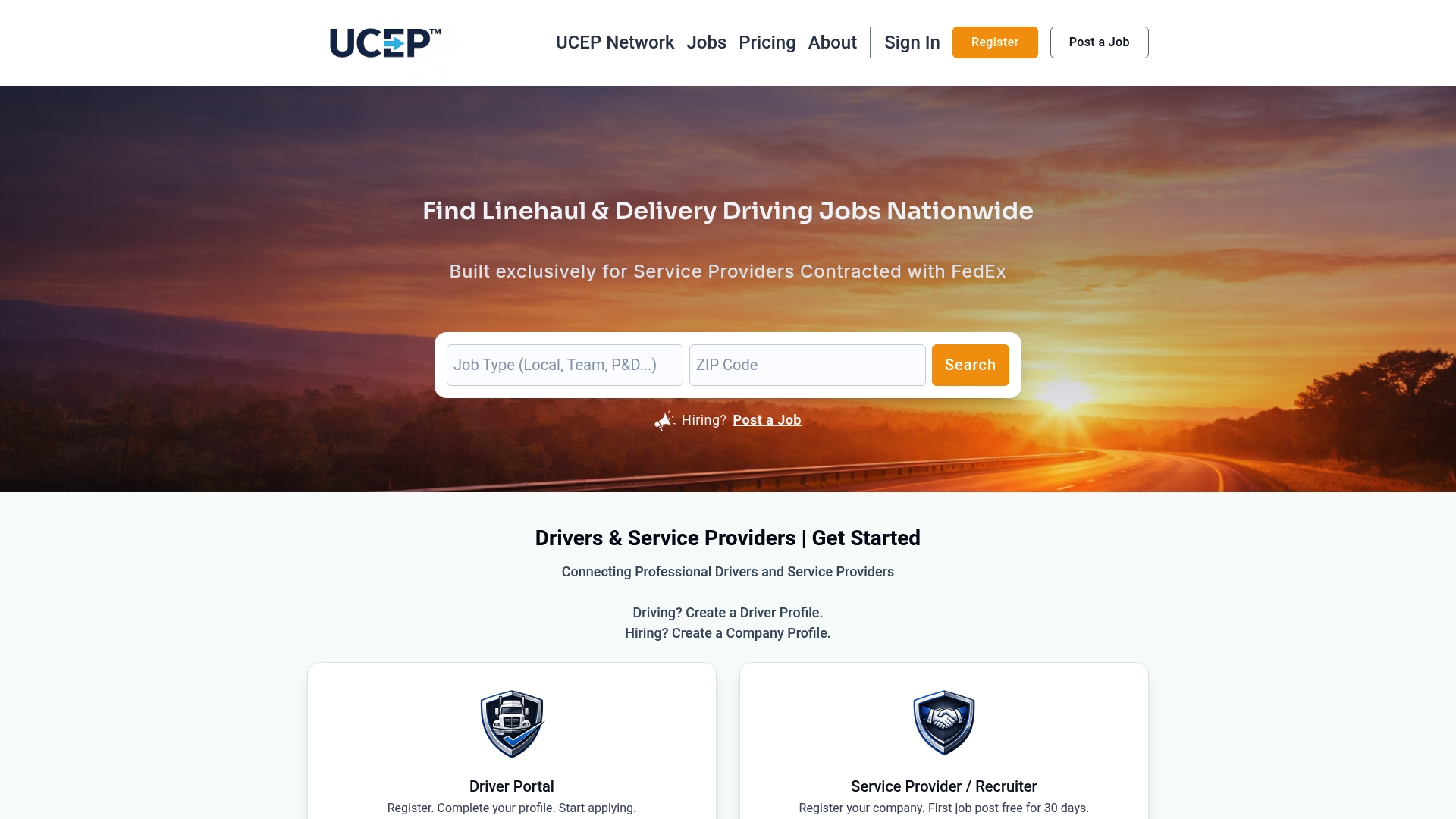
When you post on Ucep, your listing reaches drivers who already understand FedEx operations and are actively looking for Service Provider opportunities. You can also use Ucep's service provider reviews to build credibility with candidates before they apply. For contractors ready to fill open seats now, browse companies hiring drivers to see how other Service Providers are presenting their opportunities and attracting qualified applicants.
FAQ
What are the most common FedEx contractor staffing challenges?
The most common challenges are labor shortages, high driver turnover, and payroll compliance errors. These three issues account for the majority of operational disruptions and hiring difficulties FedEx contractors face.
How does driver turnover affect FedEx contractor profitability?
High turnover increases overtime costs, repeats training expenses, and reduces service consistency. An attrition rate near 20% means contractors must hire 125 drivers just to maintain a net workforce of 100.
What payroll mistakes do FedEx contractors make most often?
The most frequent errors involve 6th-day bonus calculations and overtime misclassification, especially in multi-CSA operations. These mistakes reduce driver trust and create legal exposure during audits.
How does FedEx 2.0 change contractor staffing requirements?
FedEx 2.0 requires contractors to add manager-level oversight, structured bonus programs, and formal communication workflows. Staffing for these roles is now part of meeting FedEx service expectations.
What is the most effective way to reduce FedEx contractor staffing challenges?
Proactive workforce planning combined with niche recruiting platforms produces the best results. Maintaining an active candidate pipeline and using targeted job boards reduces time-to-fill and improves driver quality.