
Fleet managers running time-sensitive freight for FedEx often assume a well-rested solo driver can cover the same ground as a team on a long haul. That assumption costs miles and money. Why team drivers share driving duties comes down to two hard limits: human fatigue and federal Hours of Service (HOS) regulations. A single driver legally tops out around 550 to 650 miles per day. A team can nearly double that. For FedEx service providers managing expedited linehaul and hot loads, understanding how shared driving responsibilities work is essential to maximizing truck utilization and staying competitive.
Table of Contents
- What is team driving and how does sharing duties work?
- How sharing driving duties reduces fatigue and boosts safety
- Team driving vs. solo driving: efficiency, distance, and revenue potential
- Hours of Service rules and the sleeper berth provision for team drivers
- Best practices for managing shared driving duties in FedEx service provider fleets
- Why team driving is the future for FedEx service providers handling time-sensitive freight
- Explore UCEP resources for FedEx service providers adopting team driving
- Frequently asked questions
Key Takeaways
| Point | Details |
|---|---|
| Continuous operation | Team driving keeps trucks moving nearly 24/7 by alternating drivers, maximizing utilization. |
| Fatigue reduction | Sharing duties helps drivers rest properly, reducing fatigue and improving safety. |
| HOS compliance | Sleeper berth provisions allow splitting rest to legally extend driving hours. |
| Higher revenue | Teams cover nearly twice the miles solo drivers do, unlocking premium freight opportunities. |
| Operational challenges | Success requires careful clock staggering, accurate log management, and compatible partnerships. |
What is team driving and how does sharing duties work?
Team driving is a trucking arrangement where two CDL-A drivers share one truck, taking turns behind the wheel and resting in the sleeper berth. The key to the arrangement is continuous truck movement. While one driver operates the vehicle, the other rests in the sleeper berth, which is the enclosed sleeping compartment built into the cab of a long-haul truck.
The swap does not happen on a fixed clock. Each driver runs their own HOS clock and swaps with their co-driver when the active driver approaches their legal limits. This is an important detail. The truck keeps moving, but neither driver is exceeding their individual limits.
Here is how the rotation typically works:
- Driver A starts the trip and drives up to 11 hours within a 14-hour on-duty window.
- Driver B rests in the sleeper berth during this time, accumulating off-duty hours.
- Driver A reaches their driving limit and moves to the sleeper berth to rest.
- Driver B takes the wheel and drives their own 11-hour shift.
- The cycle repeats, with truck stops only for fuel, inspections, or loading and unloading.
Key points about the arrangement include:
- Both drivers maintain separate Electronic Logging Device (ELD) logs.
- Neither driver's clock is affected by the other's driving time.
- On-duty time logged during loading or unloading counts against each driver's individual 14-hour window.
- Understanding the team driver success factors that make or break these arrangements is worth reviewing before you build out your team roster.
With a basic understanding of what team driving entails, let's explore how sharing duties benefits fleets operationally.
How sharing driving duties reduces fatigue and boosts safety
Fatigue is not just a performance issue. It is a safety issue with real regulatory consequences. Two trained drivers provide continuous coverage, reducing fatigue risk compared with solo driving stretched to the HOS limit. When a solo driver pushes to the edge of their legal window on a regular basis, fatigue accumulates across days, not just hours.
Team driving breaks that cycle. The driver behind the wheel is rested. The driver in the berth is recovering. Neither person is white-knuckling a stretch of highway at hour 13.
Co-driving safety practices depend on one principle: the resting driver must actually rest. Teams that treat sleeper time as optional or use it for non-sleep activities undermine the whole model.
The sleeper berth provision adds another layer of flexibility. It lets drivers split their required 10-hour off-duty time, pausing the 14-hour clock and maximizing legal driving hours. This means a driver can take 7 hours in the berth, come back on duty, drive, and then take the remaining rest time later. The 14-hour on-duty window pauses during qualifying sleeper berth periods, not just at the end of a shift.
Benefits of shared driving responsibilities for safety include:
- Reduced single-driver fatigue over multi-day hauls
- Built-in rest cycles that comply with federal minimums without creative logging
- A second set of eyes for route changes, weather, or mechanical concerns
- Lower likelihood of fatigue-related incidents during overnight runs
Pro Tip: Review your safe driving and fatigue management guidelines with your team drivers before each dispatch cycle. Fatigue management is not just the driver's responsibility. Dispatch schedules and realistic appointment windows play a direct role.
Understanding the fatigue and compliance advantages, let's compare team driving to solo driving to highlight efficiency gains.
Team driving vs. solo driving: efficiency, distance, and revenue potential
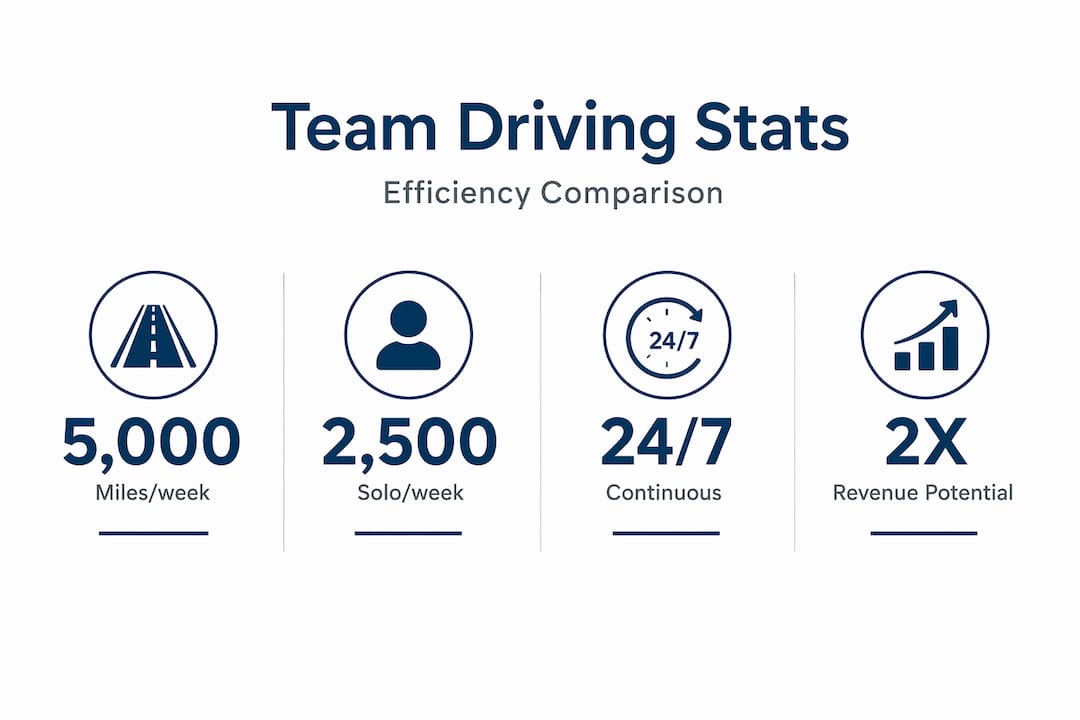
The numbers here are not subtle. Team drivers cover roughly 5,000 miles per week, nearly double the 2,500 miles covered by solo drivers under HOS regulations. That gap directly translates to truck utilization, load capacity, and gross revenue per asset.

For expedited freight and hot loads, the per-day comparison is even sharper. A team covers 1,100 to 1,300 miles in 24 hours compared to 550 to 650 miles by a solo driver, making teams essential for 48-hour cross-country deliveries.
| Metric | Solo driver | Team drivers |
|---|---|---|
| Miles per day | 550 to 650 | 1,100 to 1,300 |
| Miles per week | ~2,500 | ~5,000 |
| 48-hour cross-country feasibility | No | Yes |
| Truck utilization | ~50% | ~90% |
| Premium freight eligibility | Limited | High |
The revenue implications are direct. More miles means more loads completed per truck per week. Team trucks also qualify for premium freight rates on hot lanes, where shippers pay above-market rates for guaranteed transit times that solo drivers cannot legally meet.
Here is why this matters for your fleet:
- A solo driver simply cannot legally keep a truck moving around the clock. HOS rules cap individual driving time and mandate off-duty periods.
- A team truck operates nearly continuously, making it a different asset class than a solo-driven truck.
- Understanding the driver hiring ROI of placing qualified CDL-A team drivers versus solo drivers helps you build a business case for team positions.
- If you want to see how other FedEx service providers are structuring their fleets, fleet utilization insights from peers in the network provide practical benchmarks.
With the efficiency advantages clear, let's examine the HOS regulations and how sharing duties legally makes these higher-mileage runs possible.
Hours of Service rules and the sleeper berth provision for team drivers
HOS regulations from the Federal Motor Carrier Safety Administration (FMCSA) apply to each driver individually, not to the truck as a unit. This is the legal foundation that makes team driving viable.
Team drivers are subject to the same 11-hour driving and 14-hour on-duty limits but can split their 10-hour off-duty rest using the sleeper berth provision. The split most commonly used is 7 hours in the berth plus 3 hours in the berth or off-duty, taken in a specific sequence.
The sleeper berth provision allows splitting rest into a period of 7 or more hours in the berth plus at least 3 hours off duty or sleeper, pausing the 14-hour clock. Neither period counts against the 14-hour window when the split is used correctly.
Key rules each fleet manager should know:
- The 11-hour driving limit applies to each driver individually within their own 14-hour window.
- Time spent in the sleeper berth while the co-driver is at the wheel does not count as on-duty time.
- On-duty time during loading, unloading, or fuel stops does count against each driver's individual clock.
- ELD systems must accurately reflect driving, on-duty not driving, sleeper berth, and off-duty statuses for both drivers simultaneously.
| HOS category | Solo driver | Team driver (each) |
|---|---|---|
| Max driving per shift | 11 hours | 11 hours |
| 14-hour on-duty window | Applies | Applies individually |
| Sleeper berth split option | Yes | Yes, more practical |
| 10-hour off-duty minimum | Required | Can be split |
| 30-minute break requirement | After 8 hours driving | After 8 hours driving |
Pro Tip: Confirm that your ELD system supports dual-driver logging. Team driving compliance issues often trace back to systems logging co-driver berth time as on-duty by default. Audit ELD settings before the first dispatch.
Now that you understand the legal framework enabling team driving, let's review practical considerations for implementing a successful team driver program.
Best practices for managing shared driving duties in FedEx service provider fleets
Getting team driving logistics right requires more than pairing two qualified drivers. Dispatch planning, ELD setup, and communication protocols all determine whether the arrangement runs smoothly or creates compliance headaches.
Best team operations stagger driver start times by 2 to 3 hours to avoid simultaneous HOS clock expiration that grounds the truck. If both drivers start at the same time, both hit their limits at the same time. The truck stops. The freight is late. Staggering start times is a simple fix that most new team operations overlook.
Follow these steps to set up well-managed team driver schedules:
- Stagger start times. Offset each driver's HOS clock by 2 to 3 hours so they never expire simultaneously.
- Configure ELD systems for team mode. Modern ELD systems support multiple driver profiles to simplify accurate log management for teams. Set up both driver profiles before departure.
- Coordinate appointment windows. Schedule pickup and delivery appointments to align with driver swap times when possible. Avoid booking appointments that force both drivers into on-duty status at the same time.
- Train on on-duty vs. off-duty logging. Drivers must log loading, unloading, and fueling as on-duty not driving. This is a frequent audit finding in team operations.
- Build in communication checkpoints. Require co-drivers to brief each other at every swap on fuel level, route changes, weather, and mechanical concerns.
Key management principles for shared driving responsibilities:
- Assign compatible driver pairs when possible. Lifestyle compatibility reduces friction on multi-day runs.
- Review ELD logs after the first week of any new team pairing to catch logging errors early.
- Read service provider reviews from other FedEx contractors to learn how they structure team driver dispatch.
- Build a standard operating procedure (SOP) specific to team operations. Solo driving SOPs do not address the unique compliance requirements of shared duties.
Pro Tip: Ask drivers to log their first sleeper berth period before departure if they are starting a run after a short break. This builds a compliant HOS buffer before the load begins moving.
Having covered practical management tips, here is our perspective on why team driving is a strategic advantage that beats solo driving for demanding freight operations.
Why team driving is the future for FedEx service providers handling time-sensitive freight
Solo driving is a practical default for most freight. But for FedEx service providers competing on expedited freight and tight delivery windows, solo operations hit a ceiling fast. Team driving doubles truck utilization and revenue potential while enhancing safety and compliance. That is not a theoretical benefit. It shows up in loads completed per week, premium rate access, and on-time delivery scores.
The common objection is that team driving is harder to staff and harder to manage. That is true. But the alternative is leaving trucks sitting idle while solo drivers sleep, losing premium lanes to competitors who have invested in team operations.
There is also a retention angle worth considering. Strong team partnerships, when matched well, reduce turnover. Drivers who work with a reliable co-driver they trust are less likely to leave. That is not a soft benefit. Driver turnover is one of the highest direct costs in fleet management.
Fleet managers who treat team driving as an exception rather than a core capability will find themselves limited to freight that fits a solo driver's output window. That window is getting narrower as customer expectations for transit times continue to tighten.
The service providers that build real team driver programs, with staggered HOS planning, proper ELD configurations, and compatible driver pairs, will be the ones taking the premium loads. Reviewing team driver success tips is a useful starting point for fleet managers building out that capability.
Explore UCEP resources for FedEx service providers adopting team driving
If you are looking to build or expand a team driver program, UCEP gives you direct access to the tools and connections you need. UCEP is built exclusively for FedEx service providers, which means every resource is relevant to your specific operational context.
Browse UCEP service provider reviews to see how other contractors are structuring their team driver operations and what drivers say about working with them. Join the UCEP driver network to connect with qualified CDL-A drivers who have team driving experience. When you are ready to hire, find companies hiring drivers for team roles supporting expedited FedEx freight. UCEP puts everything in one place so you spend less time searching and more time moving freight.
Frequently asked questions
Why do team drivers share driving duties instead of driving solo?
Team drivers share duties to reduce fatigue, comply with HOS limits, and keep trucks moving nearly nonstop for faster deliveries. Two trained drivers provide continuous coverage and reduce fatigue risk compared with solo driving.
How does the sleeper berth provision help team drivers share duties?
It allows drivers to split their required 10-hour rest into two periods, pausing the 14-hour on-duty clock and enabling legal continuous truck operation. The sleeper berth provision lets drivers split their 10-hour off-duty time to reset their driving clocks.
Can solo drivers legally complete hot loads within 48 hours?
No. Solo drivers are restricted by HOS limits and cannot legally complete cross-country hot loads requiring delivery in 48 hours. Solo drivers cannot legally complete a 2,800-mile hot load in 48 hours, but teams can by alternating drivers.
What are common challenges in managing team drivers' shared duties?
Challenges include coordinating staggered HOS clocks, accurate ELD logging for both drivers, and managing lifestyle compatibility between co-drivers. Poor planning can lead to both drivers running out of hours simultaneously, grounding the truck.
How does team driving impact fleet revenue and utilization?
Team driving nearly doubles miles covered and truck utilization, increasing revenue potential and access to premium freight. Team trucks cover about 5,000 miles per week compared to 2,500 by solo drivers, boosting revenue potential directly.