
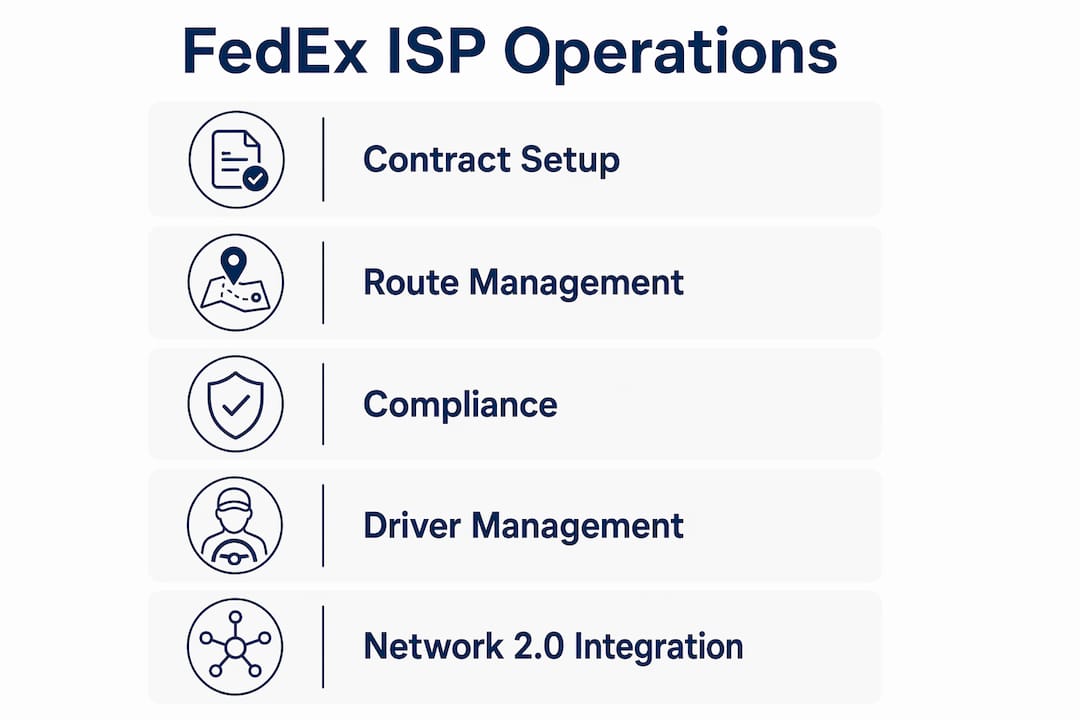
The FedEx ISP model is a business structure where an independent service provider contracts directly with FedEx to operate pickup and delivery routes using company-owned vehicles and W-2 employees. ISP stands for Independent Service Provider, and it is the recognized industry term for this contracting arrangement. Under this framework, you own the fleet, hire the drivers, manage payroll, and take full responsibility for daily operations within your assigned territory. FedEx sets the performance standards and service requirements. You run the business. Understanding the FedEx ISP model explained in full means grasping both the operational freedom and the compliance weight that come with it.
What does the FedEx ISP model require from service providers?
The ISP model is not a single-route owner-operator arrangement. Most entry-level ISP operations require managing 3–10 or more routes, with multi-route contracts phased in over time. That scale means you are running a small logistics company, not driving a truck. You need a fleet, a payroll system, and a management structure from day one.
FedEx's contracting system under Network 2.0 sets clear operational standards every ISP must meet:
- Vehicle ownership and branding: You own or lease the vehicles. FedEx requires specific branding on all trucks operating under your contract.
- W-2 driver employment: All drivers must be W-2 employees. You handle hiring, onboarding, payroll, and termination.
- Performance metrics: FedEx tracks on-time delivery rates, service failures, and safety incidents. FedEx monitors ISP performance and can terminate contracts for unmet standards.
- Terminal relationships: You coordinate daily with your assigned FedEx terminal for route assignments, volume updates, and operational communication.
- Cash reserves: ISPs must maintain 60–90 days of operating expense reserves to absorb volume shifts and route restructuring.
Pro Tip: Build your terminal relationship before you need it. ISPs who communicate proactively with station managers resolve route conflicts faster and see fewer surprise contract reviews.
The cash reserve requirement is not a suggestion. It is a survival metric. Station mergers and route restructuring happen with limited notice, and undercapitalized ISPs cannot absorb the disruption.
How does Network 2.0 change ISP operations?
Network 2.0 is FedEx's initiative to merge Ground and Express deliveries into a single unified stream. For ISPs, this is the single biggest operational shift in the model's recent history. You are no longer delivering only Ground packages on a predictable daily schedule. You are now handling time-definite Express packages alongside standard Ground volume on the same routes.

The financial stakes are real. Network 2.0 has reduced pickup and delivery costs by 10% in pilot markets, with projected savings exceeding $1 billion in 2026. That efficiency gain flows to FedEx. For ISPs, the operational complexity increases without a proportional revenue increase unless you manage routes precisely.
Here is what changes operationally under Network 2.0:
- Express package prioritization: Time-definite Express packages have strict delivery windows. Missing those windows triggers financial penalties. Treating Express as standard Ground volume is one of the most costly mistakes an ISP can make.
- Dynamic route scheduling: Static daily routes no longer work. You need routing software that adjusts in real time based on package type, delivery window, and stop density.
- Pickup consolidation rules: Network 2.0 changes how pickups are consolidated across stops. Higher stop density on merged routes can reduce per-stop cost, but only if your drivers are managing time efficiently.
- Station mergers: When FedEx merges stations, your route territory and stop count can change abruptly. ISPs maintaining 60–90 days of reserves adapt to these shifts without losing drivers or missing payroll.
Dynamic Route Optimization is not optional under Network 2.0. It is the operational foundation that separates profitable ISPs from those who struggle to break even. If you are still scheduling routes manually, you are already behind. For a broader look at how this integration affects competitive positioning, the analysis of Amazon's logistics expansion alongside Network 2.0 provides useful context.
What compliance risks do ISPs face?
Compliance is where ISP businesses face the most serious legal exposure. You employ W-2 drivers, which means federal and state labor laws apply in full. Overtime rules under the Fair Labor Standards Act, state-specific wage laws, and workers' compensation requirements all fall on you as the employer.
The legal risk goes deeper than payroll. FedEx exerts significant operational control over ISPs, including route assignments, vehicle branding, driver appearance standards, and performance metrics. Courts scrutinize that level of control when evaluating joint employer liability claims. The line between FedEx's branding requirements and your employment decisions must be clearly documented.
Key compliance areas every ISP must manage:
- Payroll accuracy: Overtime miscalculations are the most common source of wage claims. Compliance software starts at $29 per service area per week for complex payroll processing. That cost is far lower than a wage dispute settlement.
- Recordkeeping: Maintain clear records of hours worked, routes completed, and disciplinary actions. Documentation is your primary defense in any labor dispute.
- Operational separation: Avoiding IRS or state reclassification risks requires keeping your employment decisions, including compensation and discipline, fully separate from FedEx's operational directives.
- Safety compliance: FedEx can terminate contracts for safety failures. Driver training records and vehicle inspection logs must be current and accessible.
Pro Tip: Treat your compliance documentation as a legal asset, not an administrative task. Clear records distinguishing your employment decisions from FedEx's branding controls are your best protection against joint employer claims.
Clear documentation separating branding and safety controls from employment control is the single most effective risk reduction tool available to ISPs. Build that paper trail before you need it in court.
How do you build a reliable driver workforce as an ISP?
Driver recruitment and retention are the operational bottleneck most ISPs underestimate. You can have excellent routes and solid cash reserves, but a high-turnover driver workforce will erode both. Effective culture building and training programs improve hire quality and operational consistency more than any single technology investment.
The table below compares recruitment approaches by effectiveness for ISP operations:
| Recruitment approach | Best use case | Key advantage |
|---|---|---|
| General job boards | High volume, low filter | Wide reach, low cost per post |
| Targeted ISP job boards | FedEx-specific roles | Pre-qualified candidates, less screening time |
| Driver referral programs | Culture-fit hires | Lower turnover, faster onboarding |
| CDL school partnerships | Entry-level pipeline | Consistent candidate flow |
Targeted job boards deliver better ROI for ISPs hiring drivers because candidates already understand the FedEx delivery environment. General job boards generate volume. Targeted boards generate fit. For ISPs managing 5–10 routes, a single bad hire in a key position costs more in retraining and missed deliveries than a full month of job board fees.
Technology also plays a direct role in retention. Route management software that gives drivers clear, optimized stop sequences reduces frustration and end-of-day overtime. Drivers who finish on time and feel organized stay longer. Pair that with consistent onboarding and a clear performance feedback process, and turnover drops. Understanding what it takes to succeed as a team driver under FedEx ISP contracts helps you set realistic expectations during hiring conversations.
Financial stability also affects your ability to recruit. ISPs with strong cash reserves can offer competitive pay without waiting for FedEx settlement cycles to clear. Drivers notice when payroll is consistent and on time. That reliability becomes a recruiting advantage in tight driver markets.
Key Takeaways
The FedEx ISP model requires ISPs to operate as full employers, managing vehicles, drivers, payroll, and compliance independently while meeting FedEx's strict performance and service standards under Network 2.0.
| Point | Details |
|---|---|
| Multi-route operations are standard | Most ISPs manage 3–10+ routes; single-route models are not the norm under current contracts. |
| Cash reserves are non-negotiable | Maintain 60–90 days of operating expenses to absorb station mergers and volume shifts. |
| Network 2.0 adds complexity | Express packages require dynamic routing software to avoid financial penalties for missed windows. |
| Compliance documentation protects you | Clear records separating your employment decisions from FedEx's controls reduce joint employer liability risk. |
| Targeted recruitment improves retention | FedEx-specific job boards produce better-fit candidates and lower turnover than general platforms. |
Why the ISP model rewards operators, not managers
Running a FedEx ISP business in 2026 is fundamentally different from what it was five years ago. The operators I have seen succeed are not the ones with the most routes. They are the ones who treat their ISP like a data-driven logistics company, not a fleet management job.
The shift that matters most is moving from reactive to proactive. Most ISPs I have spoken with react to Network 2.0 changes after they happen. The ones building real profitability are tracking their Express-to-Ground package ratios weekly, adjusting routes before FedEx asks them to, and using their cash reserves as a growth tool rather than an emergency fund.
The compliance piece is where I see the most avoidable damage. ISPs lose contracts not because they deliver poorly, but because their documentation is weak when a labor claim surfaces. The era of easy profits in the ISP model is over. What replaces it is a more disciplined, technology-supported operation where every decision, from hiring to routing to recordkeeping, has a measurable outcome.
My honest recommendation: invest in compliance software and a targeted recruiting platform before you invest in a new vehicle. The truck depreciates. The systems compound.
— Aaron
How Ucep helps ISPs find qualified drivers faster
Finding drivers who already understand the FedEx delivery environment is one of the hardest parts of running an ISP. Ucep is a dedicated recruiting platform built exclusively for FedEx service providers, connecting you with candidates for linehaul, CDL-A team, CDL-A solo, and pickup and delivery roles.
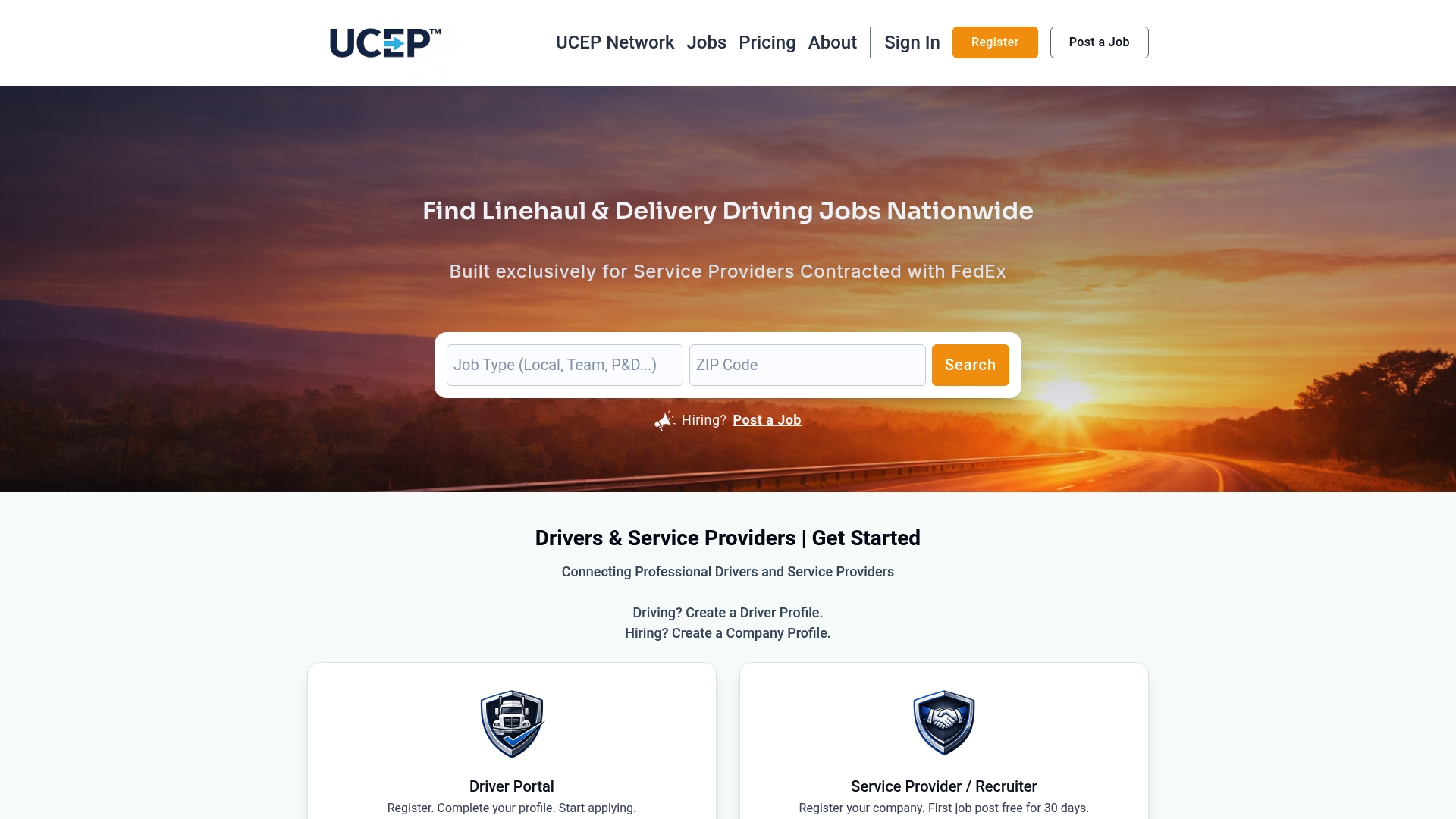
Ucep removes the noise that comes with general job boards. Every candidate on the platform is looking specifically for FedEx-related driving work, which means less time screening and more time onboarding. You can browse companies hiring drivers or review service provider profiles to see how other ISPs are building their teams. If you are managing multiple routes and need a consistent driver pipeline, Ucep gives you a focused place to find it.
FAQ
What is the FedEx ISP model?
The FedEx ISP model is a contracting structure where an independent service provider owns vehicles, employs W-2 drivers, and operates multiple delivery routes under a direct contract with FedEx. The ISP manages all employment, payroll, and compliance obligations independently.
How many routes does a FedEx ISP typically operate?
Most ISPs operate 3–10 or more routes. Single-route models are not standard under current FedEx contracting requirements, and multi-route operations are phased in as part of the ISP agreement.
What is Network 2.0 and how does it affect ISPs?
Network 2.0 merges FedEx Ground and Express deliveries into one unified delivery stream. ISPs must now handle time-definite Express packages alongside Ground volume, which requires dynamic routing software and increases the risk of financial penalties for missed delivery windows.
What cash reserves does a FedEx ISP need?
ISPs should maintain 60–90 days of operating expenses in reserve. This buffer covers payroll and fleet costs during station mergers, route restructuring, or volume fluctuations that occur with limited advance notice.
How can ISPs reduce driver turnover?
Targeted job boards that attract FedEx-experienced candidates, consistent onboarding programs, and route management software that reduces driver frustration all contribute to lower turnover. Reliable, on-time payroll is also a direct retention factor in competitive driver markets.