
Finding qualified pickup and delivery drivers is one of the biggest operational challenges service providers face today. A bad hire creates route delays, damages customer relationships, and adds costly turnover to your workload. These pickup delivery driver hiring tips are designed for service providers and business owners who need practical, specific guidance. You will learn how to write job descriptions that attract the right candidates, screen for safety and reliability, structure competitive pay, manage compliance requirements, and build a recruitment process that holds up under real operational pressure.
Table of Contents
- Key Takeaways
- 1. Write job descriptions that cover the actual job
- 2. State requirements clearly and without ambiguity
- 3. Publish transparent pay details
- 4. Use background checks and driving records as your baseline
- 5. Ask the right interview questions
- 6. Build compliance into your hiring timeline, not after it
- 7. Optimize your sourcing strategy
- 8. Train drivers from day one, not week three
- My take on what actually matters in driver hiring
- Find qualified pickup and delivery drivers faster with Ucep
- FAQ
Key Takeaways
| Point | Details |
|---|---|
| Write specific job descriptions | List exact duties, tools, and license requirements to attract qualified applicants who self-select accurately. |
| Screen for behavior and record | Combine driving record checks with behavioral assessments to evaluate safety and customer service fit. |
| Be transparent about pay | Publishing clear pay details, including base rates and bonuses, improves applicant quality and reduces drop-offs. |
| Build compliance into your timeline | Start FMCSA checks and employer safety requests early to avoid onboarding delays and candidate loss. |
| Use niche recruitment channels | Targeted job boards and referral programs reach experienced drivers faster than general posting sites. |
1. Write job descriptions that cover the actual job
Generic job postings produce generic applicants. If your posting says "deliver packages," you will attract anyone with a driver's license and no particular sense of what your operation requires. Listing specific duties like loading vehicles, using route optimization tools, capturing proof of delivery, managing customer interaction, maintaining vehicle condition, and processing returns changes who applies.
When candidates read a detailed posting, they assess their own fit before they apply. That means fewer unqualified resumes landing in your inbox and more conversations with people who already understand the role. Matching your job description to the actual dispatch and route workflows, including the specific tools your team uses, also helps new hires contribute faster and shortens training time significantly.
Name the technology your drivers will use. Route management apps, delivery software and tools, and proof-of-delivery systems are now standard in professional operations. Candidates who are already familiar with them are a real advantage.
Pro Tip: Include one or two sentences about your company culture and growth opportunities in the job posting. Employers who showcase supportive environments and technology adoption see measurably lower turnover.
2. State requirements clearly and without ambiguity
Vague requirements waste your time and the candidate's time. Being upfront about physical demands and license requirements creates transparency and lets candidates disqualify themselves before you schedule an interview.
State the following clearly in every posting:
- Valid driver's license class required (standard, CDL-A, CDL-B)
- Acceptable driving record standards (no DUIs, number of moving violations allowed)
- Physical requirements such as lifting capacity in pounds
- Availability requirements including weekends, early mornings, or peak seasons
- Whether candidates must use their own vehicle or if one is provided
- Any delivery zone or geographic coverage expectations
This level of specificity is a filter. It removes candidates who cannot meet your standards before any screening begins. That alone saves several hours per open position.
3. Publish transparent pay details
Candidates actively compare multiple offers. A posting that says "competitive salary" signals nothing and loses candidates to employers who state actual numbers. Publishing clear pay details including hourly rates, tips, bonuses, and reimbursements improves applicant quality because serious candidates take the posting seriously.
Your pay section should address:
- Base hourly rate or per-delivery rate
- Whether tips are passed through and how
- Performance bonuses and how they are earned
- Mileage or fuel reimbursement policy
- Pay schedule (weekly, biweekly)
A pay structure comparison helps you decide what model fits your operation:
| Pay Model | Best For | Key Consideration |
|---|---|---|
| Hourly base only | Consistent route volumes | Limits performance motivation |
| Per-delivery rate | High-volume operations | Can pressure speed over safety |
| Hourly base plus bonus | Most operations | Balances fairness and motivation better than either model alone |
| Hourly plus tips | Customer-facing delivery roles | Dependent on customer behavior |
Benefits also matter for retention. Health insurance, paid time off, retirement contributions, vehicle maintenance allowances, and schedule flexibility are not extras. They are retention tools that reduce the cycle of rehiring. Candidates who see a full picture of what the role offers are more likely to accept and stay.
4. Use background checks and driving records as your baseline
Every driver hire requires a minimum set of screening steps before you make an offer. These are not optional. They protect your business, your customers, and other drivers on the road.
Your baseline screening should cover:
- Motor vehicle record (MVR) check from every state the candidate held a license in over the past three years
- Criminal background check appropriate to your jurisdiction and role
- Drug screening per your company policy
- Reference checks from previous employers
Advanced screening techniques that combine background and driving record checks with behavioral assessments reduce risk and improve fit for delivery roles. A clean driving record tells you about the past. A behavioral assessment tells you how someone will handle a delayed route, an angry customer, or a missed delivery. Both matter.
Pro Tip: Ask candidates directly about their approach to customer interaction during a delivery dispute. Delivery roles require safety, reliability, and customer service under time pressure simultaneously. That combination is harder to screen for from a resume alone.
5. Ask the right interview questions
Effective delivery driver interviews go beyond confirming work history. You are evaluating how a candidate thinks and behaves under the conditions your operation actually creates.
Here are practical questions to include:
- "Describe a time your route changed unexpectedly. How did you handle it?" Tests adaptability and problem-solving.
- "How do you prioritize deliveries when you are running behind schedule?" Tests time management and judgment under pressure.
- "What steps do you take before starting a delivery shift?" Tests pre-trip safety habits.
- "Have you used any route optimization or delivery management apps? Which ones?" Tests technology familiarity.
- "Walk me through how you would handle a customer who says their package was delivered but they cannot find it." Tests customer service skills and composure.
Each question targets a specific job requirement. Compare answers across candidates using the same criteria so your decisions stay consistent. Check past employer references specifically for attendance, safety incidents, and customer service performance. Those three factors predict delivery job performance more reliably than most other indicators.
6. Build compliance into your hiring timeline, not after it
Compliance requirements for pickup and delivery drivers vary based on role type. Non-CDL roles have lighter regulatory requirements. CDL and commercial motor vehicle (CMV) roles carry federal compliance obligations you cannot skip.

For CDL or DOT-regulated hires, FMCSA mandates pre-employment Clearinghouse drug and alcohol queries and MVRs from every state where a driver held a license in the past three years before they operate any CMV. Noncompliance can result in significant fines and operational shutdowns.
The compliance steps to build into your process:
- Submit FMCSA Clearinghouse pre-employment query with electronic driver consent
- Order MVRs from all applicable states
- Request previous employer safety performance records (DOT-regulated employers)
- Conduct pre-employment drug testing
- Assemble and maintain a driver qualification file for every CMV hire
Previous employer safety requests have a 30-day response window built into the process. Start these requests early, run them in parallel with interviews, and do not wait until you have made an offer. Delaying these steps is one of the most common reasons qualified candidates drop off during onboarding.
Pro Tip: Build a compliance checklist specific to each role type in your operation. A thorough driver qualification file workflow confirms that no driver moves to active status without completed queries, MVRs, drug tests, and documented sign-offs.
7. Optimize your sourcing strategy
Where you post the job determines who sees it. General job boards reach a broad audience that includes many people with no interest in or experience with delivery work. Using niche job boards and social media improves targeted reach and attracts better-matched applicants for transport roles.
Practical sourcing approaches for pickup driver recruitment include:
- Post on transportation-specific job boards where experienced drivers are already searching
- Use social media platforms to share open roles in local driving and delivery groups
- Build an employee referral program that rewards current drivers for successful hires
- Engage with community organizations, trade schools, and CDL training programs for entry-level pipelines
- Target specialized candidate pools through transport industry channels rather than generalist platforms
Referral hires tend to stay longer and onboard faster. Current drivers know the actual demands of the work and tend to refer people they believe can handle it. That informal pre-screening has real value.
8. Train drivers from day one, not week three
Onboarding is part of your hiring strategy. Candidates accept offers and then decide whether to stay based on what they experience in the first few weeks. Disorganized onboarding pushes good drivers out before they have contributed anything.
Training drivers thoroughly on technology use, customer service standards, and safety protocols dramatically improves both performance and retention. Hands-on practice with your delivery software, route tools, and proof-of-delivery systems reduces errors in the field and gives new hires confidence in the work.
Structure your first week to cover route tools, company communication protocols, customer interaction standards, vehicle inspection procedures, and escalation processes. A driver who knows exactly what to do when something goes wrong is far more valuable than one who figures it out alone.
My take on what actually matters in driver hiring
I have reviewed enough hiring processes to know where service providers consistently lose good candidates. The most common mistake is treating compliance as a final step instead of a parallel one. You identify a strong candidate, move through interviews, make an offer, and then start the background and Clearinghouse process. Two weeks later the candidate has taken another job. Planning hiring timelines around regulatory check turnaround times is not a procedural detail. It is the difference between filling a role and starting over.
The second thing I would push back on is the idea of the "perfect candidate." Most service providers I work with describe an ideal hire who has five or more years of experience, a spotless record, CDL, and existing familiarity with their specific software stack. That person exists but is rarely available on your timeline. The more productive question is: what is the minimum viable qualification for this role, and can I train the rest?
Transparency in your posting is also doing more work than most people realize. Detailed and transparent job postings signal professionalism to candidates who are comparing multiple offers. When your posting shows exactly what the job pays, what the schedule looks like, and what tools you use, you attract candidates who are making an informed choice. That informed choice correlates directly with lower early turnover.
Speed matters in this market. But speed without process creates churn. The service providers with the best hiring outcomes move fast and work from a defined checklist, not from memory.
— Aaron
Find qualified pickup and delivery drivers faster with Ucep
Ucep is built specifically for service providers contracted with FedEx who need to fill pickup and delivery, CDL-A solo, CDL-A team, and linehaul roles. General job boards make you compete for attention in a crowded field. Ucep puts your job postings in front of drivers who are already searching for FedEx-related opportunities.
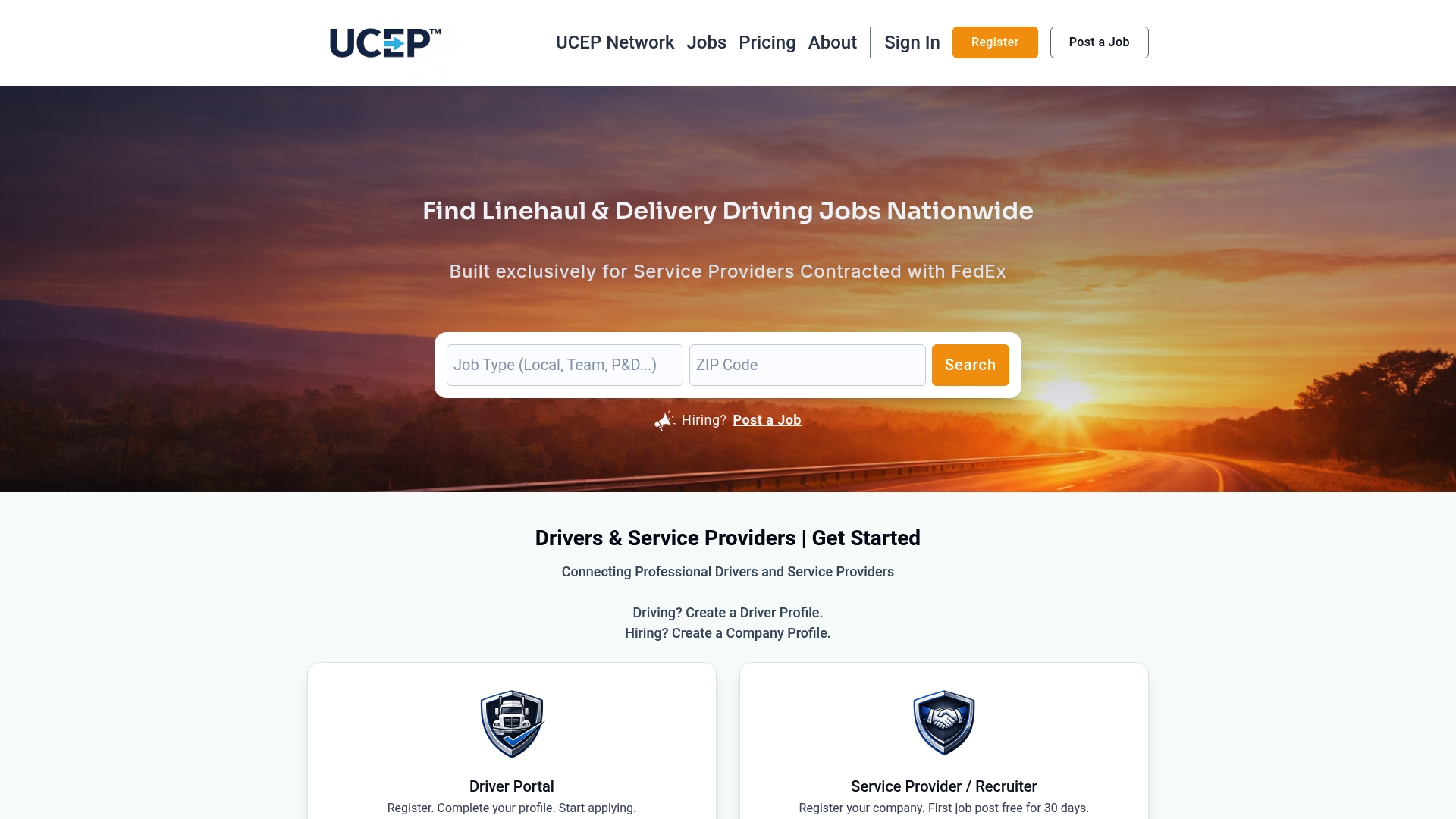
You can post a driver job directly on Ucep and reach a targeted pool of candidates with relevant experience. The platform is designed around the compliance and role requirements specific to FedEx service provider operations, so you spend less time filtering unqualified applicants and more time evaluating real candidates. If you are working to apply the pickup delivery driver hiring tips in this article, Ucep gives you the infrastructure to do it efficiently. Visit Ucep to get started.
FAQ
What should a pickup and delivery driver job description include?
A strong job description lists specific duties like route management, proof of delivery, customer interaction, and vehicle maintenance, along with exact license requirements, physical demands, availability, and pay details. Vague postings attract unqualified applicants and increase screening time.
How do you screen delivery driver candidates effectively?
Start with MVR checks, criminal background checks, and drug testing as baseline requirements. Add behavioral interview questions to evaluate time management, safety habits, and customer service under pressure. Checking references with previous employers for safety and attendance records adds another layer of reliability.
What compliance steps are required for CDL delivery driver hires?
FMCSA requires pre-employment Clearinghouse drug and alcohol queries, MVRs from all states where the driver held a license in the past three years, and previous employer safety performance requests before a CDL driver operates any commercial motor vehicle. Build these steps into your hiring timeline early to avoid delays.
What pay structure works best for pickup and delivery drivers?
An hourly base rate combined with performance bonuses typically balances fairness and motivation more effectively than per-delivery pay alone. Publishing the full pay structure, including tips and reimbursements, in your job posting improves both applicant quality and offer acceptance rates.
Where should service providers post delivery driver jobs?
Niche job boards focused on the transportation industry, along with social media targeting local driving communities, outperform general job boards for delivery roles. Employee referral programs and partnerships with CDL training programs also produce strong candidates with lower screening overhead.