
Solo and team driver hiring differences define two distinct operational models that directly shape your fleet's mileage output, pay structure, driver retention, and compliance burden. Logistics managers and HR professionals who treat these roles as interchangeable make costly mistakes. Solo drivers operate independently on regional or over-the-road (OTR) routes, while team drivers run in pairs to keep a truck moving nearly around the clock. The right choice depends on your freight priorities, budget, and how well you screen candidates before they ever turn a key.
1. How do solo and team driver pay structures differ?
Pay structure is the sharpest contrast between the two hiring models. Solo drivers average 2,500 miles per week at roughly $1.85 per mile, generating about $4,625 in gross weekly revenue per truck. That figure is straightforward to budget and easy to communicate to candidates.

Team drivers cover a different scale entirely. Teams run 4,000+ miles per week at approximately $2.20 per mile, producing around $8,800 in gross weekly revenue per truck. That sounds like a strong gain, but that revenue splits between two drivers, so each individual nets less than a solo driver earning at full rate.
The math matters for recruitment. Team drivers earn higher per-mile rates because they deliver faster and qualify for premium expedited freight. However, candidates who do not understand the split often feel underpaid once they start. Transparent pay communication at the job posting stage prevents that friction.
- Solo driver gross: ~$4,625/week per truck, one driver keeps it all
- Team driver gross: ~$8,800/week per truck, split equally between two drivers
- Net individual pay for team drivers is often lower than solo, despite higher mileage
- Expedited freight rates of $2.50–$4.00 per mile are available to teams but not typically to solo OTR drivers
Pro Tip: State the split pay structure explicitly in your team driver job posting. Candidates who understand the math upfront are far less likely to leave after their first paycheck.
2. What operational complexities come with team driver hiring?
Team driving increases your administrative workload significantly. Managing dual Hours of Service logs means two sets of DOT physicals, two electronic logging device records, and two compliance timelines running simultaneously. One driver's violation affects the other's schedule and your safety rating.
Fuel and maintenance costs rise with continuous operation. Team driving increases fuel consumption by 15–20% compared to solo operation. Trucks running nearly 24 hours a day accumulate miles faster, which accelerates tire wear, oil change intervals, and brake replacement cycles.
Tax classification adds another layer of risk. Misclassifying team drivers creates audit exposure, especially when one driver owns the equipment and the other does not. Your HR team needs clear policies on co-driver classification before you post the role.
Retention risk doubles with team hiring. If one partner leaves, the remaining driver is either reassigned or goes idle. That disruption costs you a full truck's productivity, not just one driver's shift.
- Dual HOS logs require twice the compliance monitoring
- Fuel costs rise 15–20% from continuous operation
- Accelerated maintenance schedules increase per-truck operating costs
- Tax classification errors with co-drivers trigger audits
- One partner's departure grounds the entire team
Pro Tip: Build a co-driver replacement protocol before you need it. Know in advance whether you will reassign the remaining driver solo, pair them with a new candidate, or temporarily idle the truck.
3. What screening criteria improve solo and team driver hiring?
Effective screening starts with separating hard credentials from route realities in your job posting. Listing CDL class, MVR requirements, and medical card status in the first three lines of a posting filters unqualified applicants before they apply. That saves your HR team hours of review time per open role.
Route expectations belong in the posting too. Explicitly stating OTR versus regional, expected time away, and pay structure drives better applicant fit and reduces early turnover. A driver who applies knowing they will be away for three weeks at a time is far less likely to quit in month two.
For solo driver roles, your screening checklist should cover:
- CDL-A license with appropriate endorsements
- Clean MVR with no major violations in the past three years
- Valid DOT medical card
- Confirmed route type preference (OTR, regional, or local)
- Home-time expectations aligned with your schedule
For team driver roles, add these criteria:
- Verified driving history for both candidates
- Temperament compatibility assessment (driving style, sleep schedule, communication)
- Aligned financial goals between partners
- Shared understanding of the split pay model
- No history of partnership disputes or early team dissolutions
Trial periods reduce risk in team hiring. Pairing two drivers on a short regional run before committing to a full OTR team assignment reveals compatibility issues early. A two-week trial costs far less than a full team breakup three months into a long-haul contract.
Targeted job boards that reach CDL-qualified candidates directly reduce the volume of unfit applicants and shorten your time to hire. Posting on platforms built for the trucking industry produces better results than general job sites.
4. How do solo and team driving affect driver lifestyle and retention?
Solo drivers value control. They set their own pace within HOS limits, manage their own rest stops, and generally follow predictable schedules on regional routes. That independence attracts drivers who prioritize home time and personal routine. Solo driver advantages include lower stress from shared quarters and fewer interpersonal conflicts.
Team drivers trade that independence for mileage. Teams legally run 11 hours each per day, which theoretically doubles daily distance compared to a solo driver covering 500–650 miles. The trade-off is spending days in a cab with another person, sleeping in a bunk while your partner drives, and coordinating every stop.
Personality clashes are the leading cause of team driver turnover. A speed-focused driver paired with a safety-first driver creates constant tension and increases the risk of HOS violations. That mismatch does not just hurt retention. It creates liability.
Matching driver expectations with job realities is the single most effective retention tool available to logistics managers. Drivers who know exactly what they are signing up for before day one stay longer, perform better, and refer better candidates.
Lifestyle factors that affect retention by driver type:
- Solo drivers: More predictable home time, greater schedule autonomy, lower interpersonal stress
- Team drivers: Higher mileage potential, less frequent home time, shared living space for days at a stretch, dependency on partner performance
Understanding driver mental health and home time pressures helps you write more accurate job descriptions and set realistic expectations during interviews.
5. When should you hire solo vs team drivers for specific logistics goals?
The right choice depends on your freight type, delivery speed requirements, and route geography. Solo drivers fit regional and predictable-schedule operations. Team drivers fit expedited freight and long-haul lanes where speed is the primary value delivered.
| Scenario | Best fit | Key reason |
|---|---|---|
| Regional delivery routes | Solo driver | Predictable schedule, lower cost per truck |
| Expedited OTR freight | Team driver | Continuous operation, faster transit times |
| Time-sensitive cross-country loads | Team driver | 4,000+ miles/week capacity |
| Driver retention priority | Solo driver | Lower lifestyle friction, more home time |
| Budget-constrained operations | Solo driver | Lower fuel and administrative overhead |
| Premium freight lanes | Team driver | Higher per-mile rates justify added cost |
Fuel and administrative costs must factor into your team driver ROI calculation. The 15–20% fuel increase and dual compliance burden offset a portion of the revenue gain from higher mileage. For some freight lanes, the math favors solo drivers even when team drivers cover more ground.
A mixed fleet approach works well for mid-size operations. Running a core of solo drivers on regional routes while deploying a smaller team driver pool for expedited loads gives you flexibility without overcommitting to either model.
Key Takeaways
The most effective driver hiring strategy separates solo and team roles by operational goal, screens candidates against route realities, and communicates pay structure clearly before the first interview.
| Point | Details |
|---|---|
| Pay structure differs significantly | Solo drivers keep full per-mile earnings; team drivers split higher gross revenue between two people. |
| Team hiring adds compliance burden | Dual HOS logs, DOT physicals, and tax classification risks increase administrative workload. |
| Screening must include route realities | Posting home-time policies and route type upfront reduces early turnover for both driver types. |
| Personality fit drives team retention | Incompatible driving styles and financial goals are the primary cause of team driver splits. |
| Fleet composition should match freight type | Use solo drivers for regional routes and team drivers for expedited, long-haul freight lanes. |
What I have learned from watching fleet managers get this wrong
Logistics managers consistently underestimate how different these two hiring decisions actually are. They post a generic CDL-A job, screen for license and MVR, and then wonder why team drivers quit in month three or why solo drivers on OTR routes burn out by month six.
The core mistake is treating driver type as a checkbox rather than a hiring strategy. Solo and team driving are different jobs with different lifestyle demands, different financial realities, and different compatibility requirements. A driver who thrives solo may be a disaster in a team setup, not because of skill, but because of temperament.
What I have seen work consistently is building two separate hiring pipelines. One for solo roles with clear regional route expectations and honest home-time commitments. One for team roles with a compatibility screening step built in before any offer goes out. Succeeding as a team driver requires a specific mindset that not every CDL-A holder has, and your screening process should reflect that.
The managers who get this right also revisit their job postings regularly. If your team driver posting is not explicitly stating the split pay model, the shared bunk reality, and the home-time frequency, you are attracting the wrong candidates. Honest postings feel like they might reduce applicant volume. They actually increase the quality of every application you receive.
— Aaron
Ucep makes driver recruitment more targeted
Finding qualified solo and team drivers in the same general job market wastes time and produces poor matches. Ucep is built exclusively for Service Providers contracted with FedEx, which means every driver browsing the platform is already oriented toward FedEx-related roles.
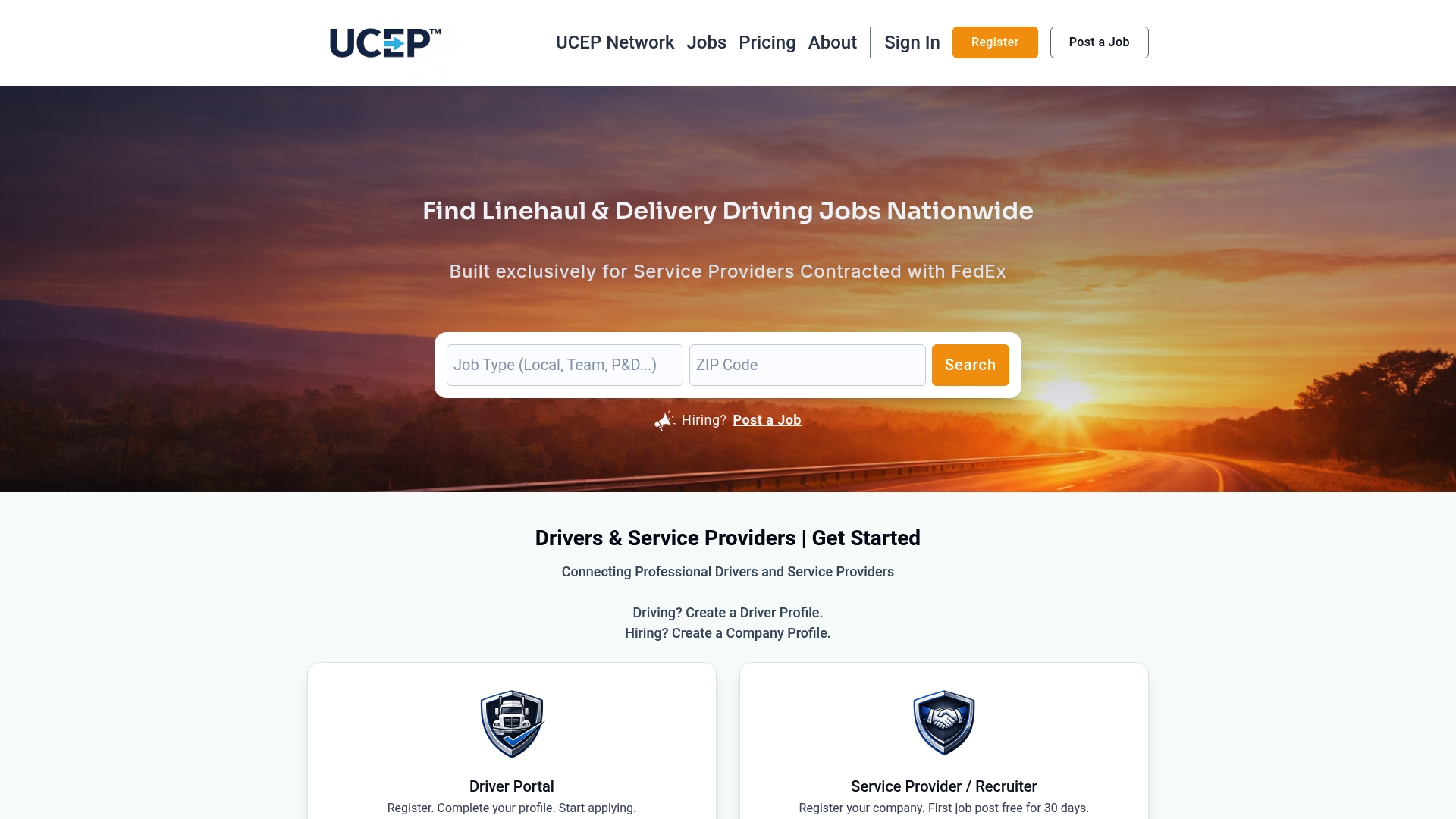
You can post CDL-A solo, CDL-A team, linehaul, and pickup and delivery roles directly on Ucep and reach candidates who are actively looking for exactly those positions. Browse service provider reviews to see how other operators are structuring their driver programs, or explore companies hiring drivers to benchmark your own recruitment approach. When your job posting reaches the right audience from day one, you spend less time screening and more time onboarding.
FAQ
What is the main pay difference between solo and team drivers?
Solo drivers earn the full per-mile rate on roughly 2,500 miles per week. Team drivers earn a higher per-mile rate on 4,000+ miles per week but split that gross revenue equally, which often results in lower individual net pay.
Why do team drivers have higher turnover than solo drivers?
Personality incompatibility and misaligned financial expectations are the primary causes. Drivers with different speed preferences, sleep schedules, or income goals create friction that leads to early partnership dissolutions.
What credentials should you screen for when hiring CDL-A drivers?
Screen for a valid CDL-A license with appropriate endorsements, a clean MVR with no major violations in the past three years, and a current DOT medical card. For team roles, add a temperament compatibility assessment for both candidates.
When does hiring team drivers make financial sense?
Team drivers make financial sense on expedited, long-haul freight lanes where speed justifies the premium per-mile rate and the added fuel and compliance costs. For regional or budget-sensitive routes, solo drivers typically produce better margins.
How do you reduce early turnover in both driver types?
State route type, home-time frequency, and pay structure explicitly in the job posting. Drivers who self-select based on accurate information stay longer and perform better than those who discover the reality after starting.
Recommended
- What It Takes to Succeed as a Team Driver for Service Providers Contracted with FedEx | UCEP Meta description - United Contractor Employment Portal
- Why Targeted Job Boards Deliver Better ROI for Service Providers Hiring Drivers - United Contractor Employment Portal
- Safe Delivery Driving Summer 2026 | Reduce Delivery Risk - United Contractor Employment Portal