
The biggest common first-year CDL driver challenges are backing accidents, Hours-of-Service violations, skipped pre-trip inspections, poor trip planning, regulatory missteps, probation failures, health decline, financial stress, equipment breakdowns, and isolation. Each one is manageable with the right habit in place before it becomes a pattern.
Here is a fast-reference list of each challenge and the single most effective action to address it:
- Backing accidents: Use GOAL (Get Out And Look) before every reverse maneuver, every time.
- HOS and fatigue: Plan your driving day before you start the engine, not mid-shift.
- Pre-trip inspections: Run a written checklist, not a mental one, every morning.
- Trip planning and parking: Use a truck-specific GPS and identify two parking options before you leave the yard.
- Regulatory compliance: Know your Clearinghouse status and never skip a drug-test notice.
- Probation and dispatch: Communicate proactively, especially when something goes wrong.
- Health and isolation: Set a fixed sleep window and schedule calls home like appointments.
- Financial pressure: Build a three-month expense buffer before your first solo run.
- Equipment failures: Know your carrier's breakdown protocol and keep the number saved.
- Seasonal and weather hazards: Check road conditions and bridge freeze warnings before every shift in winter.
Pro Tip: The single habit that protects your career most in year one is documentation. Log every delay, every dispatch instruction, every defect report. A paper trail turns a disputed incident into a resolved one.
Table of Contents
- What makes the first-year CDL driver learning curve so steep?
- How do HOS rules and fatigue affect new CDL drivers?
- What does a solid pre-trip inspection actually look like?
- How should new drivers handle trip planning and parking?
- What regulatory rules most often end a new driver's career?
- How do you survive the 90-day probation period?
- What health and mental health habits actually work on the road?
- What mistakes do rookie truck drivers make most often?
- What does the data say about year-one risks and outcomes?
- Key Takeaways
- What an experienced recruiter would tell every new CDL driver
- Ucep connects new CDL drivers to stable FedEx-contracted roles
- Useful sources and further reading
What makes the first-year CDL driver learning curve so steep?
Backing and tight-dock maneuvers cause more new driver incidents than any other skill gap. A 53-foot trailer does not respond the way a car does in reverse, and the spatial awareness required takes deliberate practice to build. Most rookies underestimate how long that takes.

Why backing trips up new drivers
The core problem is that you cannot see the full trailer arc from the cab. Mirrors show you a slice of the picture, not all of it. New drivers tend to commit to a line too early, then overcorrect, which compounds the error. Preventable backing accidents stay on a driver's record for three years and affect both CSA scores and insurance eligibility.
GOAL (Get Out And Look) is the industry standard response. Before every backing maneuver, exit the cab, walk the full path, check overhead clearances, and confirm the dock or space is clear. It adds 90 seconds. It prevents incidents that cost careers.
Pre-docking approach checklist
- Identify the dock number and confirm the approach angle before you pull past it.
- Set your mirrors: both sides adjusted to show the trailer edge and the ground line.
- Exit the cab and walk the path. Check overhead clearances, curbs, and any obstacles.
- Back slowly. If you lose sight of a reference point, stop and get out again.
- Use a spotter when one is available. If no spotter is present, treat every blind spot as occupied.
Additional habits that accelerate skill-building:
- Practice in an empty lot during off-time. Straight-line backing, then 45-degree, then 90-degree.
- Ask your trainer or a senior driver to watch one backing session per week and give direct feedback.
- Review your carrier's telematics data after each shift. Hard events during backing show up there.
Pro Tip: If your carrier uses dash cameras or side cameras, review your own footage after difficult docks. Watching your own approach from the outside fixes errors faster than any verbal correction.
Understanding what trucking skills assessments actually test helps you prioritize which maneuvers to drill before your first evaluation.
How do HOS rules and fatigue affect new CDL drivers?
HOS violations and poor sleep are career killers. Treat Hours-of-Service compliance and sleep planning as core driving skills, not administrative tasks. FMCSA's HOS regulations set the legal framework, and your ELD enforces it automatically. The problem is that new drivers often run close to the limit without building in realistic buffers.
The rules that trip up rookies most often:
- The 11-hour driving limit within a 14-hour on-duty window. You cannot extend the 14-hour clock by taking a break.
- The 30-minute break requirement after 8 cumulative hours of driving.
- The 70-hour/8-day limit for carriers operating every day of the week.
- The 34-hour restart provision, which resets the 70-hour clock but requires two consecutive 1:00–5:00 AM periods.
Daily planning checklist for HOS compliance
- Before your shift starts, check your available hours on the ELD. Know your exact limit.
- Map your route and calculate realistic drive time, including traffic and construction delays.
- Identify your 30-minute break window and plan it at a truck stop, not a roadside shoulder.
- Build a 45-minute buffer into your ETA. Shippers and dispatch prefer an early arrival to a violation.
- Identify your planned stop for the night before you leave. Parking shortages make last-minute decisions dangerous.
Fatigue-reduction tactics that work in a sleeper berth:
- Set a consistent sleep window, even if the schedule shifts. Your body adapts to timing faster than to duration.
- Block light with blackout curtains or a sleep mask. Truck stop lighting is bright and disruptive.
- Limit caffeine to the first half of your driving shift. Late caffeine delays sleep onset even when you are exhausted.
- Use the sleeper berth split provision strategically: a 2-hour sleeper break plus a 8-hour main rest period counts as a full 10-hour reset under FMCSA rules.
- If you feel drowsy, pull over legally and take a 20-minute nap. Drowsy driving is a leading cause of fatal truck crashes according to NHTSA road safety data.
What does a solid pre-trip inspection actually look like?
Consistent, complete pre-trip inspections stop most roadside failures and prevent the CSA-impacting defects that follow a driver for years. Skipping or rushing this step is one of the most common first-year truck driver struggles, and it is entirely preventable.
Ordered pre-trip routine
- Engine compartment: Check oil, coolant, power steering fluid, and belts. Look for leaks under the hood and on the ground.
- Tires: Check pressure visually and with a gauge. Look for cuts, bulges, and tread depth. Check all lug nuts for tightness.
- Lights: Test headlights, brake lights, turn signals, and marker lights. Walk the full trailer.
- Brakes: Check brake hoses, slack adjusters, and brake drums. Test the air pressure build-up rate.
- Coupling: Confirm the fifth wheel is locked. Tug test the trailer. Check the kingpin and landing gear.
- Cargo securement: Verify straps, chains, and load distribution before every departure.
- Cab interior: Seatbelt, mirrors, wipers, horn, and ELD status.
When you find a defect:
- Photograph it immediately with your phone. Timestamp matters.
- Log it in the Driver Vehicle Inspection Report (DVIR) before moving the truck.
- Notify your carrier's maintenance line or dispatcher. Do not move a truck with a safety-critical defect.
Dos and don'ts for minor fixes:
- Do replace a burned-out marker light if your carrier permits it and you have the bulb.
- Don't adjust brake components yourself unless you are certified to do so.
- Do document every defect you report, even minor ones. Patterns matter to maintenance teams.
- Don't move a truck with a brake defect, tire blowout risk, or coupling issue. Refusing is your legal right and your professional obligation.
How should new drivers handle trip planning and parking?
Poor trip planning and reliance on consumer GPS are leading causes of avoidable incidents for new CDL drivers. A standard navigation app does not know your truck's height, weight, or axle configuration. Routing a loaded trailer into a low-clearance bridge or a no-truck zone creates an incident that goes on your record regardless of who gave you the directions.
Trip-planning template
- Route check: Verify bridge heights, weight limits, and truck-restricted roads on your planned route. Use a truck-specific GPS or routing tool.
- Fuel plan: Identify truck stops with diesel at the intervals your tank requires. Pre-plan for fuel surcharge tracking.
- Parking plan: Identify two legal overnight parking options along your route before departure. Truck parking shortages in metro areas are severe; waiting until 9:00 PM to find a spot often means driving fatigued to find one.
- Weigh station plan: Know which weigh stations are on your route and your loaded axle weights before you leave the shipper.
- ETA buffer: Add 45 minutes to your calculated drive time for traffic, inspections, and dock delays.
Navigation and parking habits that reduce incidents:
- Use a truck-specific GPS unit or app. Consumer GPS does not account for truck restrictions.
- Pre-check your delivery address on satellite view. Identify the dock entrance, turning radius, and any overhead hazards before you arrive.
- Use the Trucker Path app or a similar truck-parking tool to check real-time lot availability at major stops.
- When parking is unavailable at your planned stop, pull into a legal rest area or truck stop earlier rather than driving fatigued to find a better spot.
- In metro areas, plan to arrive at your delivery location during off-peak hours when dock access and street maneuvering are easier.
Trip planning and realistic earnings calculations are closely connected. Unpaid detention time at docks reduces your effective per-mile rate significantly, and new drivers who do not account for it often feel financially blindsided.
What regulatory rules most often end a new driver's career?
Clearinghouse entries and serious traffic violations are immediate career threats. A single positive drug test during probation can bar you from company rehire and remains on record in the FMCSA Drug and Alcohol Clearinghouse. Speeding 15 or more mph over the limit and reckless driving are classified as serious traffic violations by FMCSA, and two within three years can disqualify you from operating a commercial vehicle.
The behaviors that trigger mandatory or random testing:
- Pre-employment: required before your first solo assignment.
- Random testing: carriers run pools year-round. Selection is random and you cannot predict it.
- Post-accident: required after any accident involving a fatality, injury, or disabling damage.
- Reasonable suspicion: a supervisor observes behavior consistent with impairment.
- Return-to-duty: required after any violation, with follow-up testing for a period set by a Substance Abuse Professional (SAP).
If you receive a drug test notice, report immediately. Delays are treated as refusals, and a refusal carries the same consequences as a positive result.
ELD and logkeeping dos and don'ts:
- Do verify your ELD status at the start of every shift. Malfunctions must be reported and documented.
- Don't allow a co-driver or dispatcher to edit your logs without your knowledge. You are legally responsible for your record.
- Do use the personal conveyance (PC) and yard move (YM) status correctly. Misuse is a common audit flag.
- Don't drive beyond your available hours because a dispatcher pressures you. The violation is yours, not theirs.
For a detailed breakdown of CDL drug testing requirements and what Clearinghouse entries mean for your hiring eligibility, that resource covers the full process.
Common misunderstandings:
Will a single positive drug test end my career? Not permanently, but it will end your current job and require completion of a return-to-duty process with a SAP before you can drive commercially again. The entry stays in the Clearinghouse and is visible to any prospective employer who queries it.
Does a serious traffic violation in a personal vehicle count? Serious traffic violations in a commercial vehicle trigger FMCSA disqualification rules. Violations in a personal vehicle may still affect your MVR and insurance eligibility depending on your carrier's policy.
How do you survive the 90-day probation period?
One-third of new drivers either quit or are terminated within the first 90 days. Consistent, proactive communication is often the single biggest differentiator between drivers who make it through and those who do not.
Carriers track multiple metrics during probation. Telematics data captures hard braking, rapid acceleration, lane departure events, and fuel efficiency. On-time delivery percentage, communication response time, and the number of safety events all feed into a risk profile your carrier builds on you during this window. Ask your fleet manager which metrics matter most and track simple proxies yourself.
Probation survival checklist
- Answer every dispatch call or message within 15 minutes, even if you cannot resolve the issue immediately.
- Report delays before they become problems. A call 30 minutes before a late arrival is far better than a missed appointment with no notice.
- Document every exception: weather delays, shipper hold times, dock closures. Date, time, and who you spoke with.
- Show up early. Arriving 15 minutes before a scheduled pickup signals reliability without requiring any special skill.
- Never argue with dispatch over the radio or in writing. Raise concerns through the proper channel after the load is delivered.
Script examples for common situations
Reporting a delay to dispatch: "I'm running approximately 45 minutes behind on load [number] due to [specific reason]. My revised ETA is [time]. Do you want me to notify the receiver directly?"
Asking for clarification on a load: "I want to confirm the delivery instructions for [load number] before I depart. The BOL shows [detail] but the shipper told me [different detail]. Which takes priority?"
Documenting a shipper hold: "I arrived at [facility] at [time]. I'm being held for dock availability. I'll update you when I'm loaded and have a departure time."
Industry experts recommend building a strong dispatcher relationship through consistent communication. That relationship often determines access to better routes faster than driving skill alone.
What health and mental health habits actually work on the road?
Basic sleep hygiene and small, repeatable movement and food routines protect safety and performance more than willpower alone. The mental toll of isolation, irregular sleep, and limited access to healthy food hits harder than the physical demands of the job for many new drivers.
Specific habits that fit a sleeper berth routine:
- Set a fixed sleep window and protect it. Irregular sleep timing degrades alertness faster than short sleep duration.
- Use blackout curtains and earplugs or a white noise app. Truck stop noise and light are significant sleep disruptors.
- Keep a small cooler stocked with protein, fruit, and pre-made meals. Reducing fast food to two or fewer meals per week makes a measurable difference in energy levels.
- Do a 10-minute walk at every fuel stop. It is not a workout, but it breaks the sedentary pattern that causes back pain and fatigue.
- Schedule video calls with family and friends like appointments. Spontaneous calls get skipped; scheduled ones happen.
- Join a driver forum or online community. Peer networks reduce the isolation that pushes many rookies out of the industry before the 90-day mark.
If you feel persistently low, anxious, or unable to sleep even when you have the time, contact your carrier's Employee Assistance Program (EAP) or the FMCSA's driver wellness resources. These services are confidential and exist specifically for commercial drivers.
Pro Tip: Stack micro-habits at fuel stops: walk for 10 minutes, refill your water bottle, and prep one healthy snack for the next driving block. Three habits, one stop, zero extra time.
What mistakes do rookie truck drivers make most often?
Single errors are expected in year one. Repeating the same careless mistake is what puts a career at risk. The following table identifies the most common rookie errors, the corrective action, and a measurable sign that the habit is improving.
| Mistake | Fix | Measurable sign of progress |
|---|---|---|
| Rushing backing maneuvers | GOAL every time, no exceptions | Zero backing incidents in 30 days |
| Using consumer GPS | Switch to truck-specific routing before first solo run | No low-bridge or restricted-road incidents |
| Skipping pre-trip inspection | Use a written checklist, not a mental one | Zero roadside defect violations in 90 days |
| Poor cab organization | Assign a fixed location for every item you use daily | No delayed departures due to missing gear |
| Arguing with dispatch | Raise concerns after delivery, not during | No documented communication incidents |
| Chasing advertised pay without checking deductions | Ask for a sample settlement sheet before accepting a job | Actual weekly pay matches your pre-hire calculation |
| Signing a lease-purchase in year one | Wait until you have stable earnings data | Positive monthly cash flow after all truck costs |
Lease-purchase programs signed in year one frequently create negative cash flow because rookies underestimate ownership costs and earnings volatility. Year-one income is commonly $35,000–$40,000, and a lease payment on top of that leaves little margin for slow weeks or mechanical costs.
Preventive daily habits:
- Complete your pre-trip checklist before touching the steering wheel.
- Confirm your parking plan before you leave the shipper.
- Check your available HOS hours at the start and midpoint of every shift.
- Log every delay and exception before you forget the details.
What does the data say about year-one risks and outcomes?
The research consensus is clear: backing incidents and HOS or Clearinghouse issues are the top measurable risks in year one, and financial stress combined with probation policies significantly increase termination risk.
| Source | Key finding | Why it matters to a rookie |
|---|---|---|
| OTrucking | Backing accidents stay on record for 3 years | One incident affects CSA and insurance eligibility for years |
| Second Chance Guide | One-third of new drivers quit or are terminated within 90 days | Probation is the highest-risk window of your career |
| Midwest Truck Driving School | Year-one earnings commonly run $35,000–$40,000 | Budget planning must account for this range, not advertised highs |
| NSTCDL | Clearinghouse positives and serious violations are immediate career threats | Compliance awareness is non-negotiable from day one |
| TruckingJobsInUSA | Consumer GPS routing causes avoidable incidents | Truck-specific navigation is a safety tool, not a preference |
Financial stress among new drivers correlates with higher rates of preventable accidents and poor decision-making, according to industry reporting from Midwest Truck Driving School. Drivers managing financial pressure are more likely to skip rest, rush maneuvers, and accept loads that push their HOS limits.
"Mistakes in the first year are expected. The career risk is pattern repetition rather than single errors. Every difficult load is a learning opportunity, not a personal affront." — ELDT Nation first-year guidance
Carriers use the trainer and probation period to deliberately test drivers with difficult customers and routes. Expecting this reduces frustration and helps rookies treat assignments strategically rather than personally.
Key Takeaways
The most effective way to survive your first year in trucking is to treat compliance, communication, and consistent habits as the job itself, not as extras on top of driving.
| Point | Details |
|---|---|
| GOAL on every backing | Get Out And Look before every reverse maneuver; backing accidents stay on record for three years. |
| Plan HOS before your shift | Check available hours and identify your overnight parking stop before you leave the yard. |
| Never skip pre-trip | A written checklist prevents the roadside defects that damage your CSA score and safety record. |
| Communicate proactively | Report delays before they happen; one-third of new drivers are terminated within 90 days, often for communication failures. |
| Budget for year-one earnings | Year-one pay is commonly $35,000–$40,000; build a three-month expense buffer before your first solo run. |
| Ucep for FedEx-contracted roles | Ucep lists CDL-A solo, team, linehaul, and pickup and delivery roles from FedEx Service Providers nationwide. |
What an experienced recruiter would tell every new CDL driver
If you do three things in year one, show up early, answer dispatch, and never hide a mistake, you will keep your job and position yourself for better routes and better pay. Most drivers who wash out in the first 90 days do not fail because of driving skill. They fail because they go quiet when something goes wrong.
The behaviors that trainers consistently say separate drivers who build careers from those who cycle through carriers are straightforward. First, treat every difficult assignment as deliberate practice, not punishment. Carriers test new drivers with hard customers and tight routes on purpose. Rookies who handle those loads without complaint get access to better freight faster. Second, document everything. A driver who can produce a timestamped record of a shipper delay, a dispatch instruction, or a defect report is almost impossible to discipline unfairly. Third, ask questions before a situation becomes a problem. Dispatch would rather answer a clarifying question at the start of a run than manage a crisis at the delivery end.
The financial side deserves equal attention. Year-one earnings are commonly $35,000–$40,000, and the gap between that figure and what job postings advertise is real. Drivers who understand CDL-A career growth milestones and plan their first two years accordingly make smarter decisions about which carriers to start with and when to move.
Ucep connects new CDL drivers to stable FedEx-contracted roles
New CDL drivers often spend weeks applying to generic job boards that mix unrelated freight roles, unverified carriers, and listings with no detail on pay structure or home time. Ucep is built differently. It is a dedicated platform for FedEx Service Providers, which means every listing is tied to a contracted operation with defined routes, structured onboarding, and clear role types.
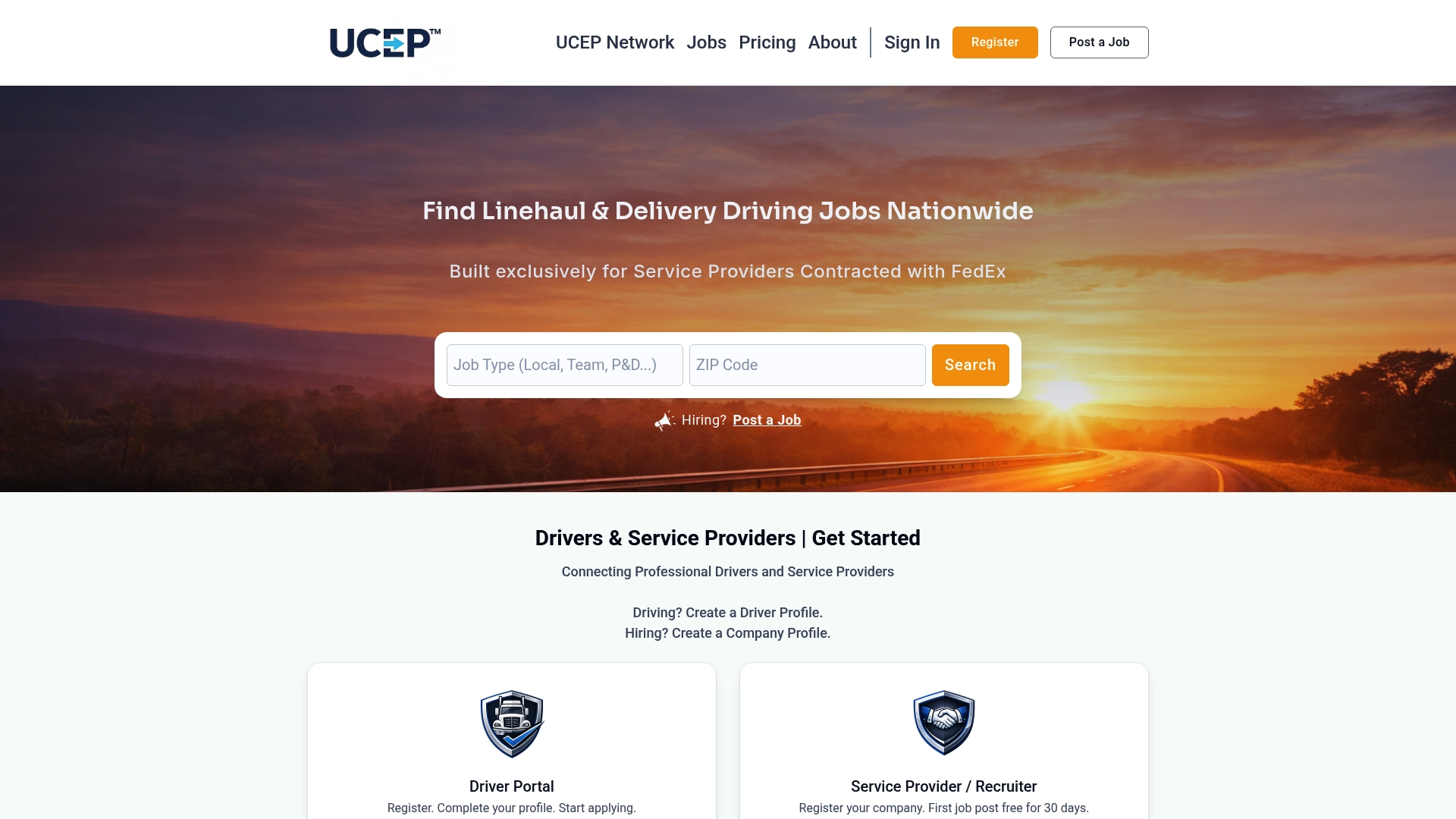
For a new driver, that specificity matters. You can filter by role type (CDL-A solo, CDL-A team, linehaul, or pickup and delivery), research employers through the terminal and employer directories before you apply, and track your applications in one place. Ucep also surfaces internal reviews from drivers and service providers, so you can evaluate a carrier's culture and communication style before your first interview.
If you are ready to find a FedEx-contracted driving role that fits your license, location, and schedule, browse open CDL-A positions on Ucep and apply directly through the platform.
Useful sources and further reading
These are the best sources to consult if you want to go deeper on specific first-year issues covered in this article.
| Source | What it covers | Why it helps a rookie |
|---|---|---|
| FMCSA HOS Summary | Official Hours-of-Service rules and ELD requirements | The primary regulatory reference for HOS compliance |
| NHTSA Road Safety | Crash data, fatigue research, and safety recommendations | Backs fatigue and drowsy-driving risk with federal data |
| OTrucking New Driver Guide | Backing accident risk, lease-purchase warnings, year-one overview | Practical overview of the risks that affect CSA and insurance |
| Midwest Truck Driving School | Pay realities, financial stress, isolation, and home time | Honest account of what recruiters do not tell new drivers |
| ELDT Nation First-Year Guide | Common mistakes, pay ranges, habit correction | Identifies the pattern errors that end careers vs. one-off mistakes |
| Second Chance Guide: First 90 Days | Probation metrics, attrition data, carrier testing behavior | Explains what carriers measure and why one-third of drivers leave in 90 days |
| NSTCDL First-Year Driver Guide | Clearinghouse, drug testing, serious traffic violations | Covers the compliance risks with the most immediate career consequences |
| TruckingJobsInUSA Survival Guide | Trip planning, consumer GPS risks, detention time and earnings | Practical route-planning and pay-calculation guidance |
Additional Ucep resources for new drivers:
- CDL-A driver requirements explained for beginners: licensing, endorsements, and baseline eligibility.
- How to prepare for a CDL driving job interview: practical tips for your first carrier interviews.
- How to onboard new CDL drivers quickly: what the onboarding process looks like from the carrier side.