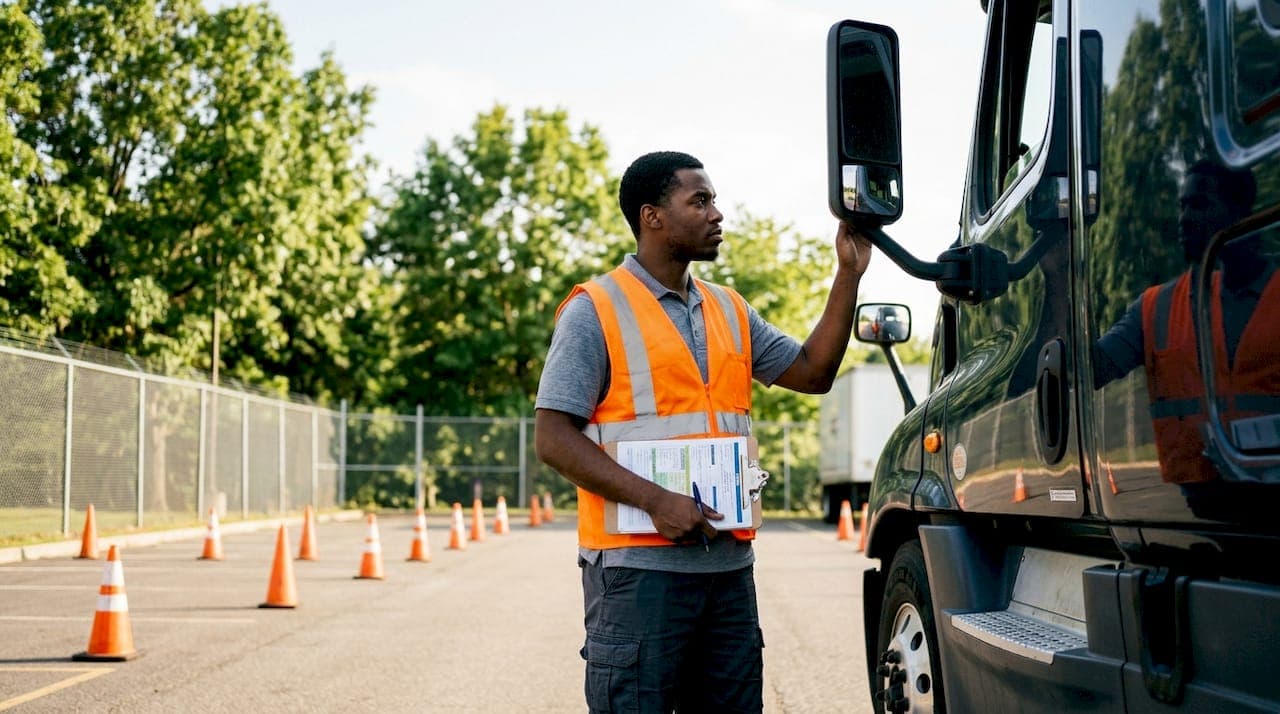
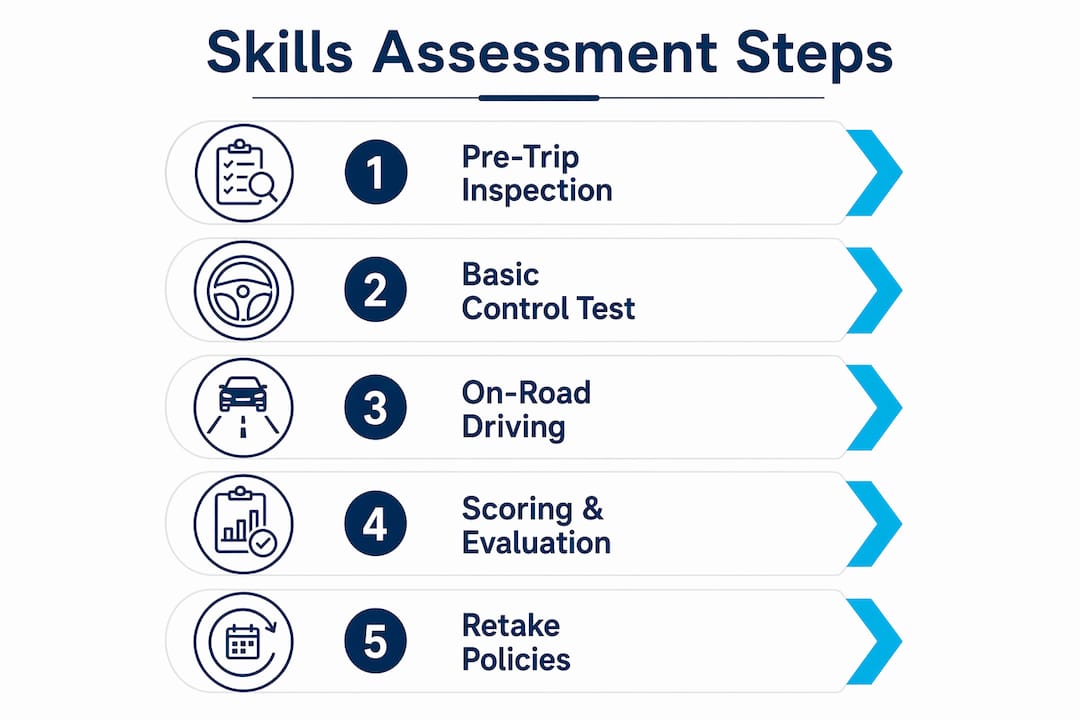
A trucking skills assessment is the federally mandated practical test every Commercial Driver's License (CDL) applicant must pass before operating a commercial motor vehicle on public roads. Under 49 CFR 383.113, the assessment has three required components, completed in strict order:
- Pre-trip vehicle inspection — you identify and verbally explain the condition of every safety-critical part on the vehicle
- Basic control skills test — you demonstrate precise vehicle maneuvering through a set of backing and positioning exercises
- On-road driving test — you drive through real traffic conditions while an examiner evaluates your judgment, control, and adherence to traffic laws
All three parts must be passed to receive a CDL. Failing any single component stops the test for that day. The assessment also plays a direct role in employment decisions, since carriers and FedEx Service Providers use CDL status as a baseline qualification for linehaul, CDL-A solo, and CDL-A team roles.
How to prepare for the pre-trip vehicle inspection
The pre-trip inspection tests whether you can identify safety problems before they become road hazards. You must name, point to, and explain each safety-critical item on the vehicle, covering the engine compartment, steering, suspension, brakes, wheels, lights, and the sides and rear of the vehicle. Air brake-equipped vehicles add a separate set of checks, including verifying low-pressure warning devices and confirming adequate air pressure build-up.
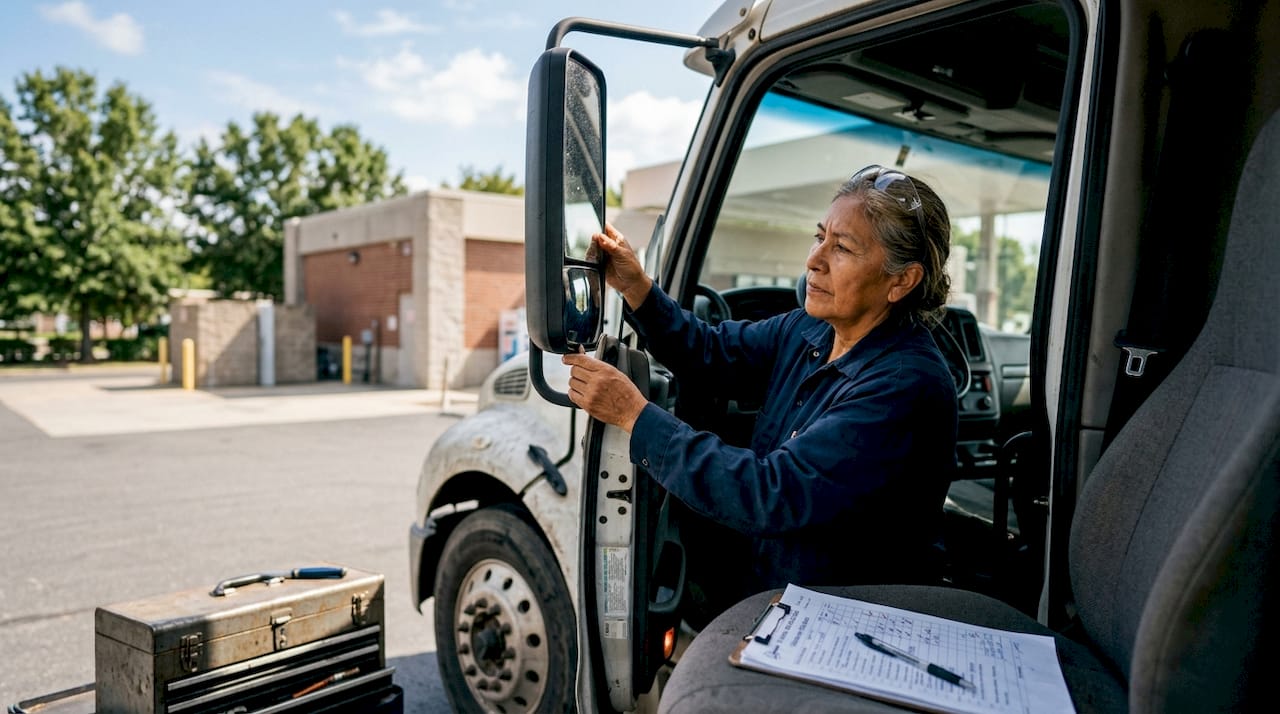
Examiners expect narration, not silence. Pointing and explaining the condition and function of each part is required; simply naming parts without context often leads to failure. Think of it as talking through your reasoning out loud.
Practical preparation steps:
- Study the CDL Manual's vehicle inspection section and use the official checklist during practice runs
- Practice on the same vehicle class you will test in, so the layout is familiar
- Walk through the inspection in the same sequence every time to build a reliable routine
- Pay extra attention to tire condition, brake adjustment, and air system connections, since these are common failure points
Pro Tip: Speak clearly and at a steady pace during the inspection. Examiners note whether you can explain what you are checking for, not just that you touched the part. Silence during the inspection is one of the most common reasons candidates lose points.
How to prepare for the basic control skills test
The basic control skills test measures your ability to move and position a large commercial vehicle accurately. According to the AAMVA 2022 Modernized CDL Skills Test standard, you must complete four specific exercises:
- Exercise 1: Forward stop
- Exercise 2: Straight line backing
- Exercise 3: Forward offset tracking
- Exercise 4: Reverse offset backing
Each exercise tests spatial awareness and your ability to judge the vehicle's position relative to cones or boundary markers. Errors like striking a cone, pulling up to correct, or going out of bounds each carry point deductions.
Time matters here. The vehicle inspection and basic control test share a combined 60-minute window, so slow or hesitant maneuvering can cost you on both segments. Practice under timed conditions to build the confidence and speed the test requires.
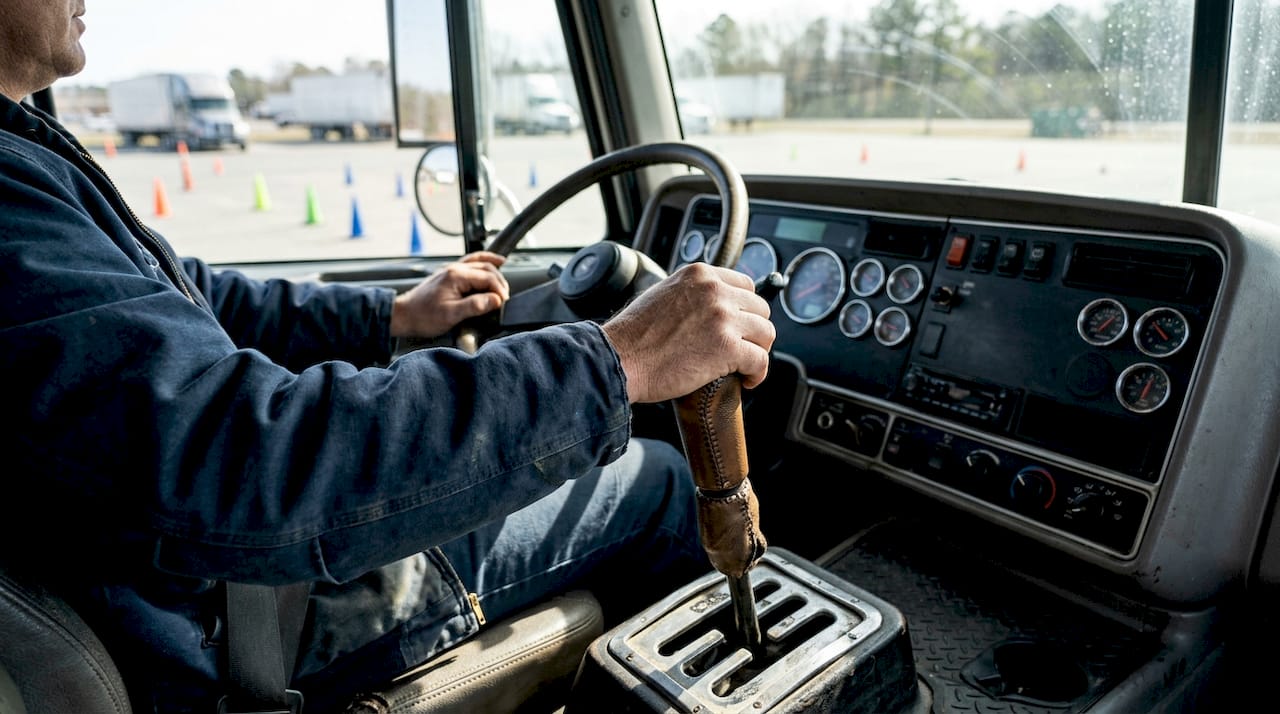
Pro Tip: Before your test date, spend time in the cab getting comfortable with mirror placement, gear positions, and throttle response. Drivers who know their controls instinctively make fewer corrections during backing exercises.
How to prepare for the on-road driving test
The road test evaluates how you handle a commercial vehicle in live traffic, demonstrating skills outlined by a road freight transport management system tailored for freight logistics. The on-road test must be completed within 30 minutes and covers the following required skills:
- Proper visual search methods, including mirror use and scanning ahead
- Signaling correctly when changing lanes or turning
- Adjusting speed for road configuration, weather, visibility, and traffic conditions
- Selecting safe gaps when merging, passing, or crossing traffic
- Positioning the vehicle correctly before and during turns to prevent off-tracking
- Maintaining a safe following distance based on road and weather conditions
- Observing other vehicles' behavior before changing speed or direction
Stress management is a real factor during this segment. Examiners watch for hesitation, overreaction to traffic, and failure to check mirrors consistently. Treat the test route as a normal drive and apply the same habits you would use on any delivery run. Reviewing safe driving practices for challenging road conditions, including construction zones, can sharpen your situational awareness before test day.
What you need to know about fees and retake policies
Test fees vary by state and testing agency. In Washington State, for example, the standard skills test fee is $175 for truck or passenger tests and $100 for school bus tests, with that fee covering two attempts. Vehicle rental, if you do not have access to a qualifying commercial vehicle, often adds $250 or more on top of the test fee.
Key policies to understand before you schedule:
- The test is strictly sequential. You cannot take the road test without passing the inspection and basic control segments first
- Failing any segment means no further testing that day; you must reschedule and, in most states, pay again
- Retake rules differ by state. Some states require a waiting period before you can retest; others allow same-week scheduling
- Check your state's DMV or licensed third-party examiner for exact fee structures and rescheduling windows
Budget for at least two attempts when planning your test timeline, and confirm local policies before you book.
Why passing the trucking skills assessment matters
Passing the CDL skills assessment is more than a licensing formality. It confirms that you meet the FMCSA's safety standards for commercial vehicle operation, which directly affects carrier safety fitness ratings and federal compliance standing. Carriers with drivers who hold valid CDLs earned through the full skills test process demonstrate stronger safety management controls during FMCSA compliance reviews.
From an employment standpoint, your CDL is the baseline credential every Service Provider and carrier checks first. Platforms like Ucep connect qualified CDL holders with FedEx Service Providers hiring for linehaul and delivery roles, and a clean, properly earned CDL is what gets your application in front of those opportunities.
The assessment also serves a broader public safety function. The pre-trip inspection requirement, in particular, acts as a gatekeeper against mechanical failures that cause accidents. A driver who can identify a brake defect or a tire problem before leaving the yard removes that hazard from the road entirely.
Health and safety habits during the test
Your physical and mental state on test day directly affects your performance. Arrive rested. Fatigue impairs reaction time, mirror-checking frequency, and decision-making, all of which examiners observe closely during the road test. Eat a normal meal beforehand and avoid stimulants that cause jitteriness or distraction.
Wear appropriate footwear with a firm sole. Flip-flops or loose shoes affect pedal feel and can cause unintended throttle or brake inputs during the basic control exercises. Dress for the weather if any portion of the inspection takes place outdoors.
Stay aware of severe weather conditions that could affect the road test. If conditions are genuinely unsafe, most testing agencies allow rescheduling without penalty. Do not attempt the road test in conditions that exceed your current skill level.
Purpose and benefits of a trucking skills assessment
The trucking competency assessment exists to verify that every CDL holder can operate a commercial motor vehicle safely before they carry freight or passengers on public roads. It standardizes the baseline across all states, so a CDL earned in Texas carries the same minimum competency guarantee as one earned in Ohio.
For you as a driver, passing the assessment builds documented proof of your skills. That record supports career advancement into higher-paying roles like CDL-A team driving, where carriers require demonstrated competence before placing two drivers on a long-haul route together. The assessment also reinforces habits, such as pre-trip inspection discipline, that reduce your personal liability on the road.
What vehicle types are covered in the assessment
The CDL skills test applies across all commercial vehicle classes, and the specific vehicle you test in determines your license class:
- Class A: Combination vehicles, including tractor-trailers; requires all three test components
- Class B: Single large vehicles such as straight trucks and large buses; requires vehicle inspection, basic controls, and road test
- School bus: Requires a skills test conducted in a school bus of the same vehicle group
- Endorsements: Tanker, double/triple trailer, and passenger endorsements each require additional skills testing in the applicable vehicle type
You must test in a vehicle representative of the class you intend to drive. Testing in a smaller vehicle and then operating a larger class commercially is not permitted under federal rules.
How examiners evaluate your trucking skills
Examiners score the assessment against a standardized criteria sheet aligned with 49 CFR 383.113. Key evaluation criteria include:
- Vehicle inspection: Completeness of the inspection, accuracy of verbal explanations, and identification of any safety defects
- Basic controls: Number of pull-ups, cone strikes, boundary violations, and overall positioning accuracy
- Road test: Visual search habits, signaling, speed management, gap selection, lane positioning, and compliance with all traffic laws
Each error carries a point value. Accumulating too many points in any segment results in a fail for that segment. Examiners also watch for automatic disqualifiers, such as a serious traffic violation or an accident during the road test, which end the test immediately regardless of the score up to that point.
Understanding driver evaluation criteria before your test helps you focus practice time on the specific behaviors examiners measure, rather than general driving habits.
Key Takeaways
A trucking skills assessment requires passing three sequential components under 49 CFR 383.113: pre-trip vehicle inspection, basic control skills, and an on-road driving test, all within a total time frame set by testing authorities.
| Point | Details |
|---|---|
| Three mandatory components | Pre-trip inspection, basic controls, and road test must all be passed in order to earn a CDL. |
| Sequential structure | Failing any segment stops the test; you must reschedule and typically pay fees again. |
| Time limits apply | The vehicle inspection and basic controls test have a combined time limit, followed by a separate time limit for the road test. |
| Fees vary by state | Test fees vary by state and testing agency; additional vehicle rental fees may apply. |
| Employment impact | A valid CDL earned through the full skills test is the baseline credential carriers and Service Providers require. |