If you are looking into a commercial driving career, getting CDL-A driver requirements explained clearly is the first real obstacle you face. The information online is scattered, inconsistent, and often mixes federal rules with state variations. Some sources say you need to be 21. Others say 18. Some skip the 2022 training mandate entirely. This guide cuts through that noise. You will get a straight breakdown of every requirement, from basic eligibility and medical certification to the Commercial Learner's Permit process, skills testing, and endorsements, so you know exactly where you stand before you take a single step.
Table of Contents
- Key takeaways
- CDL-A driver requirements explained from the start
- The CLP and ELDT training process
- What to expect from the CDL skills test
- Endorsements and additional testing
- Staying qualified after you get your CDL-A
- My take on where candidates actually go wrong
- Find CDL-A driving opportunities with Ucep
- FAQ
Key takeaways
| Point | Details |
|---|---|
| Age depends on driving type | You can drive intrastate at 18, but must be 21 for interstate commercial driving. |
| ELDT is mandatory since 2022 | All first-time CDL-A applicants must complete federally registered Entry-Level Driver Training before testing. |
| CLP requires a 14-day hold | You cannot schedule your skills test until at least 14 calendar days after your CLP is issued. |
| You supply your own test vehicle | The DMV does not provide a truck for the skills test. You must bring a qualifying commercial vehicle. |
| Medical certification is ongoing | Your DOT medical card must stay current throughout your career, typically renewed every 24 months. |
CDL-A driver requirements explained from the start
A Class A CDL (Commercial Driver's License) is the highest tier of commercial license in the United States. Under federal regulation, Class A covers combination vehicles with a Gross Combined Weight Rating of 26,001 pounds or more, where the towed vehicle's GVWR exceeds 10,000 pounds. Think semi-trucks, tractor-trailers, and tanker combinations. If you want to drive those, this is the license you need.
Understanding CDL A driver qualifications starts with separating federal minimums from state-specific rules. The Federal Motor Carrier Safety Administration (FMCSA) sets the floor. States can add to it, but they cannot go below it. So when you read conflicting information, it is usually because one source is citing a state rule and another is citing the federal baseline.
Age eligibility
The age question trips up a lot of people. You must be at least 18 for intrastate driving (within your state's borders) and 21 for interstate driving (across state lines). That distinction is based on the type of commerce you are engaged in, not simply the size of the vehicle. So a 19-year-old can legally drive a loaded tractor-trailer in intrastate routes, but cannot haul freight across state lines until age 21.
Other basic prerequisites
Before you can apply for a CDL-A, you need to meet several baseline conditions:
- You must hold a valid non-commercial driver's license from your state of domicile.
- You must be able to read and speak English well enough to understand traffic signs and communicate with the public and authorities.
- You must provide your Social Security number for record verification.
- You must pass a DOT physical exam conducted by an FMCSA-certified medical examiner. This produces your Medical Examiner's Certificate, which is required before you can receive your CLP.
- Common disqualifying conditions include uncontrolled diabetes, epilepsy without a waiver, uncorrected vision below 20/40, and certain cardiovascular conditions. Many of these have exemption pathways, but you need to verify through FMCSA.
Pro Tip: Schedule your DOT medical exam early, before you begin any other application steps. If a medical condition requires documentation or an exemption, addressing it now prevents delays down the line.
The CLP and ELDT training process
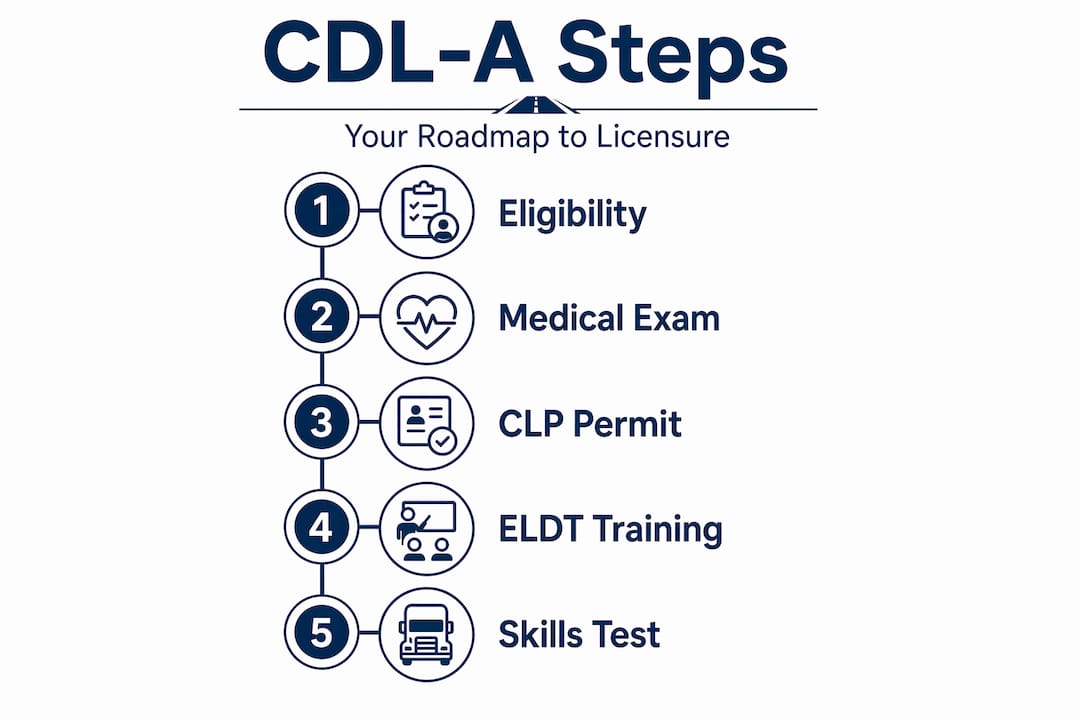
Once you meet the basic prerequisites, your next move is applying for a Commercial Learner's Permit. The CLP is the required starting point. You cannot take a CDL-A skills test without one.
Here is the standard process, step by step:
- Study and pass the knowledge tests. To receive your CLP, you must pass the CDL General Knowledge test at minimum. For a Class A, you also take the Combination Vehicles test. If you plan to add endorsements later, some states allow you to test for those during the CLP application.
- Submit your application to your state DMV. You will provide your medical certificate, proof of identity, proof of residency, and your regular driver's license. Fees vary by state but typically run $50 to $100.
- Complete FMCSA-registered Entry-Level Driver Training (ELDT). Since February 7, 2022, ELDT from a registered provider is mandatory for all first-time CDL-A applicants. Training has two parts: a theory component and a behind-the-wheel component. Both must be completed with an FMCSA-approved school. The school submits your completion record electronically to the FMCSA Training Provider Registry. If that record is not on file, the DMV cannot schedule your skills test, full stop.
- Wait the mandatory 14 days. Federal rules require a minimum 14-calendar-day hold between your CLP issue date and your skills test. Most states allow the CLP to remain valid for 180 days, with one renewal option. Plan your training to finish well within that window.
- Schedule your skills test. Book your appointment early. DMV test slots fill up, especially in high-population states.
Pro Tip: Confirm with your ELDT provider that your completion records have been uploaded to the FMCSA Training Provider Registry before you contact the DMV. Candidates get turned away on test day because the electronic record was not submitted by the school.
Drivers who held a valid CDL-A before February 7, 2022 are generally exempt from ELDT requirements if they are simply renewing. However, if you are upgrading your CDL class or adding certain endorsements, ELDT applies again regardless of your experience level.
What to expect from the CDL skills test
The skills test is where most candidates feel the most anxiety. It has three parts, and you must pass all of them.
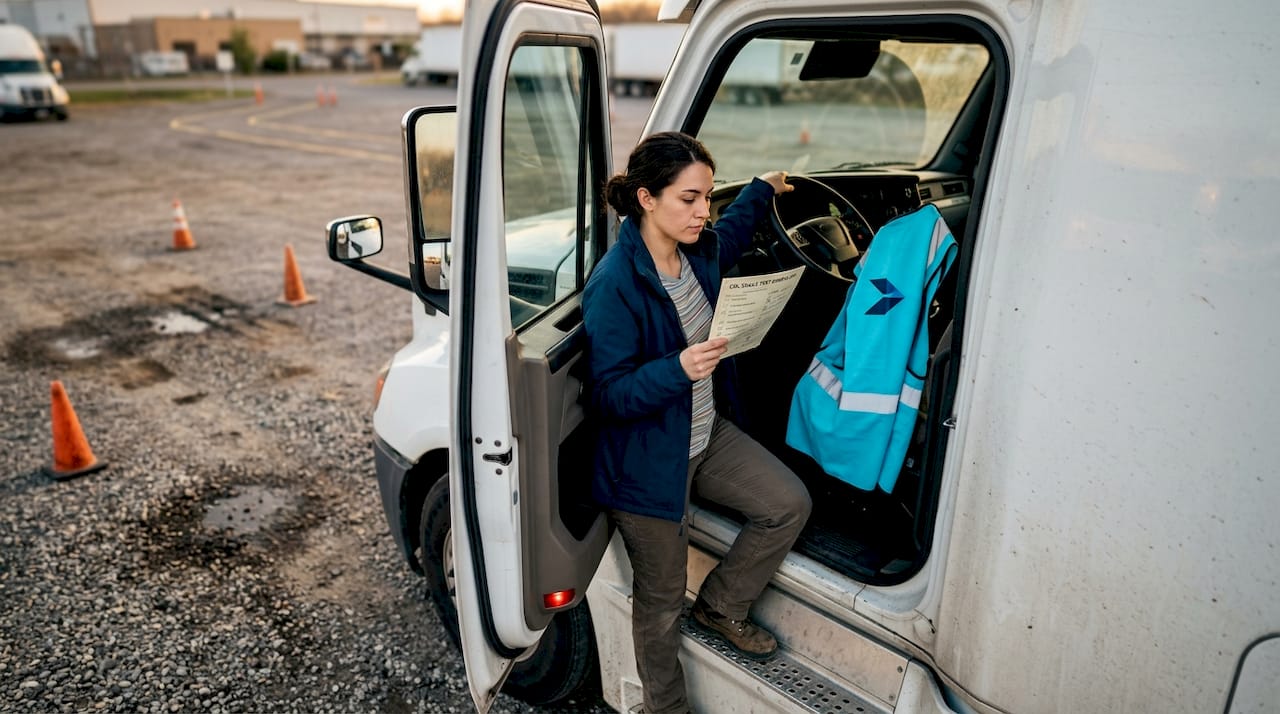
The CDL skills test covers a pre-trip vehicle inspection, a basic vehicle control section, and an on-road driving portion. Each is scored separately, and failure in one means retesting that section.
- Pre-trip inspection: You walk around the vehicle and verbally explain to the examiner what you are checking and why. You are not just pointing at parts. You are demonstrating knowledge of brake systems, tire conditions, lights, fluid levels, and safety equipment. Examiners assess both your knowledge and your execution.
- Basic vehicle control: You perform maneuvers in a controlled area. These include straight-line backing, offset backing, and alley docking. Speed is not the goal here. Precision and awareness are.
- On-road test: You drive a designated route in actual traffic. The examiner evaluates lane control, mirror use, speed management, turning technique, and railroad crossing procedures, among other things.
One fact that catches many first-timers off guard: you must provide your own commercial vehicle for the test. The DMV does not supply a truck. This means you need to arrange access to a qualifying Class A vehicle, either through your training school or another source, before your test date.
Common reasons candidates fail include not knowing the pre-trip inspection items cold, over-steering during backing maneuvers, and poor mirror scanning habits on the road test. All of these are fixable with deliberate practice.
Pro Tip: Do at least three full mock pre-trip inspections out loud before test day. Verbalizing the steps builds recall under pressure and helps examiners see you actually understand what you are inspecting.
Endorsements and additional testing
A Class A CDL on its own qualifies you for most standard freight hauling. But if you want to expand your driving opportunities, endorsements matter. Here is a comparison of the most common ones:
| Endorsement | Code | Additional ELDT required? | Background check? |
|---|---|---|---|
| Hazardous Materials | H | Yes | Yes (TSA security threat assessment) |
| Tanker Vehicles | N | No | No |
| Doubles/Triples | T | No | No |
| Passenger Transport | P | Yes | No |
| School Bus | S | Yes | No |
| Combination (Tanker + Hazmat) | X | Yes (via H) | Yes |
One point that many CDL holders underestimate: adding endorsements like Hazmat, Passenger, or School Bus requires new ELDT even if you already have a CDL. The training requirement is tied to the endorsement category, not just your license date. Experienced drivers upgrading their credentials get caught off guard by this regularly.
For Hazmat specifically, plan for extra time. The TSA security threat assessment can take several weeks. You cannot receive the endorsement until clearance is granted.
From a planning standpoint, if you know you will eventually need Tanker and Doubles/Triples endorsements, those two require only a knowledge test, no additional ELDT. Getting them early adds value without significant extra effort.
Staying qualified after you get your CDL-A
Earning your CDL-A is not a one-time event. Keeping it valid requires ongoing attention to a few specific areas.
Your DOT medical card is valid for up to 24 months in most cases, though certain conditions require more frequent recertification (every 12 months or even annually). You are required to self-certify your operating category to your state DMV, which ties into whether you need a current medical card on file.
Here is what you need to track after licensing:
- Renew your medical certificate before it expires. A lapsed medical card can result in a CDL downgrade by your state.
- Report any new medical conditions, medications, or changes in health status to your medical examiner at renewal.
- Maintain a clean driving record. Certain traffic violations, including disqualifying offenses, can suspend or revoke your CDL regardless of your other qualifications.
- Before starting any new driving position, a DOT pre-employment drug test and an FMCSA Drug and Alcohol Clearinghouse query are required by law. Employers must complete both before you operate commercially.
- Keep all endorsements current and renew them on your CDL renewal schedule to avoid gaps.
Pro Tip: Set a calendar reminder 90 days before your medical card expires. That gives you time to find an FMCSA-certified examiner, complete the physical, and get the updated certificate to your state DMV without any lapse.
My take on where candidates actually go wrong
I have seen a lot of people work through the CDL-A process, and the same mistakes come up over and over. The ones that cost the most time are almost never about driving ability.
The biggest time-waster I have observed is poor planning around the 14-day CLP holding period. Candidates finish their knowledge tests, get their CLP, and then assume they can test the next week. When they find out about the mandatory wait, and then discover that DMV test slots are booked out two or three weeks, they have lost nearly a month of momentum. Scheduling around the CLP wait period from day one would have prevented that entirely.
The second issue is ELDT record compliance. I cannot stress this enough. Candidates complete their training, show up on test day, and get turned away because their school never submitted the electronic record to the FMCSA registry. That is not the DMV's problem to fix. It is yours to verify in advance.
I have also watched experienced drivers get blindsided by the endorsement ELDT requirement. Someone with ten years of driving and an existing CDL-B decides to upgrade. They assume their experience exempts them from training. It does not. ELDT requirements for upgrades apply regardless of time behind the wheel.
The process is manageable. The people who get through it quickly are the ones who read the rules before they start, not after they hit a wall.
— Aaron
Find CDL-A driving opportunities with Ucep
Once your CDL-A is in hand, the next step is finding the right opportunity. Ucep is a dedicated job board built specifically for drivers seeking positions with FedEx Service Providers, including CDL-A solo, CDL-A team, linehaul, and pickup and delivery roles. If you want to see what CDL-A positions look like in practice, browse verified listings in one focused place rather than sorting through general job boards. You can also visit the Ucep Q&A page for answers to common questions about driver requirements and the application process. Ucep keeps the process clear and the opportunities relevant.
FAQ
What age do you need to be to get a CDL-A?
You must be at least 18 years old to drive commercially within your state (intrastate), and 21 to drive across state lines (interstate). The age requirement is based on the type of commerce, not the vehicle class.
Is ELDT training required for all CDL-A applicants?
Yes. Since February 2022, all first-time Class A CDL applicants must complete Entry-Level Driver Training from an FMCSA-registered provider before taking the skills test. This includes both a theory and a behind-the-wheel component.
What is the CLP holding period before the skills test?
Federal rules require you to hold your Commercial Learner's Permit for a minimum of 14 calendar days before you can take the CDL skills test. Most states issue CLPs that are valid for 180 days.
Do I need ELDT if I already have a CDL?
If you are upgrading your CDL class or adding endorsements such as Hazmat, Passenger, or School Bus, ELDT is required even if you already hold a CDL. Simply renewing an existing license of the same class does not trigger the requirement.
What vehicle do I need to bring to the CDL skills test?
You must bring your own qualifying commercial vehicle to the skills test. The DMV does not supply a test truck. Most candidates arrange access through their ELDT training school or a third-party provider.