
The best places to hire qualified FedEx drivers right now are CDL schools, a rotating two-week paid job board schedule; employee referrals; targeted Facebook driver groups; and truck-stop flyers. Start today: contact two nearby CDL schools, launch a referral bounty, and put a rotating board post live on UCEP, the job board built specifically for FedEx-contracted Service Providers. That combination gets qualified applicants into your pipeline within two weeks, not two months.
TL;DR:
- Using CDL schools and referrals consistently yields higher retention and quality hires, with schools typically producing one to three long-term drivers per quarter.
- Targeted Facebook groups and truck-stop flyers can convert at higher rates for route-ready drivers who already hold a CDL and need specific opportunities.
- Job postings should clearly specify license class, vehicle type, schedule, and pay range early to attract suitable applicants and reduce disqualification.
- Verification steps—including CDL, medical certificate, MVR, background check, and drug screening—must be completed before drivers handle routes to ensure compliance and safety.
- Building a structured, rotating hiring pipeline over 60 to 90 days with multiple channels prevents reactive hiring and improves long-term retention.
Table of Contents
- High-Yield Recruiting Channels and What Each One Actually Delivers
- How Do You Write a FedEx Driver Job Posting That Filters Correctly?
- Screening and Verification Checklist for FedEx Driver Candidates
- Build a 60–90 Day Hiring Pipeline That Doesn't Rely on Panic Hiring
- Onboarding and Retention Primer to Reduce Costly Turnover
- Legal and Compliance Considerations When Hiring FedEx Drivers
- Key Interview Questions and Red Flags for FedEx Driver Roles
- Best Practices for Partnering With FedEx or FedEx-Approved Staffing Agencies
- Why the Fastest Hiring Wins Come from Ignoring the Obvious Channel First
- Post Your Next FedEx Driver Opening on UCEP
- Sources
- FAQ
High-Yield Recruiting Channels and What Each One Actually Delivers
Not every channel earns the same return, and treating them as interchangeable wastes your recruiting budget. Some produce volume. Others produce drivers who show up for orientation and stay past 90 days.
CDL schools deliver fewer applicants but higher quality. Field reports show a single school relationship typically yields one to three hires per quarter, and those hires tend to stick longer than board applicants because instructors have already vetted them for basic competency. Build the relationship by offering to speak at graduation, sponsoring a class, or simply showing up monthly with your card.
Paid job boards work best on a rotation, not a permanent listing. Run a two-week posting on one board, pull the data, then shift budget to whichever produced hires, not just applications. Indeed generates high volume with mixed quality, ZipRecruiter runs lower volume with slightly better candidates, and Snagajob skews toward a younger applicant pool — match the board to the role you're filling.
Referral bounties convert better than almost any paid channel when structured correctly. Referral hires show higher show-rates and longer retention than untargeted board hires, but only when the payout timing is clear (half at 30 days, half at 90) and every current driver knows the offer exists.
Other channels worth running in parallel:
- Targeted Facebook groups for local CDL holders and owner-operators, posted weekly rather than once
- Truck-stop flyers with a QR code linking straight to a mobile apply page
- Second-chance hiring partnerships with local workforce nonprofits, which can pre-screen candidates and unlock WOTC credits up to $2,400 per qualifying hire
Targeted Facebook groups and truck-stop flyers often convert at higher rates than conventional boards for route-ready drivers who already have a CDL and just need the right opportunity.
How Do You Write a FedEx Driver Job Posting That Filters Correctly?
A vague posting attracts vague candidates. The job description itself is your first screening tool — get specific and you'll spend less time disqualifying people after the fact.
- State the license class. CDL-A, CDL-B, or non-CDL, with any endorsement required.
- Name the vehicle and weight class. A 26-foot box truck reads differently than a sprinter van.
- List the schedule plainly. Night linehaul, weekend P&D, or home-every-night routes; ambiguity here kills show rates.
- Publish a real pay range. Skip "competitive pay" and post the actual number.
- Note physical demands. Lifting requirements, dock work, or extended sitting.
Build the application around a single mobile page or a QR code drivers can scan from a flyer or a truck-stop bulletin board. If your applicant pool includes bilingual candidates, post in both English and Spanish, and lead with the phrase that matters most to drivers: "home every night" or "out three days, home four."
For a ready-made structure, adapt the driver job description template rather than building one from scratch every time you post a role.
Pro Tip: Put the pay range near the beginning of the posting rather than at the end. Drivers scroll fast, and boards often truncate long descriptions before the pay ever appears.
Screening and Verification Checklist for FedEx Driver Candidates
A five-minute phone prescreen saves hours later. Ask about license class, current endorsements, availability for the specific shift, and whether the candidate understands the route type (linehaul versus P&D) before scheduling anything further.
Once a candidate clears the call, verify these before extending an offer:
- Valid CDL matching the role's required class and endorsements
- Current DOT medical certificate
- Motor Vehicle Record (MVR) pulled directly, not self-reported
- Background check covering criminal history relevant to DOT hiring rules
- Pre-employment drug screen
- Right-to-work documentation (I-9 verification)
Some findings on an MVR or background check are automatic disqualifiers under DOT rules; others are judgment calls. A candidate with a single old moving violation isn't the same risk as one with a recent DUI. If you're working with a workforce nonprofit on second-chance placements, lean on their pre-screening and oversight structure rather than making that call alone.
Require the CDL, medical certificate, and drug screen results before the offer is final. Background checks and MVR pulls can run in parallel with new-hire paperwork, but never let a driver take a loaded route before both come back clean. For a full walkthrough of the process from application to first day, see the contractor hiring process guide.
Build a 60–90 Day Hiring Pipeline That Doesn't Rely on Panic Hiring
Reactive hiring costs more and produces worse hires. A rotation schedule with consistent metrics keeps you ahead of turnover instead of scrambling after it.
- Weeks 1 to 2: Run one paid board (Indeed or ZipRecruiter), post in two Facebook driver groups, and drop flyers at two truck stops.
- Weeks 3 to 4: Pause the underperforming board, shift that budget to the one that produced actual hires, and schedule a CDL school visit.
- Weeks 5 to 8: Keep CDL schools and referrals running as always-on channels while testing a new paid board or a second social group.
- Weeks 9 to 12: Review 30-day retention on everyone hired in the first month and decide which channel earns permanent budget.
Track key metrics per channel, including hires, cost-per-hire, show-rate at orientation, and retention over the first months. Job boards should be treated as volume accelerants rather than conversion endpoints — a board that produces 40 applications and zero hires is worse than a CDL school that produces three applications and two hires.
Give it 30 to 60 days before deciding to expand, pause, or cut it entirely. For a longer list of channels to rotate through, the FedEx contractor recruiting strategies list covers additional tactics beyond this core rotation.
Onboarding and Retention Primer to Reduce Costly Turnover
Hiring a driver is only half the job. Losing them in month two erases whatever you saved on cost-per-hire.
- Pair every new driver with a ride-along or shadow shift before their first solo route
- Introduce them to a manager or dispatcher by name, not just a handbook
- Post schedules at least a week out so drivers can plan around them
- Run a 30-day check-in and a 90-day check-in, not just an exit interview when things go wrong
- Pair new hires with a mentor driver for the first two weeks
Structured referral and retention practices reduce turnover more than relying on paid boards alone, and transparency about pay progression and premium routes keeps drivers from job-hopping to a competitor over a few cents per mile.
Pro Tip: Ask your 90-day retained drivers who referred them, or how they found you. That answer, tracked over six months, tells you more about which channel actually works than any board's own analytics dashboard.
Workforce nonprofits that support second-chance hiring often stay involved past placement day, checking in on new hires and flagging problems early, which extends the benefit of the WOTC credit well beyond the first paycheck.
Legal and Compliance Considerations When Hiring FedEx Drivers
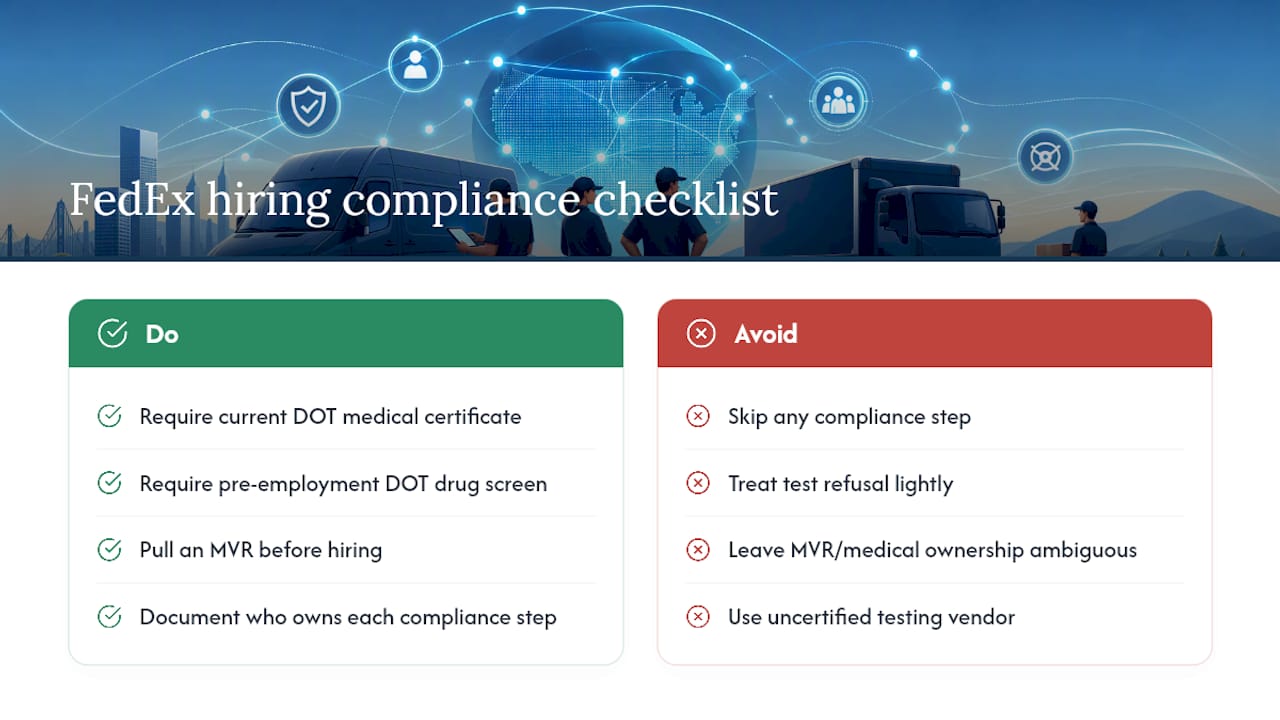
FedEx-contracted routes run under Federal Motor Carrier Safety Administration rules, and skipping a compliance step doesn't just risk a bad hire. It risks your contract standing with FedEx itself.
Every CDL driver you bring on needs a current DOT medical certificate, and every hire requires a pre-employment drug screen through a DOT-compliant testing program before they touch a route. Random testing pools apply once drivers are active, and refusal to test is treated the same as a positive result under federal rules. Keep your testing vendor's certification current and your records audit-ready.
An MVR pull isn't optional paperwork. It's the record DOT auditors and FedEx compliance reviewers will ask for first. Certain violations, including a recent DUI or a pattern of moving violations, disqualify a candidate outright under federal thresholds; others fall into judgment territory where your own risk tolerance and insurance carrier's requirements matter more than a blanket rule.
Right-to-work verification through I-9 documentation applies to every hire regardless of role, and background check scope should align with the specific route type. A linehaul driver hauling high-value freight overnight may warrant a deeper background review than a local P&D driver on a residential route.
If you're working through a staffing agency or workforce partner, confirm in writing who owns each compliance step. Ambiguity about who pulled the MVR or verified the medical certificate is exactly the gap that surfaces during a FedEx audit or, worse, after an accident.
Key Interview Questions and Red Flags for FedEx Driver Roles
A good interview for a FedEx-contracted route isn't about personality. It's about verifying the candidate can actually do the job you're describing on paper.
Ask specifically about their experience with the vehicle class and route type you're hiring for: "Walk me through your last week driving a box truck on a multi-stop P&D route." A candidate who answers in vague generalities about "driving trucks" without route specifics often hasn't done the actual job type you need.
Ask how they handle a missed delivery window or a customer complaint on the dock. FedEx-contracted routes run on tight service windows, and a driver who gets defensive or blames the customer in an interview will do the same on the road.
Confirm availability honestly. Ask directly: "This route requires being out three nights a week. Does that work for your situation?" A candidate who hesitates or negotiates the schedule during the interview will likely no-show within the first month.
Red flags worth taking seriously: inconsistent employment gaps without explanation, reluctance to authorize an MVR pull, vague answers about why they left their last driving job, and any hint that they're using this role as a placeholder while waiting on something else. None of these automatically disqualify a candidate, but they warrant a second conversation before an offer goes out.
Best Practices for Partnering With FedEx or FedEx-Approved Staffing Agencies
FedEx doesn't hire the drivers who run contracted routes directly. Service Providers do, which means your relationship with FedEx's own hiring infrastructure is more about alignment than direct recruitment.
Start by reviewing FedEx's own careers pages to understand how the company describes role types and baseline qualifications for corporate and freight positions. Aligning your job postings with that same language and those same qualification standards makes your listings easier for candidates to recognize and trust, even though you're hiring for a contracted route rather than a direct FedEx position.
If you work with a staffing agency, confirm upfront that they understand the specific compliance requirements of FedEx-contracted work, not just general CDL staffing. Agencies unfamiliar with linehaul scheduling or P&D route structures will send you candidates who look qualified on paper but don't fit the actual work pattern.
Set clear terms with any staffing partner about who handles the MVR pull, the drug screen, and the medical certificate verification. A staffing agency that treats these as optional add-ons rather than baseline requirements is a liability, not a shortcut. The strongest partnerships treat staffing agencies as an extension of your screening process, not a replacement for it.
Why the Fastest Hiring Wins Come from Ignoring the Obvious Channel First
Most Service Providers start with Indeed because it's familiar, then wonder why they're drowning in applications from people who never intended to drive a box truck. The FleetWage field data backs up what a lot of contractors already suspect: boards produce volume, not necessarily hires, and the channels that actually convert, CDL schools, referrals, local social groups, take more patience to build.
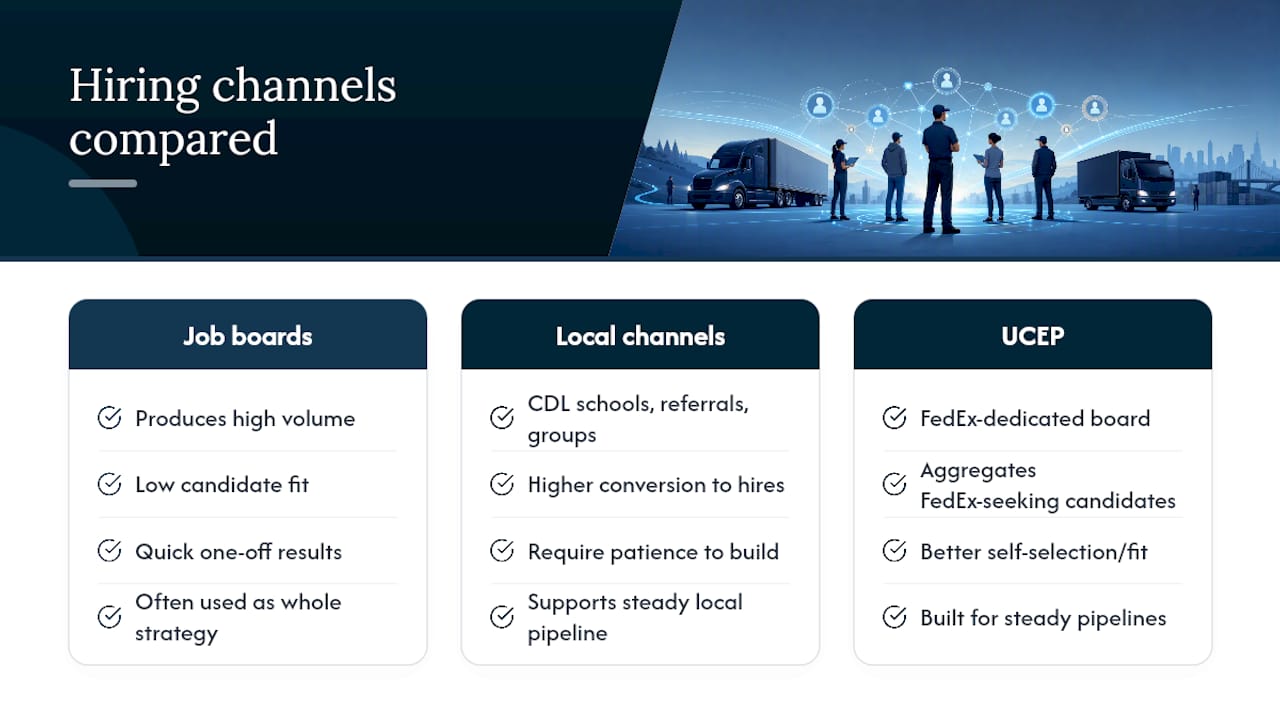
The mistake isn't using job boards. It's using them as the whole strategy instead of one rotating piece of it. A steady pipeline built on repeat local presence outperforms one-off hiring sprints, and that's exactly the gap UCEP was built to close for FedEx-contracted work specifically. UCEP exists as a dedicated job board and recruiting platform built exclusively for Service Providers contracted with FedEx, aggregating candidates who are already looking for FedEx-related driving work rather than a generic delivery gig. That focus matters more than most hiring managers give it credit for; a driver browsing UCEP has already self-selected into the category you're hiring for, which no general board can replicate.
I wrote about what separates a driver who lasts on a FedEx-contracted team route from one who quits in the first month in What It Takes to Succeed as a Team Driver for Service Providers Contracted with FedEx, and the pattern holds across every channel discussed here: specificity in the posting, honesty in the interview, and follow-through in the first 90 days beat any single recruiting trick.
— Aaron
Post Your Next FedEx Driver Opening on UCEP
UCEP is the alternative to generic job boards for FedEx-contracted hiring: instead of sorting through applicants who have no idea what a P&D route involves, you reach drivers actively searching for FedEx-related work.
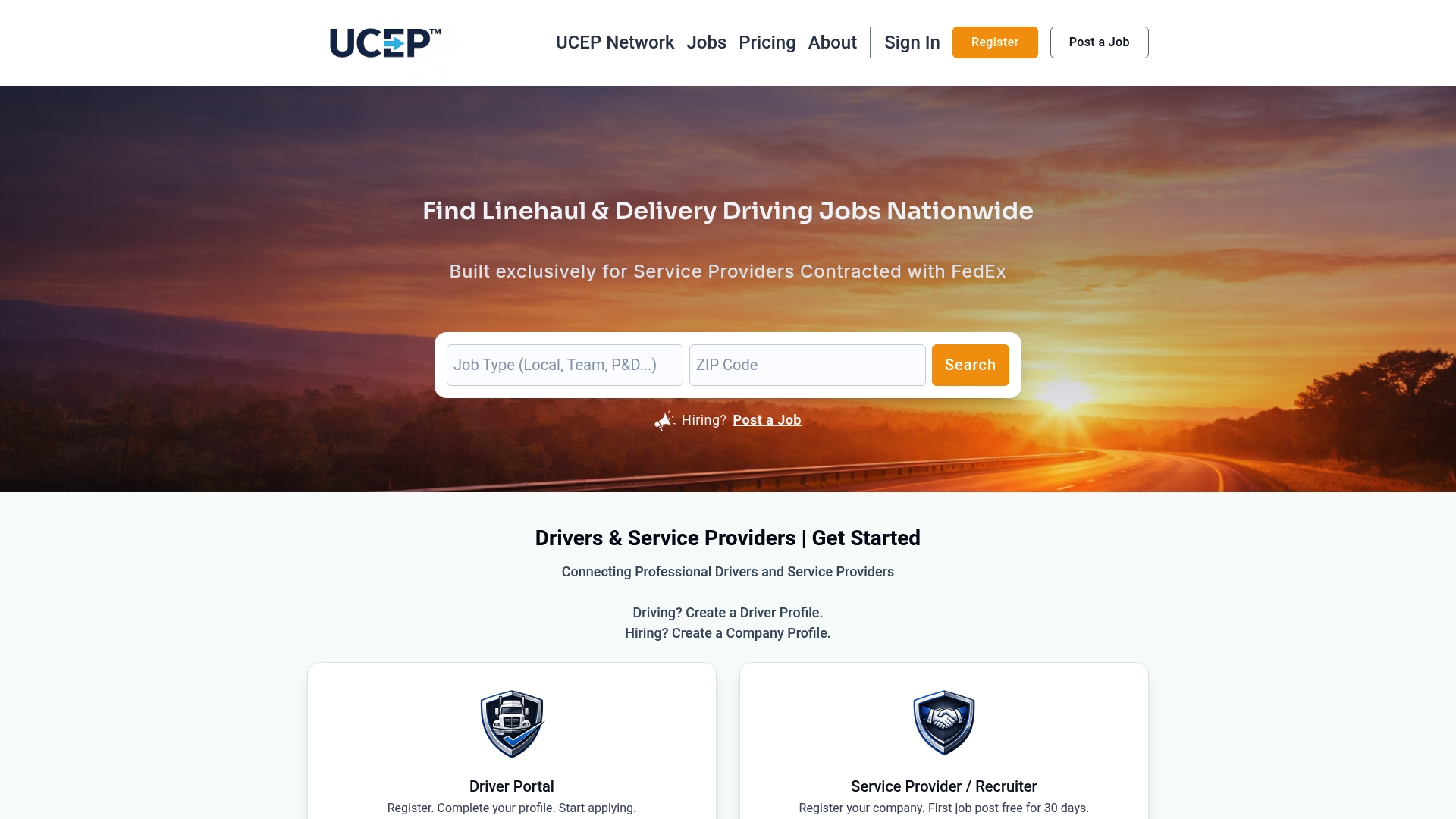
The platform includes FedEx-focused job listings for linehaul, CDL-A team, CDL-A solo, and pickup and delivery roles, employer directories, terminal directories, a built-in applicant tracking system, and targeted driver alerts so qualified candidates hear about your opening as soon as it posts. You can also browse companies currently hiring drivers to see how other Service Providers structure their listings, or check service provider reviews before deciding how to position your own company profile.
If you're ready to reach drivers who already know what a FedEx-contracted route requires, post your opening on UCEP and start receiving applications from candidates who fit the role you actually need filled.
Sources
- Where FedEx Contractors Actually Find Drivers in 2026 (Beyond Indeed) | FleetWage
- Hiring Strategies for Finding and Keeping FedEx Drivers — Route Consultant
- Hiring Delivery Drivers: How to Find, Recruit, and Train New Drivers
- FedEx careers pages (FedEx Freight)
FAQ
Where Is the Best Place to Hire FedEx Drivers?
The highest-yield combination is CDL school partnerships, referral bounties, and a rotating paid job board schedule, supplemented by targeted Facebook groups and FedEx-focused platforms like UCEP.
How Long Does It Take to Hire a Qualified FedEx Driver?
With coordinated use of rotating boards, referral programs, and CDL school outreach, Service Providers can typically move candidates from application to orientation readiness within a few weeks.
What Documents Do I Need to Verify Before Hiring a FedEx Driver?
You need a valid CDL matching the role, a current DOT medical certificate, a clean MVR pull, a passed background check, a completed drug screen, and right-to-work verification through I-9 documentation.
Do Job Boards Like Indeed Work for FedEx Driver Recruiting?
Job boards generate applicant volume but often produce lower show-rates than CDL schools or referrals, so they work best as one rotating channel rather than the sole recruiting strategy.
Can Staffing Agencies Help With FedEx Driver Hiring?
Yes, but only agencies that understand FedEx-contracted compliance requirements, including MVR pulls, drug screens, and DOT medical certificates, add real value over handling screening in-house.