
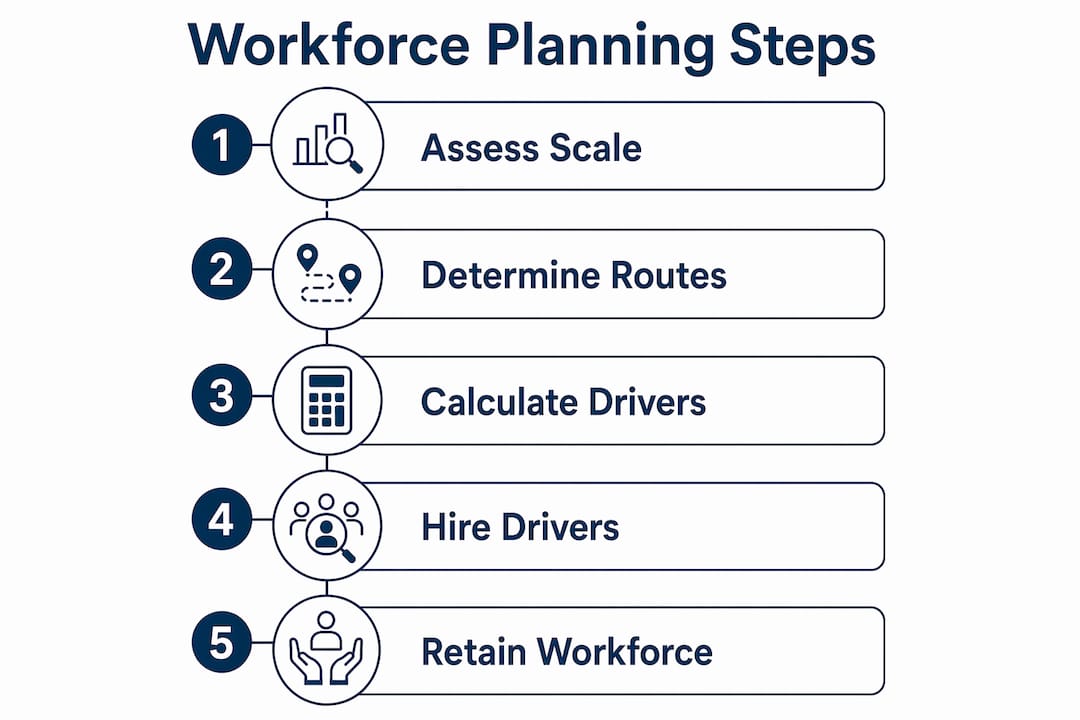
Workforce planning for FedEx contractors is the process of aligning hiring, retention, and HR practices to meet FedEx Ground ISP contract requirements and maintain a compliant, scalable driver workforce. The FedEx Independent Service Provider model sets hard operational thresholds: contractors must own at least 5 routes or deliver 500 stops daily to qualify, which means your driver headcount is never optional. Workforce planning, known in logistics as contingent workforce management, is the discipline that keeps your staffing aligned with those contractual demands. This guide covers the ISP scale requirements, legal compliance, driver bench building, and retention practices you need to run a sustainable operation in 2026.
How does workforce planning for FedEx contractors work?
FedEx Ground ISP contractors operate under a model that ties contract survival directly to operational scale. Meeting the minimum route threshold requires a capital investment typically between $300,000 and $500,000. That financial commitment makes workforce planning a business-critical function, not an administrative task.
Failing to maintain scale has real consequences. FedEx can require you to merge with another ISP, acquire additional routes, or exit the network entirely. Each of those outcomes is avoidable with a proactive driver workforce strategy.
The ISP model also places full employer responsibility on you. You set pay, manage schedules, and handle discipline. Approximately 6,000 ISPs operate across the U.S., and each one competes for the same pool of qualified drivers. That competition makes structured workforce planning the difference between a stable operation and a constant hiring crisis.
What the scale requirements mean for your headcount
Your route count and daily stop volume determine how many drivers you need on any given day. The table below maps common ISP scale levels to approximate driver requirements.
| ISP Scale Level | Routes Operated | Estimated Drivers Needed |
|---|---|---|
| Minimum qualifying | 5 routes | 6–8 drivers |
| Mid-size operation | 15–25 routes | 18–30 drivers |
| Large ISP | 40+ routes | 50+ drivers |
These figures assume single-shift operations with a small backup pool. Seasonal volume spikes, driver absences, and onboarding delays all push the required headcount higher.
Key risks of ignoring scale-driven workforce needs:
- Route coverage gaps that trigger FedEx performance reviews
- Forced route consolidation or loss of contract
- Overtime exposure from overworking a thin driver pool
- Compliance failures when unvetted drivers fill urgent gaps
How to build a legally compliant contractor workforce
FedEx faces over 160 lawsuits alleging joint employer status with its contractors, and settlements exceeded $460 million in 2015–2016. That litigation history is a direct warning for every ISP. If your HR practices mirror FedEx policies too closely, courts may treat you as a joint employer, exposing you to overtime and wage claims.
The legal firewall between you and FedEx depends on one principle: all employment decisions must stay inside your ISP entity. Hiring, firing, pay rates, scheduling, and discipline must all originate with you, not FedEx. Overlapping operational control with FedEx policies in any of these areas weakens your independent contractor status and creates liability.
Compliance audits are the most practical tool for protecting that independence. Audits every 1–2 years verify that your hiring, payroll, and HR decisions remain free from FedEx influence. They also create a documented record that supports your defense if a lawsuit arises.
- Establish your own employee handbook. Write policies that reflect your ISP's standards, not FedEx's operational manual.
- Use your own payroll system. Pay drivers directly through your entity with your own pay structure.
- Document every HR decision. Keep written records of hiring criteria, discipline actions, and terminations.
- Conduct annual compliance reviews. Verify that no FedEx manager has directed your drivers' schedules or work assignments.
- Separate onboarding from FedEx orientation. Run your own new-hire process before drivers interact with FedEx facility staff.
Pro Tip: Hire an employment attorney familiar with the ISP model to review your HR documentation at least once a year. One audit finding caught early costs far less than a wage claim settlement.
How do you build a scalable driver workforce strategy?
Reactive hiring is the most common and most costly mistake FedEx contractors make. When a driver quits on a Monday and you post a job on Tuesday, you are already behind. Contractors who shift to a flexible workforce strategy maintain a bench of credentialed candidates and scale capacity to demand rather than scrambling after gaps appear.

A credentialed driver bench means you keep a pool of vetted applicants who have completed background checks, hold valid licenses, and meet your ISP's hiring standards. When a position opens, you fill it from the bench rather than starting from scratch. This approach directly addresses onboarding delays, which can run two to four weeks for a new driver who needs background clearance and route training.
Workforce planning aligned 3–6 months in advance of seasonal volume peaks prevents understaffing during the highest-demand periods. For FedEx contractors, that means building your driver pool before peak season, not during it.
Practical steps for building a scalable driver bench:
- Track certification expiration dates. CDL renewals, medical certificates, and background check windows all have deadlines. Missing one sidelines a driver.
- Post jobs continuously, not reactively. Keeping an active listing on a niche job board generates a steady pipeline of qualified candidates.
- Use milestone-based hiring. Hire ahead of planned route expansions, not after you win the routes.
- Treat workforce development as a capital expense. Budgeting for retention and certification programs produces measurable returns through lower turnover and fewer emergency hires.
- Maintain a minimum bench size. A good rule is one vetted backup driver for every five active routes.
Pro Tip: Build relationships with local CDL training programs. Graduates looking for their first commercial driving job are often willing to commit to an ISP that offers consistent routes and competitive pay.
What tools and practices improve contractor workforce management?
Workforce management software gives you real-time visibility into scheduling, certification status, and labor costs. Entry-level field apps handle basic scheduling and time tracking. Enterprise platforms add certification management, compliance reporting, and payroll integration. The right choice depends on your route count and administrative capacity.
Structured onboarding is the single most effective retention tool available to you. Drivers who complete a formal onboarding process, including route shadowing, safety training, and a clear 90-day performance review, stay longer than drivers thrown into routes without support. FedEx Ground drivers earn an average of $20.32 per hour, with annual earnings ranging from $35,760 to $68,000 depending on territory. That pay range means your drivers receive competing offers regularly. A strong onboarding experience and a clear career path are your primary retention tools.
Monitoring labor costs as a percentage of revenue gives you an early warning system for workforce problems. When overtime hours spike, it signals understaffing before a route coverage failure occurs. When turnover rises, it signals a compensation or culture problem before it becomes a staffing crisis.
Retention practices that work for ISP operations:
- Offer a clear pay progression tied to tenure and performance
- Provide paid safety certifications as a benefit, not a requirement
- Recognize driver milestones publicly within your team
- Create a direct line of communication between drivers and management
- Review compensation annually against ISP pay benchmarks in your territory
Workforce costs treated as investments, rather than expenses to minimize, produce better long-term outcomes. Contractors who budget workforce development as a capital line item build loyalty and reduce the turnover cycle that drains time and money from operations.
Key Takeaways
Effective workforce planning for FedEx contractors requires proactive driver bench building, strict HR independence, and treating staffing as a capital investment rather than a reactive cost.
| Point | Details |
|---|---|
| Meet ISP scale thresholds | Maintain enough drivers to cover at least 5 routes or 500 daily stops to protect your contract. |
| Preserve legal independence | Keep all hiring, pay, and discipline decisions inside your ISP entity to avoid joint employer liability. |
| Build a credentialed driver bench | Maintain vetted backup drivers to fill gaps quickly without sacrificing compliance or quality. |
| Plan 3–6 months ahead | Align hiring timelines with seasonal volume peaks to prevent understaffing during critical periods. |
| Invest in retention | Budget for onboarding, certifications, and pay progression to reduce turnover and lower long-term hiring costs. |
What I've learned about workforce planning as a FedEx contractor
Most contractors I've worked with treat workforce planning as something they do after a problem appears. A driver quits, a route goes uncovered, and then the hiring process starts. That sequence is the root cause of most operational failures in the ISP model.
The contractors who run stable, profitable operations do one thing differently: they treat their driver bench as a business asset, not a headcount number. They know exactly how many vetted drivers they have ready to activate, and they replenish that pool continuously. That discipline is what separates contractors who grow their route count from those who struggle to hold what they have.
Legal independence is the other area where I see contractors underestimate the risk. The joint employer litigation history in the FedEx network is not abstract. It is a direct consequence of ISPs letting FedEx operational culture bleed into their HR practices. Your independence is both your legal protection and your operational identity. Guard it with documented processes, not just good intentions.
Workforce strategy is not an HR function. It is a business function. The contractors who treat it that way build operations that can scale, survive peak season, and compete for the best drivers in their market.
— Aaron
Ucep helps FedEx contractors find qualified drivers
Finding credentialed drivers for FedEx routes is one of the most consistent challenges ISP contractors face. Ucep is a dedicated recruiting platform built exclusively for Service Providers contracted with FedEx, connecting you with qualified candidates for linehaul, CDL-A team, CDL-A solo, and pickup and delivery roles.
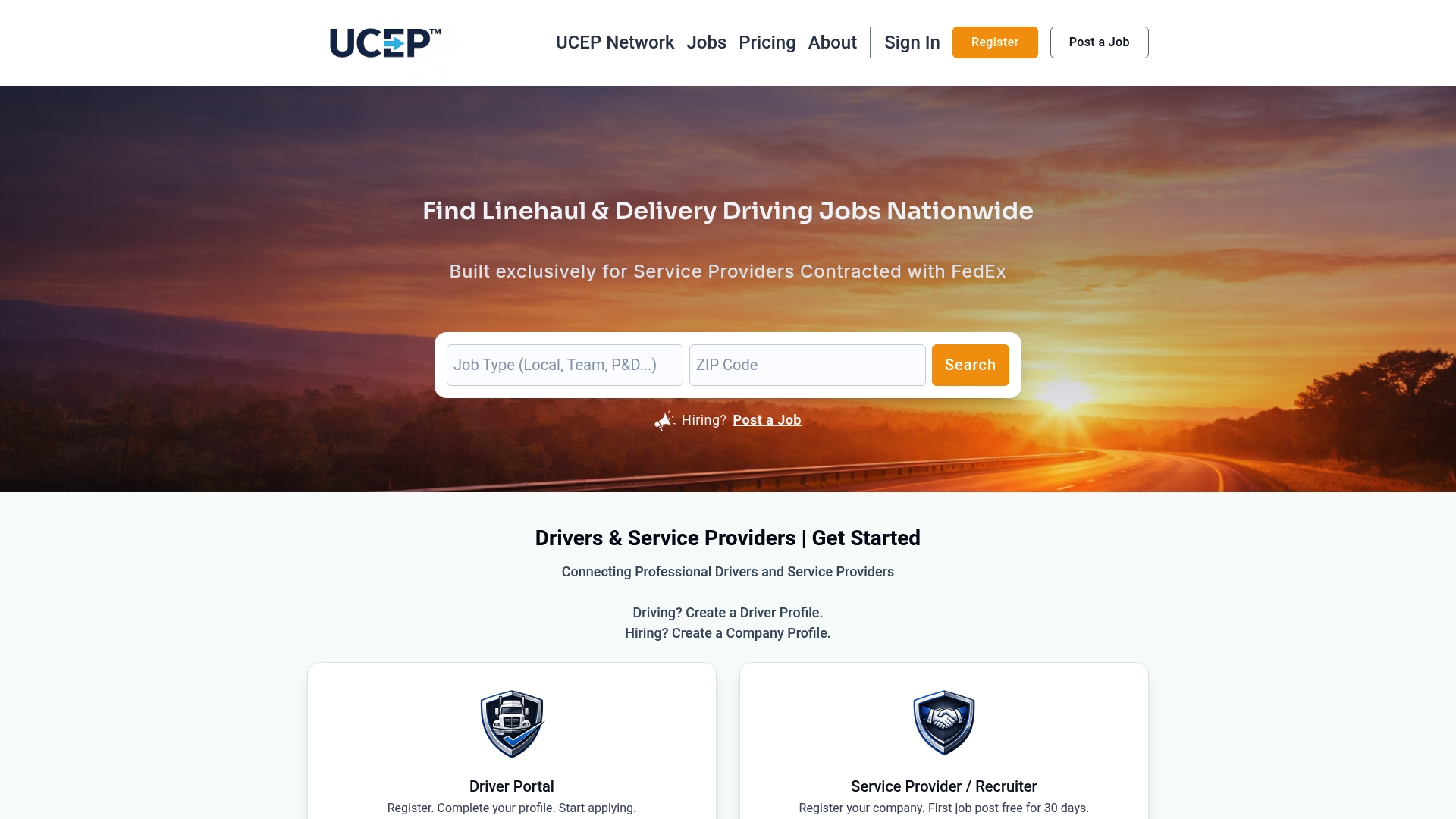
Ucep removes the noise of general job boards by focusing entirely on the FedEx contractor network. Every driver on the platform is looking specifically for FedEx-related opportunities, which means your postings reach a more relevant audience. If you are building your driver bench or filling an urgent gap, post your open roles on Ucep and connect with drivers who are ready to work in your network. You can also read what other service providers say about Ucep before getting started.
FAQ
What is workforce planning for a FedEx contractor?
Workforce planning for a FedEx contractor is the process of aligning driver hiring, retention, and HR practices with ISP contract requirements. It includes maintaining enough drivers to meet route and stop thresholds while preserving legal independence from FedEx.
How many drivers does a FedEx ISP contractor need?
The minimum qualifying ISP operates 5 routes, which typically requires 6–8 drivers to maintain coverage. Larger operations with 40 or more routes need 50 or more drivers, plus a backup bench.
What is the joint employer risk for FedEx contractors?
FedEx has faced over 160 lawsuits alleging joint employer status with its ISPs. Contractors reduce this risk by keeping all hiring, pay, and discipline decisions entirely within their own entity.
How often should a FedEx contractor conduct a compliance audit?
Compliance audits every 1–2 years are the recommended standard for ISP contractors. These audits verify that HR and scheduling decisions remain independent from FedEx control.
How do FedEx contractors reduce driver turnover?
Structured onboarding, clear pay progression, and paid safety certifications are the most effective retention tools for ISP contractors. Treating workforce development as a capital investment rather than a cost to minimize produces the best long-term results.