
Yes, you can become a FedEx independent contractor, but the timeline depends on the role. Start by creating a BuildAGroundBiz account, gathering your business and financial documents, and scheduling a DOT physical if you'll be driving. Driver approvals typically move in days to a few weeks; full contractor approval usually takes weeks to several months. Specialized job boards list FedEx-related driving and staffing opportunities if you want to see what's currently open while you prepare.
TL;DR:
- Full FedEx contractor approval typically takes three to six months, while driver approval usually occurs within three weeks.
- Missing or incomplete documents, especially financial statements and insurance proof, are the main cause of delays in the contracting process.
- The vetting process for contractors involves in-depth review of financial capacity, business structure, and staffing plans, which are more complex than driver background checks.
- Preparing all required paperwork early, including vendor choices and staffing plans, can significantly speed up approval times.
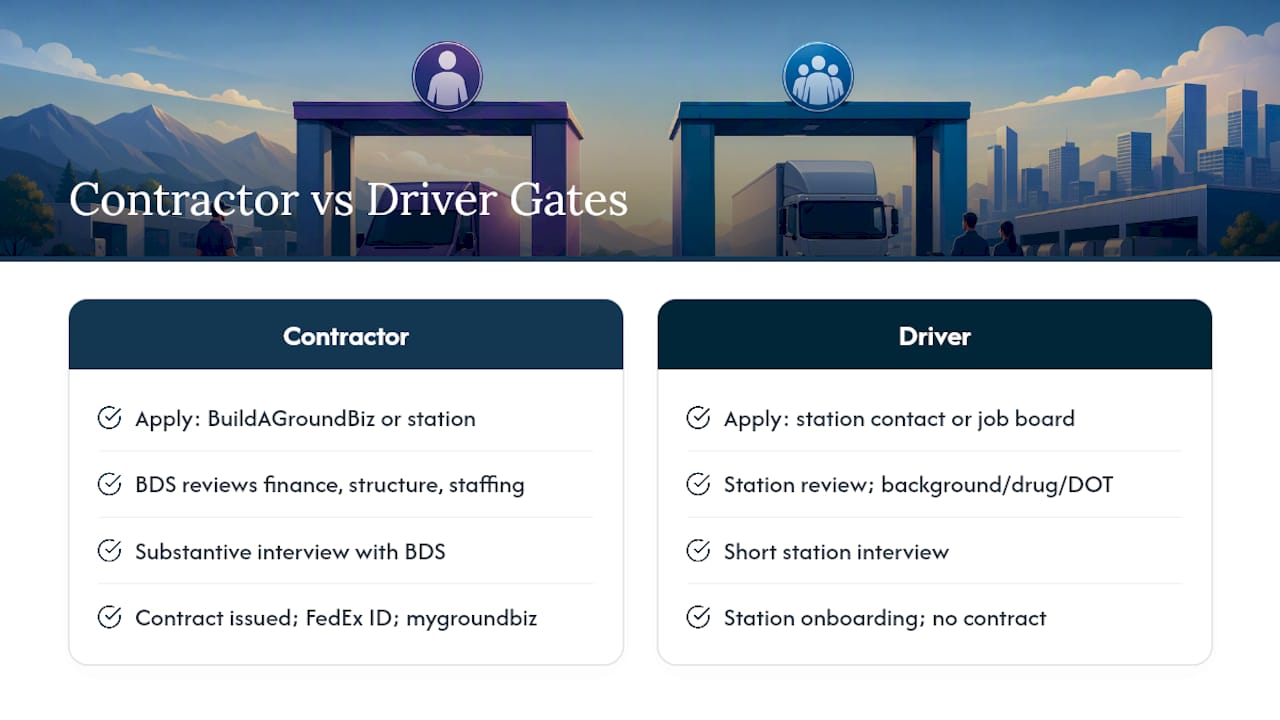
- The application process is divided into four gates, each with specific reviews, making timely document provision crucial for progress.
Table of Contents
- Quick Checklist: Documents, Financials, and Readiness Items Before You Apply
- Step-by-Step: From Application to Onboarding
- How Long Does It Actually Take to Get Approved?
- What Documents and Qualifications FedEx Actually Checks
- What FedEx Looks For in the Interview
- Getting Your Operation Ready: Fleet, Insurance, and Cash
- Finding Roles and Building a Hiring Pipeline With UCEP
- A Recruiter's Take on What Actually Speeds Approval
- Find FedEx Contractor Job Listings on UCEP
- Where to Verify These Details Yourself
- Sources
Quick Checklist: Documents, Financials, and Readiness Items Before You Apply
Most delays in the FedEx contractor hiring process come from missing paperwork, not failed background checks. Get these items in order before you touch the application.
- Business formation proof. An LLC or corporation filing, EIN confirmation, and a basic staffing or business plan showing how you'll cover routes.
- Insurance readiness. You don't need policies bound on day one, but you need proof you can secure the required commercial lines once a contract is offered.
- Driver qualification files. A current DOT physical, a clean or explainable motor vehicle record, and readiness for a drug test.
- Account setup. Register on BuildAGroundBiz to view territories, and expect mygroundbiz portal access once you're issued a FedEx ID.
Pro Tip: Scan every document into one folder before you start the application. Reviewers move faster on complete files, and incomplete submissions are the single biggest cause of stalled approvals.
Step-by-Step: From Application to Onboarding
The path from first application to running routes has four distinct gates. Each one has its own reviewer, its own paperwork, and its own way of stalling if you're not ready.
1. Apply through BuildAGroundBiz or a station contact. Prospective contractors express interest through BuildAGroundBiz, which lists open territories by region. Drivers looking for a role with an existing service provider instead of a full contractor position often go straight to a station or a specialized job board, since individual contractors handle their own driver hiring separately from FedEx's contractor vetting.
2. Vetting begins on two tracks. For contractor applicants, a Business Development Specialist (BDS) reviews your financial capacity, business structure, and staffing plan. For driver applicants, local station management typically runs the review instead, which is part of why driver hiring tends to move faster than territory contracting. Both tracks route through the same background checks: criminal history, employment verification, and in most cases a drug test and DOT physical for anyone behind the wheel. These checks are standard gating steps before FedEx issues access credentials, and they're rarely where good applicants fail. Most rejections trace back to unverifiable employment history or a missed drug test appointment, not the check itself.
3. Interview or meeting with BDS or station management. Contractor applicants usually have at least one substantive conversation with a BDS about their financial plan, insurance strategy, and how they intend to staff the route. Driver applicants typically go through a shorter interview with a station supervisor focused on availability, safety habits, and physical requirements of the job.
4. Contract approval and system access. Once a contractor applicant clears financial and operational review, FedEx issues a contract and a FedEx ID, which unlocks the mygroundbiz portal. That portal is where you'll find approved vendor lists for vehicles, scanners, and telematics equipment. Drivers, once cleared, go through station-level onboarding that covers scanner use, safety protocols, and route-specific procedures rather than a formal contract signing.
5. Onboarding and initial training. New contractors typically spend their first two to four weeks shadowing an experienced route, learning delivery software, and finalizing insurance paperwork before running solo. Drivers usually onboard faster, often within a single week, since the training is role-specific rather than business-wide.
The gap between these two tracks is the most misunderstood part of the FedEx driver hiring process. People searching for "how to become a FedEx contractor" often assume driver and contractor timelines are the same. They aren't, and conflating them is why so many applicants underestimate how long full contracting takes.
How Long Does It Actually Take to Get Approved?
Driver approvals commonly land in the 7 to 21 day range when background checks and the DOT physical clear without complications. Full contractor approval is a different animal entirely.
By the numbers: Full FedEx contractor approval commonly takes 3 to 6 months from initial application to running live routes, while driver approvals often clear in under three weeks when paperwork is complete.
That six-month upper bound isn't arbitrary. Territory contracting requires FedEx to vet your net worth, working capital, staffing plan, and insurance capacity, all of which take longer to document and verify than a single driver's qualification file. Drivers get vetted by a local station with a narrower checklist: license, record, physical, and drug test.
A few factors reliably speed things up:
- Complete financial statements submitted on the first pass, not amended later
- Proof of insurance capacity ready before it's requested
- A staffing plan that already names candidate drivers rather than describing a hiring intention
And a few reliably slow things down: incomplete tax documentation, gaps in liability coverage, and vague answers about how you'll staff a multi-route territory. If you're applying as a contractor rather than a driver, treat the financial package with the same rigor you'd give a small business loan application, because that's effectively what the review resembles.
What Documents and Qualifications FedEx Actually Checks
FedEx evaluates both your paperwork and your operational capacity before handing over a contract. Here's what typically gets reviewed.
- Business formation documents. LLC or corporate filing, EIN, and any required state business licenses.
- Financial statements. Proof of net worth and working capital sufficient to run the territory you're requesting, since FedEx evaluates financial and managerial capacity before approving contractors.
- Insurance lines. Commercial auto liability, cargo, and workers' compensation where applicable, or clear evidence you can bind these policies quickly.
- Vehicle and equipment plans. Compliant vehicles, scanners, and telematics systems, with final vendor selection happening through the mygroundbiz portal after your FedEx ID is issued.
- Driver qualification records. Motor vehicle records, DOT physical documentation, and drug test results for anyone who will drive under the contract.
Vendor access is worth flagging separately: you can't finalize vendor contracts until after you're issued portal credentials, but building a shortlist of vehicle and equipment vendors ahead of time saves real weeks once access opens.
What FedEx Looks For in the Interview
The interview stage, whether with a BDS or a station manager, isn't a formality. Candidate reports describe it as short, direct, and focused on a handful of recurring themes rather than a polished pitch.
- Safety culture. Expect direct questions about how you'd handle a late route, a vehicle breakdown, or a driver calling in sick. FedEx wants to see contingency thinking, not a rehearsed answer.
- Operational readiness. For contractors, this means questions about staffing backups and route coverage. For drivers, it's usually about availability and physical demands, echoing the format candidates describe in interview reports on Glassdoor.
- Customer service instincts. Both tracks ask some version of "how would you handle an upset customer," since delivery quality is tied directly to contractor performance scoring.
Interviewers consistently favor concrete answers over general claims. If you're asked about staffing coverage, naming an actual backup driver beats describing a plan to hire one later.
Pro Tip: Bring a one-page written staffing or safety plan to the meeting, even if nobody asks for it. Handing over something concrete signals readiness faster than any verbal answer can.
The most common stall points are vague financial answers and no backup staffing plan. Fix both before you walk in.
Getting Your Operation Ready: Fleet, Insurance, and Cash
Before your first route day, three cost categories need real answers, not estimates.
- Fleet decisions. Leasing preserves cash early; buying builds equity but requires more upfront capital. Either path routes through approved vendors listed in mygroundbiz once your ID is active.
- Insurance. Commercial auto and cargo coverage are non-negotiable, and costs vary by fleet size and route type. Guides like Diamondback Insurance's motor carrier coverage breakdown are a useful starting point for understanding coverage lines and cost drivers before you request quotes.
- Working capital for payroll. Budget for at least a few weeks of driver payroll before your first settlement check arrives, since FedEx settlement cycles rarely align with your first payroll run.
Recruiting drivers early, rather than after your contract is signed, shortens your runway to a live route. A workforce planning guide for FedEx contractors walks through staffing timelines in more detail if you're building your first hiring pipeline.
Finding Roles and Building a Hiring Pipeline With UCEP
Whether you're applying as a driver or building a contractor operation that needs drivers, Specialized job boards and employer directories give you a focused place to search instead of scattering effort across general job sites.
- Search current pickup and delivery and CDL-A openings posted directly by FedEx-contracted service providers.
- Research company listings and terminal directories to understand who's hiring and where before you apply.
- Review recruiting strategy guides if you're the one building a driver pipeline as a new contractor.
- Check listed pay ranges, route types, and terminal locations against your own availability or staffing needs before reaching out.
A Recruiter's Take on What Actually Speeds Approval
Documentation speed beats polish every time. The applicants who move fastest through this process aren't the most impressive on paper. They're the ones who respond to document requests within a day. Prioritize three things: create your BuildAGroundBiz account now, assemble your insurance and financial package before anyone asks for it, and schedule your DOT physical this week, not after an offer.
— Aaron
Find FedEx Contractor Job Listings on UCEP
If you're building a driver roster while your contractor application moves through review, or you're a driver looking for a service provider to work with directly, specialized platforms give you a focused place to search instead of digging through general job boards. These platforms are focused on service providers contracted with FedEx, so listings, employer directories, and terminal profiles are relevant to this industry.
Browse company profiles like Four Leaf Recruiting's driver listings to see how contractors structure their openings, or check Revolution Recruiting's postings and JAR Trucking's listings for a sense of typical pay ranges and route types. Create a free profile, set up driver alerts for your target region, and start applying while your paperwork works its way through the FedEx contractor hiring process.
Where to Verify These Details Yourself
- BuildAGroundBiz: Contracting with FedEx Ground for official territory listings and application steps.
- Diamondback Insurance's motor carrier guide for insurance requirements and cost ranges.
- Route Consultant's driver approval guide for driver-specific timelines.
- UCEP's workforce planning and staffing challenges guides for ongoing contractor readiness.
Sources
- BuildAGroundBiz: Contracting with FedEx Ground -> Get Started
- How to Get FedEx Ground Routes and Become a FedEx Ground Contractor in 2025?
- How to Get a New FedEx Ground Driver Approved — Route Consultant
- Employers