
The trucking driver shortage in 2026 is defined by three structural forces: an aging workforce exiting faster than new drivers enter, federal regulations removing tens of thousands of CDL holders from the eligible labor pool, and a retention crisis that pay raises alone cannot solve. The Driver Availability Index collapsed from 55 in december 2025 to 30 by march 2026, a drop that signals a labor market contracting faster than the industry can respond. The IRU reports an 11% global driver shortage as of 2025, with 63% of European operators unable to expand their fleets due to insufficient drivers. This is no longer a cyclical dip. It is a structural threat to freight capacity, supply chain stability, and carrier viability across the United States and globally.
Why trucking has a driver shortage in 2026: the core causes
The trucking workforce challenges of 2026 trace back to three converging forces, none of which is new, but all of which intensified simultaneously. Demographic attrition, regulatory disqualification, and retention failure arrived together, compressing the available driver pool from multiple directions at once. Understanding each force separately is the first step toward addressing them.
Demographic attrition is shrinking the driver base
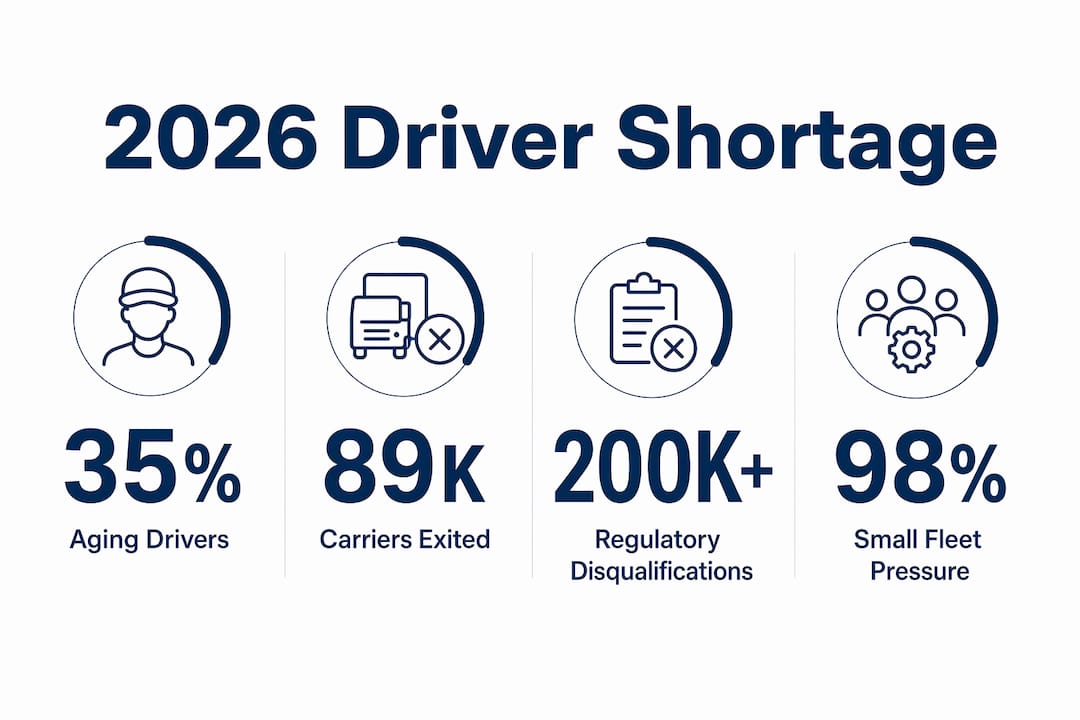
The average age of a commercial truck driver in the United States skews well above the national workforce median. Retirement rates are accelerating, and the pipeline of younger replacements is not keeping pace. The IRU projects that 20% of Europe's drivers and 24% of Australia's drivers will retire within five years. Those figures reflect a global pattern, not a regional anomaly.

Recruiting younger drivers presents its own obstacles. CDL-A training costs thousands of dollars out of pocket, and the lifestyle demands of long-haul trucking conflict with the expectations of workers entering the labor market today. Carriers that rely on traditional recruitment pipelines find those pipelines narrowing year over year.
| Region | Projected driver retirements within 5 years |
|---|---|
| Europe | 20% of current driver workforce |
| Australia | 24% of current driver workforce |
| United States | Accelerating, no single published figure |
Pro Tip: Target military veterans and trade school graduates in your recruitment outreach. Both groups have demonstrated discipline and mechanical aptitude, and they respond well to structured career pathways with clear pay progression.
- Drivers aged 55 and older represent a disproportionate share of the current CDL workforce.
- Entry-level driver training programs exist but vary widely in quality and completion rates.
- Small carriers struggle most to fund training pipelines, since they lack the capital that large fleets use to subsidize driver schools.
How have regulatory changes tightened the driver labor pool in 2026?
FMCSA regulatory enforcement is the most immediate cause of the 2026 capacity squeeze. Three specific changes removed drivers from the eligible pool faster than attrition alone would have.
-
Clearinghouse II automation. The FMCSA's Drug and Alcohol Clearinghouse II rule now automates CDL downgrades for drivers in prohibited status. By december 2024, over 180,000 CDL holders were in prohibited status. That number climbed past 200,000 by january 2026. These drivers did not simply lose their jobs. They lost their commercial licenses, creating sudden and invisible capacity losses that complicate workforce planning for every fleet manager.
-
Automated medical certification. The FMCSA's new automated medical certification system cross-references driver health records with CDL databases in real time. Drivers with lapsed or non-compliant medical certificates are flagged and removed from active status without a manual review step. Fleets that previously relied on periodic manual checks now face faster, less predictable disqualifications.
-
Non-domiciled CDL restrictions. Tightened enforcement of non-domiciled CDL eligibility has restricted a segment of drivers who previously held valid commercial licenses issued outside their state of primary residence. Combined with stricter English proficiency enforcement, these rules have narrowed the pool of legally eligible drivers further.
The prohibited driver problem is particularly damaging because it is invisible until it hits. A driver in prohibited status loses their CDL, not just their current job. Fleet managers discover the gap only when a driver fails a pre-trip compliance check or a background screening flags the disqualification. By that point, the route is already uncovered.
Pro Tip: Run continuous background monitoring on your driver roster, not just pre-hire checks. FMCSA Clearinghouse status can change between annual reviews, and a single missed update can leave you with an uncovered route and a compliance liability.
Since 2022, approximately 89,000 carriers exited the U.S. trucking market due to regulatory and economic pressure. That exit rate reflects how compliance costs and driver disqualifications have made smaller operations financially unviable.
Why is driver retention now the primary challenge over recruitment?
Retention has overtaken recruitment as the defining trucking workforce challenge of 2026. The Driver Availability Index data makes this clear: the rapid contraction from 55 to 30 between december 2025 and march 2026 reflects drivers leaving the industry, not just a failure to attract new ones.
The IRU identifies a "wage wall" as the central retention problem. Pay raises alone no longer move the needle. Carriers that increased driver compensation found that quality of life and predictable scheduling matter more to experienced drivers than additional cents per mile. Drivers who leave cite irregular home time, poor parking infrastructure, and physical fatigue as primary reasons, not insufficient pay.
- Home time predictability. Drivers with families prioritize knowing when they will be home. Carriers that offer fixed weekly schedules retain drivers at higher rates than those running open-ended dispatch models.
- Parking and rest infrastructure. Secure, clean truck stops with reliable amenities reduce the daily stress load that accelerates burnout. Drivers on routes with inadequate parking report significantly higher dissatisfaction.
- Mental health and burnout. Long-haul isolation compounds over time. Carriers that provide access to driver mental health resources see measurable improvements in retention rates.
- Equipment quality. Drivers assigned to older, poorly maintained trucks leave sooner. Newer equipment signals that the carrier values their safety and comfort.
Small operators face the sharpest retention pressure. Small fleets representing 98% of enterprises in some regions lack the capital to upgrade equipment or offer the lifestyle benefits that large carriers use to retain experienced drivers. The wage wall hits them hardest because they cannot compete on pay and cannot afford the infrastructure improvements that would compensate.
What are the broader industry and market implications of the 2026 driver shortage?
The driver shortage is reshaping freight market structure in ways that will persist beyond any single year. The most significant structural shift is the 55% private fleet and 45% for-hire split that emerged in early 2026. Large shippers are internalizing their transportation capacity rather than relying on a for-hire market they can no longer count on. That shift reduces available capacity for smaller shippers and mid-market logistics firms.
| Market indicator | 2026 status |
|---|---|
| Private fleet share | 55% of total capacity |
| For-hire carrier share | 45% of total capacity |
| Carrier exits since 2022 | Approximately 89,000 |
| Global driver shortage rate | 11% (2025 IRU data) |
The 89,000 carrier exits since 2022 are producing a supply-driven rate recovery in the truckload market. Freight rates are firming not because demand is surging but because capacity is contracting. That distinction matters for policymakers and shippers who might otherwise wait for demand to normalize before acting.
- New emission regulations are adding equipment cost burdens that smaller carriers cannot absorb, accelerating their exit from the market.
- Class 8 truck production constraints limit how quickly fleets can expand even when drivers become available.
- The capacity squeeze is most acute in regional and last-mile delivery, where driver turnover rates are highest and route density is most sensitive to labor gaps.
How can industry stakeholders respond to the 2026 driver shortage?
The driver shortage is structural, which means short-term fixes will not resolve it. Carriers, policymakers, and logistics firms each have specific levers to pull.
- Improve driver experience directly. Invest in secure parking, predictable scheduling, and newer equipment. These changes cost money upfront but reduce turnover costs that far exceed the investment.
- Automate compliance monitoring. Continuous CDL and Clearinghouse status monitoring prevents the sudden capacity losses that manual annual checks miss. Carriers using automated screening tools catch disqualifications before they disrupt operations.
- Use niche job boards for targeted recruitment. General job platforms generate high application volume but low qualification rates. Specialized driver recruitment platforms deliver candidates who already hold the required credentials and understand the role.
- Engage policymakers on training funding. CDL training subsidies and apprenticeship programs reduce the financial barrier that keeps younger workers out of the industry. Industry associations and carriers should advocate jointly for federal and state training investment.
- Plan for autonomous trucking as a medium-term offset. Autonomous trucking technologies are advancing in 2026, with driverless corridors now operational in limited regions. They are not a short-term fix, but carriers that begin integrating autonomous-ready infrastructure now will be better positioned when the technology scales.
Pro Tip: The trucking industry must pivot from growth-at-all-costs to proactive compliance and retention strategies to survive the 2026 landscape. Carriers that treat compliance as a cost center rather than a capacity protection tool will face the steepest losses.
Key Takeaways
The 2026 trucking driver shortage is structural, driven by demographic attrition, FMCSA regulatory disqualifications, and a retention crisis that pay increases alone cannot reverse.
| Point | Details |
|---|---|
| Regulatory disqualifications | Over 200,000 CDL holders in prohibited status by january 2026, removing drivers instantly from the eligible pool. |
| Demographic pressure | Europe and Australia face 20–24% driver retirement rates within five years, a trend mirrored in the U.S. |
| Retention over recruitment | The Driver Availability Index dropped from 55 to 30 in three months, signaling drivers leaving faster than new ones arrive. |
| Market restructuring | A 55/45 private-to-for-hire capacity split and 89,000 carrier exits since 2022 are reshaping freight market access. |
| Structural solutions required | Compliance automation, lifestyle improvements, and targeted recruitment address root causes; pay raises alone do not. |
The structural shift most carriers are still ignoring
I have watched the trucking industry treat driver shortages as a recruitment problem for years. Post more jobs, raise the sign-on bonus, repeat. The 2026 data makes that approach indefensible. The Driver Availability Index did not drop from 55 to 30 because carriers stopped recruiting. It dropped because drivers are leaving and regulatory disqualifications are removing others without warning.
The uncomfortable reality is that the industry built its workforce model on a demographic cohort that is now retiring, and it never built a replacement pipeline. The FMCSA's Clearinghouse II automation accelerated a problem that was already developing. Carriers that focused on compliance as a checkbox exercise are now discovering that a single prohibited driver on their roster represents a route gap, a liability, and a compliance record that affects their safety rating.
What I find most concerning for smaller operators is the compounding effect. They cannot afford continuous monitoring tools, they cannot upgrade equipment to compete on driver experience, and they cannot absorb the rate volatility that comes from losing drivers mid-quarter. The wage wall hits them hardest precisely because they have the fewest alternatives. Policymakers who want to preserve competitive freight markets need to address small carrier viability directly, not just fund autonomous trucking pilots that will take a decade to scale.
Technology will help, but not soon enough for the carriers facing capacity gaps today. The medium-term answer is retention infrastructure: parking, scheduling, equipment, and mental health support. The long-term answer is a coordinated training pipeline that treats CDL certification the way the construction industry treats apprenticeships. Until both are in place, the shortage will deepen.
— Aaron
How Ucep supports FedEx service providers navigating the driver shortage
The driver shortage makes every qualified CDL candidate more valuable. FedEx service providers competing for linehaul, CDL-A team, CDL-A solo, and pickup and delivery drivers need a recruitment channel that reaches the right candidates without the noise of general job platforms.
Ucep is built exclusively for service providers contracted with FedEx. The platform connects you directly with drivers who are already familiar with FedEx network requirements, reducing screening time and improving hire quality. You can post driver jobs and reach a focused pool of qualified candidates who are actively looking for FedEx-related opportunities. In a market where the eligible driver pool is shrinking, a targeted recruitment approach is not optional. It is the difference between a filled route and an uncovered one.
FAQ
What is the main cause of the trucking driver shortage in 2026?
The 2026 shortage is driven by three simultaneous forces: demographic retirement of older drivers, FMCSA regulatory disqualifications removing over 200,000 CDL holders from the eligible pool, and a retention crisis that pay raises alone cannot solve.
How does FMCSA Clearinghouse II affect driver availability?
Clearinghouse II automates CDL downgrades for drivers in prohibited status, meaning disqualifications happen faster and without manual review. Over 200,000 CDL holders were in prohibited status by january 2026, creating sudden capacity gaps for fleets.
Why are truck drivers leaving the industry in 2026?
Drivers cite irregular home time, poor parking infrastructure, physical burnout, and aging equipment as primary reasons for leaving. The IRU identifies a "wage wall" where pay increases no longer compensate for quality-of-life deficits.
What does the Driver Availability Index measure?
The Driver Availability Index measures the relative supply of available commercial drivers in the labor market. A score of 55 in december 2025 indicated moderate availability; the drop to 30 by march 2026 signals a rapidly contracting driver supply.
Will autonomous trucking solve the driver shortage?
Autonomous trucking is advancing in 2026, with driverless corridors operational in limited regions, but it is not a short-term solution. Carriers should plan for autonomous integration as a medium-term offset while addressing retention and compliance gaps now.
Recommended
- Life in the Miles: Truck Driver Mental Health, Home Time, and Burnout - United Contractor Employment Portal
- Why Targeted Job Boards Deliver Better ROI for Service Providers Hiring Drivers - United Contractor Employment Portal
- Trucking and Severe Summer Weather | Safety Tips for Drivers - United Contractor Employment Portal
- Safe Delivery Driving Summer 2026 | Reduce Delivery Risk - United Contractor Employment Portal