
A driver qualification file (DQ file or DQF) is the record a motor carrier keeps to show that each driver it employs is qualified to operate a commercial motor vehicle. Under 49 CFR 391.51(a), each motor carrier must maintain one for every driver it employs. This guide lists what goes in the file, the annual tasks that keep it current, and how long to retain it. It is written for FedEx Service Providers who hire linehaul, CDL-A team, CDL-A solo, and pickup and delivery drivers.
TL;DR
- Every motor carrier keeps one DQ file per employed driver. The contents are set by 49 CFR 391.51.
- Core items: application, motor vehicle records, road test certificate or equivalent, medical examiner's certificate, annual review note, and pre-employment drug and alcohol documents.
- Each year you must pull a new MVR, review the driving record, and collect the driver's list of violations.
- Keep the file for as long as the driver is employed and three years after.
- Which rules apply to a given driver depends on the vehicle and the type of operation, not on the job title.
Table of Contents
- What a driver qualification file is
- Who needs one
- What goes in the file
- Annual tasks that keep the file current
- Retention and where to keep the file
- A working checklist for Service Providers
- Common gaps to fix
- Our perspective
- Recruit drivers and start the file faster
- FAQ
- Sources
What a driver qualification file is
The DQ file is a regulated set of personnel records. It sits under Part 391 of the Federal Motor Carrier Safety Regulations, which covers driver qualifications. It is not a general HR folder. It holds the records that prove the driver was screened, medically certified and reviewed on schedule.
The file matters in two situations: when you hire, because several records must be requested and received within set windows, and when an auditor asks for it. A complete file shows you did the work. A missing item is a gap you have to explain.

Who needs one
The requirement attaches to the motor carrier and to each driver it employs. FMCSA's rules apply to commercial motor vehicles in interstate commerce. A commercial motor vehicle includes a vehicle with a gross vehicle weight rating or gross combination weight rating of 10,001 pounds or more.
That is the practical test for a Service Provider. Look at the vehicle the driver operates and the kind of work, not the label on the route.
| Driver type | What to check |
|---|---|
| CDL-A solo linehaul | Combination vehicles well over the weight threshold. Full DQ file, plus CDL records. |
| CDL-A team linehaul | One file for each team member. Each driver is qualified individually. |
| Pickup and delivery | Check the vehicle's rated weight. If it is at or above the threshold in interstate commerce, treat the driver as covered. |
| Drivers without a CDL | Some file items differ, such as the National Registry note (see below). |
Intrastate operations can be governed by state rules that adopt or modify the federal ones. If you run routes that stay within one state, confirm the state requirement with your state's motor carrier safety agency, and keep the federal standard as your baseline when in doubt.
What goes in the file
The list comes from 49 CFR 391.51(b). The file must include:
- The driver's application for employment, completed under 49 CFR 391.21.
- A copy of the motor vehicle record (MVR) from each licensing authority, obtained under 391.23(a)(1).
- The road test certificate, an accepted equivalent, or the written statement and driver's certification for a driver not required to take a road test.
- The MVR from the annual inquiry under 391.25(a).
- The note recording the annual review under 391.25(c)(2).
- The medical examiner's certificate or a legible copy. For CDL holders, also the CDLIS record if it contains medical certification status.
- A Skill Performance Evaluation Certificate or medical exemption document, where one applies.
- For drivers who do not need a CDL, a note verifying that the medical examiner is listed on the National Registry of Certified Medical Examiners.
FMCSA's own DQ file checklist adds the related items you collect while hiring: the inquiry to previous employers for safety performance history, the driver's correction or rebuttal of those records, the 3-year state inquiry, and pre-employment drug and alcohol documents.
Application for employment
The application must carry specific content. Our guide to FMCSA compliant application form fields groups those fields so your form does not leave anything out.
Motor vehicle records
Within 30 days of the date employment begins, the carrier must inquire to each State where the driver held a license or permit during the preceding 3 years. For CDL holders, the carrier must obtain the CDLIS MVR from the current licensing State and place it in the file. For a plain-language explanation of what these reports show, see what an MVR report is.

Previous employer safety history
The same planner page states that you must investigate the driver's safety performance history with DOT-regulated employers for the preceding three years, and that the records must be received within 30 days of the start of employment. If you use a PSP report in that workflow, our PSP report hiring workflow walks through it. Because background reports fall under consumer reporting law, read FCRA compliance for recruiting before you order them.
Road test or equivalent
A person must not drive a commercial motor vehicle until he or she has completed a road test and been issued a certificate. Under 49 CFR 391.33, you may instead keep a copy of the driver's valid CDL, or a road test certificate issued within the past 3 years, as the equivalent. For many CDL-A hires, the CDL copy covers this item. If your process includes a pre-hire driving or knowledge evaluation, see our overview of the trucking skills assessment.
Medical certification
The medical examination must be performed by an examiner listed on the National Registry, and the certificate is completed on Form MCSA-5876. FMCSA's checklist says commercial drivers must pass a physical exam at least once every 24 months, and the carrier keeps a copy of the certificate in the file. Our DOT medical exam checklist covers what drivers bring to the exam.
Drug and alcohol documents
Pre-employment drug and alcohol documents belong with the file, per the FMCSA checklist (citing 49 CFR 40.25(j), 382.301 and 391.23(e)). The details of test timing and what to record are in our CDL drug testing guide for hiring.
Annual tasks that keep the file current
A DQ file is not finished at hire. 49 CFR 391.25 and 391.27 set a 12-month cycle:
- Annual MVR inquiry. At least once every 12 months, obtain each driver's motor vehicle record covering at least the preceding 12 months, from each licensing authority where the driver held a license or permit.
- Annual review. At least once every 12 months, review each driver's driving record to decide whether the driver still meets minimum safe-driving requirements or is disqualified under 49 CFR 391.15.
- Review note. Keep a note in the file with the name of the person who did the review and the date.
- List of violations. Under 49 CFR 391.27(a), each driver must furnish a list of traffic-law convictions and forfeited bonds (other than parking) from the preceding 12 months.
Also track the medical certificate expiration. A professional guide from a risk advisory firm adds that a new MVR should be obtained within 15 days of receiving a driver's new medical certificate. It also lists disqualifying offenses an MVR can reveal, including DUI/DWI, leaving the scene of an accident, using a vehicle to commit a felony, and reckless driving.
A simple way to run this: keep one tracking sheet with each driver's hire date, medical certificate expiration and last annual review date, and set reminders 60 days ahead of each.
Retention and where to keep the file
Under 49 CFR 391.51(c), each file is retained for as long as the driver is employed and for three years afterward. Under 391.51(d), these items may be removed three years after the date they were executed:
- the annual MVR
- the annual review note
- the medical examiner's certificate
- any medical variance or SPE certificate
- the National Registry verification note
That means a current driver's file can be trimmed of old annual items while the core records stay.
For location, 49 CFR 390.29 lets a carrier with several offices or terminals keep records at its principal place of business, a regional office or a driver work-reporting location. Records kept away from the principal place of business must be available for inspection within 48 hours of a request, excluding Saturdays, Sundays and federal holidays. If your terminals are spread out, decide which location holds the master file and make sure someone can produce it fast.
A working checklist for Service Providers
Use this order when a new driver is hired.
- Before the offer: collect the completed application and confirm the CDL (where needed) is valid. Check the fair-chance rules in your state and city, covered in our ban the box guide.
- Before the driver operates a vehicle: pre-employment drug test and result, road test certificate or CDL copy, and a valid medical examiner's certificate.
- Within 30 days of hire start: state MVR inquiries for the prior 3 years, and previous employer safety performance history records.
- After records arrive: log any driver rebuttal, and write the review that confirms the driver meets requirements.
- Every 12 months: new MVR, review note, driver's violation list.
- At least every 24 months: new medical examiner's certificate in the file.
- After separation: keep the file three more years, then dispose of it.
Check license status too. Endorsements and restrictions can change what a driver may operate, as explained in why CDL-A drivers face license restrictions and the types of CDL certifications.
Common gaps to fix
- Missing review note. The annual MVR is in the file but nobody signed and dated the review.
- Expired medical certificate. The file holds a certificate past its expiration.
- Late previous-employer records. The request was sent, but the response was never received or followed up within the 30-day window.
- Scattered records. Parts of one driver's file are in email, a payroll folder and a terminal cabinet.
- Team drivers treated as one. Each member of a team needs a complete file.
A quarterly self-audit of five random files catches most of these.
Our perspective
Most compliance problems we see in hiring come from timing, not from missing knowledge. The rules are written down. The difficulty is that a Service Provider recruiting for several roles at once has applications, MVRs and medical certificates arriving on different days.
We built UCEP for FedEx Service Providers so that the front half of that process is organized in one place: job listings for linehaul, CDL-A team, CDL-A solo, and pickup and delivery roles, a built-in applicant tracking system, and targeted driver alerts. When applications come in through one workflow, it is easier to see which candidate has submitted what, and to start your DQ file from a complete application.
Our aim is a focused recruiting channel for FedEx-experienced drivers, so your time goes to qualifying the right candidates instead of sorting unrelated ones.
Aaron
Recruit drivers and start the file faster
UCEP is a job board and recruiting platform built for Service Providers contracted with FedEx. You can post linehaul, CDL-A team, CDL-A solo, and pickup and delivery roles, and manage applicants in the built-in applicant tracking system.
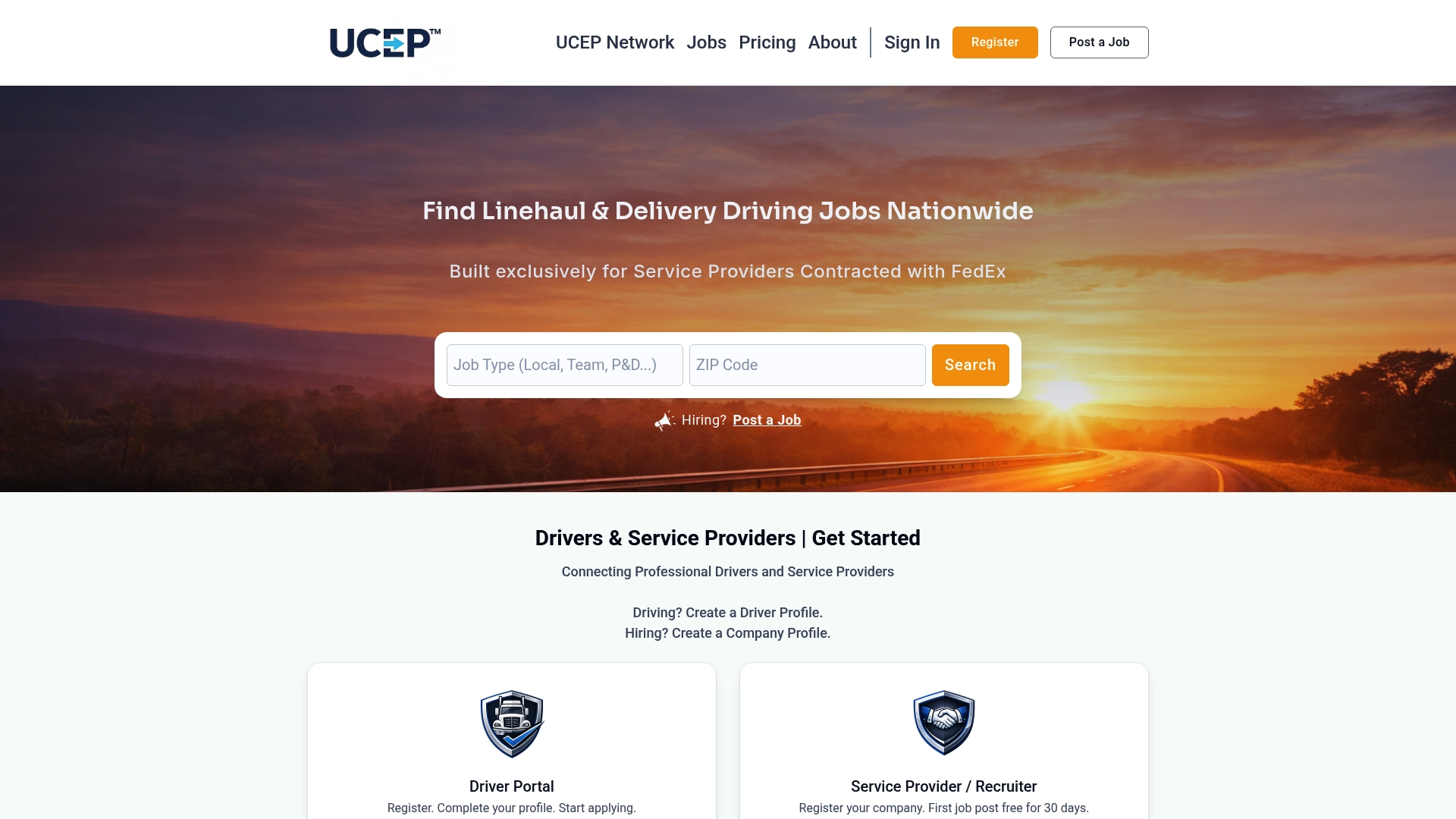
The Complimentary Trial Listing lets a new recruiter post a first job. The Standard Monthly Plan is $99 per month. See both on the UCEP pricing page, or browse the current driver job listings to see how roles appear to drivers.
FAQ
What is the difference between a DQ file and a personnel file?
The DQ file holds the records required by Part 391 for driver qualification. A personnel file holds general employment records such as payroll and performance notes. Keep them separate so the DQ file can be produced quickly on request.
How long do I keep a driver qualification file?
Keep it for as long as the driver is employed and for three years after. Certain items, including the annual MVR, review note and medical certificate, may be removed from the file three years after the date they were executed.
Can I keep DQ files at a terminal instead of the main office?
A carrier with multiple offices or terminals may keep records at its principal place of business, a regional office or a driver work-reporting location. Records at a location other than the principal place of business must be available within 48 hours of an FMCSA request, excluding weekends and federal holidays.
Does a driver's CDL replace the road test?
In many cases, yes. Under 49 CFR 391.33 a carrier may accept and keep a copy of the driver's valid CDL, or a road test certificate issued within the past 3 years, as the equivalent of its own road test certificate.
How often does the medical certificate need renewing?
FMCSA's checklist states commercial drivers must pass a physical exam by a licensed medical examiner at least once every 24 months. Keep a copy of each certificate in the DQ file.
Sources
- eCFR: 49 CFR 391.51, general requirements for driver qualification files
- FMCSA Driver Qualification File Checklist
- FMCSA Motor Carrier Safety Planner, driver qualification records
- 49 CFR 391.43, medical examination
- 49 CFR 391.25, annual inquiry and review of driving record
- 49 CFR Part 391, qualifications of drivers
- FMCSA guidelines for Parts 390 and 391
- Driver Qualifications 101 guide