
Drug testing requirements for CDL hiring mandate a verified negative result and a completed FMCSA Drug & Alcohol Clearinghouse query before any safety-sensitive work begins. Federal regulations under 49 CFR Part 382 leave no room for exceptions. Employers who skip steps or allow drivers to work while results are pending face fines up to $16,000 per violation. This guide covers every required step, the correct sequence, and the most common mistakes that put carriers at risk during CDL driver recruitment.
What are the drug testing requirements for CDL hiring?
Pre-employment drug testing for CDL drivers is defined by 49 CFR Part 40 and enforced by the FMCSA. The test must occur after a conditional job offer but before the driver performs any safety-sensitive function. A verified negative result must be on file before the driver's first trip, yard move, cargo activity, or equipment inspection.
The required test is the DOT 5-panel urine screen. It covers marijuana, cocaine, amphetamines, opioids, and PCP. SAMHSA-certified laboratories must conduct the analysis. Using a non-DOT test or an uncertified lab invalidates compliance entirely, even if the driver tests clean.
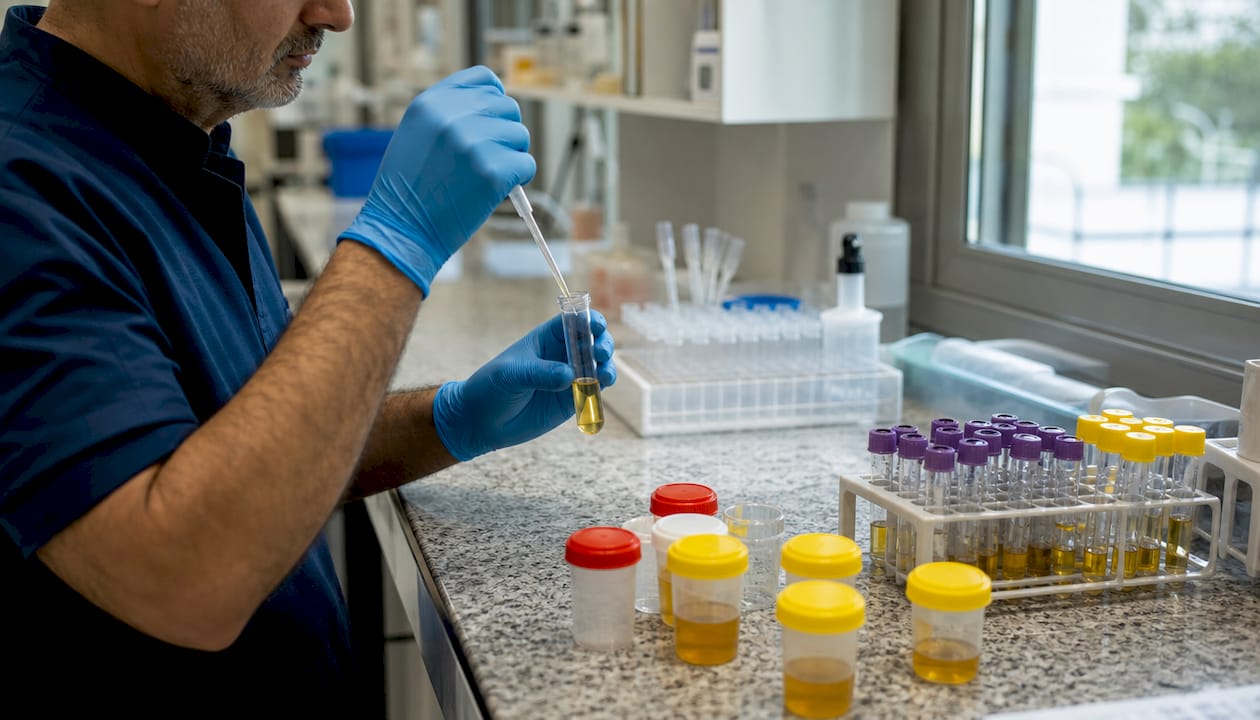
There are no grace periods under this rule. A pending result does not qualify as clearance. The driver cannot perform any safety-sensitive duty until the Medical Review Officer (MRO) confirms a negative result in writing.
Pre-employment alcohol testing is not federally required at the hiring stage. Alcohol testing applies to random, post-accident, reasonable suspicion, return-to-duty, and follow-up situations. You may add alcohol screening to your company policy, but it does not satisfy a DOT requirement.
Key pre-employment testing requirements:
- Test must follow 49 CFR Part 40 protocols at a SAMHSA-certified lab
- The DOT 5-panel urine screen is the only accepted test format
- Driver cannot begin any safety-sensitive function before a verified negative result
- Safety-sensitive functions include driving, equipment inspection, loading, and yard moves
- No provisional work period is allowed while results are pending
- A driver absent from DOT-regulated work for 30 or more consecutive days requires a full new pre-employment test before returning
Pro Tip: Keep a pre-employment drug test checklist in every driver qualification file. Date-stamp the MRO's written confirmation and store it before the driver's first scheduled duty.
How to properly use the FMCSA Clearinghouse in CDL hiring
The FMCSA Drug & Alcohol Clearinghouse query is a separate legal requirement from the drug test. Both must be completed before the driver operates a commercial motor vehicle. Confusing the two is one of the most common compliance errors in CDL hiring.
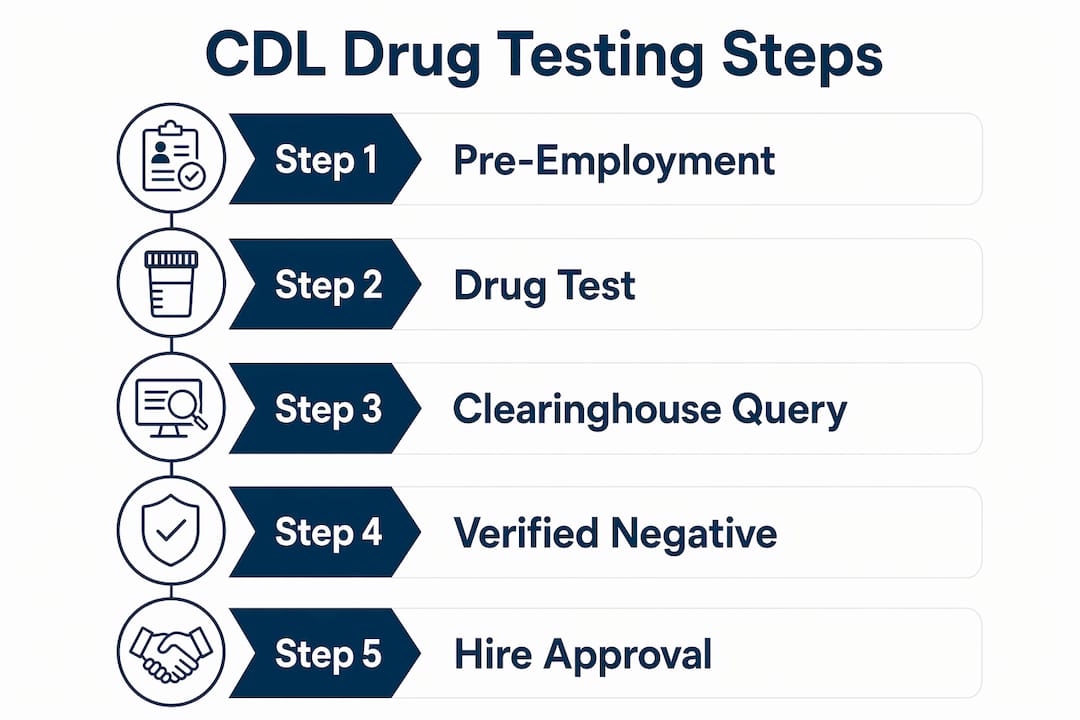
The Clearinghouse is a federal database that tracks drug and alcohol violations across all DOT-regulated employers. Violation records are retained for 5 years or until the driver completes the return-to-duty process, whichever is longer. A driver with an unresolved violation is in "prohibited" status and cannot legally drive for you regardless of how much time has passed.
The Clearinghouse is the definitive source for driver eligibility. Driver statements and standard background checks do not replace it. You must run a full query with the driver's electronic consent before the first trip. Without that consent, hiring is prohibited.
Follow these steps for every new CDL hire:
- Register your company in the FMCSA Clearinghouse as an employer
- Request the driver's electronic consent through the Clearinghouse portal
- Run a full query after consent is received
- Review the result: "No violations" clears the driver; any other status requires action
- If a violation appears, verify the return-to-duty process status before proceeding
- Document the query date and result in the driver qualification file
- For current employees, run a limited query annually
A driver with a positive or unresolved violation cannot work in a safety-sensitive role until a Substance Abuse Professional (SAP) completes the return-to-duty program and follow-up testing requirements are met.
Pro Tip: Set a calendar reminder to run annual limited queries for all active drivers. Missing the annual check is a common audit finding that carries the same penalty weight as missing a pre-employment query.
What are random drug testing requirements for CDL drivers?
Random drug testing is an ongoing obligation that begins the moment a driver joins your workforce. The FMCSA minimum annual rate is 50% for controlled substances and 10% for alcohol. These rates apply to all safety-sensitive drivers in your pool.
Selection must be unannounced and use a scientifically valid random method. Predictable patterns or manual selection do not meet the standard. You must maintain an up-to-date testing pool that reflects all active safety-sensitive employees at all times.
Random testing rates and requirements at a glance:
| Requirement | Standard |
|---|---|
| Minimum drug testing rate | 50% of safety-sensitive drivers annually |
| Minimum alcohol testing rate | 10% of safety-sensitive drivers annually |
| Selection method | Scientifically valid random process |
| Notice to driver | Unannounced only |
| Owner-operator compliance | Must join a third-party consortium |
| Documentation | Testing pool records and completion logs required |
Owner-operators working under a carrier's authority face the same random testing obligations as company drivers. They must join a third-party administrator or consortium to satisfy the FMCSA requirement. Operating without consortium membership is a direct violation.
Failure to meet the minimum testing rates or to document completions properly results in heavy fines and audit failure. Carriers with incomplete testing records are flagged during FMCSA compliance reviews, which can affect safety ratings and operating authority.
- Maintain a written random testing policy that specifies selection procedures
- Update the testing pool immediately when drivers are hired, terminated, or placed on leave
- Track completion rates quarterly to catch shortfalls before year-end
- Store all random test results in individual driver qualification files
Common compliance pitfalls in CDL drug testing during hiring
The most costly errors in CDL drug testing happen during onboarding, not during routine employment. Employers who treat drug testing as a formality rather than a compliance gate create serious legal exposure.
The five most common mistakes:
- Allowing safety-sensitive work before a verified negative result. No yard moves, no pre-trip inspections, no loading. Any safety-sensitive function performed before clearance is a violation.
- Skipping the Clearinghouse query or treating it as optional. The query and the drug test are both mandatory. Neither substitutes for the other.
- Failing to retest returning drivers. A driver who has been out of DOT-regulated safety-sensitive work for 30 or more consecutive days requires a new pre-employment test before resuming duties.
- Assuming the MRO or lab reports violations to the Clearinghouse. Employers must report drug test violations to the Clearinghouse within 3 business days. The lab does not do this for you.
- Using non-DOT tests or uncertified labs. Only SAMHSA-certified labs running the DOT 5-panel urine screen satisfy federal requirements.
Treating the Clearinghouse query and the pre-employment drug test as two separate compliance gates, not one combined step, is the single most effective habit a hiring manager can build. Both must clear before the driver touches a vehicle or any cargo. Documenting each step separately, with timestamps, is what separates carriers that pass audits from those that fail them.
Driver qualification files must include the pre-employment drug test result, the Clearinghouse query result, and documentation of driver consent. Missing files carry fines up to $16,000 per violation. Supervisors who approve a driver's first dispatch without confirming these documents are on file create personal and organizational liability.
Integrating Clearinghouse queries and drug test verification into a single automated hiring workflow reduces errors and prevents premature driver dispatch. Manual checklists work, but they depend on human consistency. Automated workflows block progression until each compliance step is confirmed complete.
Key Takeaways
CDL drug testing compliance requires a verified negative DOT 5-panel result and a completed FMCSA Clearinghouse full query before any driver performs a safety-sensitive function.
| Point | Details |
|---|---|
| Pre-employment test timing | A verified negative result must be on file before the driver's first safety-sensitive duty. |
| Clearinghouse query is separate | Run a full FMCSA Clearinghouse query with driver consent before the first trip, independent of the drug test. |
| Random testing rates | FMCSA requires at least 50% drug testing and 10% alcohol testing of your safety-sensitive pool annually. |
| Returning driver rule | Drivers absent from DOT-regulated work for 30 or more days need a new pre-employment drug test. |
| Employer reporting duty | You must report violations to the Clearinghouse within 3 business days. The MRO or lab does not do this for you. |
What I've learned from watching carriers fail audits they should have passed
I've reviewed enough driver qualification files to know that most compliance failures are not caused by ignorance of the rules. They are caused by process gaps. A hiring manager knows the drug test is required. What they miss is the exact moment it must be completed, or they assume someone else handled the Clearinghouse query.
The carriers that consistently pass FMCSA audits treat the pre-employment drug test and the Clearinghouse query as a single locked gate. Neither step alone opens the gate. Both must clear, and both must be documented with timestamps before the driver is dispatched. That sounds obvious, but the number of carriers that allow a driver to do a "quick yard move" while waiting on results is higher than most people in this industry admit.
The other pattern I see is the definition of safety-sensitive work being applied too narrowly. Hiring managers often think "safety-sensitive" means driving. It does not. Equipment inspection, loading, and cargo activities all qualify. A driver who walks into a yard and touches a trailer before their results are confirmed is already a violation. Training your supervisors on this specific point is not optional.
The 30-day return rule also catches carriers off guard. A driver who took a leave of absence, moved to a non-regulated role, or simply went inactive for a month or more needs a full new pre-employment test. Treating them as an existing employee with current clearance is a mistake that shows up in audits.
My recommendation: build your onboarding workflow so that no dispatch system can assign a driver a load until both the drug test result and the Clearinghouse query are logged as complete. Technology makes this possible. The carriers that automate these gates stop making these errors entirely.
— Aaron
Ucep connects you with CDL drivers ready for compliant hiring
Ucep is built exclusively for FedEx Service Providers recruiting CDL-A drivers for linehaul, team, solo, and pickup and delivery roles. Every driver in the Ucep network understands FMCSA compliance expectations, which means you spend less time screening and more time hiring.
Ucep gives you access to a focused pool of qualified CDL candidates, along with resources to support your driver qualification file process and compliance workflows. You can review service provider experiences from carriers already using the platform to hire with confidence. Explore the full Ucep network to see how other FedEx Service Providers are building compliant, audit-ready driver rosters. When your next CDL hire needs to clear every compliance gate before dispatch, Ucep is where the search starts.
FAQ
What drug test is required for CDL pre-employment?
The DOT 5-panel urine test conducted at a SAMHSA-certified laboratory is the only accepted format. It screens for marijuana, cocaine, amphetamines, opioids, and PCP.
Can a CDL driver work while waiting for drug test results?
No. Federal regulations prohibit any safety-sensitive function, including yard moves, inspections, and loading, until a verified negative result is on file.
Is the FMCSA Clearinghouse query the same as a drug test?
No. The Clearinghouse query and the pre-employment drug test are separate legal requirements. Both must be completed before the driver's first trip.
What is the FMCSA random drug testing rate for 2026?
The minimum annual rate is 50% for controlled substances and 10% for alcohol, applied to all safety-sensitive drivers in your testing pool.
Who reports a failed drug test to the FMCSA Clearinghouse?
The employer is responsible for reporting violations within 3 business days. The MRO and the testing laboratory do not report on the employer's behalf.