
A Motor Vehicle Record (MVR) is an official driving-history report maintained by your state's Department of Motor Vehicles (DMV) that lists your license status, moving violations, accidents, suspensions, and related administrative actions. Insurers use it to set premiums; employers use it to screen for safety risk and liability. According to Experian, an MVR is best understood as a driver's risk profile, not just a history log.
Key Takeaways
An MVR is a state-maintained driving-history report that insurers and employers use to assess risk, and every driver should review their own record before it is reviewed for them.
| Point | Details |
|---|---|
| MVR definition | An official DMV record listing license status, violations, accidents, suspensions, and points. |
| Retention ranges | Minor violations stay 3–5 years; DUI/DWI entries can remain visible for up to 10 years. |
| Who can access it | You, insurers, and employers with a permissible use under the DPPA (18 U.S.C. § 2721). |
| How to get yours | Request online, in-person, or by mail through your state DMV; fees typically range from $5–$25. |
| Ucep for drivers | Search FedEx-related driver jobs and research employers at Ucep. |
Table of Contents
- What information appears on an MVR report?
- Who can legally request or access your MVR?
- How insurers and employers use MVR data
- How long do entries stay on a driving record?
- How to request your MVR in the U.S.
- How to correct errors on your MVR
- What commonly causes a failed MVR check?
- What employers look for and how jobseekers can prepare
- Your quick MVR checklist as a driver
- Ucep connects drivers and employers in one focused place
- Sources
What information appears on an MVR report?
An MVR contains several distinct data fields. Knowing each one helps you read your record accurately and catch errors before they cost you a job or raise your insurance rate.
- Personal identification: Full legal name, date of birth, address on file, and driver's license number.
- License status: Current standing, valid, suspended, revoked, or expired, along with any class designation (Class A, B, or C) and active endorsements or restrictions.
- Moving violations: Speeding, running red lights, improper lane changes, and reckless driving. States record these with shorthand codes. For example, Utah uses numeric codes tied to specific statute sections.
- Accident entries: Collision reports filed with the DMV, sometimes with an at-fault indicator where the state tracks fault.
- Serious convictions: DUI/DWI convictions, vehicular manslaughter, and similar offenses appear as distinct entries and typically carry longer retention periods than minor violations.
- Points: Many states assign point values to violations. Accumulating too many points within a set window can trigger automatic suspension.
- Administrative actions: License reinstatement fees paid, mandatory safety courses completed, and ignition interlock requirements.
States differ on what they include. Most standard records cover several years of recent driving history. A full-history record, available in many states, shows the driver's complete credential history from the date of first licensure. Non-reportable warnings issued at an officer's discretion and private insurance-only incidents generally do not appear.
Pro Tip: Request a full-history record if you are applying for a commercial driving role. Employers screening for CDL compliance often want more than the standard three-year window, and seeing your complete record first gives you time to address anything unexpected.
The University of North Carolina School of Government's MVR reading guide notes that entries are sequenced by source agency, so a conviction entered by a court and a suspension entered by the DMV may appear in separate blocks on the same report. Read each block independently.
Who can legally request or access your MVR?
Not everyone can pull your driving record. The Driver Privacy Protection Act (DPPA), 18 U.S.C. § 2721, restricts disclosure of personal information from state motor vehicle records and defines a specific list of permissible uses.
Permissible requesters include:
- You, the driver: You can request your own record at any time with no special justification.
- Insurers: Permitted to access MVRs for underwriting and claims purposes.
- Employers: May request an MVR for employment screening when the position involves driving, provided they meet a permissible-use standard and, in most states, obtain your written consent first.
- Government agencies: Law enforcement, courts, and regulatory bodies can access records for official purposes.
- Attorneys and courts: Permitted in connection with legal proceedings.
What the DPPA means for you: An employer cannot pull your MVR without a legitimate permissible use. If a company asks for your license number and date of birth without explaining why, ask them to specify the permissible use in writing before you provide consent. This is your right under federal law.
Some states add requirements beyond the federal baseline. Colorado, for example, requires requesters to certify their permissible use when ordering records through the state DMV portal. Certified or official copies often require an in-person visit or a notarized mail request rather than a simple online order.
How insurers and employers use MVR data
Insurers treat your MVR as a forward-looking risk tool. Progressive's explainer states directly that recent moving violations and at-fault accidents affect both premium calculations and eligibility for discounts. A driver with a clean record typically qualifies for lower rates; a driver with two speeding tickets in three years may see a meaningful rate increase at renewal.

Employers, particularly those operating fleets or contracting with carriers, use MVRs for a different but related purpose: safety compliance and insurance exposure. Under 49 CFR Part 391, employers of commercial drivers must review driving records as part of the driver qualification process. This is a federal requirement, not a discretionary step.
Practical employer actions that reduce liability:
- Set written MVR screening thresholds before reviewing any candidate's record.
- Require signed written consent from every applicant before ordering an MVR.
- Document the specific entries that triggered a disqualification decision.
- Apply thresholds consistently across all candidates for the same role.
For fleet operators, Velocerta's compliance resources outline how consistent MVR review policies protect safety ratings and reduce insurer exposure over time.
Statistic callout: Insurers and safety researchers consistently find that drivers with recent at-fault accidents or moving violations present a higher likelihood of future claims than drivers with clean records, which is why MVR data sits at the center of both underwriting and fleet-safety decisions.
How long do entries stay on a driving record?
Retention periods vary by state and by the type of entry. The ranges below reflect common practice across U.S. states, but your state DMV is the authoritative source for exact timeframes.
- Minor moving violations (speeding, failure to yield): 3–5 years in most states.
- At-fault accidents: 3–7 years, depending on state rules and severity.
- DUI/DWI convictions: 5–10 years in most states. Utah's Driver License Division notes that DUI and drug-related charges may remain visible for up to 10 years on that state's records.
- License suspensions and revocations: Typically 3–7 years, though the underlying cause (e.g., a DUI) may extend visibility.
- Certain administrative actions: Some states maintain lifetime records for specific disqualifying events, particularly for CDL holders.
Colorado's DMV guidance confirms that standard records cover at least seven years, and full-history records show the driver's complete credential history with no cutoff date. If you are a CDL driver, assume employers and insurers may request the full-history version.
How to request your MVR in the U.S.
Requesting your driving record is straightforward. The method you choose depends on whether you need a standard record or a certified copy.
Step-by-step:
- Identify your state DMV's record-request page. Search "[your state] DMV driving record request" or go directly to your state's official .gov DMV site. Colorado's online portal, Mydmv, is one example of a state-run self-service tool.
- Choose the record type. Standard records work for personal review or most employer requests. Certified or official copies are required for court proceedings, some CDL applications, and certain employer requests.
- Select your request method:
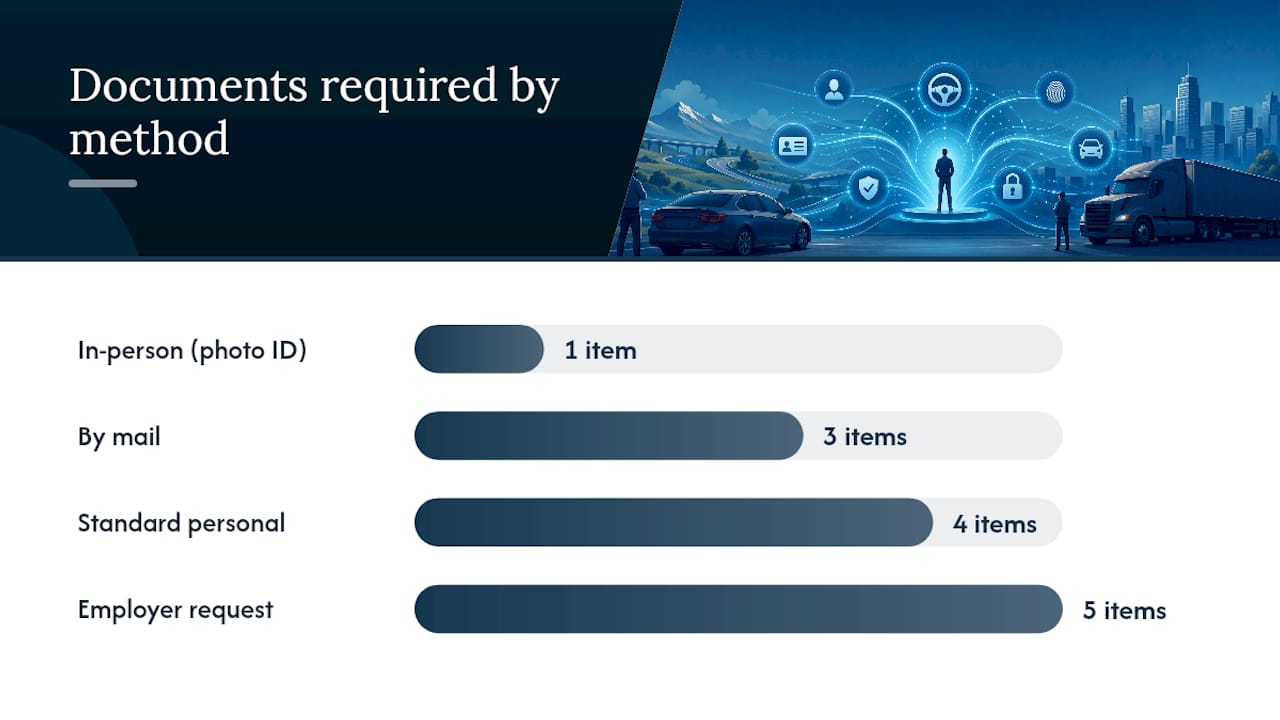
- Online: Most state DMV portals offer instant or next-business-day delivery for standard records.
- In-person: Required in some states for certified copies; bring a government-issued photo ID.
- By mail: Submit a completed request form, a copy of your ID, and a check or money order. Allow 2–4 weeks.
- Gather required documents: Driver's license number, full legal name, date of birth, and proof of identity. Employer-requested pulls also require your signed consent form.
- Pay the fee and submit.
Standard record fees typically range from $5–$25 depending on the state. Certified copies usually cost more. Check your state DMV's fee schedule directly, as fees change and vary widely.
Note: Aggregated public datasets on state open-data portals are not substitutes for a personal MVR request. Those datasets contain anonymized or summarized traffic data, not your individual driving history.
How to correct errors on your MVR
Errors on an MVR are more common than most drivers expect, and they can affect insurance rates and hiring decisions before you realize they exist.
Dispute checklist:
- Obtain a copy of your MVR and identify the specific entry you believe is incorrect.
- Pull the original source document: the police report, court disposition, or DMV administrative notice that generated the entry.
- Compare the source document to the MVR entry. Look for incorrect dates, wrong violation codes, or entries that belong to another driver with a similar name or license number.
- Contact your state DMV in writing to initiate a formal dispute. Most states have a specific dispute or correction form.
- Contact the reporting agency (the court clerk or law enforcement agency) to request a corrected or certified copy of the original record.
- Follow up by certified mail if you do not receive a response within 30 days. Keep every piece of correspondence with a date stamp.
Pro Tip: If a court dismissed a ticket but the dismissal never reached the DMV, the court clerk can provide a certified copy of the disposition order. Submit that document directly to the DMV with your dispute letter. This single step resolves the majority of conviction-related errors.
What commonly causes a failed MVR check?
Certain entries reliably result in denied coverage or hiring disqualification. Knowing them in advance lets you address issues proactively.
Common disqualifiers:
- DUI/DWI conviction within the past 5–10 years (exact lookback period varies by employer and insurer).
- Multiple at-fault accidents within a short window, often two or more in three years for commercial roles.
- Active license suspension or revocation at the time of the check.
- Reckless driving conviction, which many insurers and employers treat as seriously as a DUI.
- Missing or invalid CDL endorsements for roles that require them, such as hazmat or tanker.
- Falsified application information that contradicts the MVR, which is an automatic disqualifier at most carriers.
Illustrative employer thresholds (these vary by company and are not universal): two at-fault accidents in three years, any DUI in the last five to ten years, or any active suspension. Common hiring mistakes in CDL recruiting often stem from inconsistent application of these thresholds, which creates legal exposure for the employer.
What employers look for and how jobseekers can prepare
Employers screening drivers, including FedEx-contracted Service Providers, typically evaluate MVRs against a structured checklist. Understanding that checklist helps you prepare before you apply.
Employer evaluation checklist:
- Current license status: valid, correct class, and no active suspensions.
- Moving violations in the recent past: type, frequency, and severity.
- At-fault accidents within the lookback window.
- CDL endorsements and restrictions that match the role's requirements.
- Any DUI, reckless driving, or vehicular offense in the defined lookback period.
- Hours-of-service compliance history for commercial roles subject to FMCSA rules.
MVR results affect more than a single hire. A driver with a poor record can raise a fleet's insurer-assessed risk profile, which increases premiums across the entire operation. That is why even a single at-fault accident can carry more weight in a commercial screening than it might for a personal auto policy.
Pro Tip: If you completed a defensive driving course after a violation, or if a ticket was dismissed, bring certified documentation to the interview. Many employers have discretion to consider context, but only if you provide the paperwork. Verbal explanations rarely move the needle; certified court dispositions and course completion certificates do.
Reviewing driver recruiting red flags that FedEx Service Providers commonly encounter can help both sides of the hiring process set realistic expectations.
Your quick MVR checklist as a driver
Managing your driving record is an ongoing task, not a one-time action. Use this checklist to stay ahead of issues.
- Request your MVR from your state DMV at least once a year, or before any job application.
- Review every entry: check names, dates, violation codes, and license status for accuracy.
- Gather documentation for any entry you plan to dispute before contacting the DMV.
- Share your record with an employer only after you understand what type of record they requested and have reviewed it yourself.
- Complete a defensive driving course after any moving violation. Many states reduce points or shorten retention periods for course completion.
- Resolve outstanding tickets promptly. Unpaid fines can trigger suspensions that appear on your MVR before you know the suspension is active.
- If you hold a CDL, check your license restriction status periodically, since endorsement lapses can disqualify you from roles without warning.
Ucep connects drivers and employers in one focused place
Ucep is a dedicated job board built exclusively for FedEx-contracted Service Providers and the professional drivers who want to work with them. If you are a driver who just reviewed your MVR and you are ready to find your next role, you can search companies hiring drivers across linehaul, CDL-A team, CDL-A solo, and pickup and delivery positions nationwide.
If you are a Service Provider or recruiter, Ucep gives you access to a focused pool of qualified candidates, built-in applicant tracking, and service provider reviews that help you evaluate fit on both sides. Post your open roles and review candidates who already understand the FedEx network. Visit Ucep to get started.
Sources
Use these primary sources to verify state-specific rules, federal law, and official definitions:
- Driving Record (Also known as Motor Vehicle Records or MVRs) | Department of Revenue - Motor Vehicle
- Driving Record (MVR) | Utah Driver License Division
- 49 CFR Part 391 - Qualification of Drivers (electronic Code of Federal Regulations)
- 18 U.S.C. § 2721 - Restrictions on disclosure of personal information from State motor vehicle records
This article is general information, not a substitute for advice from a qualified lawyer. Consult a qualified legal professional about your own circumstances before acting on anything here.