
If you hold a CDL-A and have ever been passed over for a job because of a restriction code on your license, you already know how frustrating it can feel. Understanding why CDL-A drivers face license restrictions is not just useful trivia. It directly affects which loads you can haul, which carriers will hire you, and how much earning potential you have over your career. Restrictions exist for specific, identifiable reasons, and many of them can be removed. This article breaks down where restrictions come from, what they mean in practice, and what you can do about them.
Table of Contents
- Key Takeaways
- Why CDL-A drivers face license restrictions
- Common CDL-A restriction codes and their career impact
- 2026 FMCSA rule changes for non-domiciled drivers
- How to remove restrictions from your CDL-A
- My take on how drivers should approach restrictions
- Find CDL-A opportunities through Ucep
- FAQ
Key Takeaways
| Point | Details |
|---|---|
| Restrictions are not penalties | Most CDL-A license limitations result from the type of vehicle used during the skills test, not from violations or misconduct. |
| Common codes block hiring | Restrictions like E, L, and O frequently disqualify drivers from freight and linehaul roles even with clean records. |
| Retesting removes most codes | Equipment-based restrictions can be removed by retesting in a vehicle with the required feature, such as manual transmission or full air brakes. |
| Federal rules changed in 2026 | The FMCSA Final Rule now limits non-domiciled CDL eligibility to specific visa holders, affecting thousands of drivers nationwide. |
| Medical status shapes certification | Health conditions and, for non-domiciled drivers, visa status directly determine how long a medical certificate remains valid. |
Why CDL-A drivers face license restrictions
Most drivers assume a restriction on their CDL means they did something wrong. That assumption is incorrect, and it costs people jobs. The majority of CDL restrictions arise from the type of vehicle used during the skills test, not from violations, citations, or disciplinary action.
The logic behind this system is straightforward. The skills test certifies that you can operate the vehicle you were tested in. If you tested in an automatic transmission truck, the examiner has no proof you can handle a manual. A restriction code documents that gap. It is a record of what has been verified, not a judgment about your ability or your record.
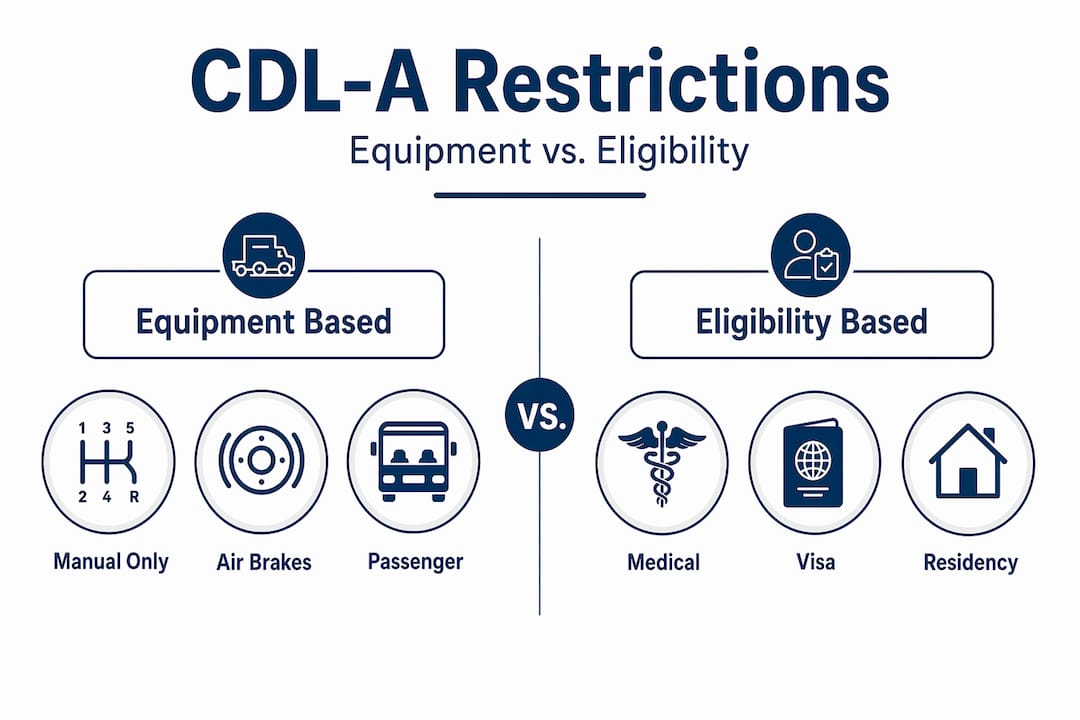
CDL restrictions fall into a few broad categories:
- Equipment-based restrictions: Applied when the test vehicle lacked a feature standard to the CDL class, such as manual transmission or full air brakes.
- Medical restrictions: Issued when a driver's health condition requires monitoring or limits the duration of their medical certificate.
- State-specific restrictions: Some states add codes based on local regulations or the specific operation type listed during licensing.
Federal rules through the FMCSA set the minimum standard for CDL-A driver regulations, but states can add requirements on top of that floor. That is why a restriction applied in one state may not have an equivalent in another, which creates confusion for drivers who relocate or apply across state lines.
Pro Tip: If you are unsure what each restriction code on your license means, contact your state's DMV or motor vehicle division directly. Ask for a written explanation. Having that documentation is useful when speaking with carriers who question your license status.
Common CDL-A restriction codes and their career impact
The restriction code printed on your license has a direct and measurable effect on which employers will consider you. Many carriers treat certain restriction codes as automatic disqualifiers, regardless of how clean your driving record is.
Here are the most common restriction codes and what they mean operationally:
| Code | Restriction | Operational impact |
|---|---|---|
| E | No manual transmission | Cannot operate most older fleet trucks or those requiring a manual gearbox |
| L | No full air brakes | Cannot operate most Class A commercial vehicles with standard air brake systems |
| O | No fifth wheel | Cannot pull standard semi-trailers, which eliminates most linehaul roles |
| Z | No airbrakes (any) | Combined restriction covering both air-over-hydraulic and full air brakes |
| V | Medical variance required | Must carry additional documentation confirming exemption status |
The L restriction and the O restriction carry the most weight in freight trucking. Carriers often reject drivers with these codes immediately because their operations depend on fifth-wheel trailers and air brake systems exclusively. A driver with an O restriction cannot legally pull a standard flatbed or dry van trailer, which rules out the majority of CDL-A positions.
The E restriction is the most common. Driving schools that use automatic transmission trucks to train students produce graduates with an E restriction automatically. It does not mean the driver is less skilled overall. It means their automatic-only test result is on record.

What makes this consequential is that fleets sometimes miss these codes during hiring. If a driver with an L restriction gets placed in a vehicle with full air brakes and is stopped during a roadside inspection, the result is an out-of-service order and potential liability for the carrier. That risk is exactly why compliance-focused carriers screen restriction codes before extending any offer.
2026 FMCSA rule changes for non-domiciled drivers
The CDL landscape shifted significantly in 2026. Non-domiciled CDL eligibility is now restricted to holders of H-2A, H-2B, or E-2 visas under the FMCSA Final Rule that took effect this year. Drivers with other work authorizations who previously held valid non-domiciled CDLs no longer qualify for renewal under federal standards.
The scale of the change is significant. California alone canceled approximately 13,000 non-domiciled CDLs following the rule. Other high-population states with large immigrant driver workforces saw similar reductions.
The rationale behind the rule centers on verification. States lack access to foreign driving histories, which creates inconsistent background checks compared to those conducted for U.S. citizens. The new rule aims to close that gap by limiting eligibility to visa categories where identity and stay duration are more reliably tracked.
For drivers who still qualify, the compliance process is more involved now:
| Requirement | Details |
|---|---|
| Verification system | States must use the SAVE system to confirm immigration status at renewal |
| Document retention | States must keep supporting documentation for at least two years |
| Renewal timing | License cannot be extended beyond the driver's authorized stay date |
| In-person renewal | Non-domiciled drivers must renew in person; no remote or mail-in renewal allowed |
Medical certification for non-domiciled drivers adds another layer. Medical certification durations are tied to both health management and visa expiration, so a driver whose visa expires in six months will receive a medical certificate valid only through that date, even if their health status would otherwise support a two-year certification.
Critics of the rule point out a real operational concern. Reducing non-domiciled drivers from the available workforce could push carriers toward less experienced drivers, which raises its own safety and pricing concerns. Carriers operating FedEx-contracted routes in states with large affected driver populations are already adjusting their recruiting strategies.
Pro Tip: If you are a non-domiciled driver affected by these changes, consult an immigration attorney and your state's CDL authority before your renewal date. Acting early gives you the clearest picture of your options and prevents a lapse in licensing that could pause your career.
How to remove restrictions from your CDL-A
The process for removing equipment-based CDL-A license limitations is more accessible than most drivers realize. It does not require appealing to a regulatory body or submitting paperwork for review. You simply retest.
Here is how the process works for the most common restrictions:
- Identify which restrictions you have. Pull your current CDL and note every code listed. Check your state's DMV website to confirm what each code means for your license class.
- Locate a vehicle that meets the requirement. To remove the E restriction, you need access to a manual transmission commercial vehicle. To remove the L restriction, you need a truck with full air brakes. Some driving schools rent test-ready vehicles for this purpose.
- Schedule a skills retest with your state DMV. You will typically need to pass the pre-trip inspection, basic vehicle control, and road test components again in the qualifying vehicle.
- Submit documentation and pay applicable fees. Once you pass, the state will update your CDL record and remove the restriction code. Processing time varies by state.
- Verify the update before applying to jobs. Request a copy of your updated MVR to confirm the restriction has been removed before submitting applications to carriers.
Medical restrictions follow a different path. If a condition like sleep apnea or hypertension has been well-managed, your medical examiner may extend the certification period during your next DOT physical. Conditions like epilepsy or seizure disorders can reduce that window to as little as one, three, or six months depending on treatment status and documentation. Consistent follow-up with your treating physician and timely submission of updated records to your medical examiner is the most reliable way to maintain or extend certification.
Pro Tip: If you are still in CDL-A training, choose your test vehicle strategically. Testing in a manual transmission truck with full air brakes from day one gives you a clean license with no equipment restrictions. That single decision affects every job you apply for.
For aspiring drivers preparing for their skills test, the vehicle used in skills testing shapes what you can legally operate after passing. Choosing a training program that uses fully equipped vehicles is not just about better preparation. It is about protecting the earning potential of your license from the moment you receive it.
My take on how drivers should approach restrictions
I have seen drivers walk away from solid career opportunities because a restriction code on their license scared off a recruiter. What I have also seen is drivers who treated that restriction as a solvable problem, retested, got it removed, and came back with a clean license ready for any role.
The honest reality is that many restrictions exist because of how driving schools structure their training programs, not because of anything a driver did wrong. Automatic transmission trucks are cheaper to maintain and easier to teach in. Schools default to them. Graduates pay for that choice with an E restriction they did not fully understand they were getting.
What I find frustrating is that neither schools nor licensing authorities do a good job explaining this before the skills test. Drivers find out about the impact of their restrictions when a carrier rejects them, not when the restriction could have been avoided. That gap in communication is real, and it costs drivers time and money.
My advice is straightforward. If you have restrictions, find out exactly which ones you have and whether they are equipment-based or medical. Equipment-based restrictions are fixable. Medical ones require ongoing management. Do not assume a restriction is permanent. And if you are entering the field now, look at what vehicle your school uses for the skills test and ask directly whether testing in that vehicle will result in any restriction codes on your CDL.
Carriers hiring for CDL-A team and solo roles need drivers with clean, unrestricted licenses. That demand is not going to change. Getting ahead of your restrictions is one of the highest-value things you can do for your career right now.
— Aaron
Find CDL-A opportunities through Ucep
Ucep is built specifically for CDL-A drivers and the Service Providers contracted with FedEx who need to hire them. If you are job searching with a clean license or working through a restriction removal, knowing which employers are worth pursuing matters.
Use Ucep's service provider reviews to see how drivers rate employers before you apply. You can also browse the Ucep driver job board to find CDL-A linehaul, team, solo, and pickup and delivery roles from FedEx-contracted Service Providers nationwide. Every listing on Ucep is relevant to your license class and focused on the FedEx network, which means less noise and more opportunities that actually match what you are qualified to run.
FAQ
What causes most CDL-A license restrictions?
Most CDL-A restrictions come from the type of vehicle used during the skills test. If a driver tested in an automatic transmission truck, an E restriction is automatically applied because manual transmission competency was never verified.
Can CDL-A restrictions be permanently removed?
Yes. Equipment-based restrictions like E, L, and O can be removed by retesting in a vehicle with the required feature. Once you pass the skills test in a compliant vehicle, the state updates your CDL record and removes the code.
What is the impact of violations on CDL status versus restrictions?
Restrictions and violations are separate issues. Restrictions relate to testing vehicle and medical status. Violations such as DUI or reckless driving convictions can lead to CDL disqualification or suspension, which is a different and more serious consequence than a restriction code.
How does the 2026 FMCSA rule affect non-domiciled CDL holders?
The FMCSA Final Rule effective in 2026 limits non-domiciled CDL eligibility to H-2A, H-2B, and E-2 visa holders. Drivers holding other work authorizations no longer qualify for CDL renewal under the updated federal standard.
Do medical restrictions expire or change over time?
Medical restrictions can improve or worsen depending on how well a condition is managed. A standard DOT physical is valid for 24 months, but conditions like sleep apnea or epilepsy can shorten that to as little as one month until better documentation is provided to the examiner.