
A pre-employment screening is a set of role-relevant checks employers use to verify a candidate's identity, work history, credentials, and fitness to perform a job before a final hiring decision is made. According to GCheck citing PBSA and HR Research Institute data, approximately 93% of organizations conduct some form of background check. That makes understanding the process useful for both sides of the hiring table.
Common checks include:
- Identity verification — confirms you are who you say you are
- Employment and education verification — confirms dates, titles, and degrees
- Criminal record searches — county, state, and federal databases
- Drug and alcohol testing — especially for safety-sensitive roles
- Medical or DOT physical exams — typically post-conditional offer
- Motor vehicle record (MVR) checks — required for driving roles
One important note: a screening does not guarantee a job offer. Checkr's pre-employment screening guide confirms that many checks, especially medical exams, occur only after a conditional offer is extended. Employers using third-party consumer reporting agencies must comply with the Fair Credit Reporting Act (FCRA), which requires standalone disclosure, written consent, and a two-step adverse action process. The EEOC also limits how criminal history and medical information can be used in hiring decisions.
Table of Contents
- What types of pre-employment screenings are there?
- What U.S. laws govern the employment screening process?
- When do pre-employment checks happen, and how long do they take?
- How should job seekers prepare for pre-employment checks?
- What happens at a pre-employment medical screening or DOT physical?
- How do you dispute errors in a pre-employment background check?
- What CDL drivers and service providers need to know about driver screening
- A practical employer checklist for compliant pre-employment screening
- Key Takeaways
- Transparent screening builds better hiring outcomes
- Ucep helps FedEx service providers hire qualified drivers
- Useful sources for further reading
What types of pre-employment screenings are there?
Pre-employment checks vary by role, industry, and employer. Below is a breakdown of the most common types, what each verifies, and who typically performs it.
| Screening Type | What It Verifies | Typical Provider |
|---|---|---|
| Identity verification | Government-issued ID, SSN trace | Consumer reporting agency (CRA) |
| Employment verification | Job titles, dates, separation reason | CRA or direct employer contact |
| Education verification | Degrees, certifications, enrollment dates | CRA or institution directly |
| Criminal record search | County, state, federal criminal history | CRA using court records |
| MVR check | Driving history, license status, violations | State DMV via CRA |
| Credit check | Credit history, debt levels | CRA (role-dependent) |
| Drug/alcohol test | Substance presence in urine, hair, or blood | Certified lab, urgent care clinic |
| DOT physical exam | Medical fitness for commercial driving | FMCSA-certified medical examiner |
| Immunization/TB/vision/hearing | Health status for regulated roles | Occupational health clinic |
| OIG exclusion check | Federal healthcare program exclusions | OIG exclusions database |
| Social media/online reputation | Public conduct, professional consistency | Internal HR or third-party tool |
A few details worth knowing about specific check types:
- Credit checks are typically reserved for finance, accounting, or executive roles where fiduciary responsibility is part of the job. Running them broadly without role justification creates legal exposure.
- MVR checks pull your driving record directly from the state DMV and are standard for any position that involves operating a vehicle, including CDL-A and pickup and delivery roles.
- OIG exclusion checks are required for healthcare and federally funded roles. The OIG exclusions list identifies individuals and entities barred from participating in federal healthcare programs.
- Drug testing for safety-sensitive transportation roles follows Department of Transportation (DOT) rules, which specify which substances are tested, the testing method (urine), and chain-of-custody requirements. The National Safety Council's workforce drug testing guidance recommends that drug testing programs be documented, role-relevant, and consistently applied.
Most background checks are conducted by FCRA-regulated consumer reporting agencies. These agencies compile data from court records, DMV databases, credit bureaus, and educational institutions. Employers are not permitted to run certain checks (like credit or criminal) without proper disclosure and consent under the FCRA.
What U.S. laws govern the employment screening process?
The legal framework for pre-employment screening in the United States involves four primary sources: the FCRA, EEOC guidance, the ADA, and GINA. Each applies at a different stage of the process.
FCRA obligations
The Fair Credit Reporting Act applies whenever an employer uses a third-party consumer reporting agency to run a background check. Employers must:
- Provide a standalone disclosure to the candidate before ordering the report. Bundling this disclosure into general application paperwork is a common and costly compliance error.
- Obtain written authorization from the candidate before the check begins.
- Follow a two-step adverse action process if the report may lead to a negative hiring decision: first, send a pre-adverse action notice with a copy of the report and a Summary of Rights; then, after allowing a reasonable response period, send a final adverse action notice if the decision stands.
Checkr's background check guide recommends allowing at least 5 business days between the pre-adverse notice and the final adverse action decision. Many FCRA failures happen not because the checks themselves are improper, but because employers skip or bundle these procedural steps.
EEOC guidance on criminal history
The EEOC's background check guidance warns that blanket criminal-record exclusions can create disparate impact against protected classes. Employers should:
- Apply criminal-history screening consistently across candidates for the same role.
- Conduct individualized assessments that consider the nature of the offense, how long ago it occurred, and its direct relevance to the job.
- Avoid automatic disqualification policies that do not account for job relevance.
ADA and GINA limits
The Americans with Disabilities Act (ADA) prohibits employers from asking disability-related questions or requiring medical exams before a conditional offer is made. After a conditional offer, medical exams are permitted, but only if they are required of all candidates for that role. The Genetic Information Nondiscrimination Act (GINA) prohibits employers from requesting or using genetic information in hiring decisions.
Pro Tip: Never ask about a candidate's medical history, medications, or disabilities during the interview or pre-offer stage. Medical inquiries belong strictly to the post-conditional-offer phase, and even then, they must apply uniformly to all candidates in that role.
State law variations
Many states layer additional requirements on top of federal law. Some states restrict the use of credit checks for employment, limit how far back criminal records can be considered, or require specific timing for adverse action notices. Employers should review applicable state law or consult legal counsel before finalizing their screening policy. The Littler legal brief on background screening provides practitioner-level guidance on navigating these federal and state compliance layers.
Employer compliance checklist:
- Apply all checks consistently across candidates for the same role
- Document the role-relevance rationale for each check type used
- Never ask medical or disability-related questions before a conditional offer
- Do not request Form I-9 documentation during pre-screening or interviews; I-9 verification is strictly post-hire
- Keep signed consent forms and audit trails for every screening
- Use FCRA-regulated vendors and verify their dispute-handling procedures
When do pre-employment checks happen, and how long do they take?
The timing of pre-employment checks follows a defined sequence. Not all checks happen at the same stage, and the order matters for legal compliance.
Typical process flow:
- Define role-relevant checks based on job duties
- Extend a conditional offer (required before medical exams or DOT physicals)
- Issue standalone FCRA disclosure and obtain written consent
- Verify identity
- Run role-relevant background checks (criminal, MVR, employment/education)
- Conduct drug testing and medical exams (post-conditional offer)
- Adjudicate results consistently against documented criteria
- If results may affect the decision, follow the FCRA adverse action process
Medical exams and DOT physicals must come after a conditional offer, per ADA requirements. Other checks, such as criminal searches and employment verification, can occur earlier, provided disclosure and consent have been obtained. ALTRES's employer screening overview confirms that separating skill assessments from background and medical checks reduces both bias and legal exposure.
Typical turnaround times:
| Check Type | Typical Turnaround |
|---|---|
| Identity verification | Instant to 1 business day |
| Employment/education verification (database) | 1–3 business days |
| Criminal record search | 1–5 business days (varies by jurisdiction) |
| Education verification (manual) | 3–10 business days |
| Drug test (urine, standard) | 1–3 business days (negative); up to 7 days if confirmed positive |
| DOT physical exam | Same day (documentation processing may take 1–3 days) |
| MVR check | 1–3 business days |
| Credit check | 1–2 business days |
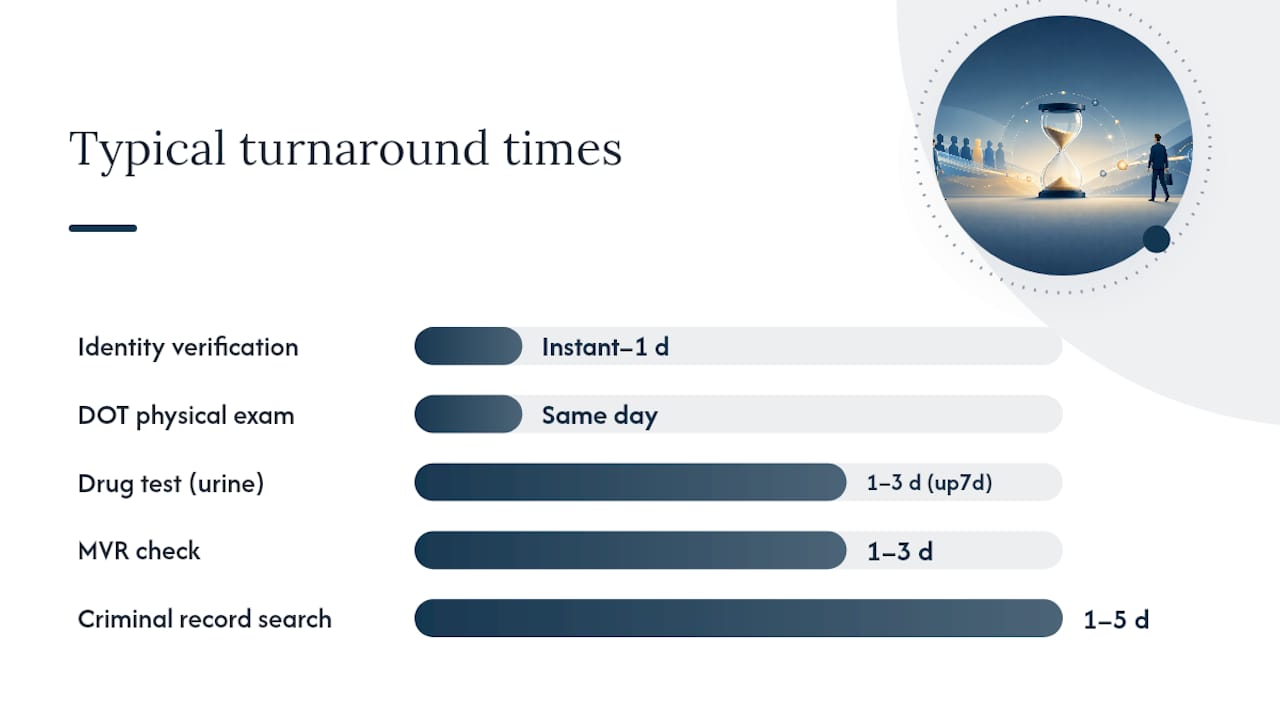
Delays are most common with criminal searches in jurisdictions that require manual court record retrieval, and with education verification when institutions require direct contact. Building a realistic timeline into your hiring process avoids gaps between offer and start date.
How should job seekers prepare for pre-employment checks?
Preparation reduces the chance of delays or surprises. Most issues that derail a screening are avoidable with a little advance work.
Candidate preparation checklist:
- Gather your documents. Bring a government-issued photo ID, Social Security card, and any professional licenses or certifications relevant to the role.
- Confirm your employment history. Know your exact job titles, employment dates, and supervisor names. Discrepancies between what you report and what employers verify are a common flag.
- Check your own background report. You can request a free copy of your consumer report from major CRAs. Review it for errors before an employer does.
- Pull your MVR. If you are applying for a driving role, request your motor vehicle record from your state DMV. Know what is on it before the employer does.
- Verify your education records. Confirm that your institution can verify your degree or enrollment. Some schools require a release form before releasing records to third parties.
- Prepare for drug testing. Avoid substances that could produce a positive result. For DOT-regulated roles, understand which substances are tested and what the chain-of-custody process involves.
- Gather medical documentation if needed. If you have a condition that requires accommodation, prepare documentation from your healthcare provider. You do not need to disclose this before a conditional offer.
Common reasons candidates run into problems:
- Positive drug or alcohol test results
- Undisclosed or misrepresented criminal convictions
- Falsified employment titles, dates, or education credentials
- DMV infractions or license suspensions (critical for driving roles)
- Mismatched identity data (name variations, address discrepancies)
Pro Tip: If you know your background report contains an error, dispute it with the reporting agency before you apply. Correcting an error takes time, and waiting until an employer flags it puts you in a reactive position.
For candidates applying to CDL or delivery driver roles, reviewing the CDL drug testing requirements guide gives you a clear picture of what DOT-regulated testing involves before you walk into a clinic.
What happens at a pre-employment medical screening or DOT physical?
Medical screenings range from a basic health check to a full DOT physical, depending on the role. Understanding what each involves helps you prepare and avoids surprises on the day.

Standard employer medical exams
For non-DOT roles, employers may require a functional capacity exam, vision and hearing tests, or immunization and TB screening, particularly in healthcare, education, or safety-sensitive environments. These exams are conducted at occupational health clinics or urgent care facilities. Common components include:
- Blood pressure and pulse measurement
- Vision acuity and color vision testing
- Hearing assessment (audiometry)
- Urinalysis (often combined with drug screening)
- TB skin test or blood test (QuantiFERON) for healthcare or school roles
- Functional capacity tests for physically demanding positions (lifting, range of motion)
ADA rules apply: the employer cannot ask about your medical history or require a medical exam before a conditional offer. Once the offer is made, the exam must be required of all candidates for that role, not just selected individuals.
DOT physicals for CDL drivers
Commercial drivers operating vehicles over 10,001 pounds in interstate commerce are required by the Federal Motor Carrier Safety Administration (FMCSA) to hold a valid Medical Examiner's Certificate. The DOT physical is conducted by an FMCSA-certified medical examiner and covers:
- Vision (minimum 20/40 acuity in each eye with or without correction)
- Hearing (ability to perceive a forced whispered voice at 5 feet)
- Blood pressure and cardiovascular health
- Urinalysis for glucose and protein
- Review of medical history for conditions that may affect safe driving
The exam is typically completed in a single appointment. The medical examiner submits results to the FMCSA National Registry, and the driver receives a Medical Examiner's Certificate valid for up to 24 months (shorter if a condition requires monitoring).
Candidate preparation steps for medical exams:
- Bring a current list of all medications, including dosages
- Bring your glasses or contact lenses if you use them for vision correction
- Bring your hearing aids if applicable
- Wear comfortable clothing if a functional capacity or physical test is included
- Be honest about medical conditions; misrepresenting your health status can void your certificate
- Ask for a copy of your results at the end of the appointment
GINA prohibits employers from requesting genetic information during any stage of the hiring process, including medical exams. If a medical examiner asks questions that seem to go beyond the scope of the exam, you have the right to ask what the information will be used for.
How do you dispute errors in a pre-employment background check?
Errors in background reports happen. Court records get misattributed, name variations cause false matches, and outdated information sometimes appears. The FCRA gives you a clear path to correct them.
Step-by-step dispute process:
- Obtain a copy of your report. Under the FCRA, if an employer takes adverse action based on a consumer report, they must provide you with a copy of that report and a Summary of Rights before the final decision is made.
- Identify the inaccurate items. Review each entry carefully. Note the specific record, date, or data point that is wrong.
- File a dispute with the consumer reporting agency. Submit your dispute in writing, identify the inaccurate information, and include supporting documents (court records, pay stubs, diplomas, DMV records, or drug test chain-of-custody paperwork).
- File a dispute with the employer if needed. If the employer has already received the report, notify them in writing that you are disputing specific items and that you have filed with the CRA.
- Track the timeline. The CRA has 30 days to investigate and respond. Keep records of all correspondence.
- Follow up on the hiring decision. If the employer issued a pre-adverse action notice, respond promptly. The recommended window before a final adverse action notice is issued is at least 5 business days, per Checkr's background check guidance.
Documents to gather for a dispute:
- Government-issued photo ID
- Court disposition documents (for criminal record errors)
- Pay stubs or W-2s (for employment history errors)
- Official transcripts or diplomas (for education errors)
- DMV records (for MVR errors)
- Drug test chain-of-custody paperwork (if the test result is disputed)
Pre-adverse vs. final adverse action:
The FCRA requires a two-step process. First, the employer sends a pre-adverse action notice with the report and Summary of Rights. You then have a reasonable period to respond or dispute. Only after that window closes can the employer send a final adverse action notice. Skipping the pre-adverse step is one of the most common FCRA violations employers face. The FCRA statute and the EEOC's employer guidance both address candidate rights in this process.
What CDL drivers and service providers need to know about driver screening
Driver-specific screening goes beyond a standard background check. CDL applicants and the service providers who hire them face an additional compliance layer under FMCSA and DOT rules.
Driver-specific checks:
- DOT physical and Medical Examiner's Certificate — required for all CDL drivers operating in interstate commerce; must be current and on file with the employer
- FMCSA Drug and Alcohol Clearinghouse query — employers must query the Clearinghouse before hiring a CDL driver and annually thereafter; drivers must provide electronic consent for full queries
- MVR check — typically covers 3–5 years of driving history; employers look for license suspensions, DUIs, serious traffic violations, and at-fault accidents
- DOT pre-employment drug test — a negative result is required before a CDL driver can operate a commercial motor vehicle; urine testing is the DOT-mandated method
- Previous employer drug and alcohol history — employers must request drug and alcohol testing records from all DOT-regulated employers in the past 3 years
- Skills or road test — some service providers require a hands-on driving assessment in addition to the formal checks
What drivers should prepare:
- A current, valid CDL with the correct endorsements for the role (e.g., HazMat, tanker, doubles/triples)
- A valid Medical Examiner's Certificate
- Consent for a full FMCSA Clearinghouse query
- A recent MVR from your state DMV
- Contact information for all DOT-regulated employers in the past 3 years
What hiring managers should request from driver candidates:
- Signed Clearinghouse consent form before the query is run
- Copy of current Medical Examiner's Certificate
- MVR from the state of licensure
- Completed previous employer drug and alcohol history request forms
Pro Tip: If you have a prior drug or alcohol violation in the FMCSA Clearinghouse, you must complete a return-to-duty process with a Substance Abuse Professional (SAP) before you can legally operate a commercial motor vehicle again. Disclosing this proactively and showing documentation of completed SAP follow-up strengthens your application rather than weakening it.
Ucep's blog covers driver recruiting red flags that service providers commonly encounter during screening, and the common mistakes in CDL hiring guide walks through compliance pitfalls that slow down or derail driver onboarding.
A practical employer checklist for compliant pre-employment screening
Running a defensible screening process requires consistency at every step. The following checklist covers the full workflow from role definition to recordkeeping.
Step-by-step employer checklist:
- Define role-relevant checks. Document which checks apply to each role and why. A delivery driver role justifies an MVR check and DOT physical; a warehouse role may not.
- Write and maintain a screening policy. The policy should specify which checks are run for which roles, how results are adjudicated, and how adverse action is handled.
- Select an FCRA-regulated vendor. Verify that your screening partner maintains FCRA compliance, has documented dispute-handling procedures, and provides accuracy guarantees in their contract.
- Issue a standalone FCRA disclosure. Provide the disclosure as a separate document before ordering any consumer report. Do not bundle it with the application or offer letter.
- Obtain written authorization. Get signed consent before running any check. Keep the signed form on file.
- Verify identity first. Confirm the candidate's identity before running any other checks to reduce the risk of misattributed records.
- Run role-relevant checks only. Limiting checks to what the role requires reduces legal exposure and candidate friction.
- Adjudicate results consistently. Apply the same criteria to all candidates for the same role. Document your rationale, especially when a finding does not result in disqualification.
- Follow the FCRA adverse action process. If a report may affect your decision, send the pre-adverse notice with the report and Summary of Rights, allow at least 5 business days, then send the final adverse action notice if the decision stands.
- Maintain records. Keep consent forms, adjudication notes, adverse action correspondence, and vendor contracts for the period required by applicable law.
Recordkeeping and policy tips:
- Store consent forms and adverse action notices separately from the general personnel file
- Document adjudication rationale in writing for every case where a finding was reviewed
- Audit your screening process annually to confirm consistent application across roles
Vendor selection criteria:
- Confirm FCRA compliance and accreditation (e.g., PBSA-accredited agencies)
- Review dispute resolution workflows and accuracy correction timelines
- Verify that the vendor's data sources are current and jurisdiction-specific
- Check that the vendor can support role-specific check packages (e.g., DOT-compliant drug testing, FMCSA Clearinghouse queries)
For employers hiring pickup and delivery drivers, the pickup and delivery driver hiring tips guide covers candidate screening steps specific to that role type.
Key Takeaways
Pre-employment screening is a legally governed process that requires employer compliance with the FCRA, EEOC guidance, ADA, and GINA, while giving candidates clear rights to disclosure, consent, and dispute.
| Point | Details |
|---|---|
| FCRA compliance is procedural | Employers must issue standalone disclosure, get written consent, and follow the two-step adverse action process before any negative hiring decision. |
| Medical exams are post-offer only | ADA rules require that medical exams and disability-related questions come only after a conditional offer is extended, applied uniformly to all candidates. |
| Candidates can dispute errors | Under the FCRA, candidates have the right to receive a copy of their report, dispute inaccurate items with the CRA, and respond before a final adverse action is issued. |
| Driver screening has extra requirements | CDL drivers face DOT physicals, FMCSA Clearinghouse queries, MVR checks, and DOT pre-employment drug tests on top of standard background checks. |
| Ucep supports driver hiring | Ucep's job board and resources help FedEx Service Providers find qualified CDL-A and delivery drivers while providing guidance on compliant screening practices. |
Transparent screening builds better hiring outcomes
The part of pre-employment screening that most guides underemphasize is communication. Employers spend significant effort on compliance mechanics, and rightly so, but the candidate experience during screening is where hiring outcomes actually diverge.
When candidates understand what will be checked, why it matters for the role, and what their rights are if something comes back unexpected, they are less likely to withdraw from the process. That matters most in driver hiring, where qualified candidates have multiple offers and a slow or opaque screening process is enough to push them toward a competitor. A service provider that explains upfront that a DOT physical, MVR check, and Clearinghouse query are required, and gives candidates a realistic timeline, will see fewer drop-offs between offer and start date.
The other underappreciated point is that most FCRA failures are not intentional. They happen because someone bundled the disclosure into the application packet, or because the hiring manager sent a rejection email before the pre-adverse notice went out. Building a documented process, not just knowing the rules, is what prevents those errors. Consistency is the protection.
For employers in the FedEx contractor space, where driver turnover is a real operational cost, a clear and fair screening process is also a signal to candidates about how the company operates. Drivers talk. A service provider known for a professional, transparent hiring process attracts better applicants over time.
Ucep helps FedEx service providers hire qualified drivers
Ucep is a dedicated job board and recruiting platform built exclusively for Service Providers contracted with FedEx. If you are hiring CDL-A team drivers, CDL-A solo drivers, linehaul drivers, or pickup and delivery drivers, Ucep gives you a focused place to post jobs, manage applicants, and research candidates, without sorting through listings unrelated to your operation.
Drivers use Ucep to find FedEx-related opportunities nationwide, browse employer profiles, and read internal reviews from other drivers and service providers. For hiring managers, the platform includes an applicant tracking system, targeted driver alerts, and employer directory tools designed for the FedEx contractor market specifically.
Post your first driver job or browse hiring resources at ucep.co.
Useful sources for further reading
The following authoritative sources were used to build this guide. Each covers a specific area of pre-employment screening law, practice, or compliance.
- What To Expect from a Pre-Employment Screening
- How to Run Employment Background Checks | Checkr
- Background Checks: What Employers Need to Know | U.S. Equal Employment Opportunity Commission
- Fair Credit Reporting Act | Federal Trade Commission
- How to Run Employment Background Checks for Hiring Success
- Pre‑Employment Screening: An Employer’s Complete Overview - ALTRES
- Littler — Background screening and privacy rights in hiring (PDF)
- OIG Exclusions
- NSC — Workforce drug testing guidance (PDF)
This article provides general information about pre-employment screening in the United States. It is not legal advice. Consult a qualified employment attorney or HR professional to confirm how current federal and state requirements apply to your specific situation.