
CDL drivers who operate commercial motor vehicles (CMVs) in interstate commerce must hold a valid Medical Examiner's Certificate (ME Certificate) that meets FMCSA physical qualification standards. The exam must be performed by a clinician listed on the FMCSA National Registry of Certified Medical Examiners. Certificates are valid for up to 24 months, though examiners may issue shorter ones when monitoring is needed. Here is the driver medical exam requirements list at a glance:
What drivers must have and do:
- A valid ME Certificate (Form MCSA-5876) issued by a National Registry examiner
- Self-certification filed with your State Driver Licensing Agency (SDLA) if you hold a CDL
- Government-issued ID, current driver's license, and a complete medication list at the exam
- Corrective lenses, hearing aids, or CPAP compliance reports if applicable
What employers must do before dispatch:
- Confirm the driver's medical status and expiration date through the CDLIS or state MVR
- Obtain and file a copy of the driver's ME Certificate in the qualification file
Pro Tip: Schedule the exam at least 30 days before your current certificate expires. That window gives you time to gather specialist letters or CPAP reports if the examiner requests them, and prevents any lapse in commercial driving privileges.
Key Takeaways
CDL drivers operating CMVs in interstate commerce must hold a valid ME Certificate issued by a National Registry examiner, self-certify with their SDLA, and renew before the certificate expires to avoid automatic CDL downgrade.
| Point | Details |
|---|---|
| Who needs the certificate | CDL holders and interstate CMV drivers with GVWR above 10,001 lb must hold a current ME Certificate. |
| Who can issue it | Only clinicians listed on the FMCSA National Registry of Certified Medical Examiners may issue a valid ME Certificate. |
| Certificate validity | Standard maximum is 24 months; examiners may issue 3- or 6-month certificates when monitoring a condition. |
| Self-certification and SDLA filing | CDL holders must self-certify their driving category and submit the ME Certificate to their SDLA before expiry. |
| Biggest avoidable mistake | Letting a certificate lapse or failing to file with the SDLA triggers automatic CDL downgrade and a federal compliance violation. |
Table of Contents
- Which drivers must get a DOT medical exam?
- Who can perform your DOT physical exam?
- What does the DOT physical exam check?
- What conditions can disqualify you, and are there exemptions?
- How long is a medical certificate valid, and when do you renew?
- What should you bring to the DOT physical exam?
- What happens after the exam: forms, self-certification, and state filing
- Employer checklist for managing driver medical compliance
- Sources
Which drivers must get a DOT medical exam?
The federal threshold is straightforward: if you operate a CMV in interstate commerce with a gross vehicle weight rating (GVWR) above 10,001 pounds, or if you hold a CDL, you generally need a current ME Certificate. The same applies to vehicles designed to transport 16 or more passengers (including the driver) or any vehicle transporting hazardous materials requiring placards.
CDL holders must also self-certify their driving category with their SDLA. There are four categories:
- Interstate non-excepted: Drives across state lines in full federal CMV service. Requires a current ME Certificate on file with the SDLA.
- Interstate excepted: Drives interstate but only in excepted operations (e.g., transporting farm supplies). No ME Certificate required, but must still self-certify.
- Intrastate non-excepted: Stays within one state but is subject to state CMV medical rules. Must meet state standards, which may mirror or exceed federal ones.
- Intrastate excepted: Stays within one state in excepted operations. No federal ME Certificate required.
State rules for intrastate drivers vary significantly. New York, California, and Tennessee each publish their own procedural guidance. Check your state DMV's CDL medical page for intrastate requirements before assuming federal rules apply to you.
Who can perform your DOT physical exam?
Only a clinician listed on the FMCSA National Registry of Certified Medical Examiners may issue a valid ME Certificate. A licensed physician who is not on the Registry cannot issue a certificate that FMCSA or your SDLA will accept, regardless of their credentials.
Clinician types who may appear on the Registry include:
- Medical doctors (MD) and doctors of osteopathic medicine (DO)
- Physician assistants (PA)
- Advanced practice registered nurses / nurse practitioners (NP)
- Doctors of chiropractic (DC) when listed on the Registry
Exceptions for specific exam components: A licensed ophthalmologist or optometrist may perform the vision portion of the exam. Veterans may use VA-certified examiners in some circumstances.
How to find a certified examiner:
- Use the National Registry search tool at nrcme.fmcsa.dot.gov
- Ask your employer's occupational health partner or safety officer for a preferred provider
- Check your state DMV's list of approved exam locations
Pro Tip: Before your appointment, verify the examiner's Registry status online. Registry listings can lapse if a clinician fails to complete recertification, and a certificate issued by a delisted examiner is invalid.
What does the DOT physical exam check?
The FMCSA Medical Examiner's Handbook frames the DOT exam as a holistic safety assessment, not a simple checklist. Examiners evaluate whether any condition could cause sudden or gradual loss of vehicle control. The exam follows a standard sequence:
- Health history review: You complete Form MCSA-5875 before the exam. The examiner reviews all conditions, surgeries, hospitalizations, and current medications, including over-the-counter and herbal supplements.
- Medications review: Certain medications (sedatives, opioids, some antihypertensives) may raise concerns. Bring the full list with dosages.
- General physical examination: Head, eyes, ears, mouth, throat, cardiovascular system, lungs, abdomen, spine, and extremities.
- Vision test: Distant acuity of at least 20/40 in each eye and binocularly, with or without corrective lenses. Horizontal field of vision must be at least 70° in each eye.
- Hearing test: You must perceive a forced whisper at 5 feet or better with or without a hearing aid, or show an average hearing loss of 40 dB or less at 500, 1,000, and 2,000 Hz in the better ear with or without a hearing aid.
- Blood pressure and pulse: Elevated readings may result in a shorter certificate or a deferral.
- Neurological screen: Reflexes, coordination, and history of seizures or loss of consciousness.
- Condition-specific checks: Drivers with sleep-disordered breathing, diabetes, or cardiovascular conditions may face additional screening or documentation requests.
The numeric thresholds under §391.41 are fixed federal standards. The table below summarizes the key ones:
| Exam Component | Federal Standard |
|---|---|
| Distant visual acuity (each eye) | 20/40 or better, with or without correction |
| Binocular visual acuity | 20/40 or better |
| Horizontal field of vision | At least 70° in each eye |
| Hearing (forced whisper) | Perceive at 5 ft or better |
| Hearing (audiometric) | Average loss ≤ 40 dB at 500, 1,000, 2,000 Hz in better ear |
Pro Tip: If you use a CPAP machine, bring a 90-day compliance report from your device's data card or app. Examiners who see documented CPAP adherence are more likely to issue a full 24-month certificate rather than a 3- or 6-month monitoring certificate.

What conditions can disqualify you, and are there exemptions?
Several medical conditions disqualify a driver under 49 CFR §391.41. The most common ones include:
- Uncontrolled or symptomatic cardiovascular disease (angina, recent MI, arrhythmias)
- Blood pressure that is consistently Stage 3 hypertensive (180/110 or higher)
- Epilepsy or any condition causing loss of consciousness without warning
- Insulin-treated diabetes mellitus (ITDM) unless the driver holds a federal diabetes exemption
- Respiratory dysfunction that interferes with safe driving
- Current clinical diagnosis of alcoholism or substance use disorder
- Psychiatric conditions that impair judgment or driving ability
- Vision or hearing that does not meet the thresholds above without a waiver
Exemption and variance paths available:
- Skill Performance Evaluation (SPE) certificate: Available for drivers with limb loss or impairment. The driver demonstrates they can safely operate the CMV with adaptive equipment.
- Federal diabetes exemption: Drivers with ITDM who meet specific clinical criteria may apply through FMCSA for an exemption that allows them to drive with a current ME Certificate.
- Vision exemption and Vision Evaluation Report (VER): Drivers who do not meet standard acuity or field-of-vision thresholds may pursue a vision waiver. California's DMV, for example, publishes detailed VER procedures that walk through the alternate standards process.
Pro Tip: A specialist letter that documents stable, well-controlled disease, recent lab results, and a treating physician's opinion on fitness to drive carries real weight with examiners. Bring it to the appointment rather than waiting for the examiner to request it.
How long is a medical certificate valid, and when do you renew?
The standard maximum validity for an ME Certificate is up to two years. Examiners may issue certificates for shorter periods when they need to monitor a condition, such as controlled hypertension or sleep-disordered breathing under treatment.
Key renewal and reporting obligations:
- Schedule your re-exam before expiry. A lapsed certificate means you cannot legally operate a CMV requiring a CDL until a new certificate is issued and filed.
- Submit the updated ME Certificate to your SDLA promptly. CDL holders must keep their state record current. If the SDLA record shows an expired medical status, the state may automatically downgrade or restrict the CDL.
- Short-term certificates require more frequent SDLA updates. A 3-month certificate means you are filing with the SDLA four times a year. Build that into your calendar.
The practical consequence of a lapse is immediate: your CDL medical status in the Commercial Driver's License Information System (CDLIS) will reflect the expiration, and a carrier that pulls your MVR will see the gap. Employers are responsible for verifying current status before dispatch.
What should you bring to the DOT physical exam?
Arriving prepared reduces the chance of a deferred result or a short-term certificate. Bring the following:
- Government-issued photo ID and your current driver's license
- Complete medication list: Every prescription, over-the-counter medication, and supplement with names, dosages, and prescribing physician
- Corrective devices: Glasses, contact lenses, or hearing aids you use while driving
- CPAP mask and compliance report if you are being treated for sleep-disordered breathing (a 90-day download is standard)
- Specialist letters or recent test results for any chronic condition (cardiology, neurology, pulmonology, endocrinology)
- Prior ME Certificates if you are renewing, so the examiner can review your history
- Self-certification forms if your state requires them at the time of the exam (check your SDLA's instructions)
Some states have additional submission steps. New York, for instance, requires drivers to self-certify their driving category and have a USDOT Medical Examiner's Certificate on file with the DMV. Review your state's CDL medical certification page before the appointment.
Pro Tip: Request a printed or digital CPAP compliance report directly from your device's connected app (ResMed myAir, Philips DreamMapper, or similar) the week before your exam. A report that is several months old may not satisfy the examiner's monitoring requirement.
What happens after the exam: forms, self-certification, and state filing
Once the examiner determines you are medically qualified, they complete Form MCSA-5876 (the Medical Examiner's Certificate) and give you a copy. Under §391.43, examiners are required to transmit exam results electronically to FMCSA according to the regulatory schedule.
Steps for CDL holders immediately after the exam:
- Receive your ME Certificate (Form MCSA-5876) from the examiner.
- Log in to your SDLA's portal (or visit in person) and update your self-certification status to reflect your driving category.
- Submit a copy of your ME Certificate to the SDLA before the expiration date on your current certificate.
- Confirm the SDLA has updated your CDL record. You can verify this through your state's MVR or CDLIS inquiry.
Employer action items:
- Pull the driver's MVR or CDLIS record to confirm the medical status and expiration date are current.
- Collect a copy of the ME Certificate and file it in the driver's qualification file.
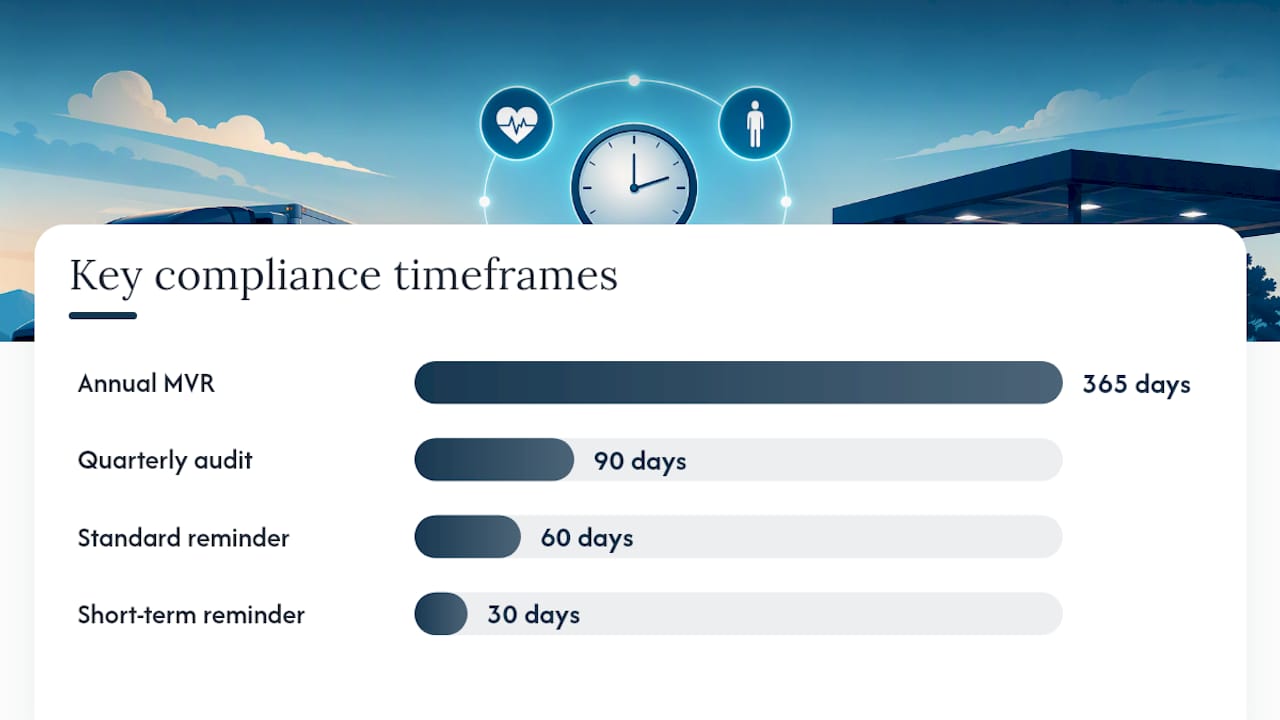
- Log the certificate expiration date in your tracking system and set a reminder at least 60 days out.
For CDL drug testing and other pre-hire documentation that runs parallel to medical certification, the CDL drug testing requirements guide covers the required forms and employer steps in detail.
Employer checklist for managing driver medical compliance
Hiring managers and safety officers carry direct responsibility for verifying medical qualification before a driver operates a CMV. A missed expiration or unfiled certificate is a federal violation. Use this checklist at hire and on an ongoing basis:
At hire:
- Verify the driver's SDLA record (CDLIS) shows a current medical status and a valid expiration date
- Collect and file a copy of the ME Certificate in the driver qualification file
- Confirm the driver's self-certification category matches the type of driving they will perform
- Review the CDL certification types to confirm the correct category applies
During operations:
- Track all ME Certificate expiration dates in a centralized system
- Set automated reminders 60 days before expiration for standard certificates and 30 days before for short-term ones
- Require drivers to submit updated ME Certificates to the SDLA and provide you with a copy before the old certificate expires
- Pull MVRs at least annually (more frequently for short-term certificates) to verify SDLA records are current
Pro Tip: Run a quarterly audit of all driver qualification files. Cross-reference ME Certificate expiration dates against CDLIS records for every driver. For new hires in their first 90 days, check monthly. This single habit catches most compliance gaps before they become violations. The onboarding guide for new CDL drivers includes a step-by-step file checklist that integrates medical verification into the broader onboarding process.
What the DOT exam process reveals about compliance culture
Most drivers and fleet managers treat the DOT physical as a formality. That framing is the root cause of the most common compliance failures: short-term certificates that nobody tracks, SDLA filings that never happen, and disqualifying conditions that surface only when an auditor pulls a driver qualification file.
The FMCSA Medical Examiner's Handbook is explicit that the exam is a safety gatekeeper decision, not a box to check. Examiners are evaluating whether any condition could cause sudden or gradual loss of vehicle control. When a driver arrives without CPAP data, without a specialist letter for a known condition, or without a current medication list, the examiner has no choice but to defer or issue a short-term certificate. That is not a medical outcome; it is a documentation failure.
Employers who build medical-status verification into monthly pre-trip checks and quarterly file audits rarely face compliance violations. Those who rely on drivers to self-report expiration dates almost always do. The administrative steps after the exam, specifically self-certification with the SDLA and employer verification through CDLIS, are where most real-world compliance gaps occur. Getting the physical done is the easy part.
Sources
Use these primary sources for regulatory text, registry searches, and state-specific filing instructions:
Federal sources:
- DOT Medical Exam and Commercial Motor Vehicle Certification | FMCSA
- § 391.41 Physical qualifications for drivers. | 49 CFR Part 391 | FAR/AIM.org
- Govinfo
- CDL Medical Certification - NY DMV
State DMV sources (representative examples):
For all other states, search "[your state] DMV CDL medical certification" to find the SDLA's current filing page. Requirements for intrastate drivers vary, and some states impose standards that go beyond the federal baseline.
This article provides general informational guidance on federal DOT medical certification requirements. It is not a substitute for legal or regulatory advice. Confirm current rules with FMCSA, your state DMV, and a qualified compliance professional before making certification decisions.
Ucep connects FedEx Service Providers with qualified CDL-A drivers across the country. If you are a Service Provider managing driver compliance, the Ucep platform gives you access to driver reviews, employer directories, and applicant tracking tools built for the FedEx network. Browse companies hiring CDL drivers or explore the Ucep network to find compliant, qualified candidates ready to work.