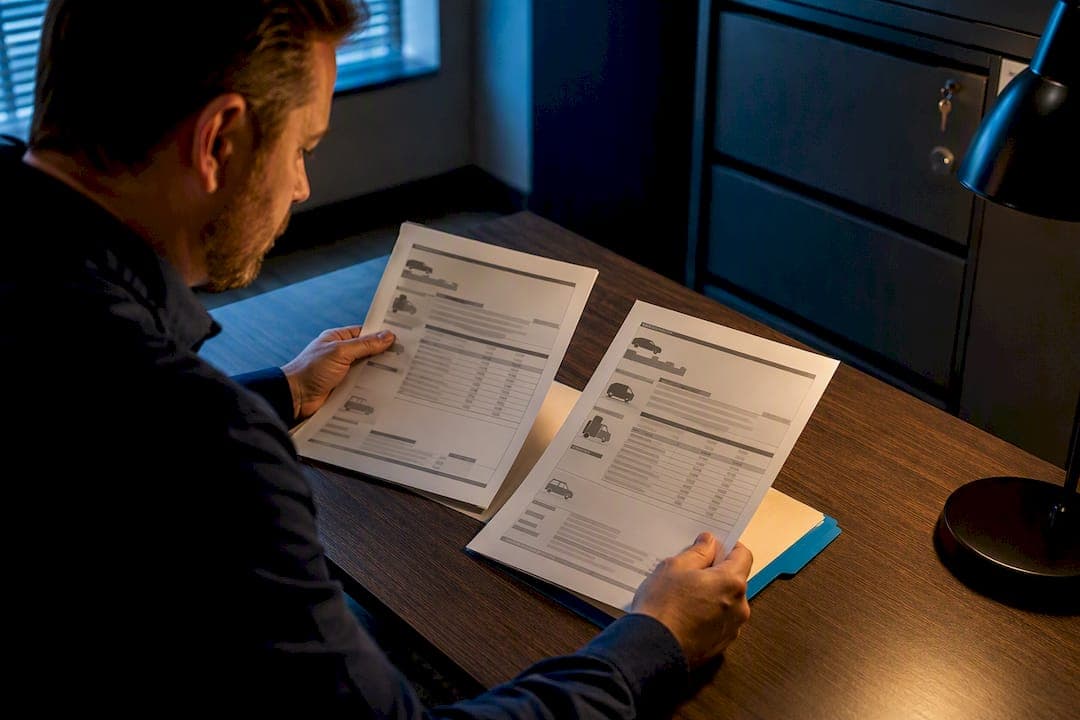
A PSP report is the official FMCSA record of a driver's federal crash and inspection history. You order it at Psp for $10 per record, and it covers five years of crash data and three years of inspection data. Used alone, it tells you very little. Paired with a state MVR and a check of the FMCSA Drug and Alcohol Clearinghouse, it becomes one of the most reliable screening tools a motor carrier has.
TL;DR:
- Ensure drivers are identified with full, accurate details on their license to avoid no-result responses, which can falsely suggest a clean record.
- Pair PSP reports with MVR and FMCSA Drug and Alcohol Clearinghouse checks to get a complete safety profile and avoid relying on an isolated record.
- Review each crash and inspection entry carefully, considering recency and context, rather than automatically disqualifying a driver based on the presence of a report entry.
- Collect all necessary consent forms separately and maintain secure, detailed records of the entire screening process for compliance and potential legal review.
- Order PSP reports after initial screening, no more than 30 days before start date, to ensure recent data and avoid delays or the need for rechecks.
Table of Contents
- Where to Get a PSP Report for Hiring and What It Costs
- What Does a PSP Report Actually Show?
- How Do You Order a PSP Report Step by Step?
- How Should You Interpret PSP Results in a Hiring Decision?
- Record Retention and Compliance Checklist
- Building a PSP Screening Workflow That Doesn't Lose Candidates
- Legal Compliance Beyond FCRA: What Else Applies to PSP Reports
- Common Mistakes Carriers Make With PSP Reports
- What Should You Do If a PSP Report Has an Error?
- When Should You Pull a PSP Report, and How Often?
- What Recruiters Get Wrong About PSP Screening
- How UCEP Helps You Move From Screening to Hiring
- Official PSP Resources and Related UCEP Guides
- Sources
Where to Get a PSP Report for Hiring and What It Costs
You order PSP reports directly at psp.fmcsa.dot.gov, the FMCSA portal built for this exact purpose. The system runs on infrastructure operated by NIC Federal (part of Tyler Technologies), which handles the account processing and payment behind the scenes, but the front door is always the official government site. Third-party resellers exist, and you should avoid them. The Department of Transportation explicitly recommends sticking with the FMCSA-hosted portal rather than outside vendors for data handling reasons.
Each pull costs $10 per driver record, billed through the portal once you have an active account. A few things to know about the account model:
- Monthly Account Holder status is the standard setup for carriers doing regular hiring.
- Payment happens per record at the time of the pull, not as a bulk subscription.
- Account activation typically takes a few business days after FMCSA reviews your registration.
- Larger carriers with high hiring volume can budget PSP costs as a near-fixed line item per applicant.
Set up your account before you need your first report. Waiting until a candidate is ready to start creates unnecessary delay.
What Does a PSP Report Actually Show?
A PSP report splits into two sections: crash history and inspection history. Neither one assigns blame. That single fact trips up more hiring managers than anything else in the document.
Crash entries include the date, the carrier's DOT number at the time, injury and fatality counts, whether a vehicle was towed, and hazmat involvement. The report does not state whether the driver was at fault. It simply confirms the driver was involved.
Inspection entries list the date, the specific violation codes and descriptions, whether the violation triggered an out-of-service order, and whether the violation was tied to the vehicle or the driver personally. A driver violation (hours of service, license issues) carries different weight than an equipment violation the carrier should have caught in maintenance.
FMCSA publishes an official sample report that lays out exactly how these fields appear on the page, including the shorthand codes hiring managers will see repeatedly. Reviewing it once before your first live pull saves confusion later.
The data behind the tool: FMCSA's own safety-impact analysis found that carriers using PSP saw measurable improvements in crash rates and out-of-service rates compared to non-users across several fleet-size classes. That is the evidence behind treating PSP as more than a compliance formality.
How Do You Order a PSP Report Step by Step?
Getting a valid, defensible PSP report follows a specific sequence. Skip a step and you risk either an invalid pull or an FCRA violation.
- Enroll as a Monthly Account Holder. Submit your organization's information through the FMCSA portal and wait for account approval.
- Create a Login.gov account. FMCSA requires multi-factor authentication for all PSP account holders once your enrollment activates.
- Collect a stand-alone FCRA disclosure and authorization. The PSP Disclosure & Authorization form must exist as its own document, separate from the job application. Folding it into a broader application packet creates FCRA exposure.
- Enter the driver's exact identifiers. Full legal name, date of birth, and CDL number, typed exactly as they appear on the license.
- Pay $10 and download the PDF. The report generates instantly once payment clears.
- Save the record. Store the PDF and the signed consent together, not in separate systems.
Pro Tip: A single typo in a name or CDL number will return no results instead of an error message, and it's easy to mistake that for a clean record. Double-check every identifier before you submit, especially on drivers with common names.
How Should You Interpret PSP Results in a Hiring Decision?
PSP data records events. It does not decide who was responsible for them. That distinction should shape every hiring conversation you have around a report that isn't spotless.
Never treat a crash entry as an automatic disqualifier. Ask the candidate about it directly, and request supporting documentation (a police report, an insurance determination) when the entry is serious enough to matter. A driver rear-ended at a stoplight shows up in PSP the same way as a driver who caused a multi-vehicle pileup. Only the follow-up conversation tells you which one you're looking at.
PSP was never designed to work in isolation. Pair it with:
- A state MVR to confirm license status, moving violations, and convictions PSP doesn't track. Our guide on MVR reports covers how the two records complement each other.
- The FMCSA Drug and Alcohol Clearinghouse, which flags disqualifying violations PSP will never show. Related guidance on CDL drug testing requirements walks through this obligation in detail.
When you weigh a PSP entry, factor in recency, severity, whether it's a one-off or part of a pattern, and what the driver says when you ask about it directly.
If PSP influences your decision not to hire someone, FCRA requires a specific sequence: a pre-adverse action notice with a copy of the report, a waiting period for the candidate to respond, and a final adverse-action notice if you proceed. Skipping any step exposes the carrier to legal risk regardless of how accurate the report was.
Document every step of that process, including the reasoning behind your final call.
Record Retention and Compliance Checklist
Retention isn't optional, and sloppy storage is one of the easier ways to lose a negligent-hiring defense you should have won.
- Keep the PSP report and its signed consent form for at least the length of employment plus three years.
- If you took adverse action based on the report, keep those specific records for five years.
- Store files with restricted access and encryption. PSP data qualifies as sensitive personal information.
- Log your evaluation rationale alongside the report itself, not in a separate email thread someone will eventually delete.
Building a PSP Screening Workflow That Doesn't Lose Candidates
Good drivers have options right now, and a screening process that drags for two weeks will cost you candidates to carriers that move faster.
- Collect all consents up front, including the PSP disclosure, MVR authorization, and Clearinghouse query consent, during the initial application step.
- Run PSP, MVR, and Clearinghouse checks in parallel, not sequentially. There's no compliance reason to wait for one before starting the next.
- Schedule the interview immediately, before results even come back, so the candidate isn't sitting idle wondering if you're interested.
- Flag entries that need more information rather than reflexively passing on the candidate. A single inspection violation from three years ago rarely tells the whole story.
Pro Tip: Candidates notice when a carrier takes ten days to run a $10 report. Set an internal target of pulling PSP, MVR, and Clearinghouse results within 48 hours of receiving signed consent, and communicate that timeline to the applicant so they know what to expect.
Request supporting documents only when an entry is genuinely serious: a fatality, a pattern of out-of-service violations, or a recent DUI-related inspection flag. Reflexively demanding paperwork for minor entries slows your pipeline for no real benefit.
Legal Compliance Beyond FCRA: What Else Applies to PSP Reports
FCRA governs consent and adverse action, but it isn't the only rulebook covering PSP use. DOT hiring regulations under 49 CFR Part 391 already require carriers to investigate a driver's safety performance history before qualifying them, and PSP is one accepted way to satisfy part of that obligation, alongside required MVR checks and previous-employer inquiries.
Confidentiality matters just as much as consent. PSP data counts as sensitive personal information about a named individual's driving record, and treating it casually, forwarding it by unencrypted email, printing copies that sit in an unlocked drawer, storing it on a shared drive without access controls, creates exposure independent of anything FCRA covers. Limit access to the people actually making the hiring decision.
There's also a nondiscrimination angle worth stating plainly: PSP entries must be applied consistently across candidates. If your policy is to review any crash entry from the past two years regardless of fault, apply that standard to every applicant, not selectively to some and not others. Inconsistent application of your own screening criteria is a discrimination risk that has nothing to do with the accuracy of the PSP data itself.
Finally, remember that PSP is a federal record, but it doesn't replace state-specific pre-employment requirements some states layer on top. A carrier operating across multiple states should confirm PSP satisfies (or supplements) any state-level screening mandate rather than assuming federal compliance covers everything.
Common Mistakes Carriers Make With PSP Reports
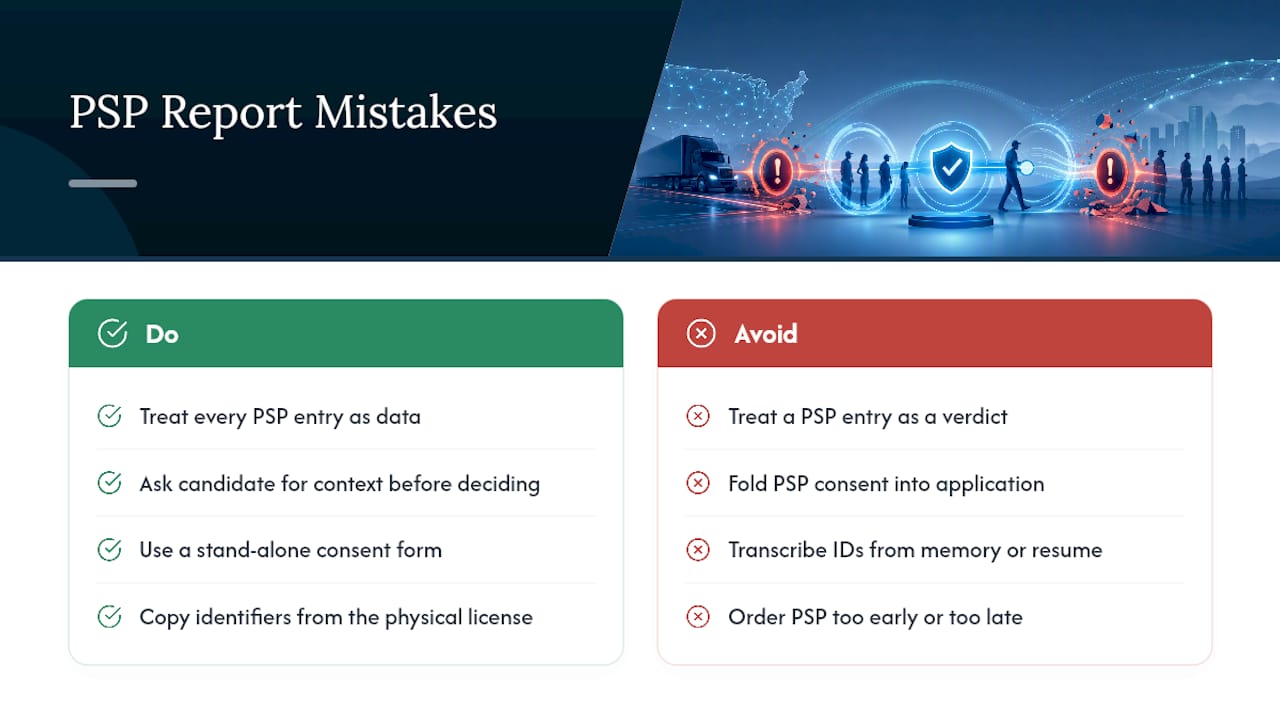
The most common error is treating a PSP entry as a verdict instead of a data point. A crash listed on the report doesn't mean the driver caused it, and an automatic rejection based solely on the entry's existence, without asking the candidate for context, is both unfair and a weak defensive position if ever challenged.
The second mistake is skipping the stand-alone consent form. Some hiring teams fold PSP authorization into a general employment application to save a step. That shortcut can undermine FCRA compliance, since the disclosure has to stand on its own, separate from other application paperwork.
Typos in driver identifiers cause more failed pulls than any system error. A middle initial included on the license but omitted in your form, or a CDL number transposed by one digit, returns a blank result that looks like a clean record instead of a failed match. Always pull the identifiers directly from the physical license, not from memory or a resume.
Some carriers order PSP too early, before a candidate has moved far enough through the pipeline to justify the $10 cost, or too late, after an offer has already been extended verbally. Order it once the candidate clears initial screening but before any formal offer, so results can still shape the decision without creating an awkward reversal.
Finally, many employers pull the report and then never store the signed consent alongside it, or store both in a location no one remembers six months later. When retention becomes relevant, usually during a legal dispute, missing paperwork is often worse than a bad PSP entry would have been. For a broader look at where PSP fits among other frequent missteps, see our guide on common mistakes hiring CDL drivers.
What Should You Do If a PSP Report Has an Error?
Errors do happen, usually from misreported inspection data or a crash mistakenly linked to the wrong carrier DOT number. If a candidate disputes a PSP entry, take the claim seriously rather than dismissing it.
Direct the driver to file a Data Q's challenge through FMCSA, which is the official channel for correcting inaccurate crash or inspection records tied to a specific driver or carrier. This process can take time, sometimes several weeks, so don't let a pending dispute automatically freeze your hiring decision if other parts of the application are strong.
In the meantime, ask for whatever documentation the driver can provide: a police report showing they weren't cited, an insurance settlement showing no fault was assigned, or a letter from a previous employer confirming the circumstances. Weigh that evidence alongside the PSP entry rather than ignoring the dispute entirely.
If you proceed with adverse action while a dispute is unresolved, note that in your documentation. Record what the driver claimed, what evidence they provided, and why you made the decision you did. That paper trail matters far more if the disputed entry turns out to be genuinely inaccurate and the candidate later raises the issue formally.
Don't let a single disputed entry become the sole reason for rejection unless it's a serious safety concern that would justify caution regardless of the outcome of the dispute.
When Should You Pull a PSP Report, and How Often?
Pull PSP once a candidate has cleared your initial screen but before extending a formal offer. Ordering it any earlier wastes money on candidates who won't make it past a phone screen. Ordering it later risks having to rescind an offer, which is worse for your reputation and the candidate's trust than a delay would have been.
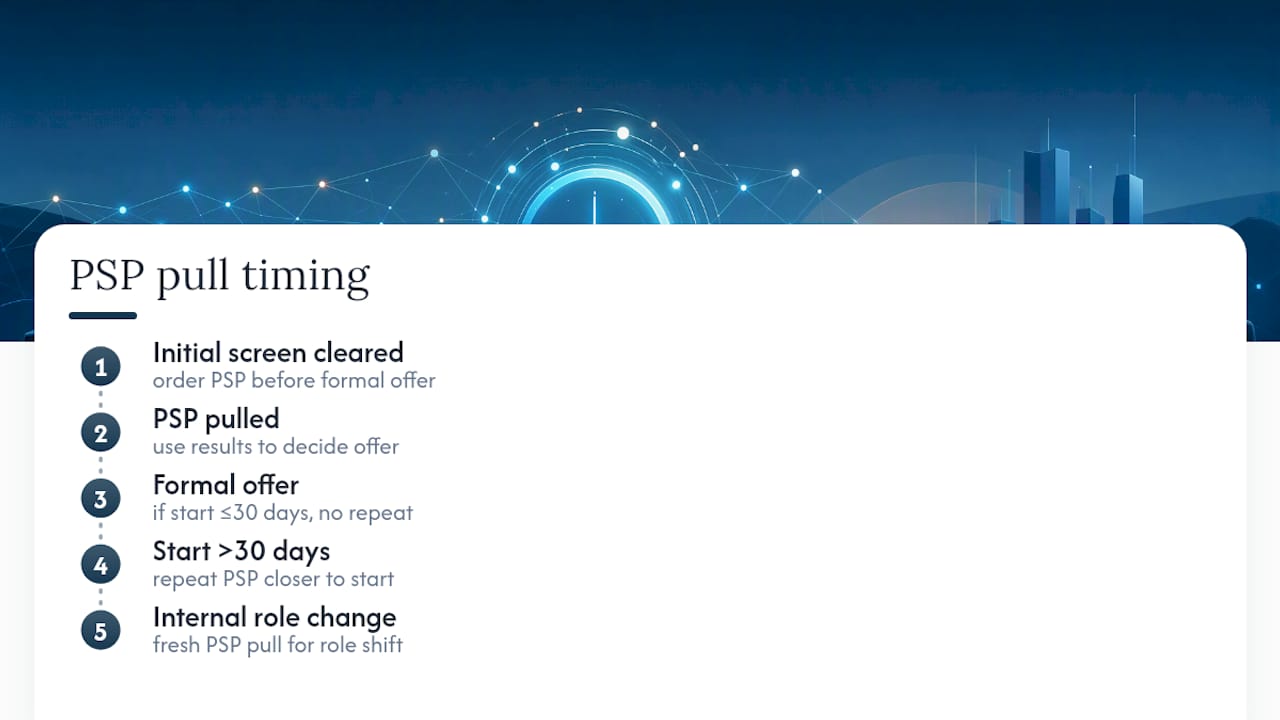
For ongoing drivers, PSP isn't typically pulled on a fixed schedule the way MVR checks often are for existing employees. Most carriers treat it as a hiring-stage tool rather than a recurring monitoring one, since the Clearinghouse and annual MVR pulls already cover ongoing safety monitoring for active drivers. That said, if a current driver is being considered for a different role, say, moving from local delivery to long-haul, a fresh PSP pull as part of that internal transition is reasonable practice, since the risk profile of the new role may differ.
Avoid pulling reports too far in advance of a start date. A gap of more than 30 days between the PSP pull and the hire date means real time for a new crash or inspection to occur that you won't see reflected in an already-downloaded PDF. If your hiring timeline stretches longer than that for any reason, plan on a second pull closer to the actual start date.
What Recruiters Get Wrong About PSP Screening
Most carriers either lean on PSP too hard, rejecting anyone with any entry, or too little, pulling it as a checkbox and never actually reading the fields. Neither approach reflects the safety-impact data FMCSA has published. PSP works best as a verification layer that speeds up good decisions, not a lone gate that slows everyone down. In a driver market where speed wins candidates, a fast, fair PSP process backed by MVR and Clearinghouse checks beats a slow, rigid one every time.
— Aaron
How UCEP Helps You Move From Screening to Hiring
Once PSP, MVR, and Clearinghouse checks clear a candidate, the next challenge is finding qualified drivers fast enough to fill your open routes. There are specialized job boards built specifically for FedEx-contracted Service Providers seeking CDL-A team, CDL-A solo, linehaul, and pickup and delivery drivers, rather than general job boards where listings compete across many industries.
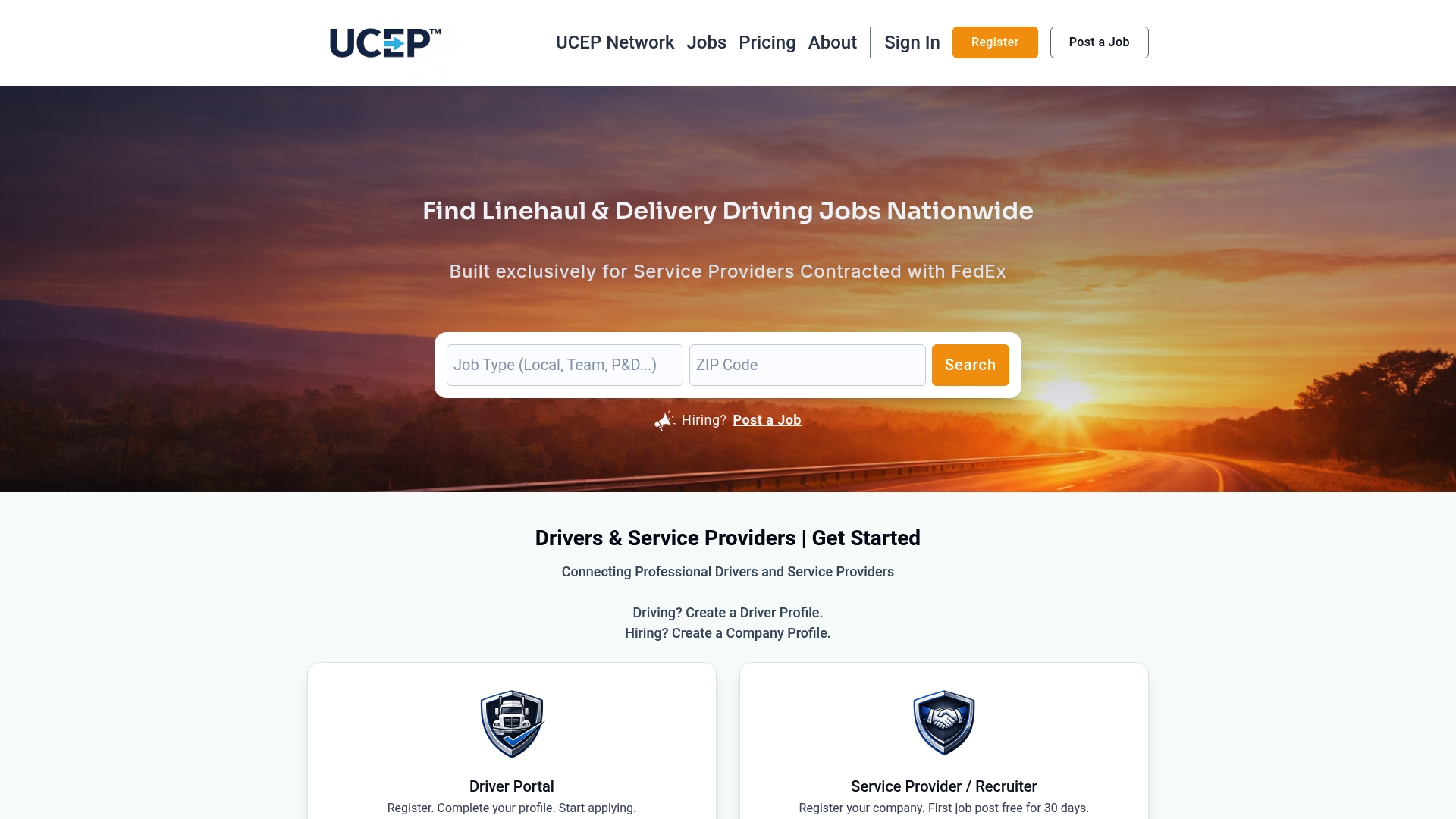
A tailored employer directory can present open roles to drivers searching for FedEx-related positions, while built-in applicant tracking helps keep screened candidates organized rather than scattered across spreadsheets and email threads. Reviews from recruiters and drivers may provide insights on reputations before committing to partnerships, and targeted alerts can assist in filling urgent openings more efficiently.
Browse the companies actively hiring drivers on UCEP right now, or check service provider reviews before you post your next opening.
Official PSP Resources and Related UCEP Guides
- Order a PSP report directly through FMCSA's portal.
- Review the official PSP sample report before your first pull.
- Read FMCSA's PSP safety-impact analysis for the data behind the tool.
- Pair PSP with an MVR report and review pre-employment screening basics.