
A driver talent community is a pool of drivers who know your work, and who you stay in touch with before, during and after a job opening. For a FedEx Service Provider, it replaces the cycle of posting a job, waiting, and starting over. For a driver, it is one place to see who is hiring, what the terminals are like and what other drivers say about employers. UCEP is built for exactly this: a job board and recruiting platform made only for Service Providers contracted with FedEx and the drivers who want to work for them.
This guide covers both readers. If you run a Service Provider, start with how a community differs from a single post and how to build one. If you drive, skip to the section on what a community gives you.
- ✓Role-specific driver listings
- ✓Targeted driver alerts
- ✓Employer and terminal directories
- ✓Reviews and applicant tracking
TL;DR
- A talent community (also called a driver talent network) is an ongoing relationship with a defined group of drivers, not a one-time job post.
- It matters for Service Providers because turnover and recruiting spend are large costs, and staying in contact with qualified drivers lowers both.
- Drivers use communities to learn about employers, pay structure and home time before they switch, and to hear about openings by word of mouth.
- UCEP gives FedEx Service Providers listings, targeted driver alerts, employer and terminal directories, reviews and a built-in applicant tracking system in one focused place.
- Linehaul, CDL-A team, CDL-A solo and pickup and delivery roles each have their own category, so the right drivers see the right jobs.
Table of Contents
- What a driver talent community is
- How a talent community differs from posting a single job
- Why it matters in dollars
- What drivers get from a community
- How to build a talent community as a Service Provider
- Social groups and a dedicated platform
- Where UCEP fits
- Our perspective
- FAQ
- Sources
What a driver talent community is
A community is a group of people connected by the same work. In trucking, a driver community is made up of CDL holders who share road knowledge, job information and support, whether online in a forum, a social group or an app, or in person at a truck stop or local meetup. Most drivers belong to more than one.
A talent community adds a recruiting purpose. The employer keeps a list of drivers who are interested, qualified or previously engaged, and has a way to reach them when a seat opens. The driver, in turn, has a place to see openings and research employers.
For FedEx work, the group is narrow on purpose. A CDL-A driver who has run linehaul lanes between terminals has a different background from a pickup and delivery driver working a daily route. A community built around FedEx-contracted work lets both groups find roles that fit what they have already done. UCEP's positioning is that it is the only driver recruitment platform dedicated exclusively to FedEx Service Providers, with targeted reach to 140,000+ FedEx-experienced drivers.
How a talent community differs from posting a single job
A job post is an event. A talent community is a process. The difference shows up in four places.
| Single job post | Talent community | |
|---|---|---|
| Timing | Starts when you have an opening and ends when you fill it | Runs continuously, so you already have contacts when a seat opens |
| Audience | Whoever happens to search that week | Drivers matched to your role type and location |
| Memory | Applicants you did not hire are usually forgotten | Applicants stay in your tracking system for the next opening |
| Trust | The driver knows only the posting | The driver can see your company profile, terminals and reviews |
The practical effect is speed. When a linehaul route opens, a Service Provider with an existing pool starts with names. One without a pool starts with an empty inbox. Our guide to hiring linehaul drivers fast walks through that process from the first post.
Why it matters in dollars
The cost of not having a pool is measurable. A University of Georgia Partnership for Transportation Industry study of 15 truckload carriers found an average turnover cost of $8,234 per driver, with a range of $2,243 to $20,729. The same study reported average annual recruitment fees of $580,175 and average referral and sign-on bonus spend of $94,163 across participating carriers. It dates from 1998, so treat the amounts as a scale of the problem, not a current price list. The direction holds: every driver who leaves restarts a cost that a ready pool can shorten.
To see what that means for your own fleet, work through the cost per hire example and the recruiting budget guide. If you budget per truck, remember that fixed costs such as Form 2290 filing costs sit beside recruiting costs, and an empty or constantly changing seat spreads them over fewer productive days.

What drivers get from a community
If you drive, a community answers questions a job ad never will. According to FreightPro, drivers use communities to ask current employees about pay structure, home time, equipment age and how dispatch treats drivers before they change companies. They also get mentorship and word-of-mouth referrals.
For FedEx-related work, that translates into a short list of things worth finding out before you apply:
- Role type. Is the job linehaul, CDL-A solo, CDL-A team, or pickup and delivery? Filter your search so you see only what you want.
- Employer. Browse the employer directory to see which Service Providers hire in your area.
- Terminal. Use the terminal directory to see where the work starts and ends, which tells you your commute and your home time.
- Reviews. Read the internal reviews from drivers and Service Providers, and submit your own after you work with an employer.
- Alerts. Set up targeted driver alerts so new openings that match you come to you.
- Applications. Keep your applications in one place instead of across many sites.
Drivers do not pay to use UCEP. You can start on the jobs page, which lists Pickup & Delivery, CDL-A Solo Linehaul and CDL-A Team Linehaul categories.
If you are a referral-minded driver, read how driver referral payouts work before you refer a friend, so you know what to lock in.
How to build a talent community as a Service Provider
A community does not appear by itself. It is built by repeating a few steps. Each step below says what it takes and where it usually goes wrong.

1. Define the roles you hire for
Write down which of your seats are linehaul, CDL-A team, CDL-A solo, and pickup and delivery. Each draws a different driver. Team roles in particular need two compatible drivers, which makes them harder to fill; our team driver recruiting strategies cover that.
Where it goes wrong: one generic "driver wanted" post attracts people who fit none of your roles. Separate categories on UCEP keep the post tied to the role.
2. Make your company profile worth reading
Drivers research employers before they apply. A complete company profile, your terminals and your reviews are what they look at first. Experienced recruiters quoted in a 2026 Suffolk News-Herald guide recommend strong ratings and reviews with transparent working conditions as part of attracting drivers. UCEP provides company profile management and a review system for Service Providers and drivers.
Where it goes wrong: a profile left blank or out of date tells the driver nothing, and they move on.
3. Post where FedEx-experienced drivers already look
Reach matters more than volume. The same Suffolk News-Herald analysis concludes that mass-market advertising is losing effectiveness and that fleets should focus on channel quality. A board used only by FedEx drivers and Service Providers is a narrow channel by design.
Where it goes wrong: paying to reach everyone and then screening hundreds of applicants who have never worked FedEx lanes.
4. Track every applicant
The built-in applicant tracking system keeps each person you hear from, not just the one you hire. When the next opening appears, you search your own list first. This is the step that turns a post into a community.
Where it goes wrong: applicants kept in email threads and spreadsheets get lost within a few weeks.
5. Reach out with targeted alerts
Targeted driver alerts let you notify drivers who match a role. Keep messages specific: the route type, the terminal and the schedule.
Where it goes wrong: vague or repeated messages. Recruiting guides on social groups note that many groups ban self-promotion, and the same instinct applies here: send fewer, more relevant messages.
6. Keep drivers once you hire them
A community only works if drivers have a reason to speak well of you. GoFleet's guide, citing recruitment directors, says fair treatment is the biggest reason for driver turnover and the first three months are the most important window. Staged referral payouts after one, three and six months of continuous employment are another approach experienced recruiters recommend to reduce early departures.
Where it goes wrong: treating retention as separate from recruiting. Reviews written by your own drivers are part of what the next candidate reads. See common driver retention mistakes and the 90-day retention metrics to track.
Social groups and a dedicated platform
Many Service Providers also recruit in social media groups. That can add reach, and our Facebook recruiting plan shows how to set it up in a week. The limit of a group is that it is not built around your roles: posts scroll away, there is no applicant record and the audience is not limited to FedEx work. A dedicated platform keeps the listing, the profile, the reviews and the applicants together, so the work you do to build a pool stays in one place.
Where UCEP fits
UCEP is a job board and recruiting platform for FedEx-contracted Service Providers and the drivers who work for them. For Service Providers, it offers job listings by role, a built-in applicant tracking system, targeted driver alerts, employer and terminal directories, internal reviews and company profile management. Plans are listed on the pricing page: a Complimentary Trial Listing for new recruiters, and the Standard Monthly Plan at $99 per month.
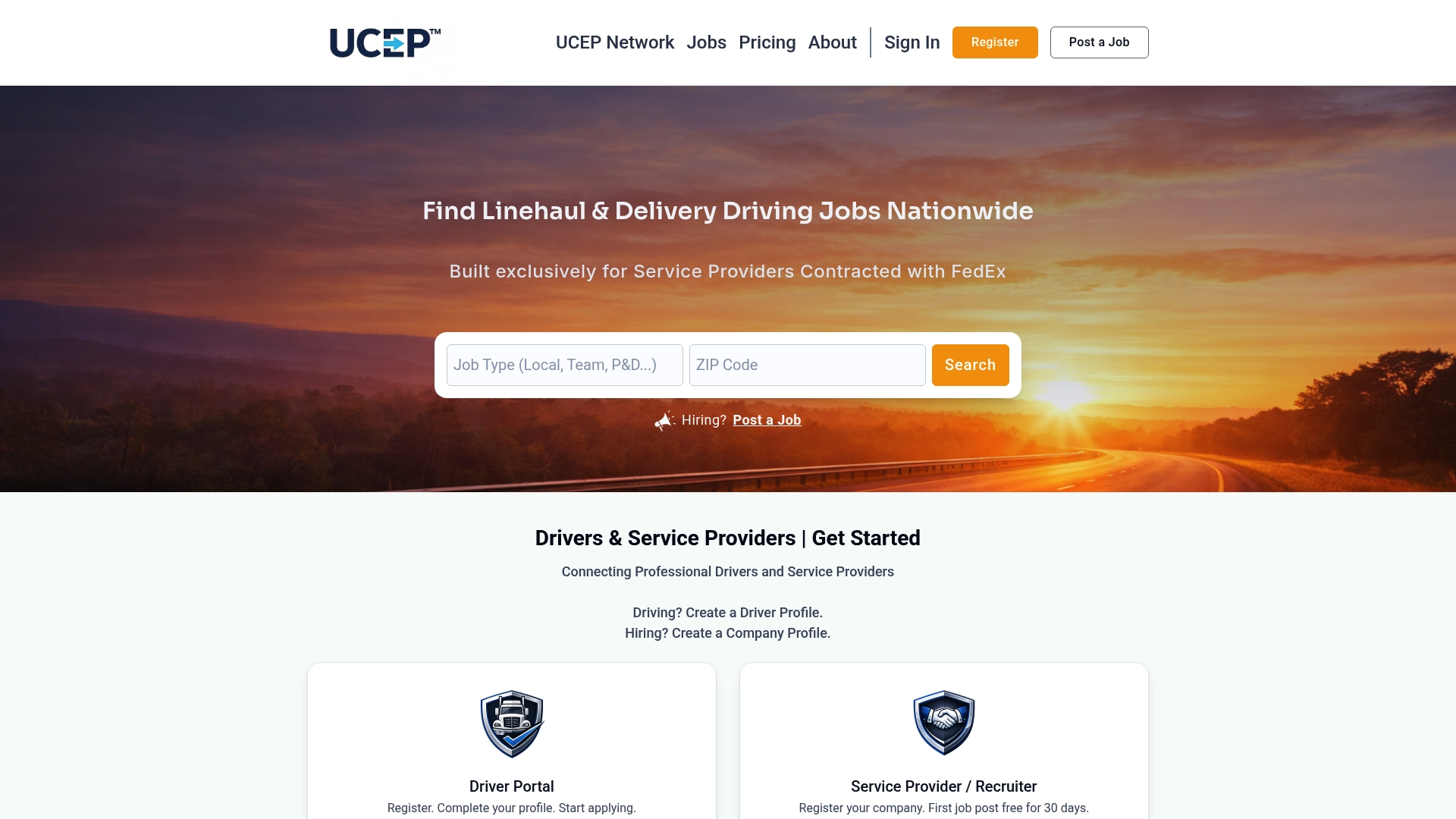
If you are hiring, start with the trial listing and post one role. If you are a driver, browse the FedEx driver jobs and filter by the role you want.
Our perspective
A single job post asks a driver to trust a stranger. A community lets the driver see who you are before they apply.
We built UCEP for one group: FedEx Service Providers and the drivers who work with them. That focus is the point. A CDL-A team driver, a linehaul driver and a pickup and delivery driver each want different things, and each should find the right role without sorting through unrelated listings.
We think Service Providers do best when they treat every applicant as a future hire, keep their records in one system and let their reputation, through reviews and a clear company profile, do part of the recruiting. Drivers do best when they can compare employers and terminals before they commit.
That is why the directories, reviews, alerts and applicant tracking sit together. Used regularly, they become your talent community.
Aaron
FAQ
What is a driver talent network?
It is an organized group of drivers an employer stays in contact with over time. Instead of starting from zero with each opening, the employer reaches out to drivers who already match the role. On UCEP, the group is drivers interested in FedEx-related work.
Does it cost drivers anything to join?
No. Drivers use job search, employer directories and blog content without paying. Service Providers pay for job posting plans, which start with a Complimentary Trial Listing.
How much does it cost a Service Provider to use UCEP?
The Standard Monthly Plan is $99 per month, and the Complimentary Trial Listing is available for new recruiters. See the pricing page for what each plan includes.
Which roles can I recruit for?
UCEP covers pickup and delivery, CDL-A solo linehaul and CDL-A team linehaul driver roles. Each has its own category, so drivers filter to the work they want and you reach the right candidates.
Sources
- Truck Driver Community: Where to Connect Online (FreightPro)
- The Costs of Truckload Driver Turnover, SP-146 (UGPTI)
- Top 7 Channels to Attract CDL Drivers in 2026 (Suffolk News-Herald)
- A Modern Guide to Recruiting & Retaining Drivers (GoFleet)