
Use Meta lead ads plus activity in high-traffic trucking Facebook groups, backed by a fast follow-up rule, to turn Facebook interest into hires. Drivers are heavily concentrated on the platform, and Instant Form ads convert that attention into applications without asking anyone to leave Facebook. Your single next move: stand up one Instant Form ad or post one job in an active trucking group today, then assign someone to respond within minutes, not days.
TL;DR:
- Running one driver-specific ad or posting in active trucking groups with a quick follow-up response can significantly increase applications from Facebook's concentrated driver audience.
- Using broad geographic targeting and retargeting video viewers or engagers yields better results under Special Ad Category rules than narrow demographic filters.
- Immediate contact within five minutes during staffed hours and using a designated owner for each lead are critical to converting Facebook leads into hires.
- Creative focused on drivers' biggest motivators, like pay or home time, paired with actual driver videos and clear next steps, outperform generic or stock imagery posts.
- Maintaining consistent ad budgets, refreshing creative every 2–3 weeks, and deploying niche channels like Ucep can improve hiring efficiency without requiring large upfront investments.
Table of Contents
- What Is Facebook Recruiting for Drivers, and Where Do You Start?
- How Do Meta Ads Work for Driver Hiring?
- What Organic Content Builds a Driver-Ready Page?
- How Fast Should You Follow Up on Facebook Leads?
- What Ad Creative Actually Gets Drivers to Apply?
- Which Metrics Tell You a Campaign Is Actually Working?
- How Does a Niche Job Board Fit Alongside Facebook?
- How Much Should You Spend on Facebook Driver Recruiting?
- What Targeting Options Remain Under Special Ad Category Rules?
- When Should You Post or Run Ads for Maximum Engagement?
- What Do Strong Facebook Ad Campaigns for Drivers Look Like?
- How Do You Stop Ad Fatigue From Killing Your Results?
- An Editorial Take on What Actually Moves the Needle
- Try Ucep as a Focused Channel for FedEx-Contracted Driver Roles
- Sources
- FAQ
What Is Facebook Recruiting for Drivers, and Where Do You Start?
Facebook recruiting drivers means using Meta's organic and paid tools, Pages, groups, the Jobs tab, and Instant Form ads, to source CDL candidates instead of relying only on job boards or referrals. The reason it works: most professional drivers already spend time on Facebook, and fleets that lean into the platform report measurable calls, applications, and hires from it.
Before you spend a dollar on ads, check the free channels. Niche trucking groups and active local or regional driver groups often produce faster replies than a cold ad. So does your own company Page, and the Jobs tab still surfaces listings to people already browsing Facebook for work.
Vet any group in under five minutes: look at posting frequency (daily activity beats a group that posts once a week), compare member count against actual comments and reactions, and read the group's rules before you post a recruiting ad, since some ban it outright.
Your posting checklist for any channel:
- A headline that states pay or home time in the first line, not buried in paragraph three
- One real photo or short clip of an actual driver, never a stock image
- A one-line call to action ("Apply in one minute" or "Message us for details")
- A clear contact route: Instant Form link, direct message, or phone number
- A plan for moderating comments so spam or complaints don't sit under your post for days
How Do Meta Ads Work for Driver Hiring?
Meta Ads (Facebook and Instagram together) give small fleets a fast, practical hiring funnel when the setup follows a few fixed rules. Choose your capture method based on what you need: Instant Forms win on speed because drivers fill pre-populated fields in one tap, a landing page wins when you need more context or a longer application, and Messenger works when you want a real conversation to start immediately.
Employment ads on Meta fall under the Special Ad Category, a policy that removes age, gender, and zip code targeting to prevent discriminatory hiring ads. Practically, that means you target broader geographic radii and lean on Special Ad Audiences instead of narrow demographic filters.
Operational rules that keep campaigns compliant and effective:
- Run one driver category per ad (solo CDL-A, team, or linehaul), never mixed
- List exact pay or mileage numbers in both the ad text and the creative
- Match your ad copy to the landing experience so drivers aren't confused mid-click
- Turn on Advantage+ lead ad features to let Meta's delivery system find likely applicants
- Connect Conversion API so offline events, like a scheduled orientation, feed back to Meta
Pro Tip: Send "showed up to orientation" as an offline event, not just "form submitted." Meta's algorithm optimizes toward whatever signal you feed it, so garbage-in leads means garbage-out delivery.
What Organic Content Builds a Driver-Ready Page?
A company Page with real content makes every dollar of ad spend work harder, because drivers use social media the way they used to use the phone: as a real-time way to check who you are before they call.
- Post short videos of drivers on the job, equipment walkarounds, and honest home-time or family moments, not corporate stock footage.
- Ask current drivers to share your posts to their own timelines; personal shares reach people your Page never will on its own.
- Cross-post your best openings into the trucking groups you vetted earlier, and keep a steady weekly cadence instead of posting in bursts.
- Reply to comments, even critical ones, since engagement signals to Meta that your Page is worth showing to more people.
Organic reach on business Pages tends to be low on its own, so plan to boost your strongest posts. That content then does double duty: it becomes social proof running underneath your paid ads, and it builds the retargeting audience of video viewers and Page engagers you'll use later.
How Fast Should You Follow Up on Facebook Leads?
Instant Forms tend to outperform external landing pages for raw volume because the fields pre-fill from a driver's Facebook profile and submission takes one tap. That convenience only pays off if someone on your team acts on it immediately.
Route every lead straight into your applicant tracking system or CRM rather than checking a Meta dashboard by hand, and pair that with Conversion API reporting so Meta learns which leads actually become hires.
- First contact within 5 minutes during staffed hours
- First contact within 15 minutes outside staffed hours, using a scheduled auto-response as a bridge
- One named owner per lead so nobody assumes "someone else" is calling back
- A routing rule that reassigns unclaimed leads automatically after 10 minutes
A driver who fills out a form and hears nothing for two hours has likely already applied somewhere else. Speed to contact is one of the few variables in this entire process you fully control, and it costs nothing extra to fix.
What Ad Creative Actually Gets Drivers to Apply?
Recruiting posts that answer a driver's biggest questions in the first five seconds outperform anything vague. Drivers scroll past generic "Now Hiring" graphics without a second look.
- Use real driver photos or short clips; drivers disqualify stock imagery on sight
- Lead with the single biggest motivator, exact pay, guaranteed home time, or newer equipment, then give one clear next step
- Build separate creative for solo CDL-A, team, and owner-operator audiences instead of one generic ad for everyone
- Run A/B tests with a stated hypothesis ("pay-first headline beats home-time-first headline for solo drivers") rather than testing randomly
Pro Tip: Write your ad headline the way a driver would say it out loud to a friend, "$1,800 a week, home every weekend," not the way HR would write it on a job description.
Which Metrics Tell You a Campaign Is Actually Working?
Lead volume is the easiest number to watch and the least useful one on its own. Track cost per orientation or cost per hire, post-application drop-off rate, time from lead to first contact, and 30 and 90 day retention where you have the data.
Test creative on a weekly cadence for 2 to 3 weeks before judging a campaign, and measure orientation rate, not just how many forms came in. Retarget people who watched your videos or started a form but didn't finish it; that group already knows who you are.
Common failure patterns to watch for:
- Running campaigns intermittently instead of always-on, which resets Meta's learning phase every time
- Mixing driver types in one ad, which confuses both the algorithm and the applicant
- Slow follow-up with no assigned owner, which quietly kills otherwise good leads
- Stock imagery that signals "generic job ad" before a driver reads a single word
How Does a Niche Job Board Fit Alongside Facebook?
Facebook is broad by design. A niche job board narrows the field to exactly the roles you're hiring for, and that focus matters when you're specifically recruiting for FedEx-contracted positions. Broad platforms surface a wide mix of trucking jobs; a focused board like Ucep filters for CDL-A team, CDL-A solo, linehaul, and pickup and delivery roles tied to FedEx Service Providers, which cuts down the noise a generic listing attracts.
The two channels work well together operationally. Route qualified Facebook leads into your ATS as usual, then cross-post your strongest openings on Ucep to reach drivers already searching specifically for FedEx-related work. Ucep also gives Service Providers a company profile page, employer directory presence, and driver reviews, tools that help a candidate vet you the same way you vet them. If you're already building recruiter workflows to manage Facebook follow-up speed, adding a second, more targeted intake source is a small operational lift with a meaningful payoff in candidate fit.
How Much Should You Spend on Facebook Driver Recruiting?
There's no single dollar figure that fits every fleet, because your cost per hire depends on your market, your pay package, and how competitive your lane is. What matters more than the total budget is how you allocate it.
Start small and prove the funnel before scaling. A single always-on campaign running a modest daily budget, tested for two to three weeks, tells you more than a large one-time spend that ends before Meta's delivery system finishes learning. Split your budget roughly into three buckets: the bulk toward your best-performing driver category ad, a smaller slice toward retargeting warmed audiences (video viewers, page engagers, form abandoners), and a small testing reserve for new creative each week.
Resist the urge to pause a campaign the moment lead volume dips. Meta's delivery system needs a stable, always-on budget to optimize properly, and stopping and restarting campaigns resets that learning every time. If you're hiring for multiple roles, split the budget by category rather than one large mixed-audience ad; a linehaul-specific ad and a CDL-A team ad pull different applicants and different costs per lead, and lumping them together muddies your read on what's actually working.
As orientations and hires start flowing back through Conversion API, shift a bit more budget toward whichever category shows the lowest cost per hire, not just the lowest cost per lead. Volume without quality is not worth spending on.
What Targeting Options Remain Under Special Ad Category Rules?
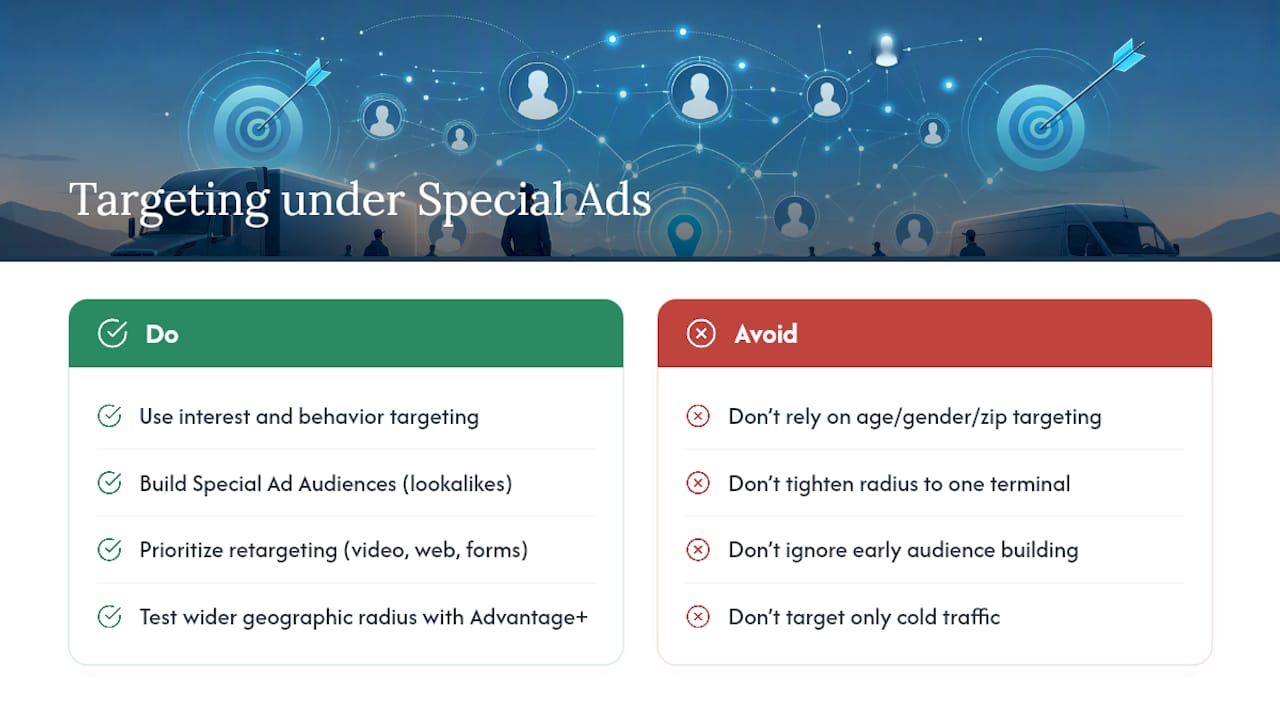
Losing age, gender, and zip code targeting sounds like a major handicap, but it pushes recruiters toward tactics that often perform better anyway. Interest and behavior targeting, built around trucking-related pages, CDL training content, and driving-adjacent interests, still works within the Special Ad Category framework.
Lookalike audiences, technically Special Ad Audiences under these rules, let you build a broader pool modeled on your best past hires or current Page followers, without touching the restricted demographic fields directly. Guides on social recruiting for drivers consistently point to broad geographic targeting paired with retargeting as the more reliable combination than trying to narrow by demographics you can no longer access anyway.
Retargeting is where the real gains show up. Warmed audiences, people who watched a driver testimonial video or engaged with your Page, convert at a noticeably higher rate than cold traffic, even with the demographic restrictions in place. Build these audiences early: video viewers from your organic content, website visitors if you run a landing page, and anyone who opened but didn't finish an Instant Form.
Geographic radius targeting deserves more attention than most recruiters give it. Rather than a tight radius around one terminal, test a wider radius and let Advantage+ delivery find drivers willing to relocate or drive to a terminal, especially for linehaul roles where the pickup point matters less than the route itself. Combine that broader radius with interest targeting around CDL schools and trucking associations, and you'll often reach qualified drivers your zip-code-restricted competitors can no longer target directly.
When Should You Post or Run Ads for Maximum Engagement?
Driver schedules don't match a typical office worker's feed habits, and that changes when your posts and ads should go live. Solo and team drivers on the road check their phones most actively during breaks, at fuel stops, and in the evening once they've parked for the day, which tends to land engagement higher in the early evening hours and on weekends when drivers have more downtime.
Sunday evening through Tuesday tends to outperform the back half of the week for organic posts, likely because drivers are either finishing a reset or starting a new week and actively thinking about their next job. Friday afternoon posts often get buried under weekend content from other Pages.
For paid campaigns, the calculus shifts slightly. Meta's delivery system runs continuously and optimizes across the full day and week once it has enough data, so an always-on ad matters more than picking a perfect launch window. That said, boosting an organic post to coincide with evening engagement, then letting a parallel Instant Form ad run continuously, captures both the organic spike and the steady paid baseline.
Test your own group and Page insights rather than assuming a universal schedule. A regional flatbed fleet with drivers running Monday through Friday will see different peak hours than a fleet running weekend freight, and your posting schedule should follow your driver base, not a generic social media calendar.
What Do Strong Facebook Ad Campaigns for Drivers Look Like?
The campaigns that consistently produce hires share a narrow set of traits rather than a clever gimmick. Fleets that treat Facebook the way they'd treat a phone call, immediate, personal, and specific, see stronger conversion than fleets running generic "Now Hiring Drivers" graphics.
A successful pattern looks like this: one ad, one driver category, a headline stating exact weekly pay or guaranteed home time, a short video of an actual driver from that fleet talking about the job, and an Instant Form asking only for name, phone number, and CDL status. Nothing extra. Small fleets running Meta Ads with a single-category-per-ad structure tend to predict hires faster than fleets trying to build a more elaborate, multi-channel setup before they've proven the basics work.

The weakest campaigns tend to share the opposite traits: mixed audiences (team and solo drivers in the same ad), vague headlines ("Great Opportunity, Apply Now"), and stock trucking photography that could belong to any fleet in the country. Drivers scroll past these within a second, and the cost per lead climbs while quality drops.
One overlooked pattern worth copying: campaigns that pair a paid ad with an organic group post running at the same time, using nearly identical messaging, tend to outperform either channel run alone. The group post builds immediate social proof and comments from real drivers, and that activity often gets screenshotted or referenced by prospects who saw the paid ad first.
How Do You Stop Ad Fatigue From Killing Your Results?
Ad fatigue shows up as a slow, quiet decline: the same creative that generated leads for two weeks starts costing more per lead with no obvious cause. It happens when Meta shows the same audience the same ad enough times that people stop noticing it, and it hits recruiting ads especially hard because the audience of active job seekers on Facebook is smaller than a general consumer audience.
Watch your frequency metric, not just cost per lead. When frequency climbs past roughly 3 to 4 for a given audience without a matching lift in results, that creative has likely run its course. Refresh the video, swap the headline, or rotate in a different driver's story rather than restarting the exact same ad.
Practical fixes that work without increasing your budget:
- Rotate creative every 2 to 3 weeks on your best-performing ad rather than letting one piece of content run indefinitely
- Split your audience so warmed retargeting groups see different creative than cold prospects
- Refresh video testimonials with a new driver every month or two so the Page doesn't feel static
- Pause and re-launch a campaign with new creative rather than editing the same ad repeatedly, since fresh ad IDs sometimes reset delivery more effectively than in-place edits
Ad fatigue is one of the few problems in Facebook recruiting drivers that a recruiter can fix without spending another dollar. It just requires someone actually watching the frequency number, which most fleets don't.
An Editorial Take on What Actually Moves the Needle
Most advice on Facebook recruiting drivers spends too much time on targeting settings and not enough on speed. The research consistently points to the same conclusion: the fleets getting hires aren't the ones with the cleverest audience segmentation, they're the ones who answer a lead in minutes instead of hours. Special Ad Category restrictions get treated like a crisis in most guides, when in practice broad targeting plus retargeting performs about as well as narrow demographic targeting ever did.
The overrated piece of conventional wisdom is the obsession with lead volume.
If you do one thing differently this week, fix your follow-up SLA before you touch your ad targeting. Then, once that funnel is stable, layer in a focused channel like a niche job board for FedEx-contracted roles specifically, since that pairing gives you both broad reach and a cleaner, role-specific signal without asking you to abandon Facebook.
— Aaron
Try Ucep as a Focused Channel for FedEx-Contracted Driver Roles
Ucep is the direct route to drivers already looking for FedEx-related work, without competing against every other trucking job on a general board. Once your Facebook funnel is producing consistent leads, add a second, narrower channel built specifically for hiring CDL-A team, CDL-A solo, linehaul, and pickup and delivery drivers.
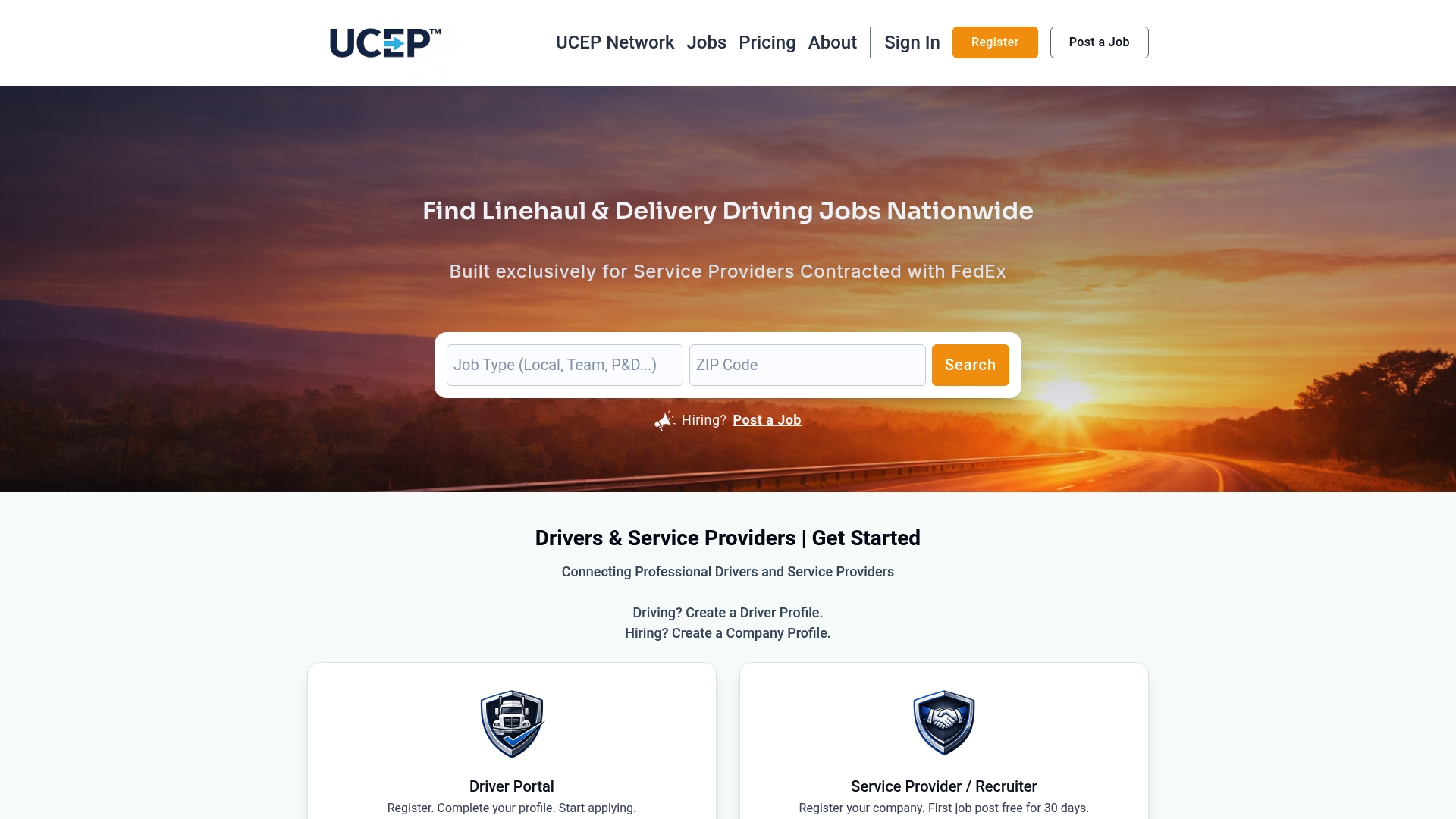
The setup takes an afternoon, not a redesign of your recruiting process. Post your open role on Ucep, keep routing your Facebook leads into your ATS as you already do, and cross-list your strongest opening so it reaches drivers specifically searching for FedEx-contracted positions. Even small fleets can test this in a single week without disrupting an existing Facebook campaign. Browse an example employer profile like Four Leaf Recruiting's company page to see how a Service Provider presents open roles, then post your own listing and see how the two channels compare over your next hiring cycle.
Sources
- How to recruit truck drivers through Facebook | Heavy Duty Trucking
- Facebook ads for truck driver recruiting: a working setup
- How to Use Social Media to Recruit Truck Drivers?
FAQ
Are Jobs Advertised on Facebook Legit?
Most are, especially from verified company Pages and established trucking groups, but treat any post asking for payment or personal financial details upfront as a red flag. Check that the poster represents a real, searchable company before applying or before boosting a post as a recruiter.
What's the Easiest Trucking Company to Get Hired By?
That depends heavily on the driver's experience level and endorsements, but Service Providers posting through focused channels like Ucep tend to list clear pay and role details upfront, which makes it easier for qualified drivers to self-select into the right openings quickly.
How Hard Is It to Get a Job at Meta?
Meta the company hires for corporate tech roles and has no connection to trucking or driver recruiting; if you're searching for driving jobs, you want Facebook the platform's Jobs tab, groups, and driver-focused Pages, not Meta's own corporate hiring.
Is Facebook Still Hiring Drivers Through Recruiting Campaigns?
Facebook itself doesn't hire drivers, but trucking companies and Service Providers actively use the platform every day through Pages, groups, and Meta Ads, and that activity has held steady as a primary sourcing channel for the industry.
Should I Use an Instant Form or a Landing Page for Driver Ads?
Instant Forms generally win for raw lead volume because fields pre-fill and submission takes one tap; use a landing page only when you need to convey more detail than a short form allows, such as multiple role variations.