
A recruiting platform centralizes targeted sourcing, automated screening, and compliance management so FedEx-contracted Service Providers hire qualified linehaul and delivery drivers faster and with lower audit risk. For high-volume CDL hiring, that combination is the difference between a full roster and a gap that costs you routes.
- Faster time-to-fill: Targeted job distribution and instant MVR/PSP verification cut the time between posting and offer, reducing vacancy days across your terminals.
- Higher vacancy-fill rates: Portal-based hiring with identity verification raises portal-based hiring by 68% and increases the likelihood of filling a vacancy by 11%, according to an American Economic Association study.
- Lower compliance and audit risk: Platforms that automate FMCSA/DOT checks and Driver Qualification File (DQF) management reduce the manual gaps that create audit exposure.
When you demo any platform, check MVR/PSP verification speed first. If the pull takes more than a few minutes, the workflow downstream will bottleneck.
Table of Contents
- What does a recruiting platform actually do for fleet hiring?
- How platform features translate into real fleet outcomes
- How to choose a recruiting platform for your fleet
- How to roll out a recruiting platform without disrupting operations
- What compliance support should your platform cover?
- Which KPIs tell you whether the platform is working?
- How Ucep maps to these requirements
- Key Takeaways
- Why specialization in fleet hiring matters more than most operators realize
- Ucep is ready when you are
- Useful sources and further reading
What does a recruiting platform actually do for fleet hiring?
The role of a recruiting platform for fleets goes well beyond posting jobs. Modern trucking-focused platforms have shifted from passive job boards to proactive compliance and hiring hubs with instant MVR/PSP/FMCSA integrations, pipeline dashboards, and pre-vetted driver pools.
Core features to look for:
- Targeted job distribution across trucking-specific channels (mobile, social, referrals)
- Applicant tracking system (ATS) with real-time pipeline dashboards
- Identity verification and instant MVR, PSP, and background checks
- FMCSA and CDLIS query automation
- Compliance alerts for expiring licenses, medical cards, and violations
- DQF management with document storage and audit trails
- Pre-vetted driver pools and multi-channel sourcing
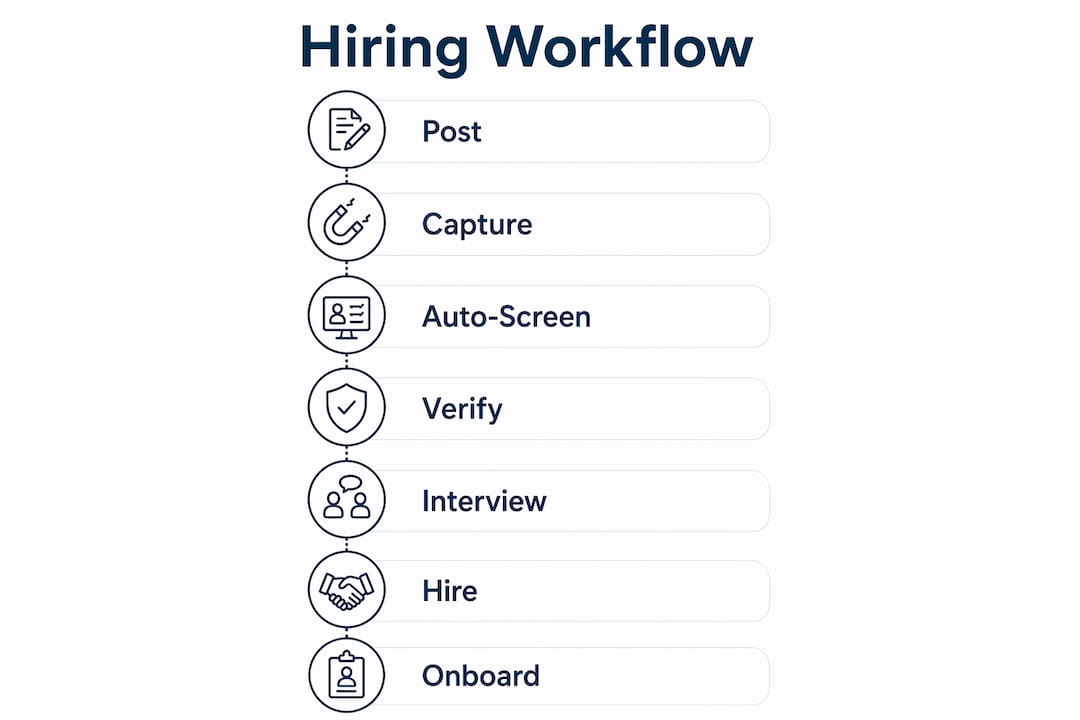
The hiring workflow on a well-built platform runs: post → capture → auto-screen → verify → interview → hire → onboard. Each stage hands off automatically, so recruiters spend time on interviews, not paperwork.
| Hiring Stage | Feature Category | What It Does |
|---|---|---|
| Sourcing | Targeted distribution | Pushes listings to niche trucking channels and driver communities |
| Screening | ATS / auto-screen | Filters applicants by CDL class, endorsements, and experience |
| Verification | MVR / PSP / background | Pulls driving records and safety scores instantly |
| Compliance | DQF management | Stores and tracks required documents; alerts on expirations |
| Pipeline | Dashboard / reporting | Shows conversion rates and bottlenecks across all open roles |
How platform features translate into real fleet outcomes
Generic job boards attract unqualified applicants for specialized fleet roles. A niche trucking platform applies role-specific filters from the first click, so the applicants who reach your recruiter already meet minimum CDL and endorsement requirements.
Stat: Targeted advertising combined with identity verification raises portal-based hiring by 68% and increases vacancy-fill probability by 11% (American Economic Association). For a Service Provider running 150 trucks across multiple terminals, that improvement in fill rate can mean the difference between meeting FedEx route commitments and running short.
The downstream benefits compound. Fewer compliance incidents reduce your exposure during DOT audits. Faster onboarding shortens the gap between hire date and first dispatch. And when your DQF records are complete and timestamped, insurance carriers have less reason to flag your fleet. Industry commentary from Spotter AI and Tenstreet notes that platforms combining instant MVR/PSP pulls with predictive risk alerts are now the standard for serious fleet operators, not a premium add-on.
A practical example: a 150-truck Service Provider using instant MVR/PSP screening can eliminate manual record-pulling for every applicant. Recruiters review a clean summary report instead of raw DMV documents, which cuts review time per candidate and improves the quality of who reaches the interview stage.

How to choose a recruiting platform for your fleet
Use this checklist during demos and procurement. Prioritize in the order listed.
- Screening automation: Can the platform auto-filter by CDL class, endorsements, and minimum MVR points without manual review?
- Instant MVR/PSP integration: Ask the vendor: what is the average pull time for an MVR? Are PSP and FMCSA Clearinghouse queries automated?
- DQF management: Does the platform generate, store, and alert on all required FMCSA driver qualification documents?
- Pipeline visibility: Can you see real-time conversion rates from application to offer across all open roles?
- System integrations: Does the platform offer APIs or SSO for your TMS, payroll, or HRIS? Ask for documentation, not just a yes.
- Mobile candidate experience: Can drivers apply and upload documents from a phone? A poor mobile experience reduces application volume for delivery roles.
- Pricing structure: Clarify subscription vs. pay-per-post, bulk posting discounts, and whether background check or verification fees are bundled or billed separately.
Red flags to avoid: platforms that function only as generic job boards with no trucking-specific filters; manual-heavy verification workflows; unclear data security practices; no audit trail for background checks or drug tests.
How to roll out a recruiting platform without disrupting operations
A phased rollout reduces risk and gives you real data before you commit fully.
- Pilot on one terminal or job type (e.g., CDL-A solo linehaul at a single terminal). Track time-to-screen, time-to-interview, application-to-hire ratio, and compliance exceptions for 30 days.
- Integrate with existing systems. Connect the platform to your TMS, payroll, and HR tools before expanding. Test data flows with a small batch of hires.
- Train recruiters and safety teams together. Recruiters need to know the screening thresholds; safety managers need to understand how compliance alerts feed into DQF records.
- Scale regionally once the pilot metrics show improvement over your baseline. Use the pilot data to set realistic improvement targets rather than relying on vendor benchmarks.
Pro Tip: Set screening thresholds before you go live. Define the minimum MVR point score and required endorsements for each role type (CDL-A team, CDL-A solo, pickup and delivery) so the platform filters automatically. Misaligned thresholds are the leading cause of application fatigue in fleet hiring — you end up reviewing volume instead of quality.
What compliance support should your platform cover?
For U.S. fleets operating under FMCSA and DOT authority, the platform must support the following checks and records:
- MVR (Motor Vehicle Record): State driving history, pulled at hire and on a recurring schedule.
- PSP (Pre-Employment Screening Program): FMCSA crash and inspection data for the prior five years.
- FMCSA Drug and Alcohol Clearinghouse: Required query before hire and annually thereafter.
- CDLIS check: Confirms the driver holds only one valid CDL.
- Drug screen tracking: Pre-employment and random testing records with secure digital storage.
- DQF management: Automated generation, storage, and expiration alerts for all required qualification documents.
- Ongoing monitoring: Automated alerts when a driver's license status changes, a violation posts, or a document expires.
For audit readiness, the platform should provide automated records export, role-based access controls, recurring re-check schedules, and timestamped evidence trails for every background check and drug test. On data security: request SOC 2 Type II certification or an equivalent assurance during vendor evaluation. Recruiting data for U.S. drivers includes Social Security numbers and sensitive driving records, so data handling standards matter as much as feature depth. Reviewing common CDL hiring mistakes before finalizing your compliance checklist can surface gaps you might otherwise miss.
Which KPIs tell you whether the platform is working?
Track these metrics from day one of your pilot to build a baseline:
- Time-to-fill: Days from posting to accepted offer, by role type.
- Cost-per-hire: Total recruiting spend divided by hires, including platform fees and verification costs.
- Application-to-hire ratio: How many applicants it takes to produce one hire. A high ratio signals poor targeting or misaligned screening thresholds.
- Vacancy-fill rate: Percentage of open roles filled within your target window.
- Retention at 30/90/180 days: Early turnover is often a hiring-quality signal, not a management one.
- Compliance incidents per 1,000 driver-days: Tracks whether better screening translates to fewer violations.
- Audit exceptions avoided: Count of DQF deficiencies caught by the platform before an audit.
Set targets from your pilot baseline, not from vendor claims. A platform that reduces your time-to-screen by 40% in a pilot is a credible improvement; a vendor promise of "50% faster hiring" with no baseline is not. E3 Recruitment's sector-led approach reinforces this: measure platform ROI with pilot baselines and use those numbers to set improvement targets.
How Ucep maps to these requirements
Ucep is built specifically for FedEx-contracted Service Providers, which means every feature is scoped to the roles and compliance requirements you actually deal with: CDL-A team, CDL-A solo, linehaul, and pickup and delivery.
| Required Capability | How Ucep Implements It |
|---|---|
| Targeted job distribution | Nationwide listings scoped to FedEx-related driver roles; driver alert notifications to active candidates |
| Applicant tracking (ATS) | Built-in ATS with pipeline visibility and application management |
| Employer and terminal directories | Searchable employer and terminal directories for candidate research and recruiter targeting |
| Driver and SP reviews | Internal review system for both drivers and Service Providers |
| Candidate quality filters | Role-specific job search filters (CDL class, role type, location) |
| Multi-channel sourcing | Mobile-accessible platform; job seeker-facing search and alert tools |
| Subscription and pricing flexibility | Tiered plans, bulk posting discounts, and a free trial listing for new recruiters |
Ucep's network of FedEx-focused employers means drivers on the platform are already oriented toward FedEx-contracted work, which improves match quality compared with a general board. The recommended first step for a new Service Provider is a trial listing for one terminal, which lets you measure application volume and candidate quality before committing to a full subscription. Niche job boards consistently outperform general boards for driver roles precisely because the candidate pool is pre-filtered by intent.
Key Takeaways
A recruiting platform built for fleets reduces time-to-fill, raises vacancy-fill rates, and supports FMCSA/DOT compliance by automating screening, verification, and DQF management from a single workflow.
| Point | Details |
|---|---|
| Verify instantly | Require MVR/PSP/FMCSA automation; manual pulls create bottlenecks and compliance gaps. |
| Pilot before scaling | Run a 30-day single-terminal pilot and track time-to-fill and compliance exceptions as your baseline. |
| Track the right KPIs | Measure time-to-fill, application-to-hire ratio, vacancy-fill rate, and retention at 30/90/180 days. |
| Require compliance depth | The platform must support DQF management, drug screen tracking, and ongoing license monitoring. |
| Use Ucep for FedEx roles | Ucep's dedicated network and ATS are scoped to CDL-A and delivery roles for FedEx Service Providers. |
Why specialization in fleet hiring matters more than most operators realize
Generic platforms create a specific problem that is easy to miss until you are already in it: volume without quality. You post a CDL-A linehaul role, receive 80 applications, and spend three days manually checking records, only to find that 60 applicants do not hold the right endorsements or have disqualifying MVR history. That is not a recruiter problem. That is a platform problem.
Sector-led hiring, where the platform itself applies trucking-specific filters and centralizes the full candidate funnel, changes the math. Recruiters spend time on qualified candidates. Compliance checks happen before the interview, not after. And because the candidate pool is pre-oriented toward FedEx-contracted work, conversion rates improve at every stage. The importance of hiring platforms is not just about convenience; it is about matching the tool to the specific qualification requirements of the role. A platform that does not understand the difference between a CDL-A team driver and a pickup and delivery driver cannot filter for one versus the other.
Ucep is ready when you are
FedEx-contracted Service Providers recruiting for CDL-A team, CDL-A solo, linehaul, and pickup and delivery roles get a faster path to qualified candidates with Ucep. The platform is built for this exact use case: a focused driver pool, a built-in ATS, terminal directories, and driver alert tools, all scoped to FedEx-related work.
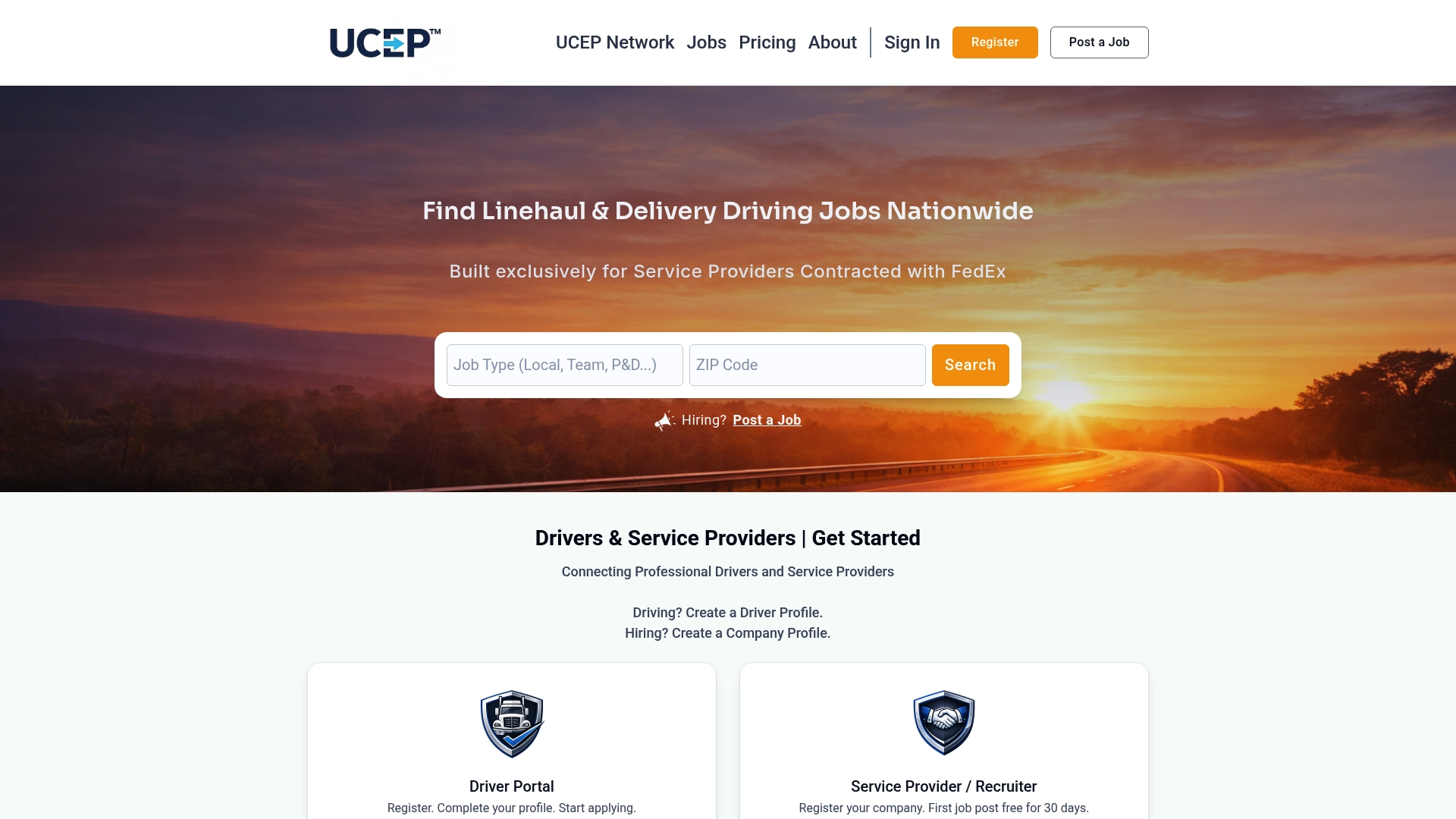
Getting started takes one step. Create your account, post a trial listing for one terminal, and track application volume and candidate quality against your current baseline. When the pilot data confirms the improvement, scaling to additional terminals and role types is straightforward. Review what other Service Providers say about Ucep before you post, or go directly to your first listing and measure the results yourself.
Useful sources and further reading
- American Economic Association — Hiring Frictions and Online Job Portals: Source of the 68% portal hiring increase and 11% vacancy-fill improvement figures cited in the BLUF and benefits sections.
- Food Logistics — Spotter AI Platform Launch: Industry commentary on the shift from passive job boards to compliance and hiring hubs with instant MVR/PSP/FMCSA integrations.
- Indeed Hiring Lab — How the Internet Changed Recruiting: Context on ghost postings and low-intensity job posting behavior; supports the argument for targeted, verification-backed platforms.
- Evolution Capital Partners — The Importance of Hiring Platforms: Guidance on matching platform type to role requirements; used to support the specialization argument.
- E3 Recruitment — Automotive and Fleet Recruitment: Sector-led hiring framework and consultative funnel management; source for pilot-baseline ROI methodology.
- Ucep — United Contractor Employment Portal: Platform features, employer directories, ATS capabilities, and subscription plans for FedEx-contracted Service Providers.
- Ucep Blog — Why Niche Job Boards Outperform General Boards: Evidence and examples supporting higher candidate quality and ROI from niche driver-focused boards.
Recommended
- What It Takes to Succeed as a Team Driver for Service Providers Contracted with FedEx | UCEP Meta description - United Contractor Employment Portal
- Dedicated Trucking Job Board Benefits for FedEx Drivers
- How to find pickup delivery driving work for FedEx
- How to Post FedEx Driving Jobs Effectively in 2026