
Cost per hire for a truck driver typically runs from the low thousands to well over the SHRM corporate average, driven by three buckets: recruiting spend, screening and compliance, and lost productivity while a seat sits empty. The exact figure depends on fleet size, driver type, and how fast you move drivers through screening. The sections below break down each cost category, give you a formula, and walk through a worked example you can adapt to your own numbers.
TL;DR:
- Most fleets underestimate total hiring costs since onboarding, lost productivity, and regulatory fees like drug tests and Clearinghouse queries are often overlooked.
- Replacing a driver within 90 days significantly increases overall costs due to repeated recruiting, screening, onboarding, and empty-seat revenue loss.
- Seasonal hiring spikes raise costs due to higher ad spend, longer time-to-fill, and increased screening costs, which can be mitigated by proactive pipeline building.
- Cost per hire for a typical fleet hiring 10 drivers over a quarter averages around $1,935 before overhead, but high turnover can push this closer to $2,700 or more.
- Using specialized channels like FedEx-focused job boards can improve applicant quality and reduce time-to-fill, especially when compared against generic recruiting platforms.
Table of Contents
- 1. What goes into the cost of hiring a truck driver
- 2. Benchmarks and a formula you can run today
- 3. Hidden and regulatory costs that raise cost per hire
- 4. Worked example: cost per hire for a 50-driver fleet
- 5. How fleets can bring cost per hire down
- 6. A focused channel for FedEx Service Provider hiring
- 7. Indirect costs that rarely show up on a hiring invoice
- 8. Why turnover rate drives cost per hire more than any single expense
- 9. Cost per hire differs by driver type and specialization
- 10. How seasonal demand shifts cost per hire
- Why most fleets measure cost per hire wrong
- Try a trial listing and measure your own cost per hire
- FAQ
- Sources
1. What goes into the cost of hiring a truck driver
Hiring cost rarely shows up as one line item. It accumulates across four categories, and fleets that only track job board invoices miss most of the real expense.
- Recruiting costs: pay-per-click ad spend, job board subscriptions, staffing agency retainers, referral bonuses, and creative or video production for recruiting campaigns.
- Screening and compliance costs: background checks, DOT physical exams, drug testing, and FMCSA Drug and Alcohol Clearinghouse queries, which run $1.25 per query. Bundle pricing is available for employers who screen at volume.
- Onboarding costs: orientation hours, trainer wages and mileage while pairing a new hire with a mentor driver, equipment assignment, and the administrative time spent processing paperwork.
- Empty-seat costs: the revenue a truck would have earned had it been running, plus the fixed costs (insurance, lease payments, permits) that keep accruing on equipment sitting idle.
The recruiting line is the one most fleets measure closely because it is the easiest to see on an invoice. Screening and compliance costs are smaller per action but recur with every applicant, not just every hire, so they add up faster than most budgets account for. Onboarding costs are driven mostly by trainer time and orientation length rather than hard cash outlay, which makes them easy to underestimate. Empty-seat costs are usually the largest bucket and the hardest to quantify, since they depend on freight rates, lane availability, and how long a truck actually sits before a replacement driver is ready to run; for a practical budgeting approach, see the detailed dump truck cost estimates for contractors.
2. Benchmarks and a formula you can run today
Before you can lower cost per hire, you need a number to compare against. SHRM's benchmarking cites an average cost-per-hire figure around $5,000 or more across non-executive roles in general industry. Trucking-specific estimates from NPTC's benchmarking work have put replacement cost per driver meaningfully higher, reflecting the added compliance burden, trainer time, and lost-service penalties that general corporate benchmarks don't capture.
The formula itself is straightforward:
- Add every dollar spent on recruiting, screening, onboarding, and hiring-related administration for a defined period.
- Divide that total by the number of drivers hired in the same period.
- Decide upfront whether you're including partial costs like trainer overhead or HR salary time, and apply that rule consistently across every calculation.
- Choose a time horizon (a quarter or a full year works best) so seasonal hiring swings don't distort a single month's number.
Consistency matters more than precision here. A fleet that excludes trainer mileage one quarter and includes it the next can't trust its own trend line.
3. Hidden and regulatory costs that raise cost per hire
Regulatory fees look small individually but compound fast across a driving workforce. The FMCSA Clearinghouse charges $1.25 per limited or full query, and employers typically buy bundles sized to their hiring volume rather than paying one query at a time.
$1.25 per query is the FMCSA's published rate for Clearinghouse checks, and that fee applies to every applicant screened, not just every hire, so a fleet running 200 applicants through screening pays for 200 queries regardless of how many it actually puts behind the wheel.
Beyond the per-query fee, a few other factors push cost per hire higher:
- Consent delays when a driver is not already registered in the Clearinghouse, which can add days to time-to-hire while the system processes a mailed consent request.
- DOT physical exams and drug testing, both required before a driver can be dispatched.
- Specialized credentials like TWIC cards or hazmat endorsements that add renewal and verification costs depending on the freight lanes you run.
Our guide to CDL drug testing requirements walks through the Clearinghouse query process and employer obligations in more detail.
4. Worked example: cost per hire for a 50-driver fleet
Here's how the math plays out for a fleet that hires 10 drivers over a quarter.
- Job board postings and multiposting fees: $1,200
- Referral bonuses paid out: $2,000
- Background checks and Clearinghouse queries for 25 applicants screened to fill 10 seats: $650
- DOT physical exams and drug testing: $1,500
- Trainer wages and mileage during orientation (40 hours per hire at a blended trainer rate): $8,000
- Lost revenue from empty seats, estimated at 5 average vacancy days per hire: $6,000
Total hiring cost: $19,350. Divided by 10 hires, that's a cost per hire of $1,935, before adding any administrative overhead.
Sensitivity matters here. If 90-day churn forces three of those ten drivers to be replaced again within the quarter, effective cost per hire on a rolling basis jumps closer to $2,700 once you count the repeat screening and onboarding spend. Shaving two days off average screening turnaround, by contrast, can cut the empty-seat line by roughly $2,400 across the same ten hires.

5. How fleets can bring cost per hire down
The single biggest lever is retention, since a driver who leaves within 90 days effectively doubles the cost of the original hire. A handful of operational changes move the number consistently.
- Give applicants a realistic preview of the route, home time, and equipment before they accept, so fewer drivers quit in the first month over mismatched expectations.
- Build onboarding around the first 90 days specifically, since that window is where most early turnover happens.
- Test specialist job boards against broad multiposting platforms rather than assuming wider reach always means more qualified applicants.
- Run referral bonus programs alongside paid postings, since referred drivers tend to stay longer than cold applicants.
- Batch background checks and Clearinghouse queries where possible to cut administrative handling time per applicant.
Pro Tip: Track time-to-fill and 90-day retention side by side with cost per hire. A channel that looks cheap on cost per hire alone can still be expensive if its hires don't last.
Our breakdown of common driver retention mistakes covers the onboarding gaps that drive early turnover in more detail, and our piece on recruiting metrics for 90-day retention lays out which numbers to track alongside cost per hire.
6. A focused channel for FedEx Service Provider hiring
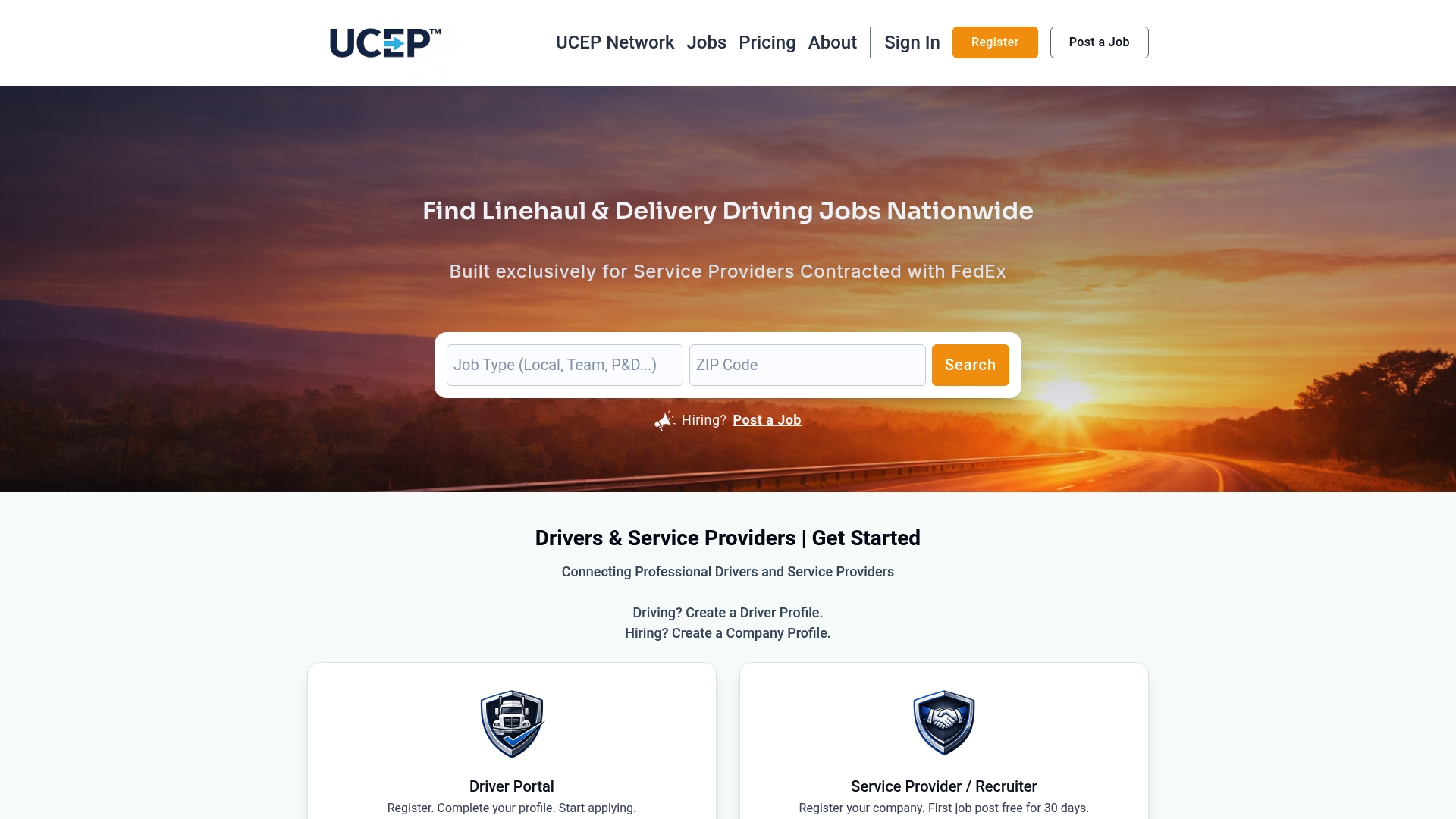
We built UCEP as a job board dedicated specifically to Service Providers contracted with FedEx, covering linehaul, CDL-A team, CDL-A solo, and pickup and delivery roles in one place rather than spreading postings across general trucking boards.
- We give Service Providers access to a large pool of FedEx-experienced drivers, narrowing the applicant pool to candidates who already understand the FedEx contractor model.
- Our platform includes employer and terminal directories, driver reviews, and a built-in applicant tracking system to streamline screening and communication.
- A Service Provider testing cost per hire can run a trial listing against a current paid channel and compare applicant quality and time-to-fill over the same posting window.
Our job board pricing breakdown compares posting costs across channels for FedEx-contracted hiring specifically.
7. Indirect costs that rarely show up on a hiring invoice
Administrative overhead is the cost category most fleets underestimate because it rarely appears as a single invoice. HR staff time spent reviewing applications, scheduling interviews, verifying credentials, and processing new-hire paperwork is real labor cost even when no outside vendor is paid.
A fleet without a dedicated recruiter often has a safety manager, dispatcher, or operations lead handling hiring tasks between other responsibilities. That time has a cost even when it's absorbed into an existing salary, and it's worth estimating hours per hire so the true cost per hire reflects internal labor, not just external spend.
Other indirect costs worth tracking:
- Software and systems used to manage applications, even when bundled into a broader HR platform rather than billed per hire.
- Legal or compliance review time for drivers with gaps in employment history or out-of-state licensing questions.
- Management time spent interviewing candidates who don't pass screening, which doesn't show up anywhere except lost hours.
None of these line items are large individually. Added together across a year of hiring, they can rival the direct recruiting spend, which is why a cost-per-hire calculation that only counts outside invoices understates the real number.
8. Why turnover rate drives cost per hire more than any single expense
Turnover and cost per hire are tied together in a way that most budget conversations miss. A fleet with low turnover hires rarely, so its total hiring spend stays low even if any single hire is expensive. A fleet with high turnover hires constantly, and every repeat hire adds another full round of recruiting, screening, and onboarding cost on top of the last one.
This is why a driver who leaves within the first 90 days is more expensive than the raw hiring invoice suggests. The fleet pays for that hire's recruiting and onboarding cost, then pays again to replace them, often before the original seat has generated enough revenue to offset the first round of expense.
Tracking turnover rate alongside cost per hire gives a more complete financial picture than either number alone. A fleet that lowers its average cost per hire through cheaper job postings but keeps a high 90-day turnover rate hasn't actually solved its cost problem. It's hiring more often at a lower unit cost, which can still produce the same or higher total hiring spend over a year.
9. Cost per hire differs by driver type and specialization
Not every driving role costs the same to fill. Long-haul CDL-A positions typically draw a wider applicant pool because drivers can apply from almost anywhere, but they also tend to have higher turnover tied to time away from home, which raises the repeat-hiring cost over a year.
Local and regional roles, including pickup and delivery positions, often draw a smaller but more geographically constrained applicant pool. Screening costs stay similar, but recruiting spend sometimes needs to be more targeted to reach drivers within a reasonable commute.
Team driving roles for CDL-A positions add another layer of complexity, since fleets are effectively hiring two compatible people at once. That can extend time-to-fill and raise recruiting cost per seat, even when the per-driver screening and compliance costs stay the same as a solo hire.
Specialized endorsements, such as hazmat or tanker certifications, narrow the applicant pool further and often require fleets to pay a premium in either wages or recruiting spend to attract qualified candidates. Fleets hiring across multiple driver types should calculate cost per hire separately for each category rather than blending them into one average, since a single blended number can hide which roles are driving the bulk of hiring spend.

10. How seasonal demand shifts cost per hire
Hiring volume in trucking isn't steady throughout the year, and cost per hire moves with it. Peak shipping seasons, particularly the months leading into the holidays, push demand for drivers up sharply, which tightens the applicant pool and often raises both ad costs and time-to-fill.
Fleets that wait until peak season to start recruiting typically pay more per hire than those who build a pipeline during slower months. Job board costs, referral bonus payouts, and even screening turnaround can all become more expensive when demand spikes across the industry at the same time, since background check and drug testing providers face the same volume surge.
Building a hiring calendar that starts recruiting ahead of known demand spikes, rather than reacting to them, is one of the more reliable ways to keep seasonal cost per hire closer to baseline. Fleets that maintain an active pipeline of warm candidates, even during slower hiring months, tend to absorb seasonal demand increases without the same cost spike that reactive hiring produces.
Why most fleets measure cost per hire wrong
Most fleets calculate cost per hire using only the costs they can easily find on an invoice: job board fees, agency retainers, background check bills. That number is real, but it's incomplete, and treating it as the full picture leads to decisions that look smart on paper and backfire in practice.
The costs that actually move the needle, trainer hours, empty-seat revenue loss, and repeat hiring from early turnover, rarely show up in a quick calculation because they require pulling data from operations and finance rather than just the recruiting budget. A fleet that cuts job board spend without addressing why drivers leave within 90 days hasn't lowered its true cost per hire. It's just shifted the expense into a column nobody's tracking.
Start by auditing one recent hire from first contact to first paycheck, and track every hour and dollar spent along the way. Test one targeted posting and one referral bonus this quarter, measure both against your current baseline, and prioritize retention fixes before chasing cheaper recruiting channels.
— Aaron
Try a trial listing and measure your own cost per hire
If your current recruiting channels are driving up cost per hire without improving applicant quality, testing a channel built specifically for FedEx Service Provider hiring costs nothing to start. We offer a Complimentary Trial Listing alongside a Standard Monthly Plan at $99 per month for fleets ready to post consistently.
- Post a role through our job board and run it alongside your current channel for 30 to 90 days.
- Compare applicant volume, time-to-fill, and 90-day retention between the two channels using the same tracking you already apply to other postings.
- Browse our driver job categories to see which roles, linehaul, CDL-A team, CDL-A solo, or pickup and delivery, fit your current openings.
Service Providers hiring for FedEx-related routes can post a job on UCEP and start measuring results against their existing cost-per-hire baseline this quarter.
FAQ
What is the new CDL rule affecting driver hiring?
Federal rules around CDL issuance and driver qualification have continued to tighten in recent years, including stricter requirements around the English language proficiency and medical certification process. Fleets should check current FMCSA guidance directly, since requirements are updated periodically and vary by jurisdiction.
How do I calculate cost per hire for my fleet?
Add up every recruiting, screening, onboarding, and hiring-related administrative cost for a set period, then divide that total by the number of drivers hired in the same period. Apply the same inclusion rules every time you calculate it, and use a consistent time horizon like a quarter or a year.
What CDL job pays around $3,000 a week?
Pay at that level is typically tied to specialized roles like team driving, oversized or hazmat-certified freight, or owner-operator arrangements rather than standard solo CDL-A positions. Actual pay depends heavily on miles run, freight type, and the specific carrier or contract, so figures vary widely by role and region.
What counts as good pay per mile for truck drivers?
Per-mile pay varies by driver experience, freight type, and region, and the Bureau of Labor Statistics tracks broader wage data for heavy and tractor-trailer drivers rather than a single per-mile benchmark. Comparing a specific offer against current BLS wage data for your region and experience level gives a more useful baseline than a flat industry number.
Sources
- Query plan bundles — FMCSA Drug and Alcohol Clearinghouse
- Heavy and tractor-trailer truck drivers — BLS
- Real costs of recruitment — SHRM