
Trucking job board pricing varies widely, from free trials up to monthly subscriptions around $99, with per-post fees and sponsored placements generally costing more depending on features. Cost-per-hire, once you factor in ad spend, screening, and empty-seat losses, averages $5,000 to $12,000 depending on role and fleet size. Niche boards like Ucep, built specifically for FedEx service-provider hiring, tend to cut wasted spend compared to general job sites because they filter for drivers who already fit your role.
TL;DR:
- Cost-per-hire typically ranges from $5,000 to $12,000 once ad spend, screening, and idle truck costs are included, especially for hard-to-fill roles.
- Monthly subscription fees for trucking job boards usually fall between $99 and $500, with per-post fees ranging from $50 to $300 depending on platform and listing duration.
- Conversion rates heavily influence the true cost-per-hire, making a platform's applicant-to-hire ratio more important than traffic volume alone.
- Niche boards like Ucep offer flat $99 monthly plans focused on FedEx-related roles, reducing unqualified applicants and streamlining recruitment for specialized positions.
Table of Contents
- What Are the Main Job Board Pricing Models for Trucking?
- How Much Does It Cost Per Applicant and Per Hire?
- How Do You Calculate True Cost Per Hire?
- How Do You Choose the Right Trucking Job Board?
- How Ucep's Pricing Maps to These Models
- Where Recruiters Should Put Their Budget in 2026
- Ready to Post Your First Listing?
- Sources
- FAQ
What Are the Main Job Board Pricing Models for Trucking?
Most trucking job boards charge you one of four ways, and knowing which model you're buying determines whether your budget scales predictably or swings with hiring volume.
- Subscription pricing charges a flat monthly or annual fee for unlimited or capped postings, giving you predictable costs regardless of how many roles you're filling.
- Per-post pricing charges a flat fee for each individual listing, which works well if you hire in bursts rather than continuously.
- Sponsored or featured job fees push your listing to the top of search results or into email alerts, usually as an add-on to a base posting.
- Pay-per-click or pay-per-applicant models charge only when a candidate clicks through or applies, shifting risk toward the vendor but often costing more per lead in competitive CDL markets.
Resume database access is a separate line item on many boards. You pay extra to search resumes proactively instead of waiting for applicants to come to you, and that fee can run as much or more than the base posting cost.
The tradeoff is straightforward: subscriptions and per-post pricing give you predictable, budgetable costs but variable reach. Sponsored and PPC models give you more visibility and volume, but the invoice moves with your hiring pace. For CDL-A team and solo roles, where the candidate pool is smaller and more specialized, broad PPC reach often wastes money on unqualified clicks. A targeted board tends to convert better per dollar than a general search campaign aimed at anyone with a driver's license.
How Much Does It Cost Per Applicant and Per Hire?
Cost-per-applicant benchmarks vary sharply by role type, and that variance is the single biggest factor in whether your job board spend feels efficient or wasteful.
Boostpoint's 2025–2026 campaign data puts median cost-per-applicant at $13.57 for company drivers, $15.20 for regional and dedicated roles, $21.13 for agricultural and rural CDL positions, and $28.50 for owner-operator recruiting. The harder the role is to fill, the more it costs to generate a single applicant.
| Role type | Median cost-per-applicant | Typical monthly subscription | Typical per-post fee |
|---|---|---|---|
| Company driver | $13.57 | $99–$300 | $50–$150 |
| Regional/dedicated | $15.20 | $99–$300 | $75–$175 |
| Agricultural/rural CDL | $21.13 | $150–$300 | $100–$150 |
| Owner-operator | $28.50 | $150–$500 | $150–$300 |
Statistic to watch: even a modest shift in conversion rate changes your cost-per-hire dramatically. At reasonable applicant-to-hire ratios, cost-per-hire can be calculated by multiplying cost-per-applicant by the inverse of the conversion rate, before adding screening and onboarding costs. At 1-in-50, that same rate produces $760 in ad spend alone.
Monthly subscription quotes for trucking-specific boards commonly fall between $99 and $500, while per-post fees on general job sites often run $50 to $300 depending on how long the listing stays active and whether it includes any sponsored boost. If a vendor won't give you a straight number without a sales call, that's normal in this industry. Many trucking job boards keep employer pricing off their public pages and require a quote, which is exactly why asking the right questions before signing matters more than comparing homepage prices.

How Do You Calculate True Cost Per Hire?
The number on your invoice is never the real cost. True cost-per-hire adds four categories together and divides by the number of drivers you actually hired.
- Add ad spend and vendor fees. This is your subscription cost, per-post fees, or PPC total for the hiring window.
- Add screening and onboarding costs. DOT physicals, background checks, and orientation time all belong here. A DOT physical alone typically runs $70 to $150 per driver, and that's before drug screening or MVR pulls.
- Add recruiter time. Hours spent reviewing applications and conducting interviews have a real dollar value, even if it's internal labor.
- Add empty-seat cost. Every day a truck sits idle costs you freight revenue, and this is often the largest number in the equation.
- Divide the total by hires, not applicants.
Here's a worked example. Say your ad spend and vendor fees total $1,500, screening and onboarding run $800, and recruiter time adds $600. At a 1-in-50 conversion rate on a $15.20 cost-per-applicant campaign, you'd generate one hire for roughly $760 in ad spend alone, pushing total cost-per-hire toward $3,660 before empty-seat losses. Add even two weeks of an idle truck, and industry guides suggest the true total lands closer to $5,000 to $12,000 once you count everything.
Pro Tip: Conversion rate moves your cost-per-hire more than any other variable. A board that charges twice as much per applicant but converts three times better is still the cheaper option overall. Ask vendors for their actual applicant-to-hire ratio, not just their traffic numbers.
How Do You Choose the Right Trucking Job Board?
The right board depends less on brand recognition and more on how closely it matches the role you're filling and how much waste you can tolerate in the applicant pool.
Run through this checklist before you sign anything:
- Role specificity: Does the board let you filter for CDL-A team, solo, linehaul, or pickup and delivery specifically, or does it lump all driving jobs together?
- Candidate intent: Are applicants actively searching for your type of role, or is the board pulling generic job-seeker traffic?
- Reporting access: Can you see applicant source, conversion rate, and time-to-fill, or do you get a black box?
- Applicant caps: Does the plan limit how many applications you can receive, and what happens if you hit that cap?
- Guarantees: Will the vendor offer a replacement posting or credit if a listing underperforms?
- ATS integration: Does the board connect to your applicant tracking system, or will you be manually exporting resumes?
- Volume discounts: Does pricing drop meaningfully if you're posting more than one or two roles at a time?
When you talk to a sales rep, ask directly whether trial postings are available, what the refund or credit policy looks like, what conversion benchmarks similar employers have seen, and whether resume database access is included or billed separately. If a vendor can't answer the conversion question with real numbers, that's a signal the platform hasn't tracked its own performance closely.
Niche boards earn their premium when your role is hard to fill. General boards and paid social can work fine for high-volume, low-specialization openings, but team driver recruiting in particular tends to reward platforms that understand the specific certifications and route types you need.

How Ucep's Pricing Maps to These Models
Ucep runs on a subscription model built around two tiers: a Complimentary Trial Listing for recruiters testing the platform and a Standard Monthly Plan priced at $99 per month for ongoing access.
That structure lines up with the subscription category described above rather than per-post or PPC pricing, which means your cost stays flat whether you're filling one opening or several in the same month. Because Ucep focuses exclusively on FedEx service-provider hiring, the applicant pool skips the noise you get on general boards.
- The trial listing lets you test candidate quality before committing to a paid plan.
- The Standard Monthly Plan supports ongoing postings for pickup and delivery, CDL-A solo linehaul, and CDL-A team linehaul roles.
- Filtering by FedEx-related experience and category reduces the volume of unqualified applicants you have to screen manually.
- Onboarding typically starts with reviewing posting cost details so you know exactly what's included before your first listing goes live.
Once you sign up, expect to build your company profile, publish your first listing, and start receiving applications within the same day. There's no long onboarding cycle to manage before candidates can find you.
Where Recruiters Should Put Their Budget in 2026
Job boards alone won't solve a tight driver market. Freight rates have climbed, and that pressure is pushing recruiting budgets up across the board, which means every dollar spent on a general listing that doesn't convert is a dollar not spent on the applicant who would have said yes.
My take: split your budget between a specialized board and a referral incentive, and weight speed-to-lead heavily. If you're not replying to applicants within two hours, you're losing them to whoever answers first. Start this week by auditing your response time against actual applicant timestamps. That single fix often improves fill rate more than switching vendors.
— Aaron
Ready to Post Your First Listing?
Ucep is the alternative to a general job board for FedEx service-provider hiring: you pay one flat $99 monthly fee instead of variable per-click charges, and every applicant already has some connection to FedEx-related driving work.
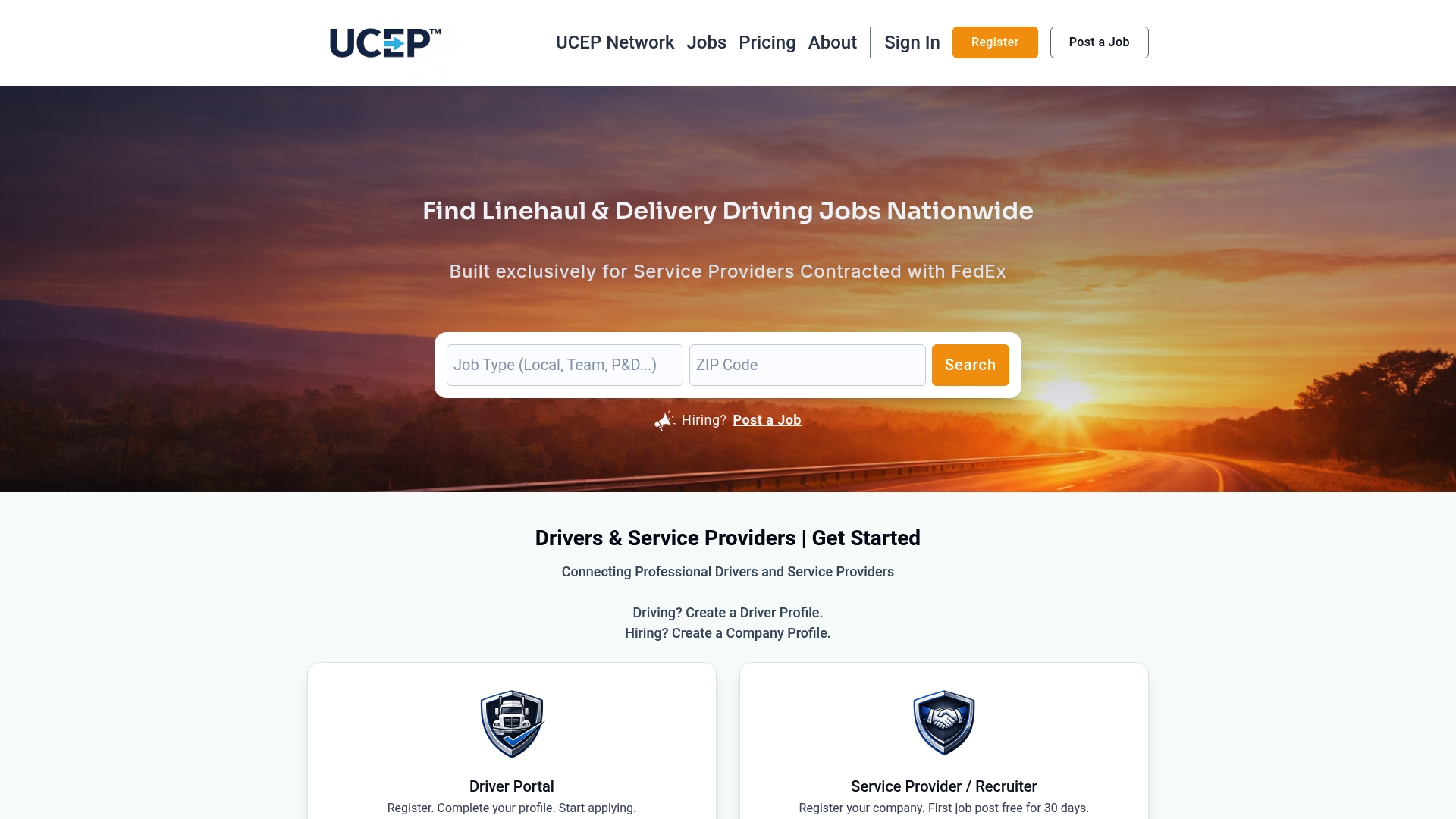
That focus is the whole point. General boards charge you to sort through applicants who may have never driven a route near a FedEx terminal. Ucep starts you with drivers already searching for pickup and delivery, CDL-A solo linehaul, or CDL-A team linehaul roles, which cuts the screening time you'd otherwise spend filtering out mismatches.
If you're testing the waters, start with the Complimentary Trial Listing. If you're ready to hire consistently, the Standard Monthly Plan gets you ongoing access. Either way, check current pricing and sign up to get your first listing live.
Sources
The pricing and cost-per-hire figures in this guide draw from a handful of trucking-specific sources rather than general HR benchmarks, since driver recruiting behaves differently from most hiring.
Occupational demand and candidate pool sizing come from the Bureau of Labor Statistics. Cost-per-applicant benchmarks by role type come from Boostpoint's 2025–2026 campaign data. Total cost-per-hire ranges are sourced from O Trucking's cost-to-hire guide and Apex Recruiting's 2026 breakdown.
- O Trucking — How Much Does It Cost to Hire a Truck Driver in 2026?
- Apex Recruiting — Cost to recruit a truck driver in 2026
FAQ
What's the Going Rate for Hauling Per Mile?
Per-mile pay varies by freight type, region, and whether the role is company, team, or owner-operator, and it shifts with freight market conditions rather than staying fixed. Job boards themselves don't set mileage pay; that's negotiated between carriers and drivers based on lane and equipment type.
What CDL Job Can I Make $3,000 a Week?
Team driving and specialized freight (hazmat, oversized loads, or high-mileage OTR routes) tend to offer the highest weekly earning potential for CDL-A drivers. Actual pay depends on carrier, route, and experience, so treat any specific weekly figure as a range rather than a guarantee.
Is There a $7,500 Tax Credit for Truck Drivers?
There is no single federal tax credit fixed at $7,500 for truck drivers. Tax benefits vary based on employment status and current laws, so drivers should consult a tax professional for accurate information.
Is Trucking Still Worth It in 2026?
Rising freight rates have increased demand for qualified drivers, and the Bureau of Labor Statistics continues to track steady demand for heavy and tractor-trailer drivers nationally. For employers, that demand means competition for drivers is real, which is exactly why cost-efficient recruiting channels like Ucep matter more than ever.