
Cost-per-hire (CPH) is the single ROI metric that holds up across trucking recruiting campaigns, and it beats application counts or click totals every time you need to compare job boards fairly. The immediate move: run a short, controlled pilot segmented by role (CDL-A team, CDL-A solo, pickup and delivery) and terminal, with a fixed budget and identical job copy. For FedEx-contracted hiring specifically, a board built around that niche, like UCEP, is worth including in that test.
TL;DR:
- Running a controlled pilot with identical job ads, fixed budgets, and role-specific segmentation helps accurately compare job boards' ROI.
- Tracking qualified applications, interviews, starts, and recruiter hours per board provides a clearer picture of true cost-per-hire beyond raw click or application volume.
- Benchmarking against your own historical performance by role and terminal yields more relevant data than comparing to industry averages.
- UCEP, a FedEx-specific job board, is effective only when roles are narrowly defined, qualification standards are high, and hiring occurs repeatedly at the same terminals.
- A pilot duration of two to four weeks suffices to gather meaningful insights, with ongoing evaluation of CPH after 30 days for decision-making.
Table of Contents
- What Metrics Actually Measure Job Board ROI for Trucking?
- How Do You Run a Controlled Pilot to Compare Job Boards?
- Measuring Applicant Quality and Downstream Hiring Outcomes
- When Does a FedEx-Focused Job Board Make Sense?
- What Do Job Boards Cost Beyond the Subscription?
- Author Checklist: What I Would Do in the First 90 Days
- Start a Trial and Test ROI Directly on UCEP
- Sources
- FAQ
What Metrics Actually Measure Job Board ROI for Trucking?
CPH tells you what it cost, in dollars and recruiter hours, to fill one seat. It is the metric Randall Reilly points to as the most consistent way to benchmark online driver recruiting, because raw application counts get inflated by low-quality clicks that never turn into a driver behind the wheel.
You need a few companion numbers to make CPH mean anything. Cost-per-application (CPA) shows how expensive it is just to generate a lead, before you know if that lead is any good. Lead-to-hire ratio shows how many applications it takes to produce one start. Time-to-fill tells you how long a seat sits open, which matters because an empty seat has its own cost in overtime and lost freight. Interview-to-start rate flags whether your screening process or your job copy is the bottleneck.
Comparing your numbers against industry averages is close to useless. Randall Reilly's own guidance is to benchmark against your own historical performance by role and terminal, not against some blended national figure that mixes flatbed recruiters in Ohio with team drivers in Texas. Your terminal's home-time policy, freight lanes, and local labor market are specific enough that an outside average tells you almost nothing useful.
Collect these data points for every campaign, every board, every role:
- Total spend and total qualified applications
- Applications by role and terminal
- Interviews scheduled and completed
- Conditional offers extended
- Confirmed starts and their date
- 90-day retention status
Cost-per-hire formula reference: The ANSI/SHRM cost-per standard gives a structured algorithm for calculating recruiting cost that adds internal labor and overhead to media spend, not just the invoice from the job board. Most trucking recruiters skip this step and end up comparing raw ad spend, which understates true cost by a wide margin.
How Do You Run a Controlled Pilot to Compare Job Boards?
A pilot only tells you something real if you control the variables that usually contaminate the comparison. Here is the sequence.
- Pick two to four boards to test, including at least one general board and one industry-specific board like UCEP for FedEx-related roles.
- Write one job posting per role type and use identical language, pay range, and qualification requirements across every board. Do not let one board's listing sound more attractive than another's.
- Set a fixed budget per board and a fixed measurement window, typically two to four weeks, long enough to smooth out day-to-day noise but short enough to act on results quickly.
- Segment by role and terminal so a CDL-A team posting in Memphis is never compared against a P&D posting in Sacramento.
- Define your attribution method before launch. Use unique application links or UTM-tagged URLs per board so your applicant tracking system (ATS) can tell you exactly where each candidate came from.
- Track qualified applications, interviews, and starts, not raw click volume, as your primary comparison metrics. This mirrors the pilot design Randall Reilly recommends for making cross-channel comparisons fair.
- Watch for cross-posted duplicates. A driver who applies through two boards should only count once in your lead-to-hire math, or your CPH numbers will look artificially better than reality.
Pro Tip: Build your tracking spreadsheet before you post a single job. Columns for job ID, source board, spend, applications, interviews, and starts take ten minutes to set up and save you hours of reverse-engineering data later.
Measuring Applicant Quality and Downstream Hiring Outcomes
Volume without quality is a distraction. A board that generates 200 applications and produces 3 drivers who pass their road test is worse than a board that generates 40 applications and produces 6 drivers who stick around past their first quarter.
Break the funnel into stages you can actually operationalize: screened, interview-passed, conditional-offer, and started. Each stage drop-off tells you something different. A high screen-to-interview drop usually means the job posting is attracting the wrong candidates, often because pay is highlighted without the home-time and schedule details that ATRI's driver demographics research identifies as decisive factors for driver decisions.
Lead-to-hire ratio, calculated as total qualified applications divided by confirmed starts, is what actually drives your CPH up or down. A board with a 15:1 ratio costs more per hire than one with an 8:1 ratio even if its per-click cost is lower.
Track these fields for every applicant, from first contact through 90 days:
- Application date and source board
- Screen result and interview date
- Conditional offer date
- Start date and terminal assignment
- Active status at day 30, 60, and 90
Your ATS should carry most of this natively. If it does not, a UTM-tagged application link paired with a simple spreadsheet, keyed to job ID and source, will produce accurate channel-level CPH without extra software.
When Does a FedEx-Focused Job Board Make Sense?
A niche board earns its place when three conditions line up: narrow role definitions, high qualification standards, and repeat hiring at the same terminals. FedEx-contracted service providers hit all three, which is exactly the gap UCEP was built to close.
General job boards send you a mixed pool. Some applicants have never driven CDL-A team routes, some do not know what pickup and delivery work actually involves, and plenty are testing the market rather than seriously job hunting. FedEx-specific targeting filters that noise before it ever hits your ATS.
Include these details in every posting to improve applicant fit:
- Terminal location and home-time schedule
- Role category (linehaul, team, solo, P&D)
- Equipment type and freight pattern
- Pay structure and any FedEx-specific requirements
Postings that spell out home-time and schedule alongside pay tend to draw applicants who already understand the job, which ATRI's demographic research ties directly to better retention outcomes. A tighter, industry-focused distribution model has been shown to raise both application quantity and quality in trucking recruiting specifically, which is the whole point of testing a niche board inside your pilot instead of assuming a general board wins by default.
What Do Job Boards Cost Beyond the Subscription?
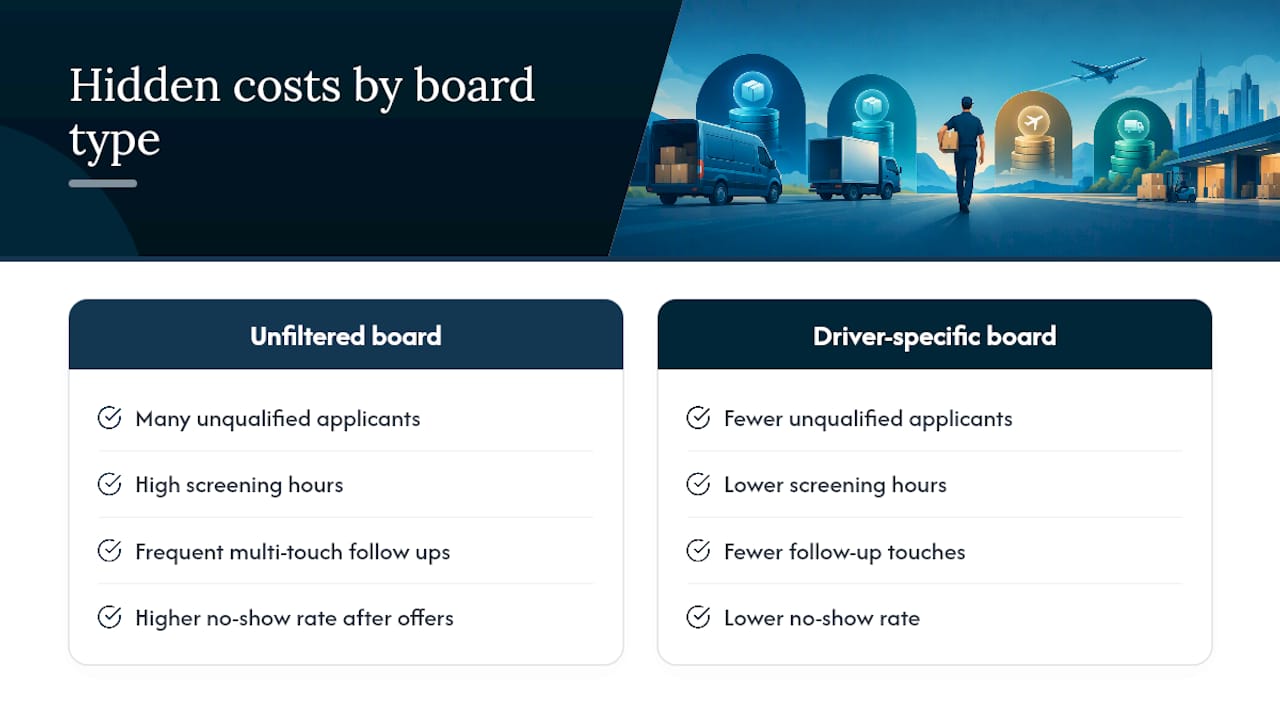
The invoice from a job board is the smallest part of your real recruiting cost. Recruiter time spent screening unqualified applicants, scheduling interviews that never show, and following up with candidates who ghost after a conditional offer adds up fast, and almost nobody tracks it.
Think through a typical week. A recruiter posts on three boards, fields 60 applications, and spends maybe 15 minutes per application on initial screening. That is 15 hours of labor before a single interview happens. If two of those boards send mostly unqualified traffic, that recruiter just burned most of a work week filtering noise instead of talking to drivers who could actually start.
Follow-up processes carry their own hidden cost too. Every candidate who requires three or four touches before scheduling an interview, and then no-shows anyway, consumes recruiter hours that never show up in a CPH calculation unless you build labor into the formula the way the ANSI/SHRM cost-per standard recommends.
The fix is not complicated. When you compare boards in your pilot, log recruiter hours per board alongside spend. A board with a slightly higher subscription cost but a much higher qualified-lead rate often wins on total cost once you add labor back in. Boards that pre-filter for driver-specific qualifications, rather than general job seekers, tend to cut this labor cost the most because the screening work has already been partially done before the application ever lands in your inbox.
Author Checklist: What I Would Do in the First 90 Days
Week one, pull your last two quarters of hiring data by role and terminal to set a real baseline, not an industry guess. Weeks two through five, launch the controlled pilot across two to four boards with identical job copy and fixed budgets. Review results weekly: qualified applications, interviews, starts, and recruiter hours logged per board.
By day 60, you should have enough starts to calculate CPH per board per role. Decide to scale the board that produces the lowest CPH after factoring in recruiter time, not the one with the most raw applications. Track 90-day retention on every hire; a cheap hire who quits in six weeks was never actually cheap.
— Aaron
Start a Trial and Test ROI Directly on UCEP
There are platforms built specifically around FedEx-contracted hiring instead of general trucking traffic that can facilitate running the exact pilot this article describes. The Complimentary Trial Listing lets you post a role at no upfront cost, and the Standard Monthly Plan at $99 per month covers ongoing postings once you decide a channel is earning its keep.
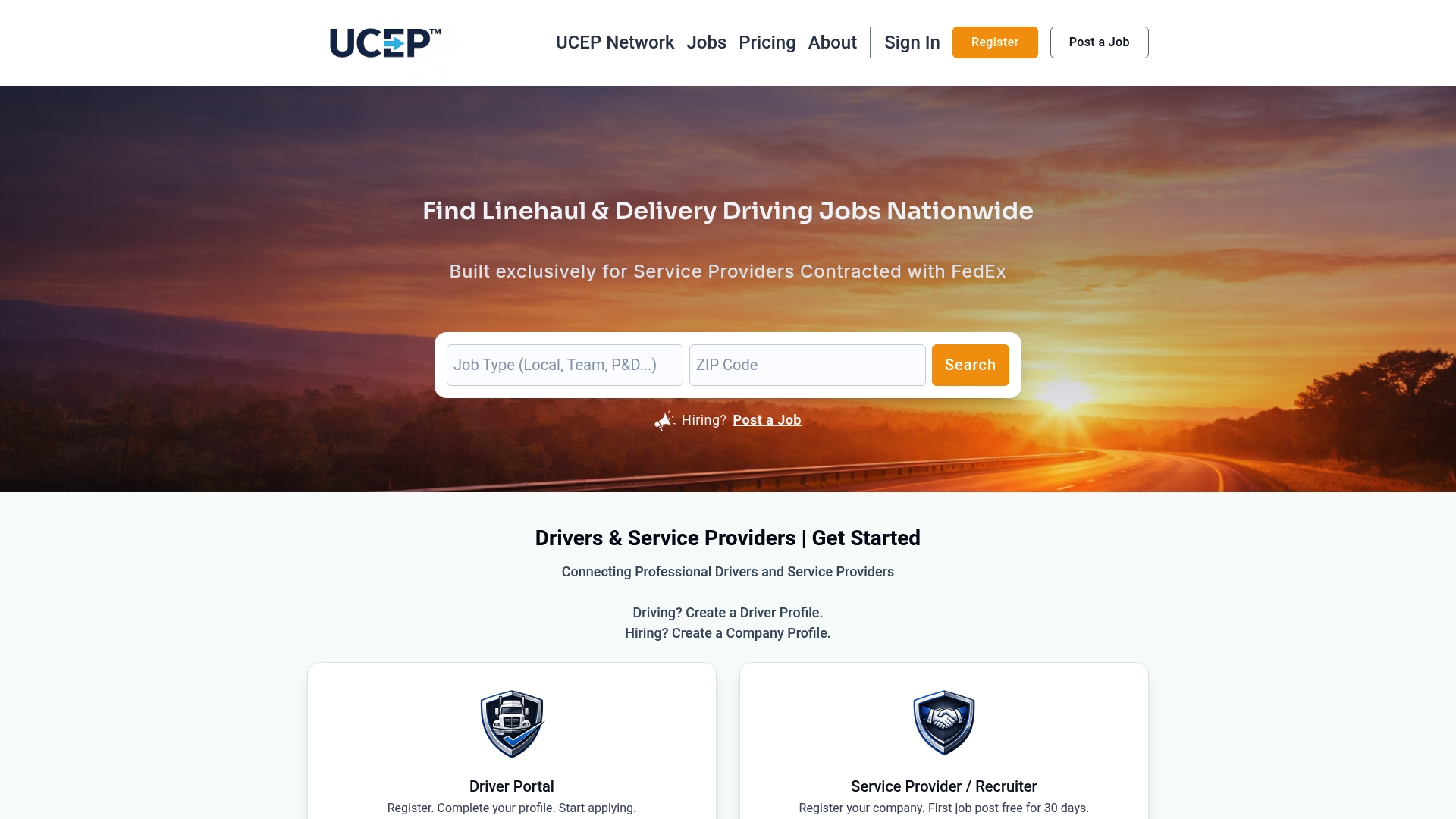
To mirror your pilot's tracking setup on UCEP, use the same job copy and qualification language you ran on other boards, tag your listing with a UTM parameter for clean attribution, and segment postings by role, whether that is a CDL-A solo linehaul, CDL-A team linehaul, or pickup and delivery position. UCEP's employer directories and internal review system also let you see how other service providers, including listings like Revolution Recruiting LLC, structure their postings for terminal fit.
Set up your trial listing this week, run it alongside whatever board you are already using, and compare CPH after 30 days using the tracking method outlined above.
Sources
Three sources are worth bookmarking before you design your next pilot. Randall Reilly's benchmarking guide lays out the controlled-pilot method referenced throughout this article. ATRI's driver demographics research explains the decision factors, beyond pay, that shape applicant quality and retention. The Tenstreet case study on Baker's Express shows what industry-focused distribution actually did to one fleet's cost per hire. For a broader look at how seasonality and geography shift recruiting benchmarks, EnerlyticsAI's fleet research is a useful supplementary read when you are setting realistic pilot expectations.
- How to Benchmark Your Online Truck Driver Recruiting Advertising - Randall Reilly
- Baker's Express Case Study | Tenstreet
FAQ
What is a good cost-per-hire for trucking recruiting?
There is no universal good number. The Randall Reilly benchmarking approach recommends comparing your own CPH by role and terminal over time rather than chasing an external target, since freight lanes, home-time policies, and local labor markets vary too much for one figure to apply broadly.
How long should a job board pilot run?
Two to four weeks is usually enough to smooth out daily noise while still letting you act on the results quickly. Keep the budget, job copy, and qualification requirements identical across every board during that window.
Does UCEP work for non-FedEx trucking roles?
No. UCEP is built exclusively for FedEx-contracted service providers hiring CDL-A team, CDL-A solo, linehaul, and pickup and delivery drivers, which is what allows it to filter out the mismatched traffic general boards tend to attract.
What is the difference between CPA and CPH in driver recruiting?
Cost-per-application (CPA) measures how much it costs to generate one lead, while cost-per-hire (CPH) measures the full cost of turning leads into a confirmed start. A board can have a low CPA and still produce a high CPH if most of its applicants never qualify.
How much does UCEP cost to test?
UCEP offers a Complimentary Trial Listing with no published price for recruiters who want to test the platform first, and a Standard Monthly Plan priced at $99 per month for ongoing postings.