
Multiposting to job boards means publishing one job listing once and distributing it automatically to dozens or hundreds of boards, with every application routed back into a single pipeline. It saves recruiting teams hours of manual entry per role and widens candidate reach across general boards, niche sites, and social channels at the same time. It works best for high-volume, multi-location, or hard-to-fill niche roles, which is exactly where most driver and logistics hiring falls.
TL;DR:
- Multiposting saves time by allowing a single draft to be distributed automatically across hundreds of boards, including niche and social platforms.
- Targeted sponsorship offers better results for hard-to-fill driver roles, as most hires come from a few select boards rather than widespread coverage.
- Systems should support native ATS integrations, proper board coverage, source-of-hire tagging, and board-specific customization to maximize efficiency.
- Setting up a first campaign requires a well-crafted job draft, verified credentials, and clear automation rules to prevent posting errors and candidate confusion.
- Tracking source-of-hire, cost-per-hire, time-to-fill, and application quality is essential to measure multiposting success and optimize your sourcing strategy.
Table of Contents
- How Does Multiposting Work Behind the Scenes?
- What Benefits Does Multiposting Actually Deliver?
- What Should You Look for in a Multiposting Solution?
- How Do You Set Up Your First Multiposted Job?
- How Do You Measure Whether Multiposting Is Working?
- What Mistakes Undermine a Multiposting Strategy?
- How Does This Apply to Driver and Logistics Hiring?
- Post Driver Roles Where Qualified Candidates Actually Look
- Sources
How Does Multiposting Work Behind the Scenes?
Every multiposting workflow starts with one canonical job draft, built either inside your applicant tracking system (ATS) or a dedicated multiposting portal. That draft becomes the single source of truth: job title, pay range, location, and requirements all get written once, then pushed outward.
The distribution itself runs through integrations, typically an API connection, a data feed, or straightforward board credentials you authorize once. Each board expects fields formatted its own way, so the platform maps your data (title, category, salary format) to match what each destination requires. Multi-posting handles this formatting and field mapping automatically, which is the real technical work happening under the hood.
Two distribution types matter here:
- Organic listings post for free based on relevance and freshness, and they typically go live within minutes.
- Paid or sponsored placements cost money for premium visibility, and they depend on board moderation, so they can take until the same day to publish.
Every application, regardless of which board it came from, lands in one pipeline with source tagging attached. That tagging is what lets you later trace a hire back to the exact board that produced it.
What Benefits Does Multiposting Actually Deliver?
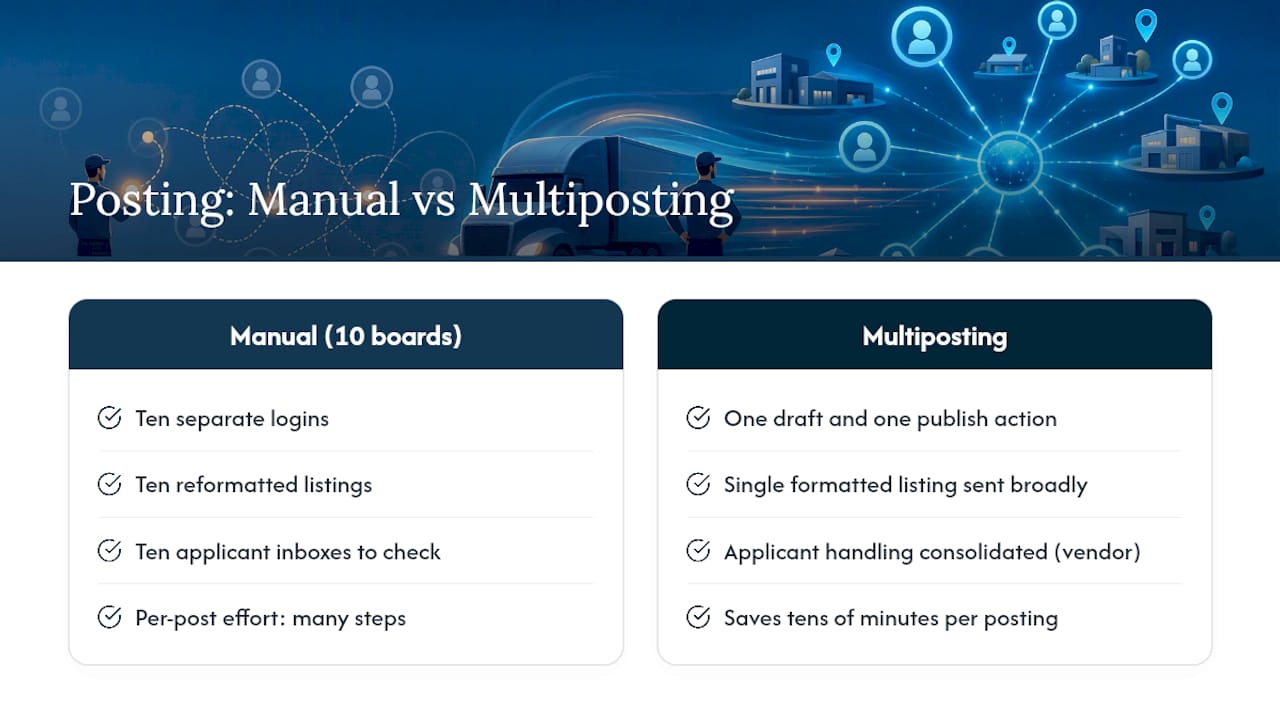
The most concrete benefit is time. Manually posting to ten boards means ten separate logins, ten reformatted listings, and ten sets of applicant inboxes to check. Multiposting collapses that into one draft and one publish action, and vendors estimate it saves recruiters tens of minutes per job posting compared to manual entry across each site.
The reach math matters too: vendor coverage ranges from roughly 100 boards to more than 3,000, spanning general aggregators, niche industry boards, and social platforms. More coverage does not automatically mean more qualified applicants, though. Most hires still concentrate around two or three boards even when a job posts broadly, so targeted placement often beats blanket coverage.
That is exactly why sponsoring a listing makes sense for hard-to-fill roles, like CDL-A team drivers or specialty technicians, while relying on organic reach for higher-volume, easier-to-fill positions like general warehouse or hourly retail staffing.
What Should You Look for in a Multiposting Solution?
Not every multiposting tool is built the same way, and the differences show up fast once you're running dozens of postings a month. Before committing to a platform, check for these capabilities:
- Native ATS integrations or partner badges confirming a direct connector, not a workaround.
- Board coverage breadth, including access to niche industry boards relevant to your hiring, not just general aggregators.
- Paid-placement controls, so you can set a budget and choose which roles get sponsored spend.
- Application routing with source-of-hire tagging built into reporting, not bolted on afterward.
- Quick Apply support, since boards offering direct-apply functionality can produce multiple times more applications than standard click-through listings.
- Per-board customization and scheduling, letting you adjust titles or salary language for local boards without rebuilding the job from scratch.
Pro Tip: Don't judge a platform purely by board count. A 3,000-board network is meaningless if your actual hires keep coming from the same three sites. Ask any vendor for source-of-hire breakdowns from comparable roles before you sign anything.
If you want a deeper comparison of pricing structures across platforms, this flexible pricing comparison breaks down what different fee models actually cost at scale.
How Do You Set Up Your First Multiposted Job?
Running your first multiposting campaign well comes down to sequence. Rush the setup and you'll spend more time fixing bad data than you saved posting in the first place.
- Draft one canonical job with standardized fields: title, location, pay, and requirements written exactly as you want them to appear everywhere.
- Connect and verify board credentials, confirming field mapping is correct before you publish anything live.
- Select your board mix, deciding which roles justify paid sponsorship and which can run organically.
- Publish a test post and confirm applications flow correctly into your ATS or pipeline dashboard.
- Set a repost cadence and automatic closure rules, so filled roles stop pulling in new applicants across every board simultaneously.
That last step matters more than it seems. A role left open on twelve boards after it's filled wastes candidate time and damages your employer reputation.
How Do You Measure Whether Multiposting Is Working?
Multiposting only proves its value when you track the right numbers. Four metrics matter most:
- Source-of-hire, showing which boards actually produce hires, not just applications.
- Cost-per-hire, factoring in both subscription fees and any sponsored spend.
- Time-to-fill, comparing before and after adopting multiposting.
- Application-to-hire conversion, which flags boards sending high volume but low quality.
Build a simple dashboard tagging every applicant by source. One staffing team that switched to multiposting used their first sixty days of data to reconfigure default board selections by role category, improving qualified applicant rates without spending more.
Quick sponsored wins look good early, but organic boards that consistently deliver steady, lower-cost applicants over months usually carry the better long-term value.
What Mistakes Undermine a Multiposting Strategy?
A few recurring errors turn multiposting from a time-saver into a mess:
- Duplicate postings confuse candidates when the same role appears under slightly different titles across boards.
- Localized satellite posts (city-specific clones of a master listing) boost local visibility but need centralized applicant tracking to avoid duplicate applications piling up.
- Truncation and mobile formatting issues cut off job descriptions on boards with tighter character limits.
- Unmanaged sponsored budgets drain spend fast without guardrails on daily or per-role caps.
- Fragmented candidate data violates most boards' terms of service and makes reporting unreliable.
Pro Tip: Before scaling to dozens of boards, run one role through your full board mix and manually check how it renders on mobile for at least three destinations. Formatting breaks are far more common than most recruiters expect.
How Does This Apply to Driver and Logistics Hiring?
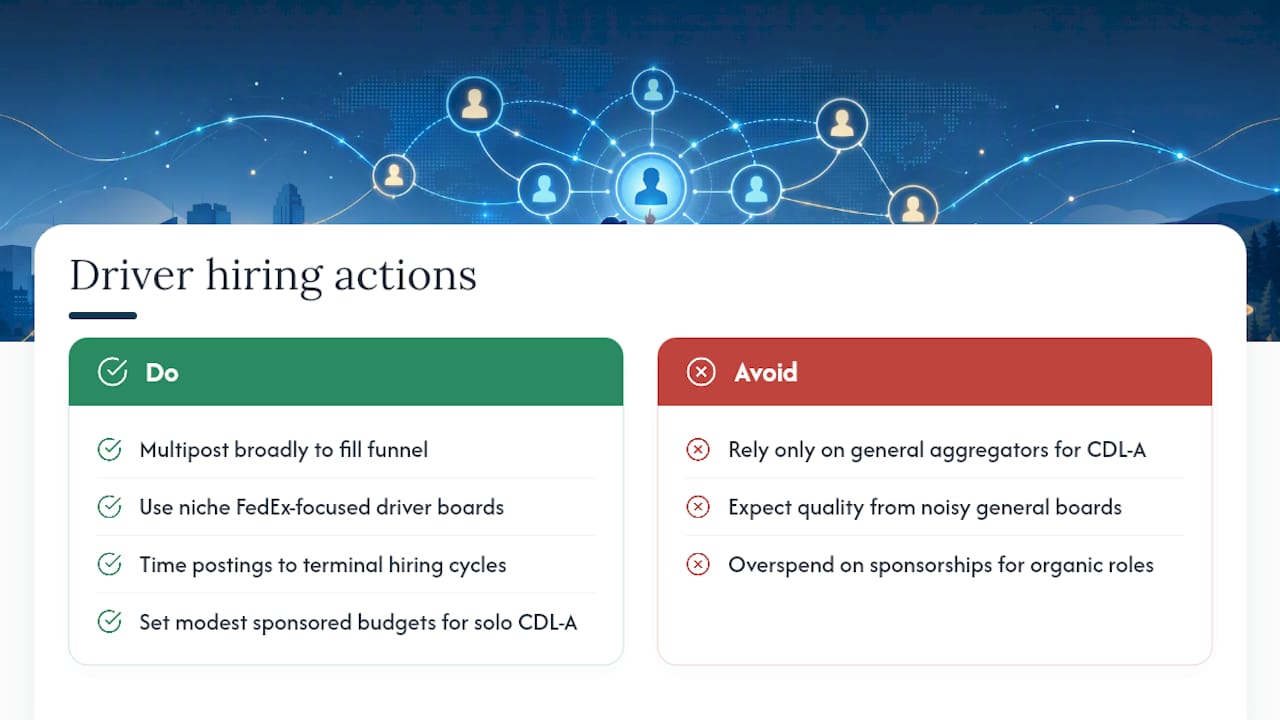
Broad multiposting fills the funnel, but driver roles need targeted boards to fill it with qualified applicants. CDL-A and linehaul positions attract more noise than signal on general aggregators. Niche boards focused on FedEx-related driving roles filter that noise out before it reaches your pipeline.
Time your postings around terminal-specific hiring cycles, and set modest sponsored budgets for solo CDL-A roles that consistently underperform organically. This logistics hiring platform guide and this breakdown of niche board ROI for driver hiring go deeper into both.
— Aaron
Post Driver Roles Where Qualified Candidates Actually Look
Broad multiposting spreads a job wide, but for FedEx-contracted Service Providers hiring CDL-A, linehaul, or pickup and delivery drivers, wide isn't the same as right. This platform is built specifically for this hiring lane: targeted listings that reach professional drivers already searching for FedEx-related work, applicant aggregation into one dashboard, and subscription posting options that scale with your hiring volume. Niche boards like this complement your broader multiposting mix by filtering for candidates who already understand the role.
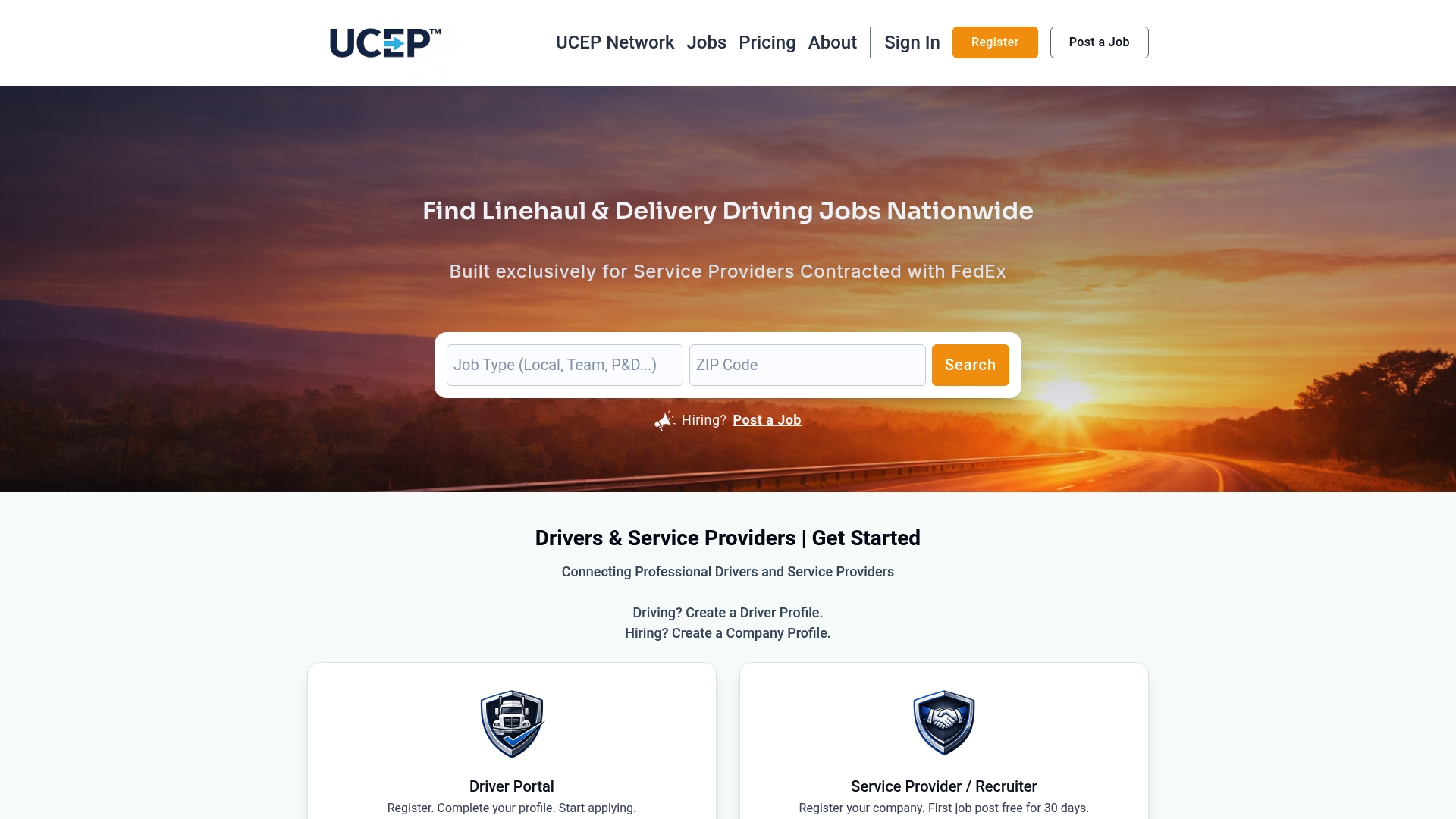
See how active listings look from employers already using the platform, like Four Leaf Recruiting or Revolution Recruiting LLC. When you're ready to reach drivers directly, post your job on Ucep and start collecting applications from candidates already looking for FedEx-related driving work.
Sources
- What Is Multi-Posting? | Candidately Glossary | Candidately
- One job. Every board that matters. | Join multiposting features
- AI Job Multiposting Software for Recruiters | Mainder
- Post Jobs to Multiple Sites with One Click | PostJobsNow