
For most logistics hires, prioritize a niche logistics job board for drivers and a role-focused ATS or professional network for management. Recruiters who post driver roles on niche boards typically screen faster because applicants already carry relevant credentials, which cuts manual review time before the interview stage. Generic boards still have a place for high-volume, entry-level warehouse roles, but for CDL-A drivers and supply chain specialists, industry-specific platforms consistently produce better-qualified applicants per post.
If you hire drivers for FedEx-contracted routes specifically, UCEP is built for that exact need. It is a job board and applicant tracking system focused only on Service Providers hiring for linehaul, CDL-A team, CDL-A solo, and pickup and delivery positions.
Here's how to use this guide:
- Scan the shortlist below if you want a quick comparison of platform types and pricing shapes.
- Jump to the role-based section if you already know whether you're hiring drivers, warehouse staff, or supply chain managers.
- Read the "how to choose" section before signing any annual contract with a vendor.
Key Takeaways
The most reliable logistics hiring strategy pairs niche platforms with driver roles and professional networks with supply chain management roles, then validates the choice with a short pilot.
| Point | Details |
|---|---|
| Match platform to role | Niche driver boards work best for CDL roles; professional networks and industry associations fit management hires better. |
| Pilot before committing | Run identical job posts on two platforms for ten business days and compare qualified applicants per post. |
| Verify credentials early | Platforms supporting pre-screening questions and certification uploads shrink driver hiring timelines. |
| Know when to outsource | Urgent, high-volume, or compliance-heavy hiring favors workforce platforms and agencies over standalone job boards. |
| UCEP for FedEx-contracted roles | UCEP specializes in CDL-A, linehaul, and pickup and delivery hiring for FedEx Service Providers, with built-in ATS and employer directories. |
Table of Contents
- Best Logistics Hiring Platforms and What Each One Solves
- Which Platform Fits Which Logistics Role?
- How Do You Choose the Right Logistics Hiring Platform?
- Job Boards vs. Agencies: When Should You Outsource Hiring?
- Why Consider UCEP for FedEx-Contracted Driver Hiring?
- What This Guide Actually Recommends
- Get Started With UCEP for FedEx-Contracted Driver Hiring
- Frequently Asked Questions
- Sources
Best Logistics Hiring Platforms and What Each One Solves
Choosing among logistics job platforms comes down to matching platform type to the role you're filling, not picking whichever site ranks highest in a search. Here's a working shortlist organized by what each category does well.
- Niche logistics job boards. Sites like JobsInLogistics connect employers with a dedicated pool of logistics talent and report deep employer relationships built over years in the sector. Best for driver and warehouse roles where industry-specific screening matters. Pricing usually runs on a subscription or per-post basis rather than a flat annual license.
- Logistics recruiting platforms with candidate databases. iHireLogistics offers a searchable resume database, AI-generated job ads, and proactive sourcing tools aimed specifically at logistics recruiters. Best for recruiters who want to source passive candidates, not just wait on inbound applications. Pricing is typically tiered by seat count and database access level.
- High-reach logistics job platforms. HiringLogistics advertises large monthly traffic among logistics professionals and pushes targeted email alerts to candidates matching your listing. Best for high-volume postings where exposure matters more than a curated pool. Pricing tends to follow a pay-per-post or bundle model.
- Workforce and staffing platforms. Services like SupplyChainWork combine job posting with staffing divisions and AI-enabled sourcing, aimed at reducing time-to-fill for supply chain positions at scale. Best for urgent, high-volume hiring surges. Pricing shifts toward a managed-service or placement-fee model rather than flat subscriptions.
- General job boards. Broad platforms with logistics category filters. Best for entry-level warehouse and hourly roles where volume matters more than niche credentials. Pricing is usually pay-per-post with wide variability.
- Professional networking sites. Best for sourcing supply chain managers, directors, and executives who aren't actively browsing job boards. Pricing runs on subscription seats for recruiter access.
- Industry association career centers. Groups like ASCM run career resources and salary benchmarking tools alongside job postings. Best for white-collar supply chain roles where compensation benchmarking matters as much as sourcing. Pricing is often bundled with membership.
- Applicant tracking systems with job board distribution. Best for recruiters who need to manage applicant flow across multiple postings from one dashboard. Pricing scales with company size and posting volume.
- Regional or local classifieds. Best for hyper-local pickup and delivery roles where commute distance matters more than national reach. Pricing is typically low-cost and pay-per-post.
- UCEP. A dedicated job board and recruiting platform built exclusively for Service Providers contracted with FedEx. Best for CDL-A team, CDL-A solo, linehaul, and pickup and delivery roles tied to FedEx contracts, with employer directories, terminal directories, internal reviews, and a built-in applicant tracking system. Pricing runs on tiered subscription plans with a free trial listing for new recruiters.
A few patterns hold across this list. Niche boards trade volume for quality: fewer applicants, but less time spent screening resumes that don't match your requirements. Workforce platforms trade cost for speed. General boards trade quality for reach. Which trade-off makes sense depends entirely on the role you're filling next.
Which Platform Fits Which Logistics Role?
Driver hiring and office-side supply chain hiring behave like two different markets, even though they both fall under "logistics recruitment." Treating them the same is the most common mistake recruiters make.
Driver hiring (CDL-A, linehaul, pickup and delivery). Niche driver boards outperform general boards here because they let you filter by CDL class, endorsement, and route type before a candidate ever applies. Targeted alerts notify qualified drivers the moment a matching role posts, which matters given how quickly good drivers get scooped up in this labor market. Trucking industry data should shape your time-to-fill expectations. Driver hiring is tighter and slower than office hiring in most markets, and budgeting for that reality up front avoids frustration later.
- Filter for CDL class and endorsements before reviewing resumes.
- Verify driving records and CDL status early. Platforms that support pre-screening questions and certification uploads shrink your funnel meaningfully.
- Use platforms built for the exact contract type, such as UCEP for FedEx-contracted routes.
Warehouse and hourly staff. Volume boards and workforce platforms work well here since the applicant pool is larger and less credential-dependent. Seasonal hiring surges (peak shipping season, holiday retail support) favor staffing partners who can flex headcount up and down quickly.
Mid-level operations and senior supply chain hires. Industry-specific white-collar boards, professional networks, and executive recruiters do the heavy lifting here. These hires respond less to job board volume and more to targeted outreach and salary benchmarking through resources like ASCM's salary survey.

Pro Tip: Build separate screening funnels for driver roles and office roles inside your ATS. Mixing the two makes it harder to spot bottlenecks specific to each candidate type.
Whatever the role, integrate platform data with your ATS wherever possible. Manual re-entry between systems is where good candidates fall through the cracks.
How Do You Choose the Right Logistics Hiring Platform?
Run every vendor through the same checklist before signing anything longer than a month-to-month agreement.
Core evaluation checklist:
- Candidate relevance: does the platform's applicant pool actually match your role type?
- Resume database quality: can you search by certification, endorsement, or years of experience?
- Sourcing tools: does the platform proactively surface candidates, or only wait for applications?
- ATS and HRIS integrations: will job data sync automatically, or require manual export?
- Pricing transparency: is the cost structure flat, tiered, or usage-based, and is that clearly stated upfront?
- Background and CDL verification support: can candidates upload credentials directly into the platform?
Ten questions to ask in a vendor demo:
- What is your average time-to-fill for roles similar to mine?
- How many qualified applicants can I expect per post, on average?
- Do you support pre-screening questions specific to CDL or certification requirements?
- What does your ATS integration actually sync, and how often?
- Is pricing per post, per seat, or a flat subscription?
- What happens if I need to pause or cancel mid-contract?
- Can I see anonymized data on applicant quality from a similar client?
- How do you handle duplicate or fraudulent applications?
- What support response time can I expect if a posting isn't performing?
- Do you offer a free trial or pilot period before a long-term commitment?
Four red flags: vague pricing that only appears after a sales call, no mention of ATS integration options, no visibility into applicant sourcing methods, and reluctance to offer any trial or short-term pilot.
Once you've narrowed it to two platforms, run a short A/B pilot: post an identical job ad on each for ten business days, then compare qualified applicants per post, time to first qualified interview, and cost per qualified applicant. That data settles the argument faster than any sales pitch.
Job Boards vs. Agencies: When Should You Outsource Hiring?
Job boards work when you have time to manage the funnel yourself and the role isn't urgent. Agencies and workforce platforms earn their fee when speed, compliance complexity, or volume outpaces what your internal team can handle alone.
- Speed vs. control: boards give you full control over screening but slower fill rates; agencies move faster but you give up some control over candidate selection.
- Cost per hire: boards are cheaper per post but require more internal recruiter time; agencies charge placement fees but reduce internal hours spent screening.
- Compliance and verification: complex CDL, background check, or DOT compliance needs often justify a managed partner who already runs those checks.
- Volume surges: seasonal peaks or urgent CDL shortages favor staffing platforms built to scale sourcing quickly.
The decision rule is simple: if you can fill the role within your normal hiring timeline using internal resources, use a board. If the role is urgent, high-volume, or compliance-heavy, bring in a workforce partner.
Why Consider UCEP for FedEx-Contracted Driver Hiring?
UCEP exists for one specific hiring problem: Service Providers under contract with FedEx who need qualified CDL-A team, CDL-A solo, linehaul, and pickup and delivery drivers. That focus shows up in the platform's structure, not just its marketing copy.
- Employer directories and terminal directories let recruiters see who else is hiring and where, which helps benchmark your own posting.
- Driver and Service Provider internal reviews give both sides visibility into reputation before a conversation even starts.
- A built-in applicant tracking system and targeted driver alerts reduce the manual work of managing applications across multiple job boards.
Pro Tip: Before committing to any platform long-term, post one role and track applicant volume against your current source for two weeks. The comparison usually settles the decision faster than reading another review.
If you're evaluating UCEP against a general board, check listings from real Service Providers like VAS Logistics or read UCEP's own take on platform alternatives to see how positioning compares across the category.
What This Guide Actually Recommends
The evidence here points to one clear judgment: driver hiring and supply chain professional hiring are not the same problem, and treating them with the same platform strategy wastes both time and budget. Recruiters who split their approach, niche boards and verification-heavy funnels for drivers, professional networks and benchmarking tools for management, consistently report cleaner pipelines.
The conventional advice to "post everywhere and see what sticks" falls apart specifically for CDL roles. Driver labor markets move fast, and a flood of unqualified applicants from a general board costs more in screening hours than it saves in reach. The smarter move is narrower: test two platforms side by side for ten business days, measure qualified applicants per post, and let that number make the decision instead of a sales call.
What should you prioritize first? Run the pilot before you sign anything annual. A platform that looks strong in a demo can still underperform against your actual applicant pool, and the only way to know is to test it against your current source with a real job posting.
Get Started With UCEP for FedEx-Contracted Driver Hiring
UCEP is the specialist alternative to general job boards for one specific need: filling CDL-A team, CDL-A solo, linehaul, and pickup and delivery roles for FedEx-contracted Service Providers. Where general logistics boards make you sift through applicants who don't understand FedEx contract requirements, UCEP's pool already knows the work.
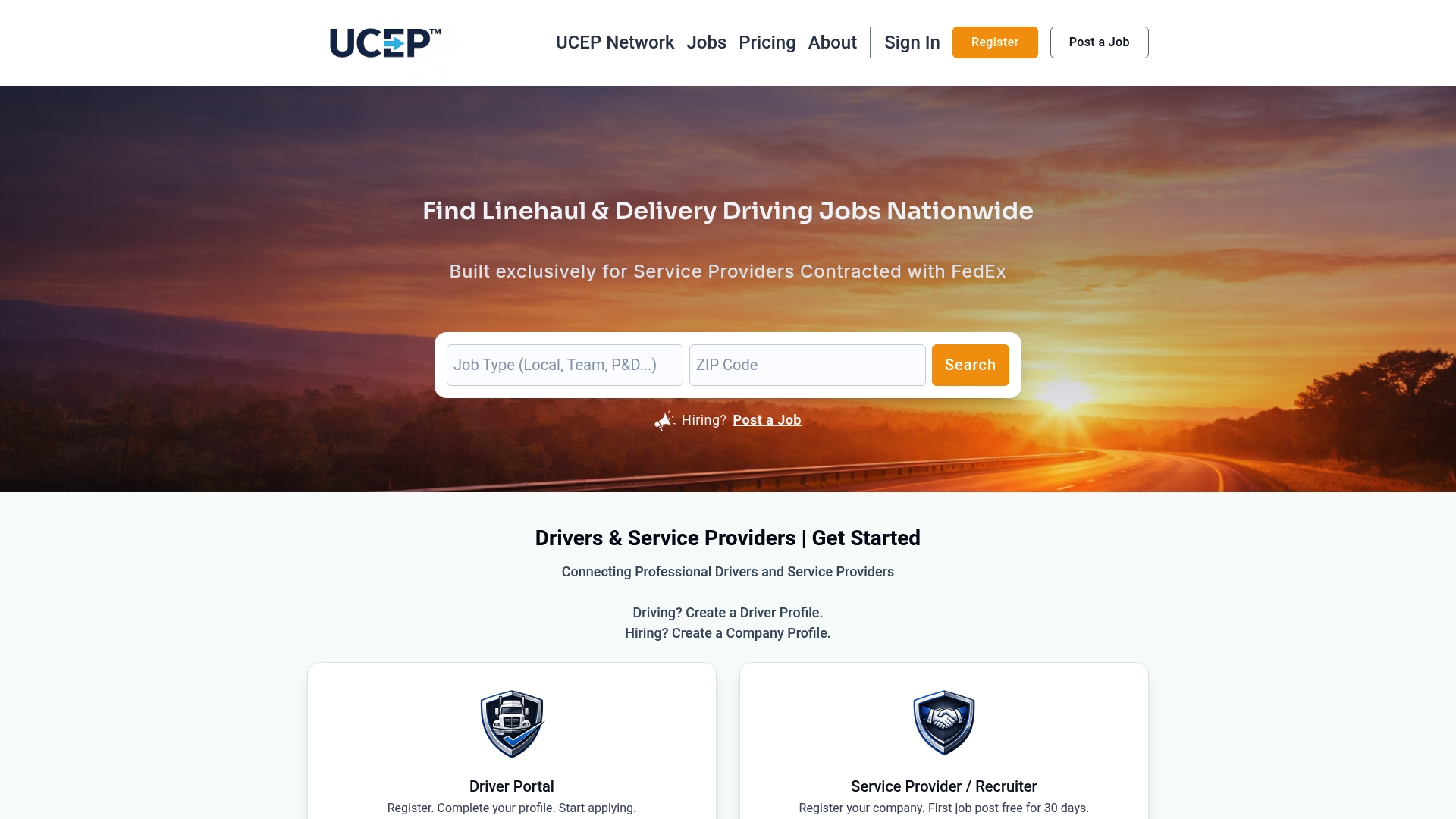
The platform gives you employer directories, terminal directories, driver and Service Provider reviews, and a built-in applicant tracking system built specifically around FedEx-related driving roles. New recruiters can start with a free trial listing before committing to a paid tier, and bulk posting discounts are available for high-volume hiring. Browse companies currently hiring drivers on UCEP to see how listings appear, or check the UCEP Network page to understand the full scope of what's available before you post your first role.
Frequently Asked Questions
What is the best logistics hiring platform for CDL drivers? Niche driver-focused boards typically outperform general job boards for CDL roles because they let recruiters filter by endorsement and certification before screening begins. For FedEx-contracted routes specifically, UCEP is built around that exact hiring need.
How long does it usually take to fill a driver role? Time-to-fill varies by region and role type, and trucking industry labor data shows driver hiring often runs slower than office-side hiring due to tighter labor supply. Budget accordingly rather than assuming a driver role fills as fast as a warehouse posting.
Should I use a job board or a staffing agency for warehouse hiring? Job boards work fine for steady, predictable hiring volume. Agencies and workforce platforms make more sense during seasonal surges or when you need candidates screened and ready faster than your internal team can manage alone.
Do logistics job boards integrate with existing ATS systems? Many do, though integration depth varies. Ask vendors directly what data syncs automatically versus what requires manual export, since that gap often creates more admin work than recruiters expect going in.
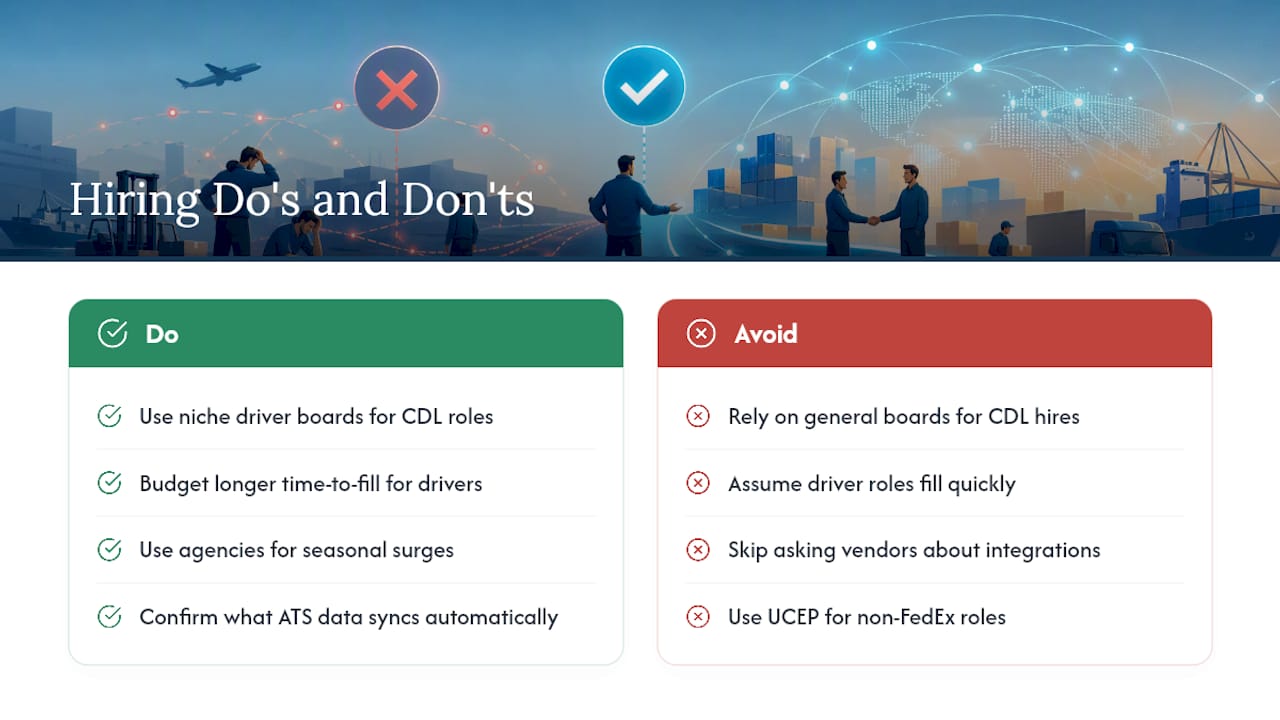
Is UCEP only for FedEx-contracted Service Providers? Yes. UCEP is built specifically for Service Providers contracted with FedEx hiring CDL-A team, CDL-A solo, linehaul, and pickup and delivery drivers, along with drivers looking for FedEx-related opportunities nationwide.
Sources
- Vendor Directory — JobsInLogistics.com profile (SHRM Vendordirectory)
- Hiring Solutions | iHireLogistics
- Hiringlogistics
- SupplyChainWork — workforce platform for the supply chain industry
- American Trucking Associations — Economics and industry data