
If you're hiring drivers for FedEx-contracted linehaul, CDL-A team, CDL-A solo, or pickup and delivery routes, UCEP is the platform to post on first. It's built specifically around Service Providers who need route-qualified drivers, not generalist job seekers scrolling through unrelated postings. Save general job boards and aggregators for a different problem: high-volume, non-route hiring where you need dozens of applicants fast and screening depth matters less than raw applicant count.
- Use UCEP first for FedEx-related or route-based driver roles.
- Use aggregators or general boards when you need volume over precision.
- Combine both when you're scaling a fleet quickly across multiple terminals.
Pro Tip: Post the role on UCEP today and check your employer directory listing at the same time. A complete profile with terminal details tends to pull more qualified applicants than a bare-bones job post.
Key Takeaways
Employers filling FedEx-contracted or route-based driver roles get faster, higher-quality hires from niche platforms like UCEP than from general job boards alone.
| Point | Details |
|---|---|
| Match platform to hire type | Use UCEP for route-based FedEx roles and aggregators only when you need broad volume fast. |
| Reduce screening burden | Niche boards pre-filter for CDL qualification, cutting the time spent sorting unqualified applicants. |
| Shorten the funnel with ATS | Prepopulated applications and centralized pipelines cut drop-off between application and orientation. |
| Write posts for scanning | Lead with route, pay, and home time, and keep the format mobile-friendly to reduce abandonment. |
| Choose UCEP for specialization | UCEP's employer directories, terminal directories, and targeted alerts are built specifically for Service Providers hiring FedEx-related drivers. |
Table of Contents
- Why Niche Driver Job Boards Often Beat General Job Sites
- What Different Posting Options Actually Deliver
- What to Budget for Cost and Time-to-Hire
- How to Write a Driver Job Post That Attracts Qualified Applicants
- How to Choose a Driver Hiring Platform Quickly
- How UCEP Approaches Driver Hiring for Service Providers
- Legal Compliance and Certification Requirements to Check
- Comparing Candidate Vetting Features Across Platforms
- Mobile Experience Matters More Than Most Employers Realize
- What Employers Get Wrong About Driver Hiring Sites
- Post Your Next Route Opening on UCEP
- Sources
Why Niche Driver Job Boards Often Beat General Job Sites
General job boards cast a wide net and catch a lot of noise along with it. A roundup of top trucking job boards found that niche sites concentrate candidates who already hold a CDL and understand route work, which cuts down on the resume pile you have to sort through to find someone qualified.
That concentration matters more than it sounds like it should. When every applicant already meets your baseline requirements, your screening time shifts from "does this person qualify" to "is this person the right fit," which is a faster and more useful question to answer.
Niche boards work best for:
- Pickup and delivery roles where local route familiarity and reliability matter more than long-haul experience.
- CDL-A team and solo positions where endorsement type and equipment experience need to match precisely.
- Linehaul hiring where night shifts, terminal-to-terminal routes, and DOT hours-of-service compliance narrow the qualified pool significantly.
General boards don't disappear from your toolkit entirely. They're useful when you're testing a new market or need a large applicant pool to compare against your niche results. But for FedEx-contracted Service Providers specifically, a targeted job board approach tends to deliver a shorter path from post to hire.
What Different Posting Options Actually Deliver
Every platform type solves a different hiring problem. Matching the platform to the job is what determines whether you fill the seat in a week or a month.
- Niche job boards deliver targeted reach and stronger candidate matches. These work best for specialized CDL roles where the applicant pool needs to already meet route or equipment requirements before you talk to them.
- Aggregators and multi-post distribution tools push your listing across many boards at once, trading precision for speed and scale. Use these when you need a large volume of applicants in a short window, such as opening a new terminal.
- ATS-integrated hiring centers cut manual work by prepopulating applications and centralizing your candidate pipeline. Tenstreet's hiring center is a widely used example, reducing the friction between application and onboarding.
- Local classifieds and community channels can produce a quick local hire, but they usually require heavier manual screening since there's no built-in qualification filter.
Most experienced recruiters end up running a mix. A practical workflow many fleets follow is posting to a niche board first, layering in aggregator distribution for reach, and routing everything through an ATS to keep the pipeline organized instead of scattered across inboxes.
What to Budget for Cost and Time-to-Hire
Pricing shapes vary widely across platform types. Some trucking job boards offer free postings, others charge per post, and many run on subscription tiers, so confirm current pricing directly with each vendor before budgeting.
Time-to-hire follows a pattern, too. Niche boards tend to move faster because the applicant pool is pre-qualified. Distribution tools speed up volume but add screening time on the back end. ATS-integrated platforms shorten the funnel the most because they prepopulate applications and eliminate the manual data entry that stalls candidates between applying and scheduling orientation.
- Screening time adds real cost even on "free" boards.
- Onboarding delays between application and orientation raise your effective cost-per-hire.
- Driver turnover after a rushed hire often costs more than the platform fee ever would.
Screening and onboarding drag is usually the hidden cost employers underestimate, not the sticker price of the job post itself.
How to Write a Driver Job Post That Attracts Qualified Applicants
A job post that reads like a legal disclaimer won't pull the applicants you want. Structure it so a driver can decide in ten seconds whether the role fits.
- Lead with route, pay, and home time. Drivers scan for these three details first; bury them and you lose the read before it starts.
- List CDL class and endorsement requirements up front. This filters out unqualified applicants before they waste your time or theirs.
- Format for quick scanning. Short bullets, a clear compensation range, and equipment and shift details beat dense paragraphs every time.
- Reduce application friction. A direct apply button, mobile-first form, and ATS prepopulation cut drop-off between click and completed application.
- Include screening prompts. Ask about DOT medical card status, endorsement type, and route experience directly in the post so you're not chasing that information after the fact.
Pro Tip: Put your pay range and home-time policy in the first two lines of the post. Drivers who don't see it immediately tend to assume the worst and move on to the next listing.
How to Choose a Driver Hiring Platform Quickly
Vetting a platform doesn't need to take weeks. A short checklist gets you to a decision fast:
- Candidate quality metrics. Ask what percentage of applicants meet baseline CDL and endorsement requirements before you ever see them.
- ATS or CRM integration. Confirm whether the platform connects to your existing hiring workflow or forces a manual export.
- Distribution network. Understand exactly where your post appears and whether that reach matches your hiring need.
- Pricing transparency. Get a straight answer on cost per post, subscription tiers, or bulk discounts before signing anything.
- Candidate data ownership. Confirm you own the applicant pipeline rather than renting access to leads one post at a time.
Watch for red flags: opaque lead resale where you can't tell where an applicant actually came from, no verification process for CDL or endorsement claims, long onboarding delays before your first post goes live, or unclear attribution when you ask which channel produced a hire. When you're on the phone with a vendor rep, two questions cut through most sales pitches fast: "What percentage of your applicant pool holds an active CDL?" and "Do I own this candidate data, or are you reselling it?"
How UCEP Approaches Driver Hiring for Service Providers
UCEP specializes exclusively in connecting Service Providers contracted with FedEx to qualified drivers, leveraging RJR Worldwide Corp.'s linehaul resources rather than trying to serve every industry at once. The platform's employer directories, terminal directories, and targeted driver alerts are built around the specific hiring patterns of linehaul, CDL-A, and pickup and delivery roles.
Internal review of hiring outcomes shows niche job boards consistently outperform general boards for Service Providers, largely because the applicant pool arrives pre-filtered for route relevance and CDL qualification.
This piece was written by Aaron, a UCEP contributor focused on driver recruitment strategy for FedEx-contracted Service Providers. That specialization is the whole point: a platform built around one hiring problem tends to solve it better than a platform built to solve every hiring problem at once.
Legal Compliance and Certification Requirements to Check
Driver hiring carries regulatory weight that general hiring doesn't. Any platform you use should support, not obstruct, your compliance obligations under the Federal Motor Carrier Safety Administration's rules, including CDL verification, DOT medical certification, and drug and alcohol clearinghouse checks required before a driver gets behind the wheel.
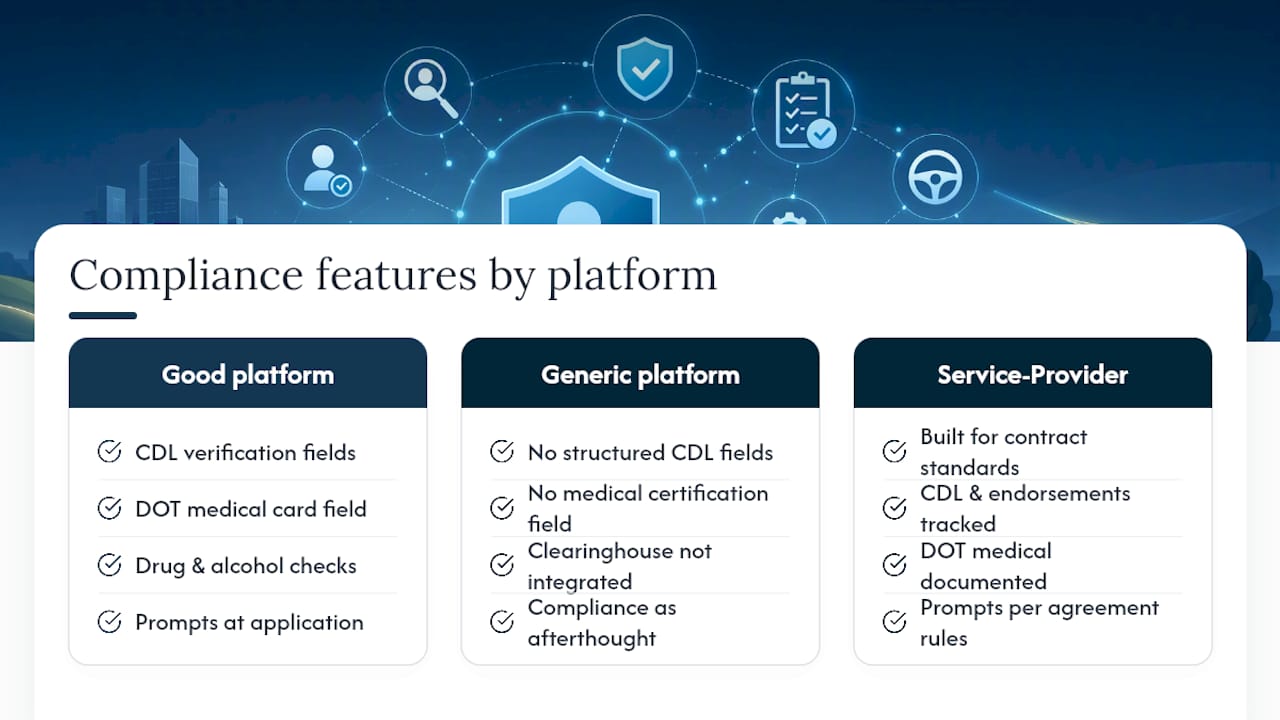
A hiring platform itself doesn't certify a driver as compliant. That responsibility sits with the Service Provider or motor carrier doing the hiring. What a good platform does is make compliance easier to track: fields for CDL class and endorsements, space to document DOT medical card status, and a structure that prompts you to collect the right information at the application stage instead of after an offer is made.
Watch for platforms that treat compliance as an afterthought, with no structured fields for CDL or medical certification data. That gap pushes the verification burden entirely onto your team later in the process, usually after you've already invested time in a candidate who may not have qualified in the first place.
If you operate under a FedEx Service Provider agreement, your compliance obligations extend beyond general DOT rules to whatever standards your contract specifies. A platform built around that context, rather than a generic job board with no awareness of route-specific requirements, tends to align better with what you actually need to document at hire.
Comparing Candidate Vetting Features Across Platforms
Background checks and drug testing integration vary enormously across hiring platforms, and the differences matter more than most job posts let on.
Some platforms stop at collecting an application and leave verification entirely to you. Others integrate directly with background check vendors and drug and alcohol clearinghouse systems, letting you initiate a check from within the same dashboard where the application landed. That integration saves real time, particularly when you're filling multiple routes at once and can't afford to chase paperwork manually for each candidate.
Look for platforms that let you:
- Flag CDL class and endorsement status at the application stage, not after an interview.
- Track DOT medical certification expiration dates so you're not caught off guard.
- Connect to drug and alcohol clearinghouse verification without manually reentering candidate data.
- Document motor vehicle record checks in a centralized candidate file rather than a separate spreadsheet.
The gap between a platform that just collects applications and one that supports the full vetting chain shows up fastest when you're hiring under time pressure. A route sitting empty for two extra weeks because verification paperwork got lost in email costs far more than the difference in platform fees ever would.
Mobile Experience Matters More Than Most Employers Realize
Most drivers apply from a phone, not a desktop. If your job post or application form isn't built for mobile, you're losing qualified candidates before they finish the first page.

A clunky mobile form is one of the quietest reasons a job post underperforms. Drivers scanning listings between routes or during a break won't wrestle with a form that requires zooming and pinching to read a field label. If the apply button leads to a page that loads slowly or times out on a mobile connection, most candidates simply back out and move to the next listing.
Platforms built with mobile-first application design tend to see fewer abandoned applications between the click and the completed submission. Features that matter here include short forms with minimal typing, the ability to upload a CDL photo directly from a phone camera, and confirmation messages that load fast on a cellular connection rather than requiring Wi-Fi.
When you're evaluating a platform, actually open the application on your own phone before you commit. Time how long it takes to get from the job listing to a completed application. If it takes you more than two or three minutes on a good connection, a driver applying between shifts is likely to give up.
What Employers Get Wrong About Driver Hiring Sites
The conventional advice tells recruiters to "cast a wide net" and post everywhere at once. That advice makes sense for entry-level warehouse work. It falls apart for CDL-A and route-based hiring, where the cost of a bad screening process outweighs the cost of a smaller applicant pool.
What gets overlooked is that volume and quality pull in opposite directions. A general board might hand you fifty applications for one route, but if forty-five don't hold the right endorsement, you've just traded screening time for applicant count, not saved it. Recruiters who prioritize platform fit over platform reach tend to fill roles faster, even when their applicant numbers look smaller on paper.
If you're hiring for FedEx-contracted routes, start with a platform built around that exact problem. Layer in an aggregator only once you've confirmed the niche approach isn't producing enough volume. Most employers do it backward, and it costs them weeks they didn't need to lose.
— Aaron
Post Your Next Route Opening on UCEP
Ucep gives Service Providers something a general job board never will: a candidate pool that already understands FedEx-contracted route work before they ever click apply. Instead of sorting through applicants who need the basics of linehaul or pickup and delivery explained to them, you're reviewing drivers who already fit the job type you posted.
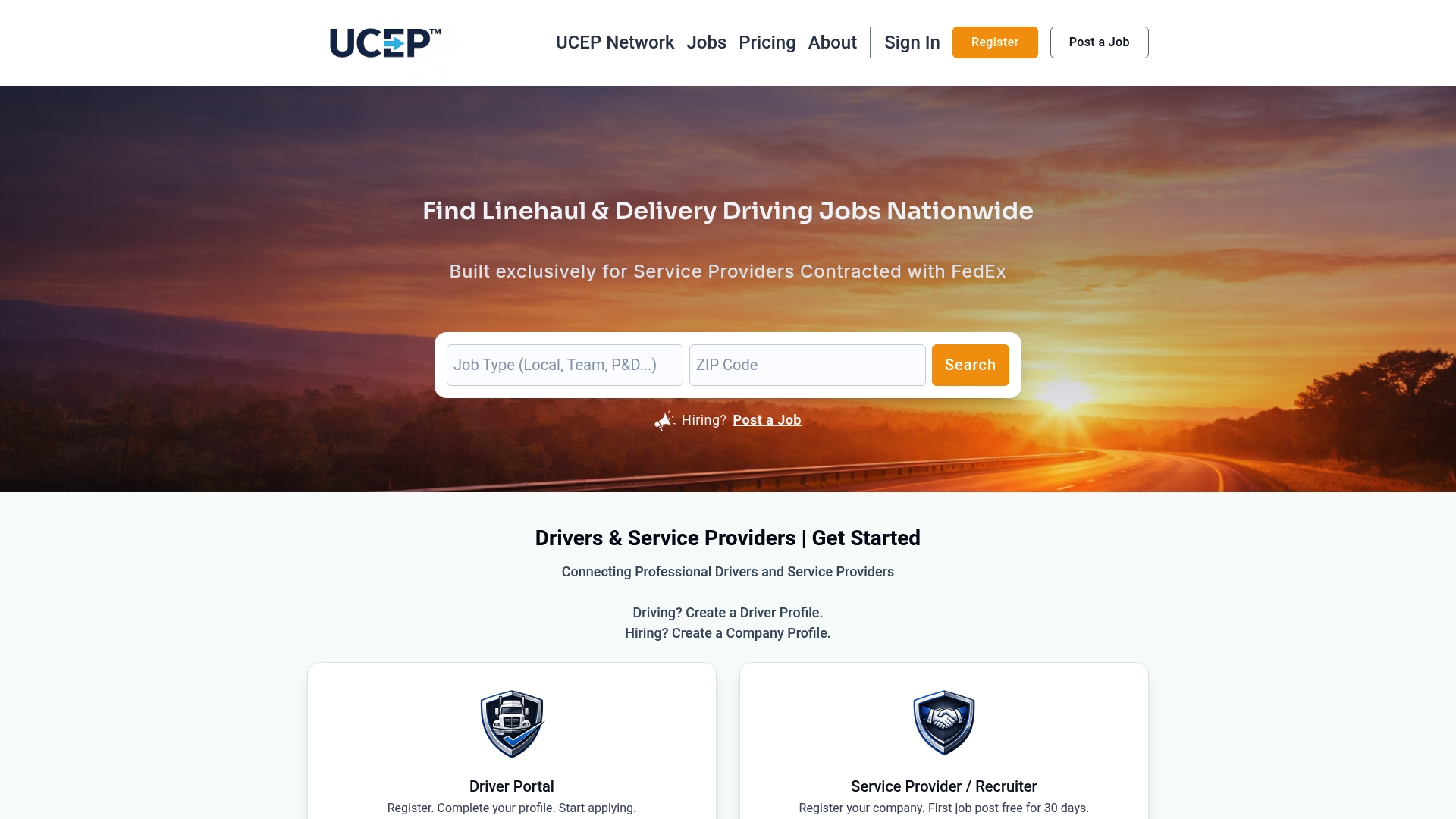
The platform includes employer directories, terminal directories, targeted driver alerts, and a built-in applicant tracking system, all built around the hiring patterns specific to FedEx-related roles. You can see how listings appear to candidates by browsing an example like the Four Leaf Recruiting driver jobs page, or check how reputation signals show up on the service provider reviews page before deciding how to build out your own profile.
If you're ready to fill a route today, post your open driver role on UCEP and set up a targeted alert so qualified candidates find your listing the moment it goes live.
Sources
- 8 Best Truck Driver Job Boards
- Truck Driver Recruiting, Marketing, Verifications & Onboarding | Tenstreet