
Switching to linehaul means moving from local routes or another driving job to hauling trailers between terminals, hubs and stations on set runs, usually at night. To make the move you need a Class A CDL, typically a doubles endorsement, a clean record and a clear idea of which run type fits your life: solo or team, assigned or unassigned. This guide covers what the work is, what employers ask for, how pay is structured and how to make the move step by step.
TL;DR
- Linehaul moves trailers between hubs and stations. Pickup and delivery (P&D) runs local routes to homes and businesses.
- Most FedEx-contracted linehaul jobs require a Class A CDL, and many require or expect a doubles endorsement.
- Runs are often overnight. Solo runs can be home daily, while team and regional runs keep you out for days.
- Pay can be per mile, a percentage of trip revenue, flat per run or tiered. Ask for the settlement breakdown before you accept.
- Read the run type, home time and pay terms in each listing, then apply to several Service Providers and compare.
Table of Contents
- What linehaul driving is
- How linehaul differs from P&D and over-the-road driving
- What you need to qualify
- Solo, team, assigned or unassigned: choosing your run type
- How to switch: a step-by-step plan
- Pay: what to check before you accept
- Questions to ask in the interview
- For Service Providers: what to assess when hiring drivers who are switching
- Find FedEx linehaul jobs, or hire the drivers
- Perspective
- FAQ
- Sources
What linehaul driving is
A linehaul driver moves freight in tractor-trailers from one facility to another. At FedEx Ground, that means linehaul transports FedEx-owned trailers over the road between stations and hubs, while P&D uses vans or small trucks to pick up and deliver packages locally.
The drivers are usually not employed by FedEx directly. FedEx Ground linehaul contractors are independent businesses that contract to run linehaul freight, own trucks and employ drivers. When you switch to linehaul in this network, you are applying to one of these Service Providers.
For a longer explanation of the work itself, see our linehaul trucking guide.
How linehaul differs from P&D and over-the-road driving
Drivers who search this topic usually compare it with what they do now. The differences are mostly about equipment, stops and schedule.
| Linehaul | Pickup and delivery | Typical over-the-road (OTR) | |
|---|---|---|---|
| Equipment | Tractor and one or more trailers | Van or small truck | Tractor and trailer |
| Work | Terminal to terminal, hub to station | Local stops at homes and businesses | Long-distance loads to varied customers |
| Pattern | Set runs, often overnight | Daily route in a service area | Weeks out, varying lanes |
| Stops | Few, at facilities | Many, all day | Shippers and receivers |
Linehaul is often described as a middle path. You drive a tractor-trailer like an OTR driver, but many runs are repeat lanes between known facilities, so the work is more predictable. Some runs bring you home daily. Others are regional or team runs with several days away.
If you are coming from P&D, our P&D role breakdown shows what you will be leaving behind, and the overview of FedEx driving positions lays out every option in one place.
What you need to qualify
Requirements vary by Service Provider, so treat the following as a typical pattern and check each listing.
CDL and endorsements
A Class A CDL is the starting point. One FedEx-contracted provider's entry-level program requires a valid Class A CDL and approved-school certification, and applicants must have or be willing to acquire a doubles endorsement. Because linehaul often involves twin trailers, the doubles endorsement is the one most worth getting early. Our doubles and triples hiring guide explains how it affects hiring, and the CDL certification overview covers the other endorsements.
Communication and paperwork skills
The job includes paperwork. A large LTL carrier states that drivers must read, write and speak English and do simple calculations to handle receipts, read maps and road signs, and maintain logs. Expect the same basics in a FedEx Service Provider's listing.
Logging and compliance
Federal rules require that motor carriers subject to the ELD rule automatically record drivers' on-duty and off-duty time with an electronic logging device, with stated exceptions. If you have only driven local routes, learn how hours of service and ELDs work before your first interview.
Carriers operating CDL vehicles must also conduct pre-employment drug testing and keep random testing procedures when they have two or more drivers. Plan on a test as part of hiring.
For a fuller checklist, see our FedEx driving requirements list.
Solo, team, assigned or unassigned: choosing your run type
Before you apply, decide which kind of linehaul work you want. The choice shapes your home time, sleep and income more than anything else.
Solo or team
Solo drivers run alone. Some providers offer solo routes home daily and regional routes home weekly. Team drivers share a truck, which keeps it moving longer but means living with a co-driver. Our comparison of solo vs team driving goes through the trade-offs, and the solo driving advantages list covers the case for working alone.
Assigned or unassigned
One FedEx contractor education session describes it this way: assigned runs have set origins and destinations and fairly fixed weekly mileage, while unassigned runs have a set origin, no set destinations and variable weekly mileage. If you need a predictable paycheck, assigned runs are easier to plan around. If you want more miles and can adapt, unassigned runs may suit you.

What the schedule looks like
One provider's description of its teams says they typically work overnight, many routes use two-person teams, dedicated runs follow set schedules and unassigned runs vary with demand. Home time in that description falls within one to five days. If you have never worked nights, treat the sleep change as part of the switch, not an afterthought.
We also cover a common run structure in how relay linehaul works for drivers.
How to switch: a step-by-step plan
- Check your credentials. Confirm your Class A CDL is current and your medical card is valid. Add a doubles endorsement if you do not have one.
- Pick your run type. Decide solo or team, home daily or regional, assigned or unassigned. Write down the minimum home time you need.
- Review your record. Service Providers look at your driving history and employment history. Know what is on your record before they do.
- Search focused listings. Filter by role type and location rather than scrolling every trucking ad. Our linehaul job listings are limited to FedEx-related roles, including CDL-A solo and CDL-A team linehaul positions.
- Research the employer. Check the terminal location, the run structure and what current drivers say about the company.
- Apply to several providers. Terms differ from one Service Provider to the next, so comparing two or three offers is more useful than accepting the first.
- Ask for terms in writing. Get the pay method, settlement format, home time and equipment details before you start.
- Plan the first 90 days. Expect training and a ramp-up period, covered below.
If you are new to CDL driving
Entry is possible without prior linehaul experience. One provider hires entry-level Class A drivers who graduated from an approved FedEx driving school. After three months of training, they may apply for a solo or team position. Programs differ, so ask any provider what their progression looks like.
If you are coming from P&D
Your advantage is that you already know FedEx's network, its scanning and its service standards. What you need is tractor-trailer time, so if your CDL is not yet Class A, start there. Providers that run both P&D and linehaul sometimes move drivers internally, so ask whether that path exists where you work now.
Pay: what to check before you accept
Linehaul pay is not one standard number. According to a FedEx linehaul business guide, pay may be per mile, a percentage of trip revenue, flat per run or tiered spot rates, with per diem and drop-and-hook pay. Weekly settlements list trip revenue, fuel surcharges, accessorials and adjustments.
That means two offers with the same headline number can pay very differently. Before accepting, ask:
- Is pay per mile, per run, percentage-based or tiered?
- Is there drop-and-hook pay, detention pay or per diem?
- How are fuel surcharges and accessorials handled?
- Will I see a weekly settlement that shows how each check was calculated?
- How are deductions and adjustments explained?
Example figures from one provider
To give you a reference point, one FedEx-contracted provider lists entry-level pay of $40,000 to $55,000 a year, solo pay of $1,000 to $1,600 a week and team pay of $1,400 to $2,400 a week, plus performance bonuses. These are one company's published figures, not a market average, so use them to frame questions, not to set expectations for every offer.
The same provider lists medical, dental, vision and life insurance, a matched 401(k) and paid time off including vacation and holiday pay. Benefits are part of compensation, so compare them as carefully as the weekly figure.
If you want to compare a flat per-run rate with your current hourly pay, our linehaul pay to hourly checklist shows how to do the conversion, including the unpaid time that runs often include.

Why transparency matters
One industry guide notes that pay transparency helps retain linehaul drivers because drivers who see the math behind each check dispute less and stay longer. As a driver, treat a clear settlement format as a good sign.
Questions to ask in the interview
A short list covers most of what goes wrong after a switch:
- Is the run assigned or unassigned, and what is the typical weekly mileage?
- Which terminal do I report to, and what time does the shift start?
- How many days am I away from home in a typical week?
- What equipment will I drive, and is it a single or a double trailer?
- How long is training, and is pay different during it?
- When can I move from solo to team, or the other way?
- When do benefits start?
- Who handles logging and compliance questions when something goes wrong?
For Service Providers: what to assess when hiring drivers who are switching
If you run a FedEx-contracted operation, drivers moving from P&D or other roles can be a strong source of linehaul hires, because they know the network. Check the CDL class, endorsements and record, and confirm your pre-employment testing process is in place. One FedEx linehaul guide says that missing required IVMR, MMR, IFTA and DOT/FMCSA paperwork can put a contract at risk, so build compliance into onboarding from day one.
Then make the listing specific. Drivers compare run type, home time and pay method, so state them plainly.
Find FedEx linehaul jobs, or hire the drivers
UCEP is a job board built only for FedEx Service Providers and the drivers who work for them. Drivers can filter by role type, research employers and terminals and manage applications without paying anything. Browse CDL-A solo and team linehaul openings to see what is available near you.
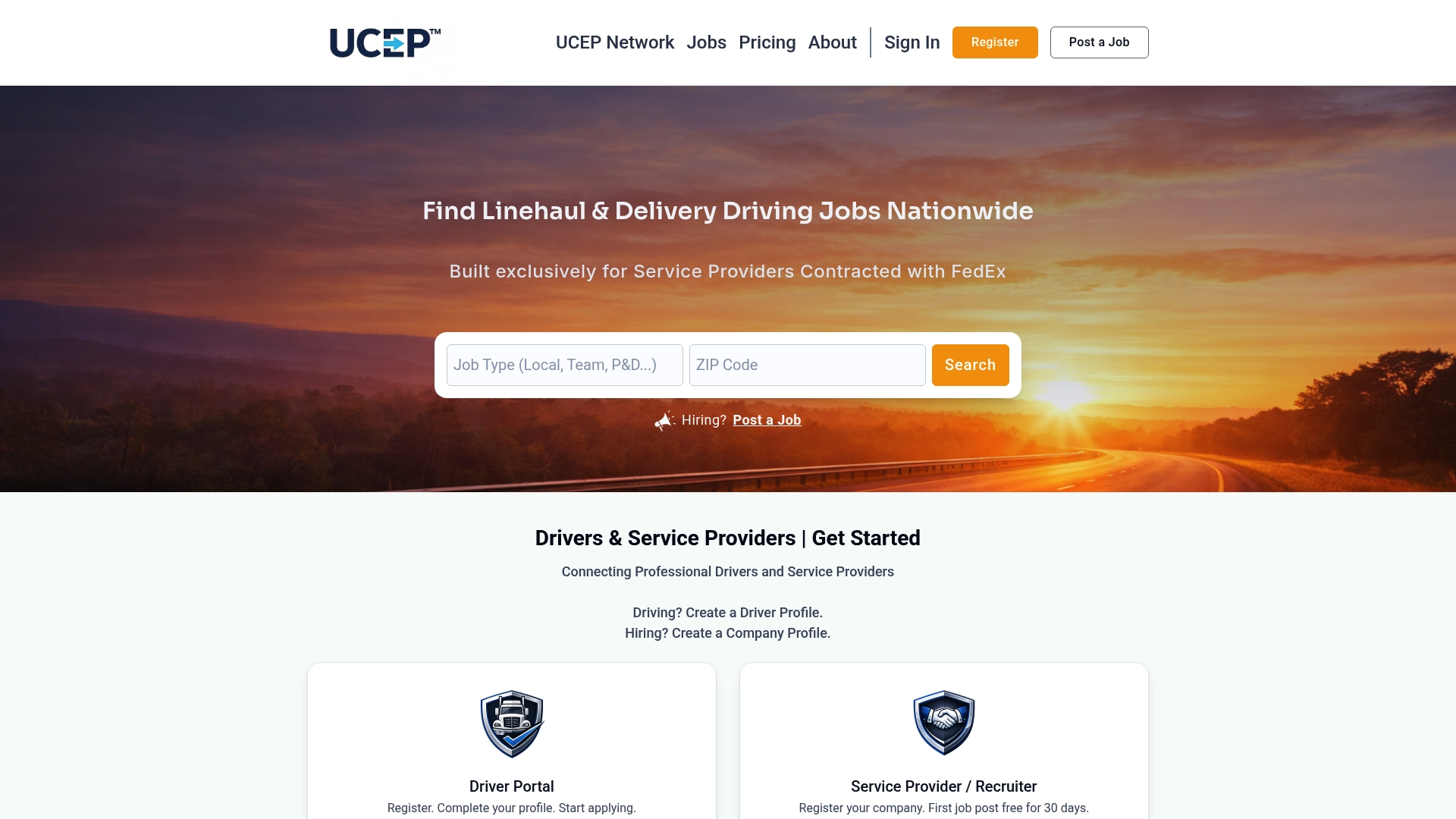
Service Providers can start with a complimentary trial listing, then move to the Standard Monthly Plan at $99 per month. Both are on the UCEP pricing page, where you can see what each plan includes.
Perspective
Most drivers who ask about switching to linehaul are not asking whether the work exists. They are asking whether a specific run will fit their life. That is a listing-quality problem more than a career problem.
We built UCEP around that. Because the platform is focused on FedEx Service Providers, the job categories match how the work is organized: CDL-A solo linehaul, CDL-A team linehaul and pickup and delivery. A driver does not have to guess whether a posting is a FedEx-related role or filter through unrelated ads.
For Service Providers, we think the same focus helps with reach. Our platform is designed to put openings in front of FedEx-experienced drivers, and the built-in applicant tracking system keeps applications in one place. Our advice to drivers is to compare terms, not just headlines. Our advice to Service Providers is to publish run type, home time and pay method in every listing.
Aaron
FAQ
What is considered a linehaul driver?
A linehaul driver hauls trailers between facilities, such as hubs and stations, rather than making local stops. In the FedEx Ground network, linehaul transports FedEx-owned trailers over the road between stations and hubs. Most of these drivers work for contracted Service Providers.
Do I need experience to switch to linehaul?
Not always. Some providers hire entry-level Class A drivers who have graduated from an approved FedEx driving school and promote them to solo or team roles after training. Others prefer drivers with tractor-trailer experience. Read each listing's requirements and ask about training.
Is linehaul work usually at night?
Often, yes. One provider describes its linehaul teams as typically working overnight, though dedicated runs follow set schedules and others vary with demand. Check the report time and run schedule in the listing before you apply.
Is linehaul better than P&D?
It depends on what you want. Linehaul uses a tractor-trailer and runs between facilities. P&D means many local stops with a smaller vehicle, and usually daytime hours. Compare the run type, home time and pay terms of the specific jobs you are considering.
Do I need a doubles endorsement?
Many linehaul roles involve twin trailers. One provider's entry-level program says applicants must have or be willing to acquire a doubles endorsement. Getting it before you apply can widen the openings you qualify for.
Sources
- BuildAGroundBiz: Contracting with FedEx Ground, types of opportunities
- Running a FedEx Ground linehaul business: the guide
- CDL Entry Level Driver Program
- LTL Driver Jobs | Old Dominion careers
- FMCSA Safety Audit Guidebook
- FedEx Linehaul Teams
- FedEx P&D Route & Linehaul Education Session