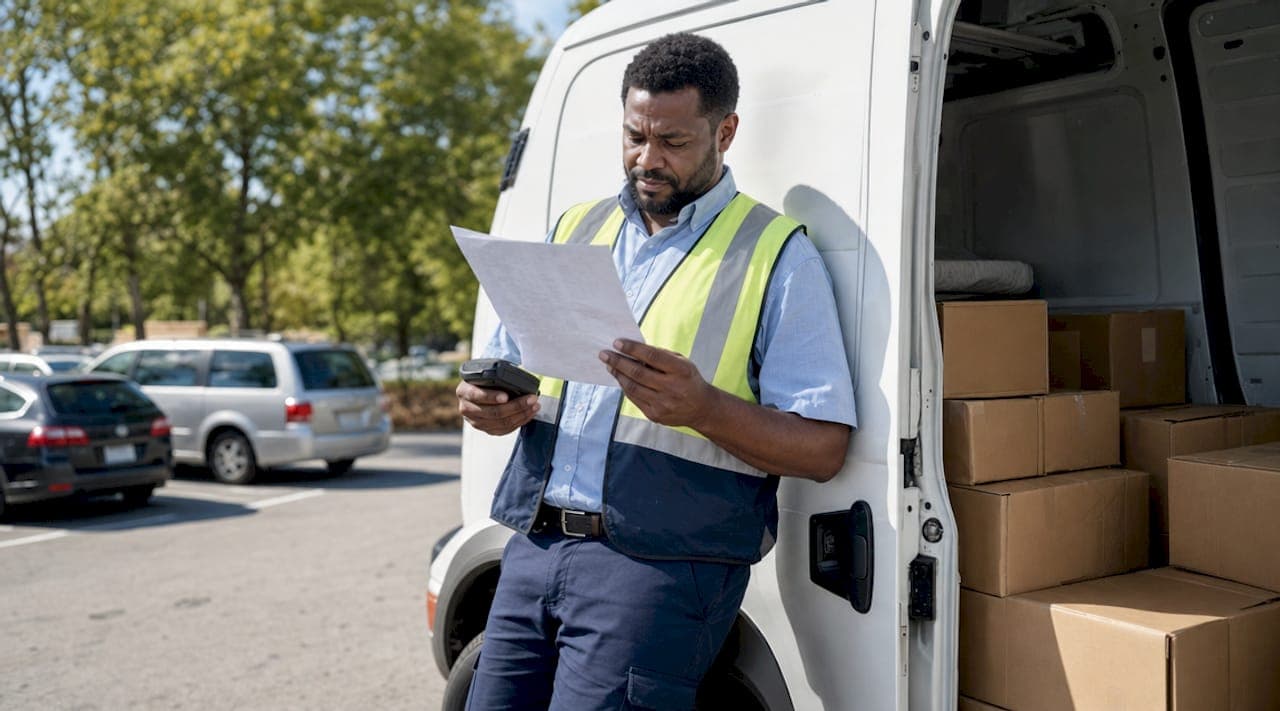
A pickup and delivery driver is defined as a professional who operates a cargo van, step van, or light truck to transport packages along assigned routes, completing both scheduled drop-offs and collections for a carrier or service provider. The pickup and delivery driver role explained in full covers far more than driving. You handle package scanning, customer interaction, route sequencing, vehicle inspections, and exception management every shift. In last-mile logistics, this role sits at the final and most visible point of the supply chain. Carriers like FedEx rely on these drivers to represent their brand at every doorstep.
What are the primary responsibilities of a pickup and delivery driver?
The daily duties of a pickup and delivery driver follow a structured sequence from the moment you arrive at the terminal to the moment you return. Understanding this sequence helps you prepare for the physical and organizational demands the job requires.
Here are the core responsibilities in order of a typical shift:
- Load and sort packages at the terminal. You load vehicles in reverse delivery order to avoid rehandling stops mid-route, which saves time and reduces fatigue. Packages destined for the last stop go in first; the first stop loads last.
- Follow assigned routes and schedules. You drive predetermined routes while adapting to real-time conditions like traffic, road closures, or weather. Rigid adherence to GPS alone is not enough. Experienced drivers develop route familiarity that supplements navigation tools.
- Scan packages at every stop. You scan each package at pickup and delivery to register tracking events in real time. This creates the data chain that customers and dispatchers rely on to monitor shipments.
- Interact with customers professionally. You are the public face of the carrier at every delivery point. Courteous communication, handling delivery concerns, and representing the brand accurately are part of the job description, not optional extras.
- Manage delivery exceptions. When a customer is not home, an address is incorrect, or a package is refused, you follow carrier protocol to document and escalate the issue using your handheld device.
- Complete vehicle inspections. You complete a Driver Vehicle Inspection Report (DVIR) before and after every shift to document vehicle condition and flag any defects.
Pro Tip: Load your vehicle the night before your mental rehearsal. Review the route sequence and identify any stops with access challenges, such as gated communities or business-only hours, before you leave the terminal.
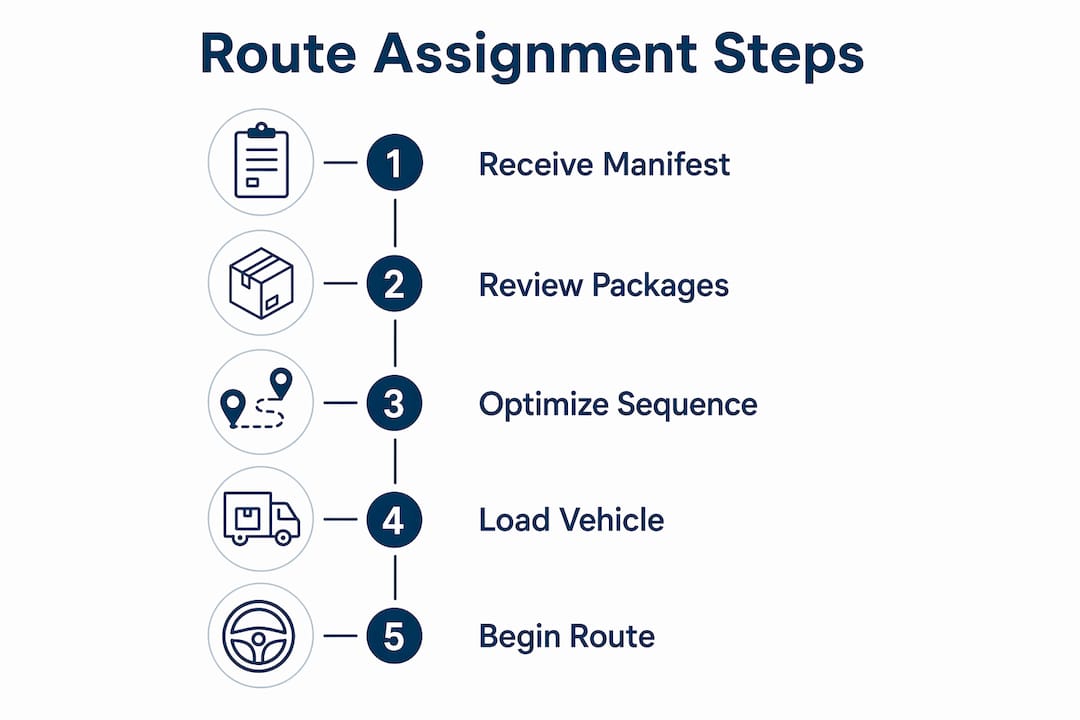
How are pickup and delivery routes assigned and optimized?
Pickup and delivery routes are not the same type of problem, and understanding the difference helps you work more efficiently with dispatchers and route management software.
| Route Type | Load Pattern | Key Challenge | Planning Priority |
|---|---|---|---|
| Delivery route | Starts full, empties progressively | Sequence stops to minimize distance | Time and mileage efficiency |
| Pickup route | Starts empty, fills progressively | Manage capacity as load accumulates | Capacity and time window management |
Delivery routes focus on dropping off a full load in the most efficient sequence. The vehicle gets lighter as the shift progresses, which is straightforward to plan. Pickup routes are more complex. You accumulate load at each stop, which means capacity is a time-varying factor. High-volume pickup stops are scheduled early to prevent the vehicle from reaching capacity before all stops are completed.
Route optimization software like those used by FedEx service providers handles constraints including time windows, vehicle weight limits, and stop sequencing simultaneously. Algorithmic routing tools adapt in real time to new pickups or delays, adjusting the sequence to keep the route feasible. Without this software, dispatchers and drivers would face a combinatorial problem that manual planning cannot solve at scale.
Poor loading order directly increases driver workload. If packages are not loaded in reverse delivery sequence, you spend time digging through the cargo area at each stop. That adds minutes per stop, which compounds across a 100-stop route into significant lost time.
Pro Tip: When you receive your route manifest, flag any pickup stops that carry high package volumes. Confirm with dispatch that those stops are sequenced early enough to avoid a capacity overflow before your last pickups.
What are the vehicle and licensing requirements for this role?
Most pickup and delivery jobs use step vans, cargo vans, or light trucks with a Gross Vehicle Weight Rating (GVWR) under 26,001 pounds. This weight threshold is the dividing line for licensing requirements.
Drivers operating vehicles under 26,001 lbs GVWR typically need only a valid state driver's license, not a Commercial Driver's License (CDL). CDL requirements apply when you operate vehicles above that threshold or pull commercial tractor-trailers. If you are pursuing a standard pickup and delivery role with FedEx service providers, a CDL is generally not required.
| Vehicle Type | Typical GVWR | License Required | CDL Needed |
|---|---|---|---|
| Cargo van | Under 10,000 lbs | State driver's license | No |
| Step van | 10,001 to 26,000 lbs | State driver's license | No |
| Large straight truck | Over 26,001 lbs | CDL Class B | Yes |
| Tractor-trailer | Over 26,001 lbs combined | CDL Class A | Yes |
Federal Hours of Service (HOS) regulations add another layer. HOS rules apply when a vehicle has a GVWR or Gross Combination Weight Rating of 10,001 pounds or more and operates in interstate commerce. Drivers who qualify may be subject to daily drive time limits and mandatory rest periods. However, short-haul exemptions reduce logging requirements for drivers who operate within a 150-air-mile radius and return to their starting point each day. For more on ELD compliance as it applies to smaller fleets, ELD compliance guidance covers the specifics for vehicles that cross the CMV threshold.
What physical demands and skills does the role require?
The pickup and delivery driver job description is physically intensive. You need to be prepared for sustained physical output across an eight to ten hour shift, not just driving.
Key physical and skill requirements include:
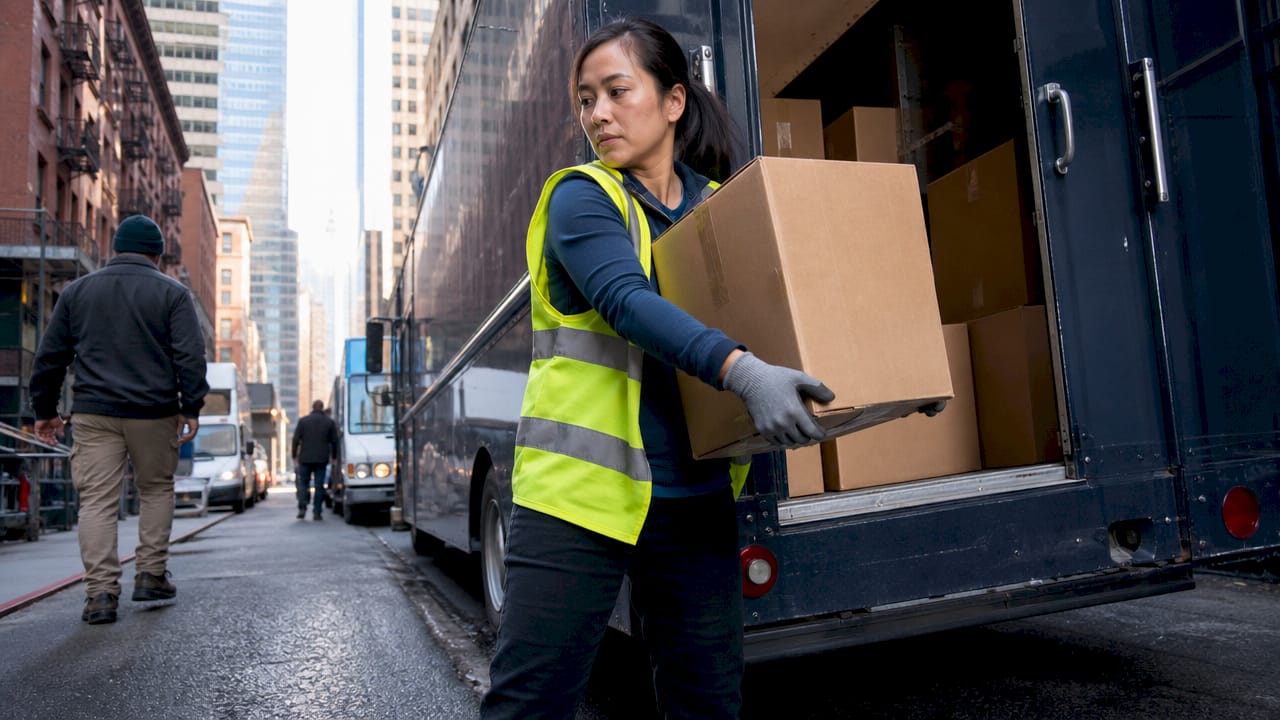
- Package handling. You carry packages up to 70 pounds repeatedly throughout your shift. Proper lifting technique is not optional. Lower back injuries are a leading cause of lost work time in this role.
- Mobility demands. You walk significant distances, climb stairs, and enter and exit the vehicle dozens of times per shift. Comfortable, supportive footwear and stretching routines reduce cumulative strain.
- Safe driving under pressure. You manage route adherence, traffic, and time windows simultaneously. Attentiveness and calm decision-making under schedule pressure are core competencies.
- Technology proficiency. You use handheld scanners and GPS navigation apps throughout the day. Handheld devices and GPS apps are the primary tools for route adherence, package tracking, and exception documentation. Comfort with these tools directly affects your accuracy and speed.
- Customer communication. You resolve delivery issues at the door, answer questions, and represent the carrier brand. Clear, professional communication reduces complaints and builds customer trust.
Sustained physical effort across a full career requires deliberate attention to ergonomics and injury prevention. Prioritizing safe lifting and ergonomic practices from day one extends your working life in this role significantly.
How do delivery drivers handle exceptions and maintain service quality?
Delivery exceptions are situations where a package cannot be delivered as planned. They are a routine part of the job, and how you handle them determines your service quality score and the carrier's reputation.
The standard process for managing exceptions follows these steps:
- Identify the exception type. Common types include customer not home, refused package, incorrect address, access denied, or damaged goods. Each type has a specific protocol.
- Document the exception immediately. Use your handheld scanner to log the exception in the delivery management system. Documenting exceptions with scanning tools and escalating per protocol maintains service accuracy and creates a record for customer service teams.
- Follow carrier-specific procedures. For FedEx service providers, this typically means leaving a door tag, attempting a secondary contact method, or returning the package to the terminal for redelivery scheduling.
- Maintain package security. Packages left unattended or mishandled create theft and damage exposure. Follow placement guidelines precisely, including photo documentation where required.
- Report patterns to dispatch. If a specific address consistently generates exceptions, flagging it to your dispatcher helps the service provider update address records and improve future delivery success rates.
Driver professionalism and customer interaction directly affect the carrier's reputation. Drivers who handle exceptions with clear communication and accurate documentation reduce customer escalations and protect the service provider's contract performance metrics. For guidance on safe driving practices that also support professional service delivery, Ucep's resources cover both safety and customer interaction standards.
Key takeaways
A pickup and delivery driver's effectiveness depends on route discipline, physical readiness, and precise exception management from the first stop to the last.
| Point | Details |
|---|---|
| Load sequence matters | Loading in reverse delivery order prevents mid-route rehandling and reduces shift fatigue. |
| Pickup and delivery routes differ | Pickup routes require capacity management as load accumulates; delivery routes focus on distance efficiency. |
| CDL not always required | Vehicles under 26,001 lbs GVWR typically require only a valid state driver's license. |
| Exception handling is a core skill | Documenting and escalating delivery exceptions accurately protects carrier reputation and service metrics. |
| Physical preparation is non-negotiable | Proper lifting technique and ergonomic habits reduce injury risk across a long career in this role. |
What I've learned about succeeding in this role
Aaron here. After working closely with FedEx service providers and the drivers they hire, one pattern stands out clearly. The drivers who last in this role are not necessarily the fastest. They are the most organized.
GPS is a tool, not a strategy. The drivers who build genuine route familiarity, knowing which apartment complexes have unreliable intercoms, which business stops require a dock appointment, and which neighborhoods have parking restrictions, consistently outperform drivers who rely entirely on navigation apps. That knowledge takes weeks to build and cannot be downloaded.
The physical side of this job is also underestimated by people entering it for the first time. Carrying packages up to 70 pounds sounds manageable for one stop. Across 80 stops in summer heat, it becomes a different challenge entirely. Drivers who treat physical conditioning and lifting technique as professional skills, not afterthoughts, stay in the role longer and advance faster.
Customer interaction is the part most job descriptions mention last, but it matters more than most new drivers expect. A calm, professional response to a frustrated customer at the door prevents complaints that can affect your service provider's performance scores. That directly affects your job security and the provider's contract standing. If you want to understand how the broader FedEx contractor network operates and what service providers expect from their drivers, the FedEx service provider overview on Ucep is worth reading before your first shift.
— Aaron
Find pickup and delivery driver jobs through Ucep
Ucep is a job board and recruiting platform built exclusively for FedEx service providers and the drivers who work with them. If you are looking for pickup and delivery jobs, linehaul positions, or CDL roles with contracted service providers, Ucep connects you directly with companies that are actively hiring.
Before applying, use service provider reviews on Ucep to assess companies by driver feedback, route quality, and compensation structure. You can also browse companies hiring drivers to find open positions by location and role type. For additional logistics industry context and freight operations insights, freight operations resources provide useful background on how last-mile networks function. Ucep keeps the search focused so you spend less time sorting through unrelated listings and more time connecting with the right service provider.
FAQ
What does a pickup and delivery driver do daily?
A pickup and delivery driver loads packages at a terminal, follows an assigned route to deliver and collect parcels, scans each package for tracking, manages delivery exceptions, and completes vehicle inspection reports before and after each shift.
Do you need a CDL for pickup and delivery jobs?
Most pickup and delivery roles do not require a CDL. Drivers operating vehicles with a GVWR under 26,001 pounds typically need only a valid state driver's license.
How are pickup and delivery routes assigned?
Routes are assigned by dispatchers using route optimization software that accounts for stop sequence, vehicle capacity, time windows, and distance. Pickup routes are sequenced to manage load accumulation, while delivery routes prioritize distance efficiency.
What physical demands should I expect as a delivery driver?
You can expect to lift and carry packages up to 70 pounds repeatedly, walk significant distances, climb stairs, and enter and exit your vehicle dozens of times per shift across an eight to ten hour workday.
How do drivers handle a missed delivery?
When a delivery cannot be completed, drivers document the exception type using a handheld scanner, follow carrier protocol such as leaving a door tag or scheduling a redelivery, and report the exception to dispatch for resolution.