
Linehaul trucking is defined as the scheduled movement of bulk freight between major transport hubs on fixed routes, covering distances of 50 to over 500 miles per run. This is the backbone of long-distance freight movement in modern supply chains, connecting ports, distribution centers, and regional depots with consistent, timed runs. Unlike last-mile delivery, which focuses on the final leg to the customer, linehaul freight definition centers on hub-to-hub reliability and volume efficiency. Fleet operators and logistics professionals who understand how linehaul works gain a direct advantage in planning, cost control, and service-level performance.
What is linehaul trucking and how does it work?
Linehaul trucking, also called line haul transportation in formal logistics contexts, operates as a multi-stage process with defined steps at both origin and destination terminals. Each stage has a specific function, and skipping or rushing any step creates downstream problems across the entire freight network.
The standard operational flow follows this sequence:
- Scanning and intake at the origin hub. Freight arrives at the terminal and is scanned, weighed, and logged into the system. This step creates the data record that tracks the shipment through every subsequent stage.
- Sorting and load planning. Planners assign freight to trailers based on volume, weight limits, and delivery schedules. Load planning at this stage directly affects fuel efficiency and on-time arrival rates.
- Scheduled route transit. The driver departs on a fixed lane with mandated rest periods built into the schedule. Compliance with Hours of Service regulations is non-negotiable and is factored into the run time from the start.
- Arrival scanning and verification at the destination hub. Freight is scanned again, inspected for damage, and handed off for the next stage of distribution. This final scan closes the loop on the shipment record.
The multi-stage scanning and sorting process is what separates professional linehaul operations from ad hoc freight movement. Each step produces data that supports billing, compliance, and customer service.
Pro Tip: Build your run schedules around mandated rest periods first, then work backward to set departure times. Drivers who start a run already behind schedule are more likely to push compliance limits.

How does linehaul differ from long haul and LTL trucking?
Linehaul trucking operates on fixed routes and schedules between designated hubs, which is its defining characteristic. Long haul and less-than-truckload (LTL) operations work differently in ways that matter for planning and cost management.
Key distinctions by type:
- Linehaul vs. long haul. Linehaul runs follow fixed lanes, typically regional, with predictable departure and arrival windows. Long haul routes are more variable, often spanning multiple regions or states, with less schedule rigidity.
- Linehaul vs. LTL. LTL consolidates shipments from multiple shippers into a single trailer. Linehaul trailers typically carry freight destined for a single hub, moving full loads on a fixed schedule rather than building loads dynamically.
- Route predictability. Linehaul operations minimize variables by design. LTL and long haul operations adjust routes based on pickup demand, which introduces more variability.
| Feature | Linehaul | Long Haul | LTL |
|---|---|---|---|
| Route type | Fixed lanes | Variable routes | Variable, multi-stop |
| Load type | Full hub-to-hub loads | Full or partial loads | Consolidated, multi-shipper |
| Schedule | Rigid, timed departures | Flexible | Flexible |
| Distance | 50–500+ miles | 500+ miles | Any distance |
| Primary focus | Hub-to-hub reliability | Point-to-point delivery | Freight consolidation |
The table above shows why linehaul trucking services suit supply chains that depend on predictable transit windows. For linehaul vs local trucking, the gap is even wider. Local delivery operates on dynamic, demand-driven routes with short distances and frequent stops. Linehaul runs on discipline and schedule adherence.

What are the primary advantages of linehaul trucking?
Linehaul trucking delivers measurable benefits to supply chains that prioritize reliability and cost control. The advantages are structural, not incidental.
- Lower per-unit transport costs. Consolidating bulk shipments on linehaul trailers reduces the cost per unit compared to small-parcel or local delivery methods. This economy of scale is the primary financial argument for linehaul over fragmented delivery.
- Predictable transit times. Fixed schedules allow supply chain managers to plan inventory replenishment with confidence. Predictability reduces the need for safety stock, which directly lowers carrying costs.
- Improved SLA compliance. Linehaul carriers that maintain consistent hub-to-hub arrival times give their clients a reliable planning baseline. SLA adherence matters more than raw speed in most supply chain contracts.
- Driver safety and regulatory compliance. Scheduled operations with planned rest periods improve driver safety and legal compliance compared to irregular long-haul patterns.
Reliable linehaul operations enable supply chain managers to maintain leaner inventories and reduce carrying costs, because predictable delivery windows replace the need for buffer stock.
The role of linehaul in supply chain management is not just about moving freight. It is about creating the conditions for the rest of the supply chain to function efficiently. When linehaul runs on time, every downstream process from cross-docking to last-mile delivery benefits.
What equipment and coordination practices make linehaul operations successful?
Successful linehaul operations require the right equipment, trained drivers, and tight terminal coordination. Each element supports the others.
Specialized load restraint systems
Advanced load restraint systems like e-track and f-track are standard in professional linehaul trailers. Shoring bars add a second layer of protection for mixed freight loads. These systems prevent cargo from shifting during extended runs, which reduces damage claims and protects driver safety. Drivers need specific training to use these systems correctly. A driver who knows how to load a trailer is not automatically qualified to secure freight for a 400-mile run.
Dock-level coordination and dwell time
Dock operations are where linehaul schedules are won or lost. Inefficient scanning, slow sorting, or excessive dwell time at terminals creates ripple effects that delay every downstream stage. Fleet operators should track dwell time as a key performance metric, not just departure and arrival times. A trailer that sits at the dock for 45 minutes longer than planned can throw off connections at the destination hub and cascade into missed delivery windows.
Empty miles and lane optimization
Reducing empty miles through real-time load and route optimization directly affects profit margins. Fixed schedules provide structure, but effective linehaul networks also allow for dynamic dispatch adjustments when load opportunities arise. The goal is to keep trailers full in both directions on a lane. Fleet operators who treat empty return miles as unavoidable are leaving money on the table.
Pro Tip: Track your empty mile percentage by lane, not just overall. A lane that looks acceptable in aggregate may have a serious imbalance in one direction that a targeted backhaul agreement could fix.
How can logistics professionals apply linehaul best practices?
Applying linehaul best practices requires a shift from reactive to structured operations. The following principles translate directly into better performance:
- Fix your lanes before you fix your schedules. Lane selection determines cost structure. Optimize the routes first, then build departure times around realistic transit and rest requirements.
- Prioritize SLA compliance over speed. Consistent arrival times support inventory planning and client trust. A carrier that arrives on time every day is more valuable than one that sometimes arrives early and sometimes arrives late.
- Use load planning technology. Manual load planning at scale introduces errors. Load planning software reduces mismatches between freight volume and trailer capacity, which cuts both cost and damage rates.
- Integrate tracking at every scan point. Real-time visibility from origin scan to destination verification gives you the data to identify bottlenecks before they become chronic problems.
- Build flexibility into fixed schedules. The best linehaul networks balance route discipline with the ability to adjust for volume surges or equipment issues without breaking the schedule entirely.
Linehaul trucking explained at the operational level is really about systems thinking. Every decision at the terminal affects what happens 300 miles away. Operators who internalize that connection manage their networks more effectively than those who treat each run as an isolated event.
Key Takeaways
Linehaul trucking is the most cost-effective method for moving bulk freight between major hubs when schedule reliability and per-unit cost control are the primary goals.
| Point | Details |
|---|---|
| Core definition | Linehaul moves bulk freight on fixed routes between hubs, covering 50–500+ miles per run. |
| Operational process | Each run follows scanning, sorting, scheduled transit, and destination verification steps. |
| Cost advantage | Bulk consolidation on fixed lanes reduces per-unit transport costs versus fragmented delivery. |
| SLA over speed | Consistent arrival times matter more than raw speed for supply chain inventory planning. |
| Dwell time risk | Excessive terminal dwell time cascades into delays across the entire downstream network. |
The part most operators get wrong about linehaul
Most operators who struggle with linehaul are not struggling with driving. They are struggling with the assumption that linehaul is just a longer version of local delivery. It is not. Local delivery is demand-driven and flexible by design. Linehaul is schedule-driven and rigid by design. Treating one like the other creates problems that are hard to diagnose because they look like execution failures when they are actually planning failures.
The second misconception I see consistently is that faster equals better. The best linehaul carriers are the ones with the most predictable schedules, not the fastest trucks. A supply chain manager who can set their inventory replenishment clock by your arrival time will stay with you. One who has to build buffer stock because your arrival window is unpredictable will eventually find someone more reliable.
The trend worth watching in 2026 is the pressure on linehaul operators to absorb more of the network coordination function. Shippers want fewer handoffs and more accountability across the full hub-to-hub movement. Operators who invest in team driver capabilities and real-time tracking are better positioned to meet that expectation than those running solo drivers on informal schedules.
— Aaron
Ucep connects linehaul professionals with the right opportunities
Linehaul trucking requires qualified drivers and trusted service providers. Finding both in one place is where most fleet operators lose time.
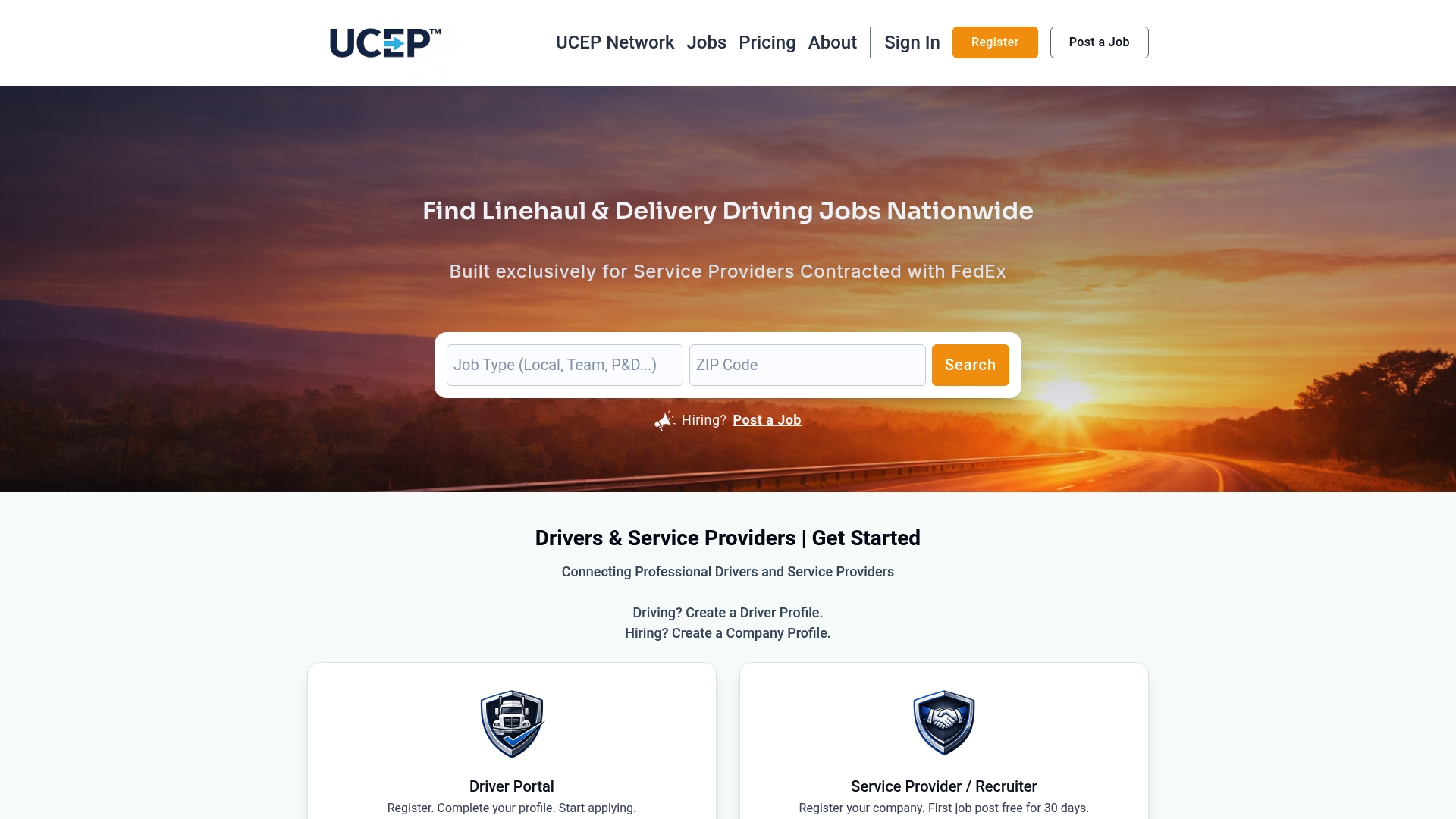
Ucep is a dedicated job board and recruiting platform built exclusively for Service Providers contracted with FedEx. You can browse service provider reviews to identify trusted carriers with proven linehaul track records. The Ucep Network connects fleet operators and contractors for professional collaboration across linehaul and pickup and delivery roles. If you are looking to staff your linehaul routes with CDL-A qualified drivers, the companies hiring drivers directory lists active openings across the FedEx network nationwide. Ucep keeps the search focused so you spend less time sorting and more time operating.
FAQ
What is a linehaul run?
A linehaul run is a single scheduled trip moving freight between two major transport hubs on a fixed route, typically covering 50 to over 500 miles. Each run follows a defined sequence of scanning, transit, and destination verification steps.
How does linehaul mileage pay work?
Linehaul mileage pay compensates drivers based on the miles driven per run rather than hourly wages. The rate per mile varies by carrier, route, and whether the driver operates solo or as part of a team.
What is the difference between linehaul and local trucking?
Linehaul operates on rigid schedules and fixed lanes between major hubs, while local trucking uses dynamic, demand-driven routes with frequent stops over short distances. The two models require different planning approaches and driver skill sets.
Why does linehaul trucking matter for supply chain management?
Linehaul provides the predictable transit times that allow supply chain managers to maintain leaner inventories and meet service-level agreements. Without reliable hub-to-hub movement, downstream distribution and last-mile delivery both suffer.
What CDL license do linehaul drivers need?
Linehaul drivers operating vehicles over 26,000 pounds gross vehicle weight require a CDL-A license. CDL-A also covers combination vehicles, which are standard in linehaul operations.
Recommended
- Safe Delivery Driving Summer 2026 | Reduce Delivery Risk - United Contractor Employment Portal
- Trucking and Severe Summer Weather | Safety Tips for Drivers - United Contractor Employment Portal
- Life in the Miles: Truck Driver Mental Health, Home Time, and Burnout - United Contractor Employment Portal
- Driver Jobs for Service Providers Contracted with FedEx | UCEP