What is relay linehaul and how does it work?
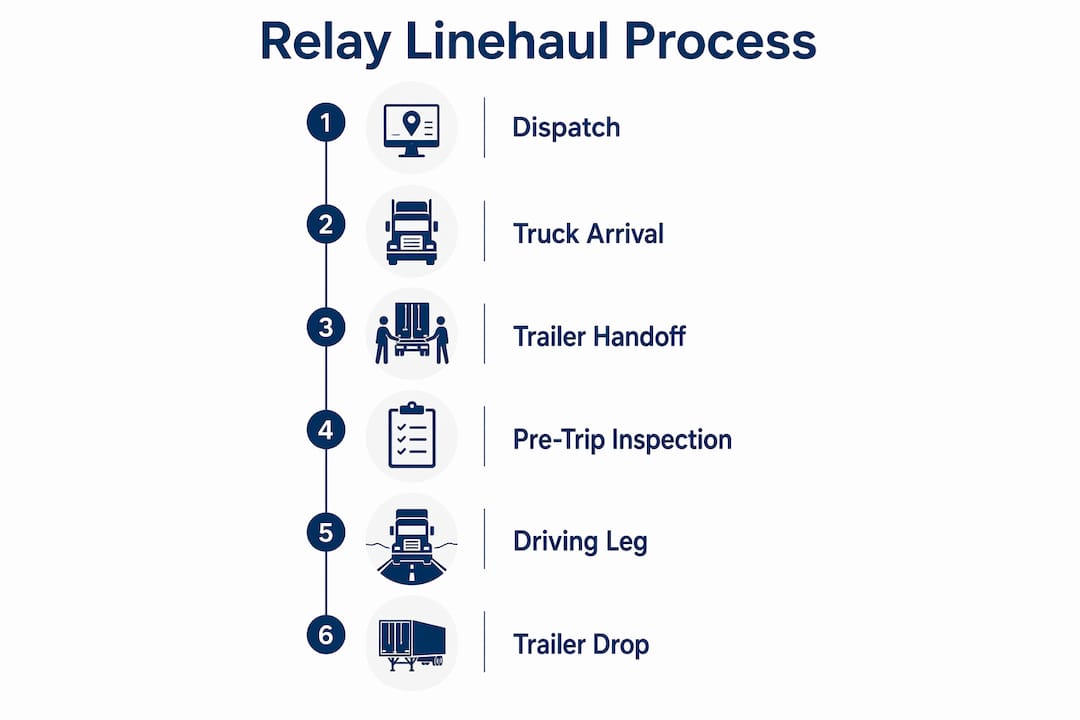
Relay linehaul splits a long-distance freight run into shorter legs, each handled by a different solo driver. Instead of one driver hauling a trailer from origin to destination, drivers exchange trailers at designated relay points or drop yards along the route. The trailer keeps moving while each driver stays within federal Hours of Service limits. This model delivers freight significantly faster than traditional solo over-the-road trucking by eliminating downtime during mandatory rest periods.
Here is how a typical relay linehaul sequence works:
- Driver A picks up a loaded trailer in Los Angeles and drives roughly 370 miles east to a relay point in Phoenix
- Driver A drops the trailer at the Phoenix drop yard; Driver B, already rested, hooks up and continues to El Paso
- Driver B drops in El Paso; Driver C takes the trailer to Dallas, completing a 1,400-mile shipment in under 24 hours
- Each driver handles one leg, stays within HOS limits, and returns home on a predictable schedule
- The trailer never sits idle; freight moves near team-driver speed using solo drivers only
No special CDL endorsement is required beyond a standard Class A. Relay runs use the same qualifications as traditional over-the-road work.
How relay points and drop yards keep freight moving
Relay points and drop yards are the physical infrastructure that make the relay model function. Without secure, well-located exchange hubs, continuous trailer movement is not possible. These facilities operate as fixed handoff locations where drivers drop a loaded trailer and another driver picks it up, a process called drop-and-hook.
- Drop yards allow drivers to unhook and leave without waiting for loading or unloading, cutting dwell time significantly
- Relay points decouple freight movement from any individual driver's HOS clock, so the shipment does not pause when a driver reaches their limit
- Strategically placed facilities on major freight corridors support the consistent freight flow relay requires
- Secure yards protect trailer assets between handoffs, reducing theft and damage risk
- Poor facility geography or limited drop yard access in a region restricts which lanes can support relay operations
- Timing coordination between drivers is critical; a late arrival at a relay point disrupts the next driver's schedule and can cascade into missed delivery windows
Pro Tip: When you are new to a relay lane, visit the drop yard during daylight before your first live run. Large facilities have specific truck routing signs that are easy to miss at night.
How Hours of Service rules shape relay linehaul operations
Federal Hours of Service regulations set the legal driving limits for commercial drivers: 11 hours of driving within a 14-hour on-duty window, followed by a mandatory 10-hour off-duty period. Relay linehaul is built around these limits. Each leg is sized so the assigned driver completes it within their available hours, then hands off to a fresh driver.
- Strict adherence to scheduled pickup and delivery windows is required; missing a window by 30–45 minutes can register as a missed appointment and harm your carrier performance score
- Carriers advise arriving 15–30 minutes early to account for large facility navigation and potential congestion
- Geofencing technology at many relay facilities requires you to be physically on-site for your app check-in to register; an off-site check-in attempt will not count
- Geofenced check-in failures result in penalties even when you completed the load correctly, so app compliance is as important as physical arrival
- Performance scores directly affect your access to loads and program eligibility; falling below performance thresholds can trigger suspension
- Coordination between relay drivers matters: if one driver is late, the next driver's schedule shifts, and delays can compound across the entire route
For drivers working within FedEx-contracted service provider networks, understanding team driver compliance requirements gives useful context for how relay timing expectations compare to other driving models.
Key benefits of relay linehaul for professional drivers
Relay linehaul improves driver job quality by replacing extended solo runs with predictable, shorter legs that bring drivers home regularly. Carriers using relay models report higher driver retention and measurable safety improvements compared to traditional over-the-road operations.
- Home time: Relay drivers typically return to their home base daily or every few days rather than being away for weeks
- Predictable schedule: Runs are generally the same length and route each day, so you know your start time, finish time, and home time in advance
- Less fatigue: Shorter legs reduce exhaustion and improve job satisfaction, which contributes to higher retention rates across relay-focused carriers
- Safety: Well-rested drivers reduce accident risk; predictable shifts also support better vehicle maintenance planning
- Earnings: Per-load pay is lower than a full OTR run, but shorter repeatable legs mean more loads per week, keeping weekly take-home competitive
- Hot loads: Relay moves time-sensitive freight at near team-driver speed without putting HOS pressure on any single driver
- Career fit: Relay suits drivers who want solo work with the scheduling advantages typically associated with team driving
How to find FedEx-related relay linehaul opportunities
Ucep is a dedicated recruiting platform built exclusively for service providers contracted with FedEx, connecting professional drivers with linehaul, CDL-A solo, CDL-A team, and pickup and delivery roles. It is the most direct path to finding relay linehaul positions within the FedEx contractor network.
- Qualifications: You need a valid Class A CDL, a clean MVR, ELD compliance, current drug testing clearance, and appropriate insurance coverage
- Job listings: Look for postings that specify relay legs, drop-and-hook operations, or linehaul runs between FedEx facilities; these indicate relay-style work
- Home base matching: Prioritize loads and lanes that start and end near your home base to reduce deadhead miles and maintain predictable personal scheduling
- Performance: Maintaining high on-time metrics gives you access to premium routes and repeat contract opportunities within the FedEx network
- Multiple carriers: Avoid relying on a single service provider; relationships with several carriers protect your income if one reduces volume
- Reviews: Check service provider reviews on Ucep to evaluate carriers before committing to a lane or contract
Safety protocols and driver responsibilities in relay linehaul
Relay linehaul places specific safety demands on drivers beyond standard over-the-road requirements. Because the trailer moves continuously through multiple handoffs, each driver is responsible for a clean, documented transition.
- Conduct a full pre-trip inspection every time you hook up to a relay trailer, regardless of how recently another driver inspected it
- Document any existing trailer damage at the relay point before departing; photo evidence protects you from liability for pre-existing issues
- Follow facility-specific truck routing at drop yards; deviating from posted routes inside large facilities creates congestion and safety hazards
- Use your ELD and carrier app for all status updates; missing a required check-in step creates a compliance gap in the load record
- Report mechanical issues immediately through your carrier's dispatch channel; a relay trailer with a defect must not continue to the next leg without clearance
- Stay within your HOS limits without exception; the relay model is designed so you never need to push your hours to complete a leg
Career progression in relay linehaul and FedEx driver roles
Relay linehaul is a practical entry point into the broader FedEx contractor network, and it opens doors to more specialized roles as you build your record. Drivers who demonstrate consistent on-time performance and clean safety records move into preferred lane assignments, higher-volume contracts, and eventually into lead or trainer positions within service provider organizations.
- New drivers often start on shorter relay legs to build familiarity with drop yard procedures and app-based check-in workflows
- Strong performance on relay runs positions you for CDL-A team driving roles, which carry higher per-mile rates
- Service providers contracted with FedEx frequently promote reliable relay drivers into dispatch support, route planning, or fleet coordination roles
- Relay experience translates directly to linehaul roles across the broader FedEx Network 2.0 infrastructure as the network expands
- Drivers who understand FedEx network changes and position themselves on growing corridors gain a competitive advantage in load access
What a typical relay linehaul shift looks like
A concrete example helps clarify the daily reality of relay driving. Consider a driver based in Dallas operating on an I-35 corridor relay lane.

The driver reports to a drop yard in the Dallas area at 6:00 PM, completes a pre-trip inspection on an assigned trailer, and checks in via the carrier app. The leg runs north to Oklahoma City, approximately 200 miles, taking roughly 3.5 hours. At the Oklahoma City relay point, the driver drops the trailer at a designated spot, confirms the drop in the app, and a second driver already on-site hooks up and continues north. The Dallas driver is back home before midnight.
The next evening, the same driver picks up a southbound trailer at the same Dallas drop yard, runs a leg to San Antonio, drops, and returns. The route repeats on a weekly schedule. Weekly earnings depend on how many legs the driver completes and the carrier's per-leg or per-mile rate structure.
This pattern reflects what relay trucking research in 2026 consistently shows: predictable routes on the same corridor, regular home time, and a workload that fits within HOS limits without pressure.
Ucep lists relay linehaul positions with FedEx-contracted service providers across the country. Browse companies hiring drivers on the Ucep platform to find relay runs that match your home base and CDL qualifications.
Key Takeaways
Relay linehaul delivers freight 40–70% faster than traditional solo over-the-road trucking by keeping trailers moving through multiple driver handoffs at drop yards, all within federal Hours of Service limits.
| Point | Details |
|---|---|
| Delivery speed advantage | Relay linehaul improves delivery times by 40–70% compared to traditional solo OTR trucking. |
| HOS compliance by design | Each relay leg is sized so drivers complete it within their legal 11-hour driving window. |
| Home time and retention | Relay drivers return home daily or every few days, reducing fatigue and improving retention. |
| App check-in is mandatory | Geofenced check-in must occur on-site; off-site attempts do not register and trigger penalties. |
| Finding FedEx relay jobs | Ucep connects drivers with FedEx-contracted service providers offering relay linehaul roles nationwide. |