For most commercial truck drivers, the break rule that applies is the federal one: a 30-minute break after 8 cumulative hours of driving. State meal and rest break laws, including California's, do not apply to drivers covered by federal hours-of-service rules. If you drive for a FedEx Service Provider, or you hire drivers for one, knowing where that line falls keeps schedules legal and pay questions simple. The details are below, along with the exceptions that decide whether a particular driver is covered.
TL;DR
- Property-carrying drivers must take a 30-minute break once they have driven 8 cumulative hours without a break of at least 30 minutes, per FMCSA.
- The break can be off duty, on duty not driving, or sleeper berth, and it can count toward on-duty time.
- California's meal and rest break rules are preempted for drivers subject to federal hours of service, long-haul or short-haul.
- Drivers who are not subject to hours-of-service rules may still fall under state law, so classify each role before you set a break policy.
- Pair break rules with the 11-hour driving limit and the 14-hour window when you plan routes and schedules.
Table of Contents
- The federal 30-minute break
- Related limits the break does not change
- Newer federal pilot programs
- State meal and rest break laws
- What this means for Service Providers
- What this means for drivers
- Finding FedEx driving jobs with clear schedules
- Perspective
- FAQ
- Sources
The federal 30-minute break
The federal hours-of-service rules (49 CFR Part 395) are written by the Federal Motor Carrier Safety Administration (FMCSA), the agency that regulates interstate trucking. For property-carrying drivers, the rule requires a break of at least 30 consecutive minutes after 8 cumulative hours of driving time.
Two points trip people up:
- The 8 hours are cumulative, not consecutive. FMCSA's driver's guide says driving is not permitted once more than 8 hours have passed since the end of your last 30-minute break in driving time. Short stops of a few minutes do not reset the clock. Only a qualifying 30-minute interruption does.
- The break does not have to be off duty. It may be taken on duty not driving, off duty, or in the sleeper berth. Fueling, paperwork or other non-driving work can satisfy it if it lasts at least 30 consecutive minutes.
FMCSA's Q&A also confirms you can combine non-driving statuses, for example 10 minutes off duty followed by 20 minutes on duty not driving, as long as the whole period is consecutive. Yard moves and roadside inspections can count toward the break when logged as on duty, not driving, according to FMCSA's 2020 rule presentation.
Worked example
A linehaul driver starts at 6:00 a.m. and drives until 10:00 a.m. (4 hours), unloads and fuels from 10:00 to 10:20, then drives until 2:00 p.m. (4 more hours). The 20-minute stop is under 30 minutes, so it does not qualify. The driver has 8 cumulative driving hours and must now take 30 consecutive minutes before driving again. Had the stop lasted 30 minutes of on-duty work, no extra stop would have been needed.

Related limits the break does not change
The break sits inside a larger set of limits. FMCSA's summary for property-carrying drivers:
| Limit | Rule |
|---|---|
| Driving limit | 11 hours after 10 consecutive hours off duty |
| Driving window | No driving beyond the 14th consecutive hour on duty |
| 30-minute break | After 8 cumulative driving hours without a 30-minute interruption |
| Weekly limit | 60/70 hours on duty in 7/8 consecutive days |
| Restart | 34 consecutive hours off duty resets the weekly total |
The driver's guide notes the break does not extend the 11-hour driving limit or allow driving past the 14th hour. Taking a break does not stop the 14-hour clock. If you plan CDL-A team or solo routes, our linehaul schedule examples show how these limits fit into real shifts.
Who skips the 30-minute requirement
Drivers who qualify for either short-haul exception in 49 CFR 395.1(e)(1) or (2) are not required to interrupt driving for the 30-minute break, per the FMCSA guide. Many pickup and delivery drivers work within those exceptions. Whether yours do depends on the radius, the shift length and the vehicle class, so check the exception conditions against each route.
Newer federal pilot programs
In June 2025 FMCSA announced two pilot programs in its fact sheet: a Flexible Sleeper Berth pilot allowing 6/4 and 5/5 splits, and a Split Duty Periods pilot that lets drivers pause the 14-hour on-duty period for 30 minutes to 3 hours. FMCSA describes them as a way to study whether more schedule control improves rest. Pilots have participation terms, so confirm the current status on FMCSA's site before building a schedule around them.
State meal and rest break laws
State meal and rest break laws set fixed breaks at fixed points in a workday. Federal hours-of-service rules work differently: they cap driving and on-duty time rather than scheduling breaks at set intervals, as Payne & Fears summarizes.
California is the state that drivers and employers ask about most. Its Wage Order 9-2001, as described in the Ninth Circuit's June 2026 opinion, provides:
- A 30-minute meal period for work over 5 hours, waivable by mutual consent if the day is 6 hours or less.
- A second 30-minute meal period past 10 hours, waivable only if the day is 12 hours or less and the first was not waived.
- A 10-minute rest period for every 4 hours worked.
- One additional hour of pay at the regular rate for each workday a meal or rest period is not provided.
On a typical 8-hour shift, that means two 10-minute rest breaks plus a 30-minute lunch, against one 30-minute break under federal rules.
Why California's rules do not apply to HOS drivers
FMCSA issued a December 2018 order finding California's rules preempted as applied to property-carrying drivers covered by federal hours of service. The Ninth Circuit upheld preemption for long-haul drivers in 2021, and a California Court of Appeal extended it to short-haul drivers in 2022, as the California Employment Law Report recounts. In June 2026 the Ninth Circuit again upheld preemption.
The practical result: a driver subject to federal hours of service follows the federal break rule, not California's meal and rest periods, and an employer does not owe premium pay for missed state breaks to that driver.

The catch: not every driver is subject to HOS
HRCalifornia notes that not every driver is covered by hours-of-service rules, and advises employers to review FMCSA regulations and consult counsel to decide which drivers are exempt from California's rules. Interstate or intrastate status matters here. OSHA's trucking guidance explains that interstate character depends on the shipper's fixed and persistent intent at the time of shipment, even if the route stays inside one state. A package moving within one state can still be interstate commerce.
If you employ drivers in California or another state with its own break law, have an employment attorney confirm how each role is classified.
What this means for Service Providers
If you run a FedEx-contracted operation, a clean break policy rests on a few habits:
- Classify every role. List linehaul, CDL-A team, CDL-A solo and pickup and delivery positions, and note which are covered by hours of service and which use a short-haul exception.
- Write the break rule into the job description. Drivers want to know how breaks work before they apply. Our driver job ad compliance checklist covers what ads should state.
- Log statuses accurately. A qualifying break depends on how time is recorded. See how driver status automation works.
- Keep pay clear. Break time and stop time can affect pay. Our guide to claiming unpaid stop pay and the one on pay transparency laws cover what to document.
What this means for drivers
- Plan the 30-minute break before hour 8 of driving. Use a fuel stop with 30 minutes of on-duty work if it fits, or go off duty.
- Know your exception. If you run short-haul, ask your Service Provider in writing whether you qualify, since that decides whether the break rule applies to you.
- Do not assume a state's rules follow you. California's meal and rest breaks do not apply to drivers covered by federal hours of service.
- Keep inspections in your routine. Pre-trip checks count as on-duty time. If you haul refrigerated freight, this reefer pre-trip inspection checklist lists what to look at before you roll.
- Stay medically current. See the DOT medical exam checklist.
Finding FedEx driving jobs with clear schedules
If you are a Service Provider, UCEP is a job board built only for FedEx-contracted Service Providers. It lists pickup and delivery, CDL-A solo and CDL-A team linehaul roles, and it reaches 140,000+ FedEx-experienced drivers. Plans include a Complimentary Trial Listing and a Standard Monthly Plan at $99 per month, and the platform has a built-in applicant tracking system. See pricing to post a role.
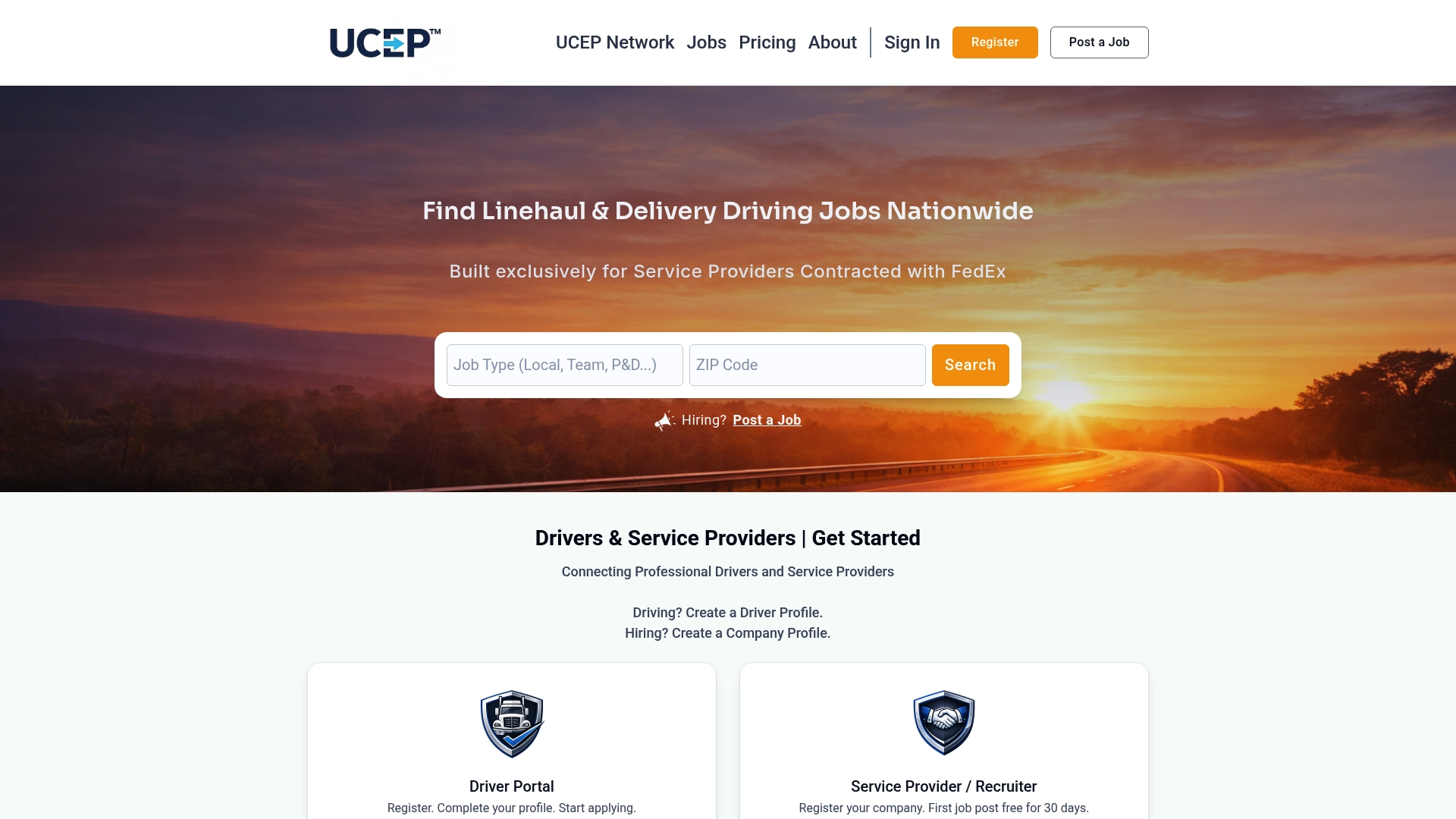
Drivers can browse FedEx-related driver jobs by role, and use the employer and terminal directories and reviews to research a Service Provider before applying. Browsing is free for drivers.
Perspective
Break rules look like a legal detail until they show up in a hiring conversation. Drivers ask how long a shift runs, whether they will be stopped for a 30-minute break, and how time is recorded. Service Providers who answer in the job post get better applications.
We built UCEP for one audience: FedEx Service Providers and the drivers who work with them. That focus lets listings be organized by the roles drivers search for, with company profiles, terminal directories and reviews beside them. A clear role description, including the schedule and how breaks work, belongs in that profile.
Our advice to Service Providers: classify each position, state the break expectations plainly, and post where FedEx-experienced drivers already look.
Aaron
FAQ
How long is the mandatory break for truck drivers?
Property-carrying drivers must take at least 30 consecutive minutes after 8 cumulative hours of driving without a 30-minute interruption. It can be off duty, on duty not driving, or sleeper berth.
Do truck drivers get paid rest breaks?
Federal hours of service rules set limits on driving and on-duty time but do not create paid rest periods. California's paid 10-minute rest breaks do not apply to drivers covered by federal hours of service. Pay for break time is set by the employer, so check the pay terms in the job posting.
Is a 20-minute lunch break legal in California for truck drivers?
For drivers subject to federal hours of service, California's 30-minute meal period requirement is preempted, so the federal rule governs. A 20-minute stop alone would not satisfy the federal 30-minute break unless the whole period reaches 30 consecutive minutes, for example by combining it with other non-driving time.
How many hours can a truck driver drive in a day?
Property-carrying drivers may drive up to 11 hours after 10 consecutive hours off duty, and not beyond the 14th consecutive hour on duty, per FMCSA.
Sources
- When must a driver take a 30-minute break? (FMCSA)
- Hours of Service (FMCSA)
- Does the 30-minute break have to be consecutive? (FMCSA)
- Interstate Truck Driver's Guide to Hours of Service (FMCSA)
- Hours of Service Changes since June 1, 2020 (FMCSA)
- Summary of Hours of Service Regulations (FMCSA)
- Supporting America's Truck Drivers fact sheet (FMCSA)
- Ninth Circuit opinion, June 4, 2026
- Federal Register order, December 28, 2018
- Trucking Industry: Highway Driving (OSHA)
- FMCSA Regulations Override California's Meal and Rest Break Rules (HRCalifornia)
- Interstate Truck Drivers Are Exempt from California Meal and Rest Break Rules
- Ninth Circuit Upholds FMCSA Preemption of California Break Laws
- Reefer Pre-Trip Inspection Checklist