
Before you post a driver job ad, you must confirm three things: whether the role requires an FMCSA Clearinghouse query, whether the ad's language and requirements meet federal and state anti-discrimination rules, and whether your state requires a posted pay range. Skipping any of these steps creates real legal exposure. This guide breaks each requirement into specific fields, checks, and templates you can apply today.
TL;DR:
- Employers must ensure their driver ads include a pay range if required by state law, even for remote or multi-state postings.
- Clear consent protocols and company registration are essential to avoid delays when conducting FMCSA Clearinghouse queries during hiring.
- Application and investigation procedures should follow federal regulations, including documenting efforts to contact prior employers and verifying safety histories.
- Job ad language must avoid discrimination and blanket license requirements unless justified by essential job functions and state law tests.
- Using compliant templates and platforms like UCEP can simplify meeting federal, state, and industry-specific posting and application standards.
Table of Contents
- At-a-glance employer compliance checklist
- FMCSA Drug & Alcohol Clearinghouse: how to run queries and avoid hiring delays
- What to collect on applications and how to investigate prior employers
- Ad language, anti-discrimination limits, and state license rules
- Pay transparency and state posting obligations for multi-state ads
- Practical job-ad and application templates you can reuse
- What auditors and plaintiffs focus on now
- How UCEP helps you post compliant driver ads
- Sources
- FAQ
At-a-glance employer compliance checklist
Run through this sequence before you publish a driver job ad or move a candidate into screening.
- Confirm that driving is genuinely an essential job function before stating a license requirement in the posting.
- Check your insurer's minimum age, experience, and driving-record standards, then set your advertised minimums to match.
- Look up your state's pay-transparency and job-posting laws and add a salary range if required.
- Build your application form around the fields required by 49 CFR §391.21 and set up a folder structure for the driver qualification file before your first applicant arrives.
- Decide which Clearinghouse query type you need: a limited query for annual checks on current drivers, or a full query with consent for pre-employment screening.
Each of these steps ties directly to a federal rule or a state statute covered in the sections below. Treat the list as a pre-publish gate, not a one-time setup task, since insurer minimums and state laws change often enough to warrant a quarterly review.
FMCSA Drug & Alcohol Clearinghouse: how to run queries and avoid hiring delays
Any employer of a CDL or CLP holder must query the FMCSA Drug & Alcohol Clearinghouse before hiring and at least once a year for current drivers. A limited query only tells you whether a resolved or unresolved violation exists in the driver's record. A full query, which requires the driver's electronic specific consent, shows the actual violation details and is the standard for pre-employment screening.
Consent works differently for each query type. Limited queries rely on general consent the driver gives once. Full queries need specific, electronic consent tied to that particular request, which the driver must complete inside the Clearinghouse system itself, not on paper.
To run queries without stalling your hiring pipeline:
- Register your company in the Clearinghouse and purchase a query plan before you need it, not after an offer is on the table.
- Send the consent request as soon as a candidate accepts a conditional offer, and confirm the driver's CDL number and state match your records exactly.
- If a driver selects U.S. Mail for consent delivery instead of electronic consent, expect delays measured in days, not hours.
- When a query returns a violation record, FMCSA's C/TPA job aid requires a follow-on full query within 24 hours if the driver was screened with a limited query first.
Pro Tip: Ask candidates to register with the Clearinghouse and set electronic consent as their default before their first interview. It removes the single most common cause of hiring delays.
For the testing side of this process, our CDL drug testing requirements guide covers how pre-employment testing connects to Clearinghouse reporting obligations.
What to collect on applications and how to investigate prior employers
49 CFR §391.21 sets the minimum content for a motor carrier's employment application, and most employers build their entire intake form around it. The regulation requires:
- Applicant identification details, including name, address, and date of birth.
- A three-year history of motor vehicle record items, covering license number, state, and any denials or revocations.
- A list of employers for the past three years, and for applicants who operated a commercial motor vehicle, an additional list of CMV employers going back seven years.
- Written notice to the applicant that previous employers will be contacted for a safety-performance history investigation.
Once the application is in hand, 49 CFR §391.23 requires you to actually investigate that safety-performance history, not just collect the names. You need to document good-faith efforts to contact each prior employer, keep records of what you sent and when, and note responses (or the lack of one) in the driver's file. If a prior employer never responds despite documented attempts, that gap itself becomes part of the record, and the regulation's timelines for completing this investigation still apply.
File everything, the application, the consent notices, the investigation attempts, together in the driver qualification file. Our post on common mistakes when hiring CDL drivers covers the documentation gaps that show up most often during audits.

Ad language, anti-discrimination limits, and state license rules
Job ad language carries real legal risk under Title VII, the Age Discrimination in Employment Act, and the ADA. Avoid these patterns:
- Explicit age, sex, or national-origin preferences, even phrased casually ("looking for a young, energetic driver").
- Physical or experience thresholds set higher than the job actually requires, since these can disproportionately screen out protected classes.
- Blanket disqualifications tied to disability status rather than the specific physical demands of the role.
A driver's-license requirement needs its own justification. Frame it around the job's essential functions: if driving is genuinely core to the role, say so and document why. If the position is mostly warehouse or dispatch work with occasional driving, a blanket license requirement is harder to defend.
State law adds another layer. California's SB 1100 amendment to FEHA requires employers to pass a two-part test before listing a license requirement: you must reasonably anticipate driving as a job function, and you must be able to show that alternative transportation (a taxi, rideshare, or another employee driving) is not a comparable option. Illinois has moved to restrict similar language through measures like HB4758, though the scope and timing differ from California's approach, so multi-state employers should check the current status in each state where they post.
Pro Tip: Write a one-line internal justification for every license requirement before publishing the ad. If you can't explain why the alternative isn't comparable, don't publish the requirement.
If your fleet operates in California, our partner resource on CARB diesel rules is worth a look for how state environmental rules intersect with driver operations.
Pay transparency and state posting obligations for multi-state ads
A growing number of states require a posted salary range, and the trigger is often lower than employers expect. A single remote employee in that state can be enough to activate the law, so if you reasonably expect to hire someone based in a covered state, post the range for that state.
Build this into your process:
- Add a salary-range field to every job-ad template by default, rather than deciding case by case.
- Map each posting to the states where you'd reasonably hire, including remote or multi-terminal roles.
- Keep a version of each posting per state when ranges or required language differ.
Defaulting to transparency across all postings is usually simpler than tracking exceptions state by state.
Practical job-ad and application templates you can reuse
A compliant driver job ad needs specific, published fields, not general marketing language. Use this checklist for every posting:
- Pay range or hourly rate, matching state disclosure requirements.
- Home time expectations (daily, weekly, or over-the-road schedule).
- Equipment type and any special certifications required.
- Required qualifications: CDL class, endorsements, minimum experience.
- A written essential-function justification if a driver's license is listed as required.
- A short ADA accommodation sentence inviting applicants to request one.
- Clear application instructions and expected response timeline.
- Physical qualification standards tied to the DOT medical certificate.
- A statement on drug and alcohol testing as a condition of employment.
- A note that prior employment history will be verified per federal rule.
Our driver job description template and the 8 FMCSA Compliant Driver Application Form Field Groups post give you ready-to-use field structures aligned with §391.21. Store a timestamped copy of every published ad alongside the driver qualification file it produced, so you can show auditors the exact standard you applied at the time of hire.
What auditors and plaintiffs focus on now
Enforcement attention tends to land on three things: whether your published hiring standards are consistent across postings, whether your Clearinghouse queries are current, and whether your ad language avoids exclusionary phrasing. For a quick fix, prioritize a posted salary range where required, a written essential-function justification for any license requirement, and an active Clearinghouse query plan. Small fleets often lag on the paperwork trail; large carriers more often slip on consistency across dozens of postings.
— Aaron
How UCEP helps you post compliant driver ads
UCEP is a job board built specifically for FedEx Service Providers hiring CDL-A team, CDL-A solo, linehaul, and pickup and delivery drivers. Posting through a platform built around this niche means your job categories, application fields, and templates are already structured around the qualifications these roles require.
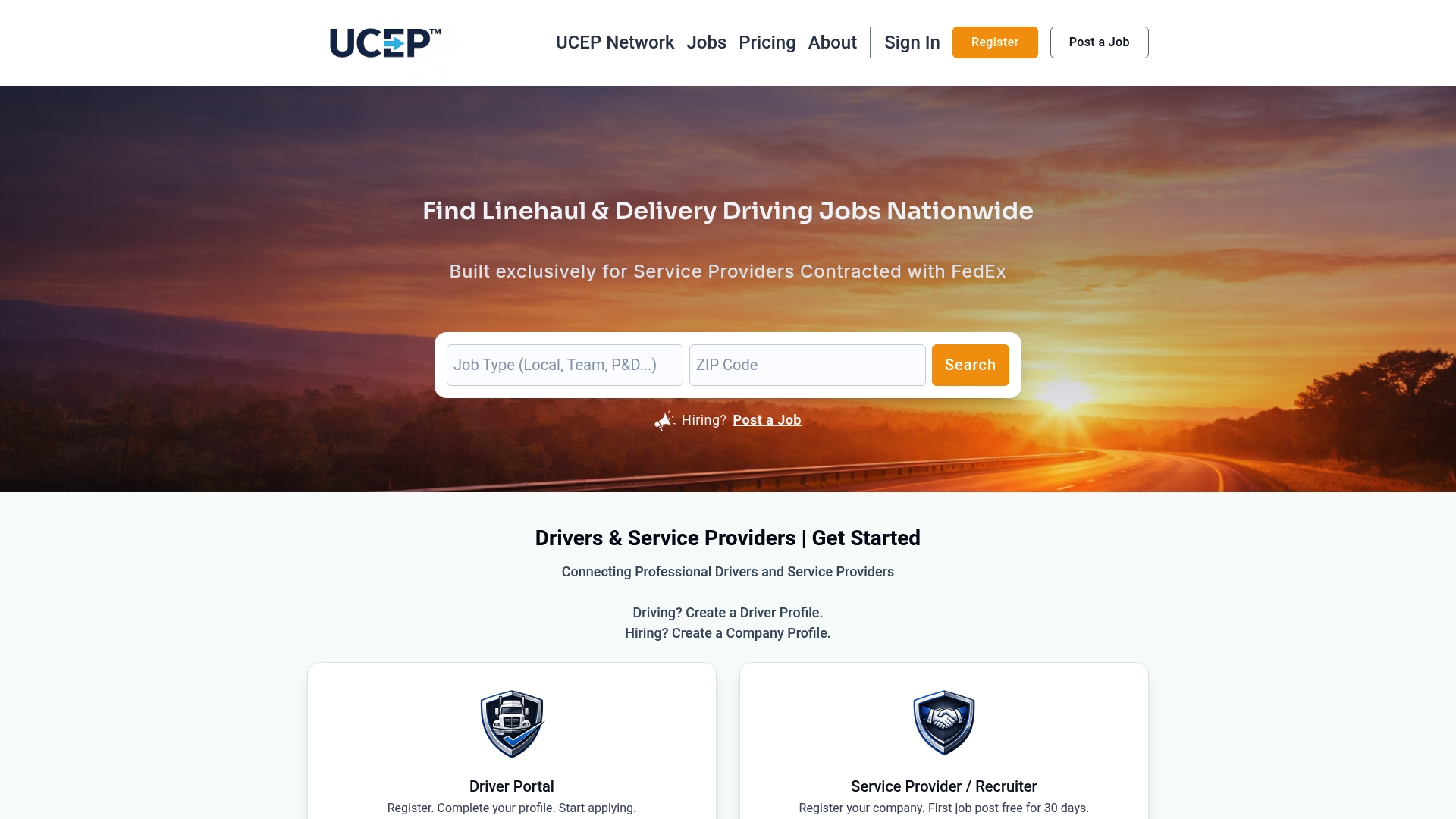
Our template resources, including the application field-group guidance and job description templates referenced above, are built to match §391.21 requirements, so you spend less time drafting from scratch and more time reviewing qualified candidates. Job listings on UCEP are organized by category, pickup and delivery, CDL-A solo linehaul, and CDL-A team linehaul, so your posting reaches drivers already searching for that specific role type.
- A trial listing option lets you post before committing to a paid plan.
- A standard monthly plan offers ongoing access to posting and applicant tracking for a monthly fee.
- Both plans include the employer directory and applicant tracking tools built into the platform.
Check UCEP's pricing and trial listing page to post your next driver job ad with a compliant template already in place.
This article is general information, not a substitute for advice from a qualified lawyer. Consult a qualified legal professional about your own circumstances before acting on anything here.
Sources
FAQ
What new trucking regulations take effect in 2026?
State-level rules on driver's-license language in job postings are the most active area heading into 2026, with Illinois moving to restrict blanket license requirements similar to California's existing SB 1100 test. Employers posting in multiple states should check each state's current statute rather than assume federal rules cover this ground.
What is the average salary for driving jobs in the USA?
Driver pay varies widely by route type, equipment, and region, and this article does not have a sourced figure to report. Check individual job postings, which increasingly include a required pay range under state transparency laws, for current figures in your target market.
Is trucking still worth it as a career in 2026?
Whether trucking is a good career choice depends on route type, home time, and pay structure, factors that vary too much by carrier and region to summarize with one figure. Reviewing job postings that disclose pay range, equipment, and schedule details, as more postings now do under state law, gives a clearer picture than any single industry-wide claim.