
You can grow a FedEx-contracted driving team profitably by maintaining a 10% headcount buffer, rotating sourcing channels measured by hire yield, scheduling preventative fleet replacement before breakdowns occur, and optimizing stop density under FedEx Network 2.0. These four moves protect margins while you scale.
The five pillars this guide covers:
- KPIs: cost-per-hire, cost-per-mile, net margin per stop, retention rate, and hire yield
- Recruiting pipeline: channel rotation, tracking hires not applicants, and job-ad structure
- Retention levers: pay design, fleet reliability, home time, and career paths
- Data-driven operations and contracts: dashboard metrics and negotiation inputs
- ROI model: break-even calculation for adding a solo or team driver
A single engine rebuild on a Class 8 tractor can be very costly, and replacing one driver entails significant recruiting and ramp-up expenses. Both figures hit the same P&L line. Platforms like Ucep and operational frameworks built around Network 2.0 realities give you the tools to avoid both.
Table of Contents
- Which KPIs actually determine your team's profitability?
- Where should you recruit drivers and how do you measure channel ROI?
- What retention tactics cost less than replacing drivers?
- How do you use fleet and service data to protect your margins?
- What does a repeatable onboarding and scaling system look like?
- What does the ROI model look like for adding a driver?
- Your 90/180/365-day implementation checklist
- Key Takeaways
- What operators get wrong about scaling a FedEx driving team
- Ucep gives FedEx service providers a direct path to qualified drivers
- Useful sources and further reading
Which KPIs actually determine your team's profitability?
Track these metrics weekly. Pull them from payroll, your telematics system, and FedEx settlement reports.
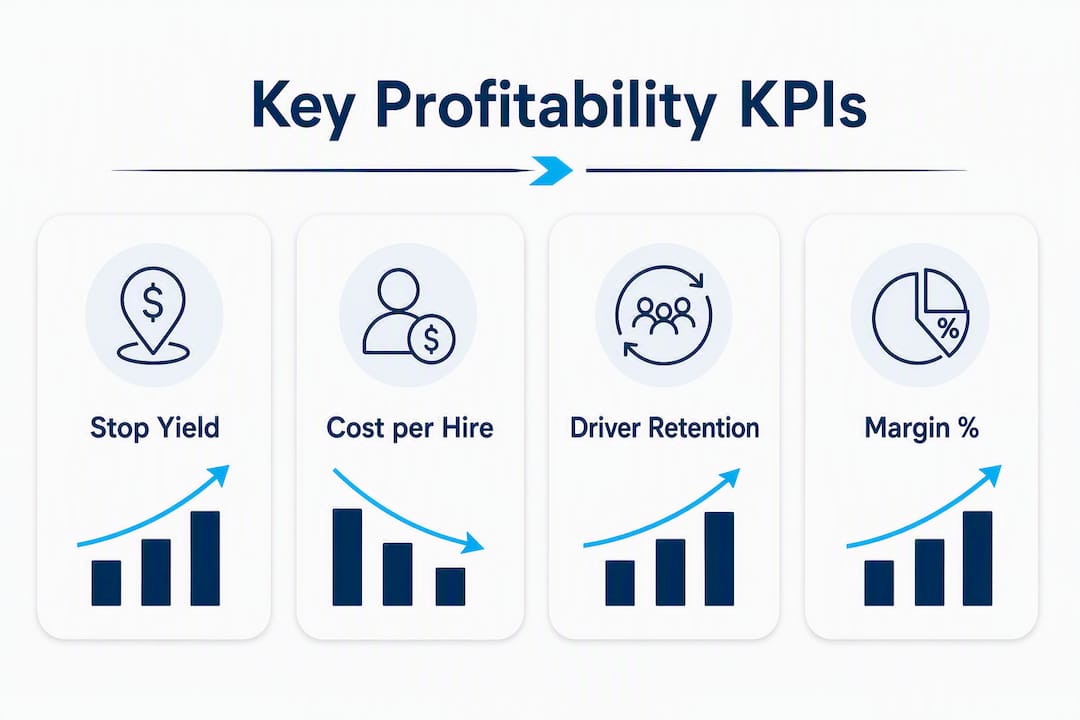
- Cost-per-hire: total recruiting spend divided by hires placed (not applicants)
- Cost-per-mile: total operating cost divided by miles driven; flag any upward trend month over month
- Net margin per stop: settlement revenue minus direct labor, fuel, and maintenance, divided by stops completed
- Retention rate at 90/180/365 days: count drivers still active at each milestone divided by total hired in that cohort
- Time-to-fill: calendar days from job posting to first shift; target under 14 days for P&D roles
- Hire yield: hires divided by applicants per channel; the single most useful channel-efficiency number
- Downtime per vehicle: hours a truck is out of service per month; anything above 8 hours signals a maintenance gap
- VEDR events per 100k miles: hard braking, following distance, and speed events tracked through your in-cab system
- Stop density: stops per mile on a given route; higher density directly raises net margin per stop
Pro Tip: Build a one-page dashboard in Google Sheets or a tool like Samsara that flags when active headcount drops within 10% of your minimum requirement. That trigger starts proactive recruiting before you reach crisis staffing.
Where should you recruit drivers and how do you measure channel ROI?
High-performing operators rotate channels and track which ones produce hires, not just clicks. Here is the channel mix to test and measure:
- Ucep: a job board built exclusively for FedEx-contracted Service Providers; applicants already understand the role type (CDL-A team, solo, linehaul, P&D)
- Niche CDL boards: targeted audiences reduce unqualified applications
- Referral programs: offer a structured bonus paid at 90 days of retention, not at hire
- CDL school placement programs: direct pipeline for new CDL holders seeking their first linehaul or P&D role
- Social groups: Facebook groups for local drivers and trucking communities
- Paid general boards: use for volume during peak season, but measure hire yield carefully
For each channel, capture these data points every two weeks:
- Number of applicants received
- Number of interviews completed
- Offers extended and accepted
- Time from application to first shift
- Retention at 90 days (hire lifetime value proxy)
A channel producing 40 applicants but 1 hire at a cost of $800 is worse than one producing 10 applicants and 3 hires at $200. Niche boards consistently outperform general boards on hire yield for FedEx-specific roles because the applicant pool is pre-filtered by role type.
For your job ads, include: required CDL class and endorsements, home-time schedule, weekly gross pay range, equipment age, and a one-sentence call to action. Ads that omit pay and home time see higher drop-off before application. For P&D driver hiring tips specific to FedEx operations, Ucep's blog covers ad structure and screening steps in detail.

Pro Tip: Panic-hiring raises accident rates and training costs. Treat the 10% buffer as a fixed operating cost in your recruiting budget, not a contingency.
What retention tactics cost less than replacing drivers?
Replacing one driver costs $5,000–$7,000 when accounting for recruiting, testing, and reduced efficiency during ramp-up. Preventing two turnovers per quarter can save more than most annual pay raises cost.
The highest-ROI retention levers, in order of impact:
- Preventative fleet replacement: equipment breakdowns are a primary driver of turnover; a scheduled replacement program costs less than a $45,000 engine rebuild plus $1,500+/week in rental trucks
- Consistent home time: publish schedules two weeks out and protect them; unpredictable schedules are among the top reasons drivers leave
- Tiered pay tied to safety and service: bonuses at 90-day and 180-day milestones, with a safety component linked to VEDR scores
- Health stipends and 401(k) matching: even modest contributions differentiate you from competitors at the same pay rate
- Mentoring and team pairing: pair new hires with a senior driver for the first 30 days; this reduces early-tenure turnover and accelerates route familiarity
Short coaching loops tied to VEDR data serve double duty. Insurers now require documented coaching sessions to qualify for lower premiums. A driver with a declining VEDR score who receives a 15-minute coaching session and signs off on it is both safer and cheaper to insure. For more on why driver experience directly affects retention, Ucep's blog covers the operational side in detail.
How do you use fleet and service data to protect your margins?
Operators who treat their business as a data-driven operation use performance metrics in contract discussions rather than relying on relationship appeals. Build a dashboard with these elements:
| Metric | Data Source | Use |
|---|---|---|
| Cost-per-mile trend | Telematics + fuel receipts | Flag margin compression early |
| Stop density by route | FedEx settlement + mapping tool | Identify routes to consolidate or expand |
| VEDR events per 100k miles | In-cab system | Insurance negotiation and coaching |
| On-time rate for Express commits | FedEx portal | Service-level documentation |
| Maintenance spend per vehicle | Fleet maintenance log | Replacement decision trigger |
Integrating small pickups into existing routes under Network 2.0's consolidated pickup rules raises stop density without adding miles. Train drivers to scan hybrid pickups correctly to avoid Express misses. Dynamic Route Optimization (DRO) tools help sequence stops to protect time-certain freight on Express-heavy routes.
When you enter a stop-rate discussion with FedEx, bring 90 days of documented service levels, safety scores, and cost-per-mile trends. That data shifts the conversation from a request to a business case.
What does a repeatable onboarding and scaling system look like?
Standardized onboarding reduces ramp time and protects service quality as you add headcount. Use this checklist for every new hire:
- Complete paperwork and DOT compliance verification on day one
- Terminal introduction and equipment walkthrough on day two
- Route shadowing with a senior driver for days three through five
- Scanner and manifest training before solo operation
- VEDR and defensive driving coaching session in week two
- 30-day performance review covering stops per hour, VEDR score, and attendance
- 60-day review adding route efficiency and customer complaint rate
- 90-day review tied to retention bonus eligibility
For scheduling, solo P&D drivers typically run five-day routes with two consecutive days off. Team drivers on linehaul need coordinated rest cycles; publish the rotation at least two weeks out. On routes where Express volume exceeds 15% of stops, assign a dedicated Express runner or schedule a mid-day sweep to protect commit times. For solo vs. team scheduling differences, the operational requirements diverge significantly at the route-planning stage.
Maintain a central certification tracker for CDL renewals, medical cards, and FedEx-required training. A lapsed medical card grounds a driver immediately and creates a coverage gap.
What does the ROI model look like for adding a driver?
Use this table as a starting framework. Fill in your actual figures from payroll and settlement data.
| Input | Solo P&D Driver | Team Linehaul Driver |
|---|---|---|
| Cost-per-hire | — | $800–$1,500 |
| Expected stops/day at full productivity | — | N/A (miles-based) |
| Revenue per stop | Varies by settlement | Varies by linehaul rate |
| Insurance delta per added driver | $200/month | $300/month |
| Estimated break-even | 6–10 weeks | 10–14 weeks |
Well-run FedEx P&D operations typically land net margins between 10% and 20%. A solo driver added to a dense existing route reaches break-even faster because incremental fuel and maintenance costs are lower relative to the revenue added per stop.
Pro Tip: Model a 7% swing in operating costs (comparable to a General Rate Increase cycle) in your break-even calculation. If a 7% cost increase pushes break-even past 16 weeks, the route density or stop rate needs adjustment before you hire.
Your 90/180/365-day implementation checklist
Days 1–90
- Build your KPI dashboard (cost-per-hire, hire yield, cost-per-mile, VEDR events, stop density)
- Post open roles on Ucep and at least two additional channels; tag each applicant with a source
- Launch a referral incentive program with a 90-day retention trigger
- Start a preventative maintenance schedule for every vehicle in the fleet
Days 91–180
- Pull hire-yield data by channel; cut or reduce spend on channels below your cost-per-hire target
- Formalize the onboarding checklist and assign a mentor for each new hire
- Run your first VEDR coaching sessions and document them for insurance purposes
- Complete your first ROI model for a new hire using 90 days of actual settlement data
Days 181–365
| Milestone | Action | Owner |
|---|---|---|
| Margin review | Compare net margin per stop to 10–20% benchmark | Operator |
| Contract prep | Compile 90-day service and safety data for stop-rate discussion | Operator |
| Scale decision | Apply 10% EBITDA rule: scale if margin supports buffer cost | Operator |
| Channel audit | Confirm Ucep and referrals are primary hire-yield sources | Hiring manager |
Peak season between November and January can require staffing increases of 50–100%. Build that surge into your 365-day plan and start recruiting for it by September.
Key Takeaways
Scaling a FedEx-contracted driving team profitably requires a 10% headcount buffer, hire-yield tracking by channel, preventative fleet replacement, and stop-density optimization running simultaneously.
| Point | Details |
|---|---|
| Track hire yield, not applicants | Measure hires per channel every two weeks; cut channels that miss your cost-per-hire target. |
| Prevent turnover before it happens | Replacing one driver costs $5,000–$7,000; fleet reliability and consistent home time are the highest-ROI retention levers. |
| Build a data dashboard first | Cost-per-mile trends, VEDR events, and stop density are your negotiation inputs with FedEx, not just internal reports. |
| Model break-even before hiring | A solo P&D driver on a dense route can break even in a matter of weeks.; test a 7% cost swing before committing. |
| Use Ucep for FedEx-specific recruiting | Ucep's job board targets CDL-A team, solo, linehaul, and P&D applicants already familiar with FedEx-contracted operations. |
What operators get wrong about scaling a FedEx driving team
Most operators treat hiring as a reactive function. A truck goes down or a driver quits, and the job post goes up the same afternoon. That sequence is where margin leaks.
The operators who consistently land in the 15–20% net margin range do something different: they run recruiting as a standing operation, not a response. They post roles before they need them, they measure which channels produce drivers who stay past 90 days, and they treat the 10% headcount buffer as a fixed line item rather than a luxury.
Fleet reliability follows the same logic. A preventative replacement schedule feels like overhead until you price out a $45,000 engine rebuild plus rental truck costs while your route still has to run. The math is not close.
The data-driven operations piece is where most operators leave money on the table. Stop density, VEDR trends, and on-time rates are not just internal scorecards. They are the inputs FedEx uses to evaluate your operation, and they are the inputs you should bring to any stop-rate conversation. Showing up with documented service levels changes the dynamic.
Ucep gives FedEx service providers a direct path to qualified drivers
Ucep is a job board and recruiting platform built exclusively for FedEx-contracted Service Providers. It connects hiring managers with CDL-A team, CDL-A solo, linehaul, and pickup and delivery applicants who are already looking for FedEx-related roles, which means less screening time and higher hire yield from the first posting.
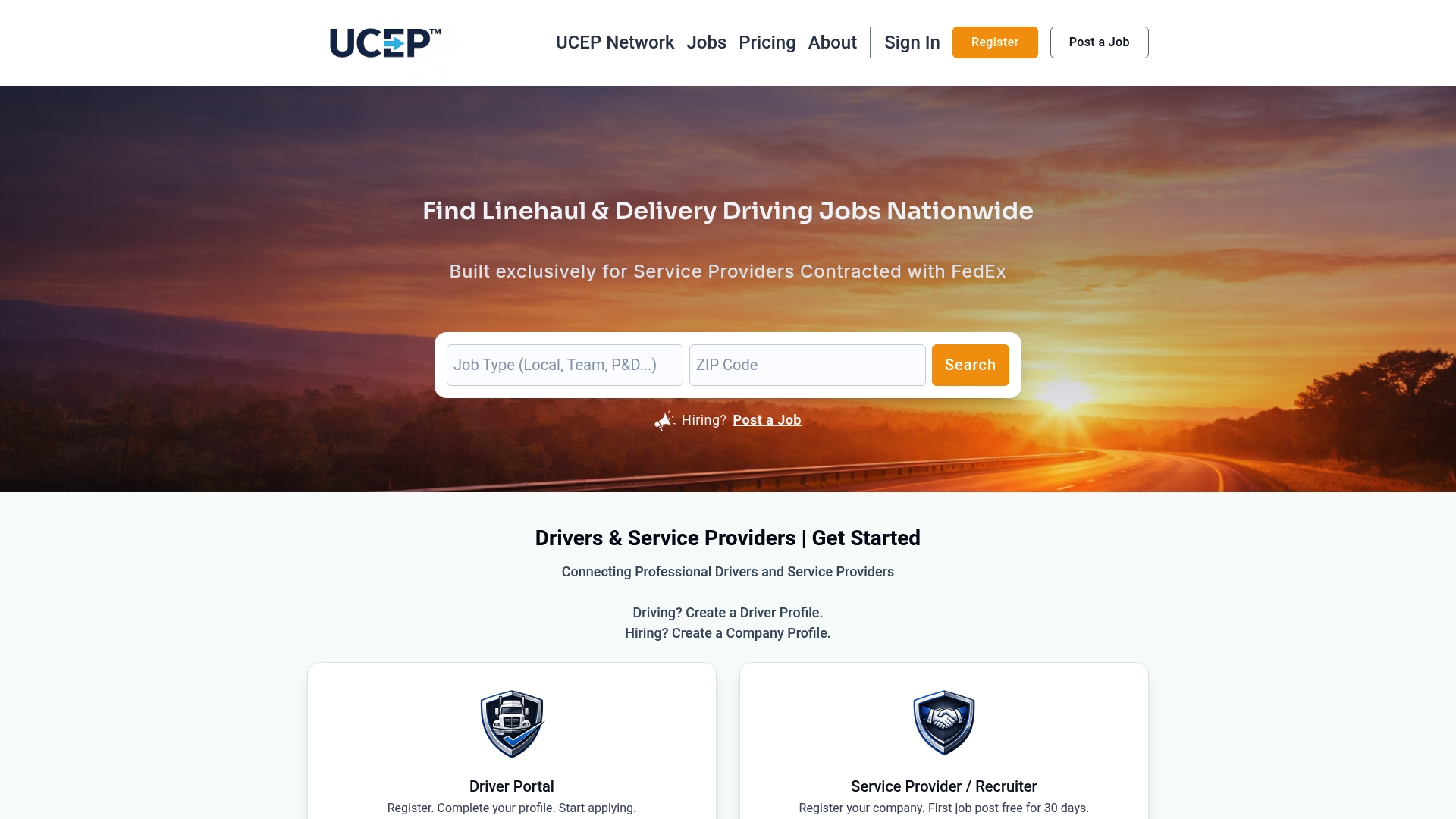
Features available to Service Providers on Ucep include a built-in applicant tracking system, targeted driver alerts, employer and terminal directories, and internal reviews that help drivers evaluate your operation before applying. You can post a role, enable source tracking, and start measuring hire yield from day one.
To get started, post your first role on Ucep or review the Ucep network options to find the subscription tier that fits your current hiring volume.
Useful sources and further reading
- What Is a FedEx Ground Contractor? — LegalClarity — peak season staffing obligations and Schedule K
- Team Driver Recruiting Strategies for CDL-A Hiring — Ucep Blog — channel tactics and screening for team roles
- Solo vs. Team Driver Hiring Differences — Ucep Blog — scheduling and onboarding differences by role type
- How to Hire Linehaul Drivers Fast — Ucep Blog — time-to-fill reduction for linehaul positions
Recommended
- What It Takes to Succeed as a Team Driver for Service Providers Contracted with FedEx | UCEP Meta description - United Contractor Employment Portal
- Why team drivers share driving duties: A fleet guide
- Why Driver Experience Matters for FedEx Service Providers
- How to Post FedEx Driving Jobs Effectively in 2026