CDL application abandonment happens when a qualified candidate starts an application but never submits it. The single highest-impact fix is shortening your application to around five minutes and pairing it with fast response times once a candidate applies. Nearly all online job applicants never finish what they start, and shorter forms combined with quick follow-up reverse that pattern fast.
TL;DR:
- Shortening the application process to five minutes and removing duplicate or unnecessary fields significantly boosts completion rates, with some studies showing up to a 365% increase.
- Immediate acknowledgment and quick disposition within three to five days are crucial for maintaining candidate interest and reducing abandonment.
- Fixing the largest drop-off points by analyzing step-level data ensures efforts focus on the most impactful stages of the application funnel.
- Sending timely reminders and using lightweight screening questions help re-engage stalled candidates and filter for serious applicants.
- Testing each change individually and measuring core KPIs such as completion rate, time-to-complete, and cost-per-application is key to optimizing recruitment workflows.
Table of Contents
- Quick wins: 6 immediate changes to reduce abandonment
- Diagnose abandonment: how to measure and where to look in your funnel
- Form and UX fixes that reduce friction
- Speed and communication: SLAs, dispositioning, and routing applicants
- Re-engagement and intent filtering
- Measure and validate: A/B tests and KPIs that prove impact
- What recruiters consistently get wrong about drop-off
- How UCEP can help you pilot these fixes
- FAQ
- Sources
Quick wins: 6 immediate changes to reduce abandonment
Before you touch your applicant tracking system or run a redesign, start with changes you can ship this week.
- Shorten the application toward five minutes using progressive profiling and resume import instead of asking for everything up front.
- Remove fields that duplicate data you already collect elsewhere, like re-entering an address already on a resume.
- Build the flow mobile-first, since most CDL candidates apply from a phone, and add save-in-progress so a dropped signal doesn't cost you a candidate.
- Set acknowledgement SLAs measured in minutes and disposition SLAs measured in days, not weeks.
- Send SMS or one-click reminders to candidates who started but didn't finish.
- Add drop-off tracking at each step so you know which change actually worked.
Pro Tip: Test one change at a time. Stacking five fixes in the same week makes it impossible to tell which one moved your numbers.
Diagnose abandonment: how to measure and where to look in your funnel
You can't fix what you haven't measured. Before changing your form, find the exact step where candidates leave.
- Track apply-start rate, apply-complete rate, average time-to-complete, and step-level drop-off for each page of your application.
- Add events in your analytics platform or ATS for apply-start, resume-upload, each step timestamp, and final submit so you can see where candidates stall.
- Walk through your own application on a phone with a weak signal to reproduce the friction a real candidate feels.
- Rank drop-off stages by volume and fix the highest-volume stage first, since that's where small changes produce the biggest lift.
This sequence matters because fixing a low-traffic step while ignoring your biggest leak wastes effort. Most Service Providers find one or two steps account for most of the loss.
Form and UX fixes that reduce friction
Once you know where candidates drop off, the fix is usually the same: ask for less, and make what remains easier to complete on a phone.
- Collect only the field groups you need to screen a candidate at apply time; our guide to FMCSA compliant application field groups breaks down what belongs at this stage versus later.
- Postpone background checks, references, and employment verification until after initial screening rather than front-loading them into the first form.
- Enable resume or LinkedIn import and single-click resume upload so candidates never retype information you already have.
- Design for mobile first: large touch targets, a visible save-and-resume option, and no confusing redirects to a separate ATS login screen.
Reducing application time to roughly five minutes has been linked to conversion increases of up to 365% in a large multi-platform study. That single number explains why field reduction consistently outperforms other fixes. Every field you remove, and every minute you cut from completion time, moves you closer to that threshold.
Pro Tip: Ask a non-recruiter to time themselves completing your live application on a phone. Anything over five minutes is a signal to cut, not add.
Speed and communication: SLAs, dispositioning, and routing applicants
A fast, short application only helps if your response is just as fast. Candidates who apply and hear nothing for days often assume they've been rejected and move on.
- Acknowledge every application immediately by SMS or email, even with a simple confirmation message.
- Route high-intent applicants, like those who complete every step and upload a resume, directly into a recruiter's queue instead of a general pool.
- Disposition every applicant, meaning mark them as advancing or declined, within three to five days rather than leaving them in limbo.
- Use template next-step and rejection messages so no candidate is left wondering what happened.
- Build shift coverage and alerting so applications submitted on nights or weekends don't sit untouched until Monday.
Top-rated employers disposition candidates within three to five days, and slower response times correlate with candidates abandoning the process and declining to reapply. That window is the benchmark worth building your workflow around.
Re-engagement and intent filtering
Not every candidate who stalls is gone for good. A short, well-timed nudge brings many back, and a light screening question helps you focus recruiter time on the candidates most likely to show up.
- Send a reminder about 15 minutes after a candidate stalls, a second at 24 hours, and a final, lighter-touch message at 72 hours.
- Ask for minimal information upfront, then use progressive profiling to collect deeper details, like endorsement history, once a candidate is engaged.
- Add one short intent-verification question, such as an availability window, to separate serious candidates from casual browsers.
- Use simple automation, including a chatbot, to answer common eligibility and licensing questions so candidates don't stall waiting on a human reply.
Our piece on recruiter workflows built around AI-enabled engagement walks through how this kind of light automation fits into a daily recruiting routine without adding headcount.
Measure and validate: A/B tests and KPIs that prove impact
Once you've made changes, confirm they worked before rolling them out everywhere.
- Test a short form against your current long form, and test adding an SMS reminder against no reminder at all.
- Track apply-complete rate, time-to-complete, cost-per-complete, and hires-per-application as your core KPIs.
- Set a baseline from your last 30 to 60 days of applications before changing anything, and run each test long enough to collect a meaningful sample.
- Report results weekly, and roll out the winning variant to 100% of traffic once it clears your baseline.
Carriers that pair faster, better-targeted recruiting with disciplined execution convert more of their existing applicants, which matters more in a competitive driver market than simply generating more leads.
What recruiters consistently get wrong about drop-off

Most Service Providers assume application abandonment is a lead-quality problem, so they spend on more job ads instead of fixing the form candidates already found. That's backward. A candidate who clicked "apply" already cleared the hardest step: deciding to pursue the job. Losing them after that point is an operations failure, not a sourcing one.
The other common mistake is treating speed-to-contact as a nice-to-have rather than a core metric. Recruiters who track time-to-hire but ignore time-to-first-response are measuring the wrong end of the funnel. Our guide on common mistakes hiring CDL drivers covers several of these blind spots in more depth, and the pattern holds across most Service Providers we've observed: shorter forms and faster replies consistently outperform bigger ad budgets.
— Aaron
How UCEP can help you pilot these fixes
We built our platform dedicated to Service Providers contracted with FedEx, focusing on applicants interested in FedEx-related driving work. That targeting alone reduces one source of abandonment: candidates who apply, then realize mid-form that the job isn't what they expected.
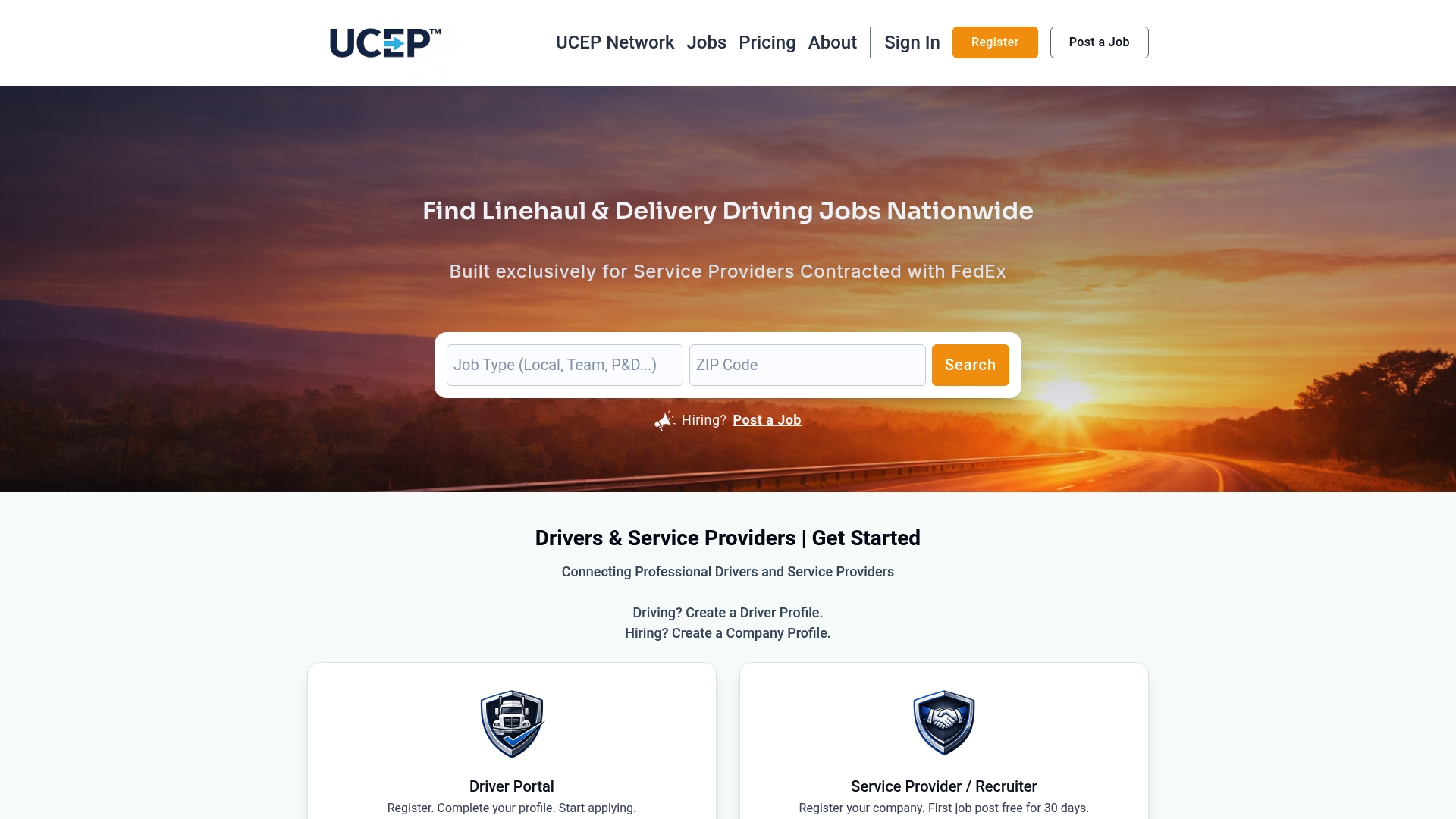
Our platform includes streamlined apply flows, an applicant tracking system, and driver alerts that help you reach candidates for linehaul, CDL-A team, CDL-A solo, and pickup and delivery roles without building that infrastructure yourself. You can browse the kind of candidate pool and job categories we serve through our driver job listings before committing to anything.
If you want to test these fixes without a long commitment, start with our Complimentary Trial Listing, or move to our Standard Monthly Plan once you've validated results. During a pilot, track the same three numbers covered above:
- Apply-complete rate compared to your current form.
- Average time-to-complete for a submitted application.
- Cost-per-complete against your current job ad spend.
Visit our pricing page to start a trial listing and measure the difference for yourself.
FAQ
What counts as CDL application abandonment?
CDL application abandonment is when a candidate begins a job application but never submits it, often because the form takes too long or asks for information they don't have on hand. Most online job applicants never finish what they start, and CDL hiring funnels follow the same pattern when forms are long or redirect candidates to a separate login.
How long should a CDL job application take to complete?
Aim for around five minutes. Multi-platform research tracking 500,000 job seekers found conversion gains of up to 365% when applications took roughly five minutes or less, making that length a practical target rather than a rough guess.
How fast should recruiters respond to a new CDL applicant?
Acknowledge new applicants within minutes using SMS or email, and move every candidate to a decision, whether advancing or declining, within three to five days. Research on candidate experience ties that three-to-five-day window to higher-rated employers, while slower responses push candidates to abandon the process.
What's the easiest first step to reduce drop-off?
Start by cutting nonessential fields from your initial application and postponing background checks, references, and other verification steps until after a candidate clears initial screening, as detailed in our guide to trucking insurance mistakes to avoid. This alone often produces a measurable completion-rate improvement before you touch anything else in your funnel.
Does UCEP offer a way to test these changes before committing to a paid plan?
Yes. Our Complimentary Trial Listing lets you evaluate our applicant pool and apply flow before moving to our Standard Monthly Plan, listed at $99 per month on our pricing page.