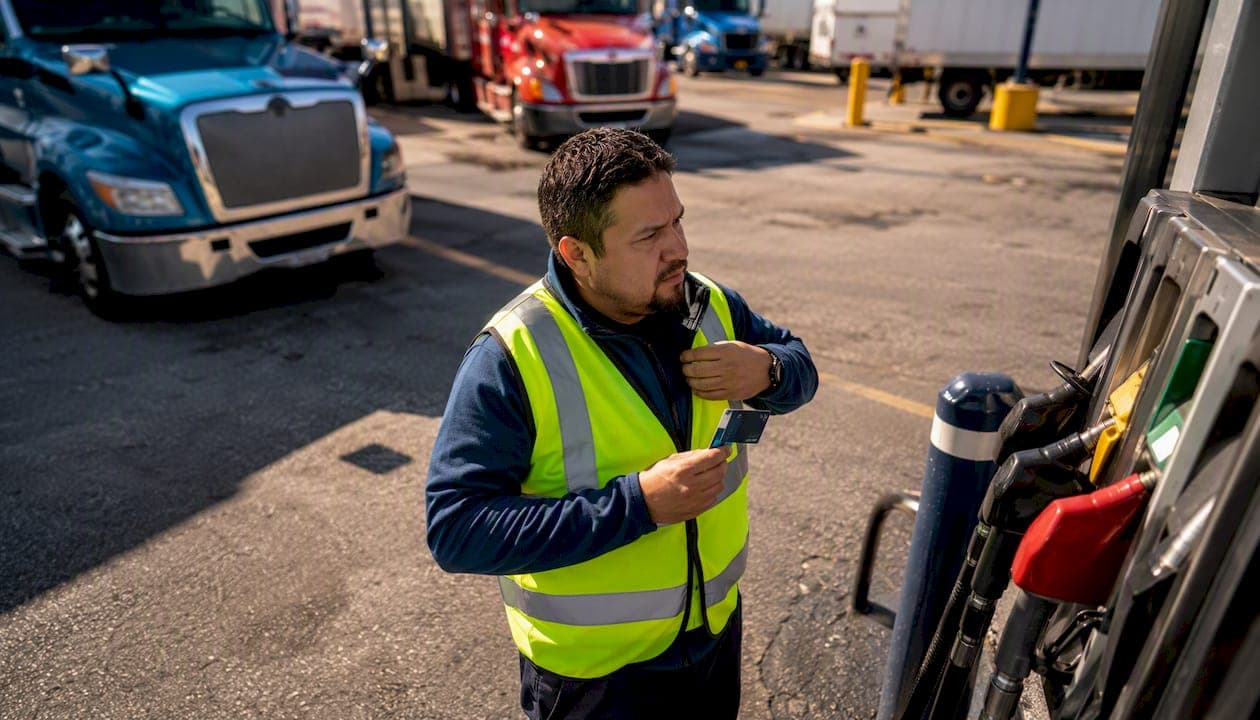
A fuel card reduces your net fuel cost, enforces purchase controls at the pump, and produces transaction-level data your operation can act on. Fuel expenses represent a significant portion of a trucking operation's cost per mile, which means even modest per-gallon savings move the margin needle. Carriers who use fuel cards consistently report a 10–20% reduction in fuel costs compared to paying at the pump without a program.
The role of a fuel card for drivers goes well beyond a payment method. At its core, a fleet fuel card is a financial control and data platform. Here is what it does in practice:
- Discounts: Negotiated per-gallon rates, starting around $0.05 per gallon and scaling higher for trucking-specific programs
- Spending controls: Grade restrictions, daily limits, and location checks enforced at the point of sale
- Reporting: Automatic transaction records with driver ID, odometer, gallons, and location
- Fraud prevention: Merchant and terminal-level restrictions that standard corporate cards cannot replicate
Fuel card programs have evolved from simple payment tools into platforms for financial control and risk management — and fleets that treat them as data platforms capture far more value than those using them only for discounts.
This guide is written for professional drivers and fleet managers, including owner-operators and contractor fleets. Aaron at Ucep covers operational tools and workforce topics for FedEx-contracted service providers and the drivers who work with them.
Table of Contents
- How do fuel cards work from swipe to report?
- What are the primary benefits for drivers and fleets?
- What features should you prioritize when choosing a card?
- How do you estimate costs, fees, and expected ROI?
- How do you roll out fuel cards and enforce best practices?
- What pitfalls and red flags should you watch for?
- Which metrics should you track to measure success?
- Key Takeaways
- Why fuel cards matter for contractor fleets specifically
- Useful sources and further reading
How do fuel cards work from swipe to report?
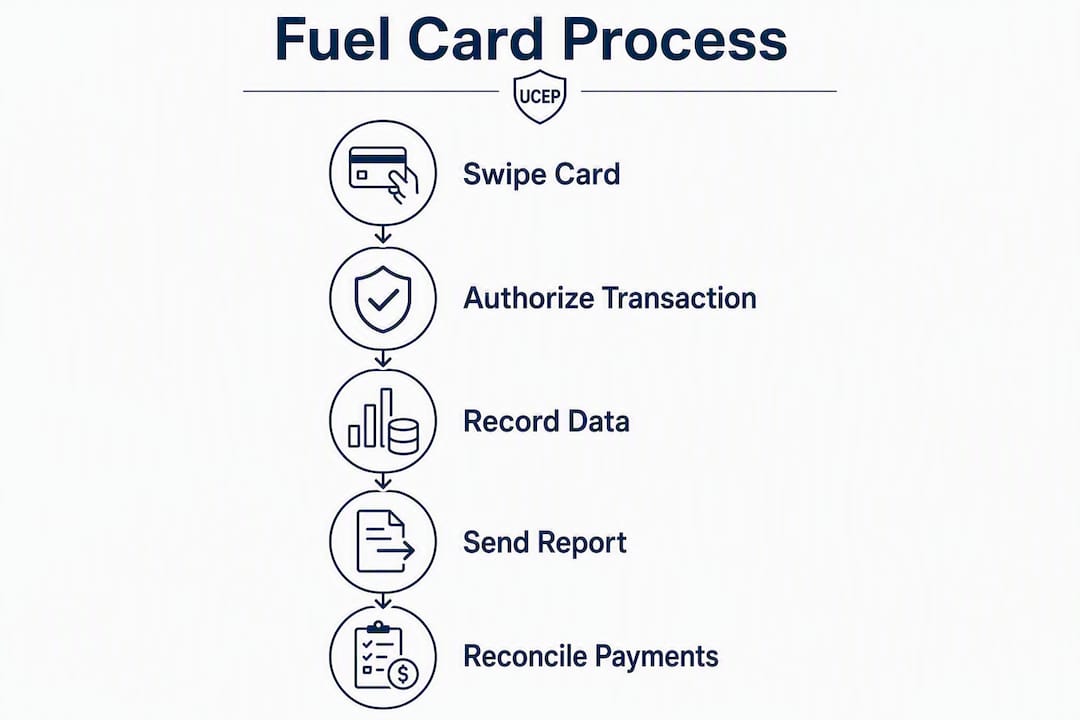
The transaction flow is straightforward. You swipe the card or enter a PIN at an authorized pump, the network applies your negotiated discount, and the transaction posts to your management dashboard within hours. Authorization happens at the terminal level, so rules you configure in your portal travel with the card.
Data captured at each fill:
- Date, time, and location
- Gallons dispensed and price per gallon
- Fuel grade selected
- Driver ID (entered via PIN or card assignment)
- Odometer reading (prompted at the pump)
- State, for IFTA reporting
Each data point serves a specific purpose. Odometer readings let you calculate cost per mile. Driver ID ties every transaction to a person, not just a vehicle. Location data flags off-route stops. Fuel cards capture odometer, driver ID, and location data that fleets can use to analyze MPG and route efficiency.
Typical card lifecycle:
- Enroll your fleet and configure account-level rules
- Activate cards and assign each to a specific driver or vehicle
- Set per-vehicle purchase rules (grade, daily limit, location)
- Drivers fuel at authorized stations using card and PIN
- Transactions post to the dashboard; alerts fire for exceptions
- Reconcile weekly against odometer logs and route records
- Export IFTA and cost-per-mile reports on your billing cycle
Billing runs on either a weekly ACH debit or a prepaid cash-secured model. Credit-term programs suit established fleets; prepaid models work for newer operators or those managing cash flow tightly.

What are the primary benefits for drivers and fleets?
The direct benefit is lower fuel cost. The operational benefits compound from there.
Carriers who use fuel cards consistently report a 10–20% reduction in fuel costs, and because fuel represents 20–30% of cost per mile, that reduction has an outsized effect on profitability. A fleet running tight margins cannot afford to leave that on the table.
Operational benefits at a glance:
- Per-gallon discounts applied automatically at participating stations
- Tighter spending controls that stop unauthorized purchases before they post
- Automatic IFTA-ready reports, eliminating manual mileage logs
- Eliminated cash advances, which reduces safety risk and simplifies driver settlement
- Driver and vehicle-level visibility for every transaction
Standard corporate credit cards expose fleets to fraud because they cannot hard-code fuel-only restrictions. Fuel cards remove that risk by enforcing merchant and terminal-level controls. A driver cannot use the card at a restaurant or convenience store if the program restricts it to fuel-only terminals.
Pro Tip: Treat your fuel card as a data source first and a payment tool second. Reconcile transactions weekly against odometer readings to catch MPG drops, off-route fueling, and unauthorized fills before they become patterns.
What features should you prioritize when choosing a card?
Prioritize features that enforce policy at the point of sale and produce reports you can actually use. A card that only offers discounts without controls is a missed opportunity.
Must-have features checklist:
- Per-gallon discount rate and station network coverage for your routes
- PIN or driver ID requirement at every transaction
- Odometer capture prompt at the pump
- Location validation and off-network alerts
- Product restrictions (diesel only, no DEF or food by default)
- Daily and per-transaction dollar or gallon limits
- Real-time exception alerts via SMS or email
- IFTA export and integration with your fleet management software
Modern portals allow granular purchase rules — restricting fuel grades, setting daily limits, and enforcing location checks at the point of purchase. That means misuse is stopped before it posts, not discovered after the fact.
Key trade-offs to evaluate:
- Broad network vs. deep discounts: A larger network gives drivers more fueling options but may offer smaller per-gallon savings. A smaller, trucking-specific network often delivers higher discounts on routes where those stations are available.
- Prepaid vs. credit terms: Prepaid programs require a cash deposit but carry no credit risk. Credit-term programs offer more flexibility but require approval and carry liability if controls are weak.
- Integration depth: Compatibility with telematics platforms and fleet management software matters for automated reconciliation. Manual data entry defeats much of the efficiency gain.
Improving fuel economy on the vehicle side amplifies card savings. Pairing a strong card program with diesel fuel economy best practices compounds the per-mile cost reduction.
How do you estimate costs, fees, and expected ROI?
Compare your net effective $/gallon after discounts and fees against your current pump price, then multiply the difference by your annual gallon volume.
Typical fee structures:
- Per-transaction fees (often $0.25–$0.50 per fill)
- Monthly account or card fees
- Network access fees on some programs
- Prepaid deposit requirements on cash-secured accounts
Sample ROI calculation:
| Input | Example value |
|---|---|
| Gallons per year | 15,385 |
| Savings per gallon (conservative) | $0.10 |
Discount programs often start at around $0.05 per gallon and increase for trucking-specific networks. At $0.10/gallon on a 15,385-gallon year, you reach the lower bound of the 10–20% savings range without accounting for fraud prevention or administrative time saved.
For a five-vehicle contractor fleet, that conservative estimate produces roughly $6,945 in net annual savings. The math scales directly with fleet size and route density.
How do you roll out fuel cards and enforce best practices?
A controlled rollout plus weekly reconciliation produces the fastest ROI. Skipping either step is where most fleets lose value.
- Select a program that matches your network routes and billing preference
- Pilot with a small group (3–5 vehicles) for 30 days before full deployment
- Configure rules per vehicle and driver — grade, daily limit, location restrictions
- Train drivers on PIN entry, odometer prompts, and approved station lists
- Enforce and monitor using real-time alerts for exceptions
- Reconcile weekly against odometer logs and route data
- Scale to the full fleet once rules are validated and drivers are consistent
Policies to set before cards go live: approved station list, fuel grade allowed, daily fill limit, required odometer entry, and whether DEF or other products are permitted. Document these in writing and distribute them during onboarding.
For onboarding new CDL drivers to your fuel card program, keep training to a single page: what to enter at the pump, which stations are approved, and what happens when an exception fires.
Pro Tip: Use real-time alerts as a coaching tool, not just a fraud detector. When a driver fuels off-network, address it within 24 hours. Consistent, fast feedback locks the behavior faster than a monthly review.
What pitfalls and red flags should you watch for?
Most lost savings trace back to poor policy enforcement or a card program that does not match your routes and reporting needs.
Red flags when evaluating a program:
- Weak reporting: No driver-level breakdown or odometer capture means you cannot calculate cost per mile
- Limited network coverage: If approved stations are not on your lanes, drivers will fuel off-network and you lose discounts
- Hidden fees: Per-transaction fees that exceed per-gallon savings on short fills
- No real-time alerts: Exception detection that runs only on a monthly statement is too slow to change behavior
- Insufficient fraud controls: Programs without PIN requirements or merchant-level restrictions replicate the same risk as a corporate card
- No integration options: Manual export-only programs add administrative work and delay reconciliation
Operational pitfalls to avoid:
- Not reconciling weekly, which lets small anomalies compound into large discrepancies
- Allowing DEF, oil, or food purchases by default without a deliberate policy decision
- Card sharing among drivers — one card per driver is the only way to maintain transaction-level accountability
Which metrics should you track to measure success?
Track cost per mile, $/gallon, unauthorized spend, average gallons per fill, and percent of in-network fueling. Those five numbers tell you whether the program is working.
| Metric | How to calculate | Cadence | Alert threshold |
|---|---|---|---|
| Cost per mile (fuel) | Total fuel spend ÷ total miles | Weekly | >10% increase week-over-week |
| Average $/gallon | Total fuel spend ÷ total gallons | Weekly | — |
| Unauthorized spend | Transactions outside approved rules | Weekly | Any single occurrence |
| Avg. gallons per fill | Total gallons ÷ number of fills | Monthly | <50% of tank capacity (possible short-fill) |
| In-network fueling % | In-network fills ÷ total fills | Monthly | less than 90% |
Fuel-card dashboards and weekly reconciliation allow managers to use fuel data as a cost-per-mile calculator and early warning system for inefficient routes. Pair transaction data with odometer readings and route logs to build a baseline, then track deviation from it.
Recommended monitoring cadence:
- Weekly: Reconcile transactions, review exceptions, address off-network fills
- Monthly: Review cost-per-mile trend, in-network rate, and average $/gallon vs. benchmark
- Quarterly: Audit card policies, update approved station lists, review program fees vs. savings
Key Takeaways
Fuel cards reduce net fuel cost, enforce purchase controls, and produce the transaction data fleets need to manage cost per mile and catch unauthorized spend early.
| Point | Details |
|---|---|
| Fuel cost share is significant | Fuel represents 20–30% of cost per mile, making card discounts a direct margin lever. |
| Savings range is measurable | Carriers who use fuel cards consistently report a 10–20% reduction in fuel costs versus paying at the pump. |
| Controls stop misuse at the pump | Set grade restrictions, daily limits, and location checks before cards go live. |
| Weekly reconciliation is the key habit | Match transactions to odometer and route logs every week to catch anomalies early. |
| Data drives better decisions | Odometer, driver ID, and location data let you calculate cost per mile and spot route inefficiencies. |
Why fuel cards matter for contractor fleets specifically
Contractor fleets operating in the FedEx network run consistent lanes, repeatable routes, and measurable load cycles. That predictability is exactly what makes fuel card data most useful. When routes are fixed, MPG benchmarks are reliable, and any deviation from baseline is a signal worth investigating.
Contractor workforce variability is one of the harder operational problems in this space. Fuel cards help by tying every transaction to a specific driver, not just a vehicle. When you rotate drivers across trucks, card-level data tells you whether a fuel efficiency drop follows the driver or the vehicle. That distinction matters for maintenance scheduling and driver coaching.
Ucep works with FedEx-contracted service providers and the drivers who power their operations. From the Ucep perspective, operational tools like fuel cards are part of the same efficiency picture as driver matching, onboarding, and retention. A service provider that controls fuel costs and enforces consistent policies is a more stable employer, and stable employers attract better drivers. You can review service provider profiles on Ucep to see how operators in the network approach their fleets.
Pro Tip: Across a variable contractor workforce, enforce fuel card policy in writing before the first card is issued. Drivers who understand the rules from day one comply at a higher rate than those corrected after the fact.
Useful sources and further reading
- How Does a Fuel Card Work? — TCS Fuel
- Fuel Cards: Beyond Discounts at the Pump — Transport Topics
- The Basics and Benefits of Fleet Fuel Cards — Motive
- How Fuel Cards Work — CoastPay
- Fuel Cards and Driver Expense Control — Wallester
Recommended
- Why team drivers share driving duties: A fleet guide
- Pickup and Delivery Driver Role Explained for 2026
- What It Takes to Succeed as a Team Driver for Service Providers Contracted with FedEx | UCEP Meta description - United Contractor Employment Portal
- The Role of Job Alerts for Drivers Seeking FedEx Roles