
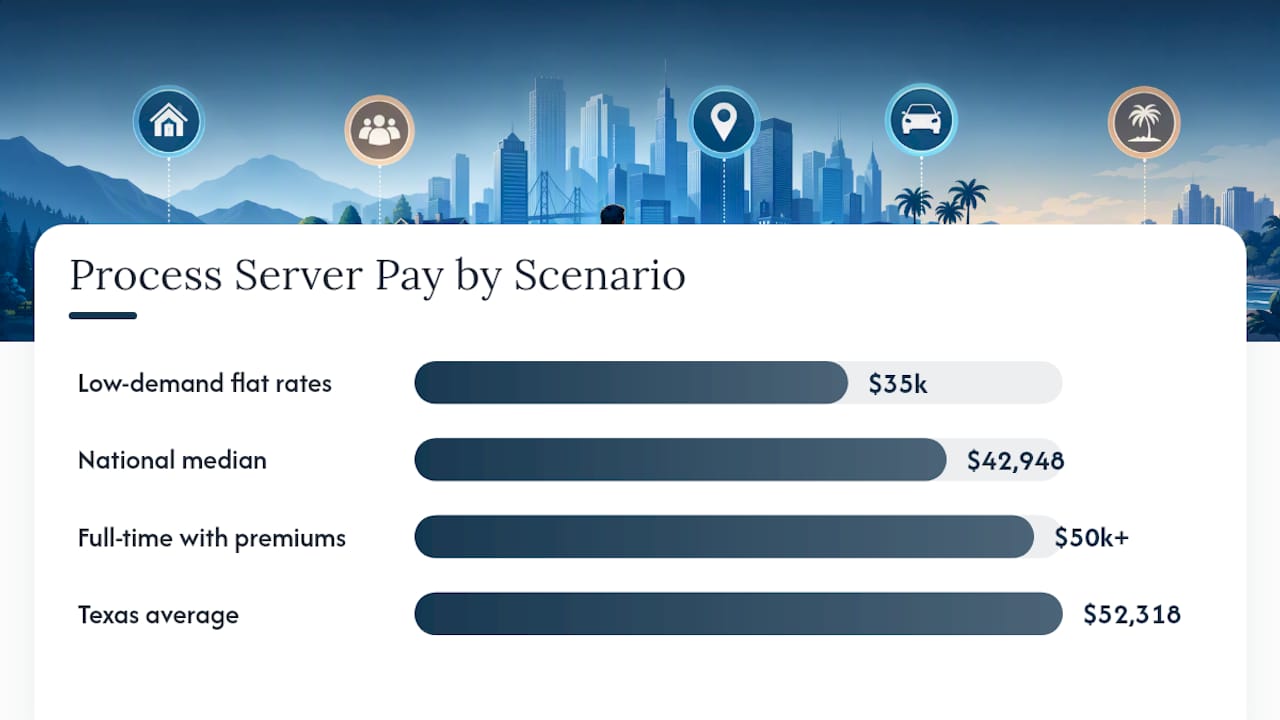
Process servers earn a median annual salary of about $42,948, or roughly $21 per hour, according to Salary. Most fall between $38,612 (25th percentile) and $50,325 (75th percentile) a year, though PayScale puts its average closer to $34,337, reflecting a different mix of respondents and reporting methods.
Quick stat check: Salary.com's reported salary range extends from a low to a high with the median situated near $42,948. That spread tells you something important before you go further: pay depends heavily on your state, your experience, and whether you're billing per job or drawing a paycheck.
Key Takeaways
Process server pay ranges from roughly $34,000 to $52,000 annually depending on state, experience, and whether you charge per service or draw a salary.
| Point | Details |
|---|---|
| National median pay | Salary.com reports a median of $42,948 annually, or about $21 per hour. |
| Pay models vary widely | Per-service fees ($20 to $100), hourly shifts, and salaried roles produce very different income ceilings. |
| Geography drives the spread | Texas averages $52,318 annually, well above the national median, per Glassdoor. |
| Expenses cut into gross pay | Fuel, licensing, bonding, and insurance can reduce net income by 20% to 30%. |
| Diversifying services pays off | Adding skip tracing, notarization, and rush fees reliably increases per-job revenue. |
If you're weighing contract-style work like process serving against other route-based or delivery contracting roles, UCEP's driver job listings for FedEx service providers show how similar per-job and per-route pay structures play out across the logistics industry, useful context if you're comparing income models before committing to one path. You can also browse service provider reviews to see how contractors describe pay reliability and workload in comparable gig-style roles, or check current openings with employers like Source Logistics Inc if you're exploring driving work as a complementary or alternative income stream.
What the Numbers Don't Tell You
The idea that process servers earn one uniform salary is one of the more persistent myths in this field. In reality, you're not choosing a job title, you're choosing among several distinct business models wearing the same name. A per-service contractor in a dense metro, a salaried employee at a court, and a freelance skip-tracer taking rush jobs across three states are all "process servers" on paper, but their income statements look nothing alike.
What the percentile tables miss is the compounding effect of add-on services. A server who treats notarization and skip tracing as afterthoughts leaves real money on the table, not because those services pay enormously more, but because they turn a single serve into two or three billable actions. That's the difference between chasing volume and building margin, and it's the lever most new servers ignore until a few years in.
The other underappreciated factor is deposit collection. Nonpayment risk quietly erodes net income for independent servers more than any single expense category, and it rarely shows up in salary surveys because it's invisible until you've eaten the cost of a skipped invoice.
Table of Contents
- How Much Do Process Servers Make Under Different Pay Structures?
- What Do Process Servers Earn at Each Experience Level?
- Where Do Process Servers Earn the Most?
- Who Hires Process Servers, and Where Does the Higher Pay Come From?
- What Factors Affect Pay, and How Can You Increase Earnings?
- Where Do You Find Process Server Work?
- What Expenses Cut Into a Process Server's Net Earnings?
- Does Certification Change What You Can Earn?
- How Do Full-Time, Part-Time, and Freelance Servers Compare?
- How Do Seasonal and Regional Swings Affect Income?
- Frequently Asked Questions
- Sources
How Much Do Process Servers Make Under Different Pay Structures?
You'll run into three common pay models in this line of work, and each produces a different income ceiling.
- Per-service (flat fee): You get paid for each successful delivery, typically $20 to $100 per job, with a commonly cited average near $60, according to Chron.
- Hourly or shift pay: Common with process-serving firms and legal-support companies that assign routes or shifts rather than individual jobs.
- Salaried or contracted employee: Less common, but some courts and larger legal firms bring servers on payroll with benefits.
Rush fees, notarization, and skip tracing add to the per-service rate. If you serve 15 papers a week at $60 each, that's $900 weekly, or roughly $3,600 monthly, before expenses. Bump the volume to 25 jobs a week and you're clearing over $6,000 a month, assuming steady case flow.
What Do Process Servers Earn at Each Experience Level?
Experience, certification, and workload push you between percentile bands. The table below reflects national percentile data.
| Percentile | Annual Pay | Hourly Rate |
|---|---|---|
| 25th percentile | $38,612 | ~$18.50 |
| Median | $42,948 | ~$21.00 |
| 75th percentile | $50,325 | ~$24.20 |
- New servers with light caseloads typically land near the 25th percentile until they build a client base.
- Certified servers who handle skip tracing, notarization, or rush jobs tend to sit at or above the median.
- Moving from solo contractor to a contracted position with a process-serving firm often trades flexibility for steadier volume, which usually raises annual totals even if the per-job rate drops slightly.
Where Do Process Servers Earn the Most?
State-by-state variation is significant, driven by cost of living, court procedural rules, and local demand for legal support services.
- Texas reports an average annual pay around $52,318, well above the national median, according to Glassdoor's Texas data.
- California and New York metro areas tend to command higher per-service fees because of dense caseloads and elevated cost of living.
- Rural states and smaller markets generally see lower per-job rates, though demand can spike around court terms or election-cycle litigation.
Metropolitan centers usually push both per-service fees and annual averages upward. A server in a major metro can charge more per job simply because legal filings, evictions, and debt-collection suits are more concentrated there. That said, be cautious with small-sample city data. A handful of high earners in one city listing can skew an average, so treat any single-city figure as a starting point, not a guarantee, and cross-check it against your own local market before setting expectations.
Who Hires Process Servers, and Where Does the Higher Pay Come From?
Your employer type shapes both your income stability and your ceiling.
- Law firms offer steady contract work, often at negotiated per-service rates that beat market average for reliability.
- Courts occasionally hire directly, usually at lower but guaranteed rates.
- Private process-serving companies assign volume work, sometimes hourly, sometimes per job.
- Legal-support firms and skip-tracing outfits pay premiums for hard-to-locate serves.
High-profile cases, out-of-state serves, and same-day rush requests typically pay well above standard rates. A steady law-firm contract smooths out your cash flow, while ad hoc jobs pay more per serve but leave gaps between assignments.
What Factors Affect Pay, and How Can You Increase Earnings?
Six variables drive most of the pay variance you'll see in this field: geography, experience, certification, case complexity, urgency, and client type. Metro markets and states with stricter service-of-process rules generally support higher fees, according to UndisputedLegal.
Pro Tip: Require a deposit on rush or skip-tracing jobs before you start. It protects you from nonpayment and signals to clients that you run a professional operation, not a side hustle.
Practical steps to raise your net income:
- Get certified where your state requires or rewards it. Certification opens access to higher-paying court and law-firm contracts.
- Add skip tracing and notarization to your service list. These add-ons routinely boost per-job revenue, per LawServePro.
- Charge for rush, multiple-attempt, and long-distance serves. These surcharges are standard practice, not overreach.
- Build two or three steady law-firm relationships. Recurring contracts smooth your income between higher-paying one-off jobs.
- Track your expenses against your gross fees monthly. You can't judge whether a rate is worth taking without knowing your true cost per serve.
Where Do You Find Process Server Work?
Most opportunities come through a handful of channels: law-firm contracts, private process-serving firms, online job boards and classifieds, court postings, and local legal or paralegal associations.
When you evaluate a posting, don't just look at the headline rate. A $50 per-service listing that requires two hours of driving per job pays worse than a $35 flat rate in a dense urban zone with five serves an hour. Some firms describe route-based, volume work similar to delivery contracting, where per-day earnings depend more on case density than the sticker rate, a pattern also common in pickup and delivery driver roles.
Recurring work usually comes down to reliability. Firms and attorneys keep sending jobs to servers who report back promptly, document attempts thoroughly, and rarely miss a deadline.
How Were These Pay Estimates Compiled?
These figures draw from Salary.com, PayScale, Glassdoor's state-level pages, and practitioner guides like LawServePro. Sample sizes and self-reported data mean estimates vary by source, and per-job fees don't convert cleanly into annual salary comparisons. Adjust these numbers against your own city's demand and your state's licensing rules before setting your pricing.
What Expenses Cut Into a Process Server's Net Earnings?
Gross fees look better on paper than they do in your bank account once you subtract operating costs. Fuel is usually the biggest recurring expense, especially if you serve across a wide county or handle long-distance jobs that involve highway miles. A server averaging 150 miles a day burns through a meaningful chunk of a $60 per-service fee just getting there and back.

Licensing and bonding costs vary by state and sometimes by county, and many jurisdictions require a surety bond before you can legally serve papers. Liability insurance is another recurring cost, particularly for servers handling eviction notices or contentious domestic cases where confrontation risk is real.
Servers who track these costs monthly, rather than estimating at tax time, price their services more accurately and avoid taking jobs that aren't actually profitable once expenses are factored in.
Does Certification Change What You Can Earn?
Certification and licensing requirements vary by state, and in some jurisdictions there's no state-level license at all, just county registration or bonding. Where certification exists, it typically opens doors to higher-paying contracts, particularly with courts and larger law firms that prefer or require certified servers for liability reasons.
Beyond legal access, certification tends to signal professionalism to law firms comparing several servers for a contract. A certified server with a documented track record of accurate proof-of-service filings often lands recurring work over an uncertified competitor charging a similar rate. The credential itself doesn't guarantee a higher per-job fee, but it widens the pool of clients willing to hire you at all, which indirectly raises your earning ceiling.
How Do Full-Time, Part-Time, and Freelance Servers Compare?
Work arrangement changes your income trajectory more than almost any other variable. Part-time servers handling 20 to 25 cases weekly can earn roughly $300 to $500 a week, according to Legal Papers, Inc., a solid supplemental income but not a living wage on its own.
Full-time, aggressive servers who handle high case volumes weekly can earn substantially more weekly, depending on job flow and efficiency. Freelance or 1099 contractors sit somewhere in between, often earning more per job than salaried employees but absorbing all their own expenses and gaps in workflow. Salaried positions with process-serving firms trade some of that upside for predictability, a steady paycheck regardless of weekly case count.
How Do Seasonal and Regional Swings Affect Income?
Court filing volume isn't constant throughout the year. Eviction filings often spike after rent-relief programs expire or during specific court terms, and debt-collection lawsuits tend to cluster around certain fiscal quarters. Servers who track their local court's filing patterns can anticipate slow months rather than getting blindsided by them.
Regional demand fluctuates too. A server in a state with strict service-of-process rules may see steadier demand because attorneys can't risk a botched serve derailing a case, while servers in looser-regulation states might see more competition driving rates down. Diversifying your client base across a few law firms and a private serving company helps smooth out both the seasonal dips and the regional demand shifts that hit single-client servers hardest.
A Day in the Life: What Does Experienced Serving Actually Look Like?
A typical day might mean eight to twelve serves across a metro area, mixing routine deliveries with a rush job or two. Fuel, insurance, and licensing fees eat into that gross total before it ever hits your bank account.
Frequently Asked Questions
Is being a process server worth it financially? It depends on your market and your willingness to diversify services. Solo servers in dense metro areas who add skip tracing and rush fees can outearn the national median of $42,948, while those relying solely on flat per-service rates in low-demand areas may struggle to clear $35,000 annually.
Is process serving hard work? It requires persistence more than physical difficulty. Locating evasive individuals, managing rejection, and documenting attempts accurately take more skill than most people expect going in.
How do process servers actually get paid? Most work under a per-service model, billed per successful delivery, though some firms and courts pay hourly or offer salaried positions with steadier but generally lower per-job value.
Is process serving profitable as a full-time career? Full-time servers who build relationships with two or three law firms and add premium services like notarization and skip tracing tend to see the most consistent profitability, often clearing $50,000 or more annually in higher-demand states.
What state pays process servers the most? Texas reports among the higher state averages at roughly $52,318 annually, though rates in dense metro areas across several states can approach or exceed that figure for experienced servers.
This article is general information, not a substitute for advice from a qualified financial advisor. Consult a qualified financial professional about your own circumstances before acting on anything here.
Sources
- Salary
- Process Server Salary in 2026 | PayScale
- How Much Money Can Private Process Servers Earn? | Chron
- Process Server in Texas 2026 - Salaries
- How Much Do Process Servers Really Make? | LawServePro