
Team driver pay split is defined as the method by which total earnings from a team truck operation are divided between two CDL-A drivers based on a pre-agreed structure. The three primary models are per-mile pay, percentage-of-revenue splits, and owner-operator expense-sharing arrangements. Each model produces different take-home amounts even when gross revenue looks identical. Understanding which model applies to your situation, and exactly how the math works, is the most direct way to protect your earnings before you sign anything.
What is team driver pay split, and what models exist?
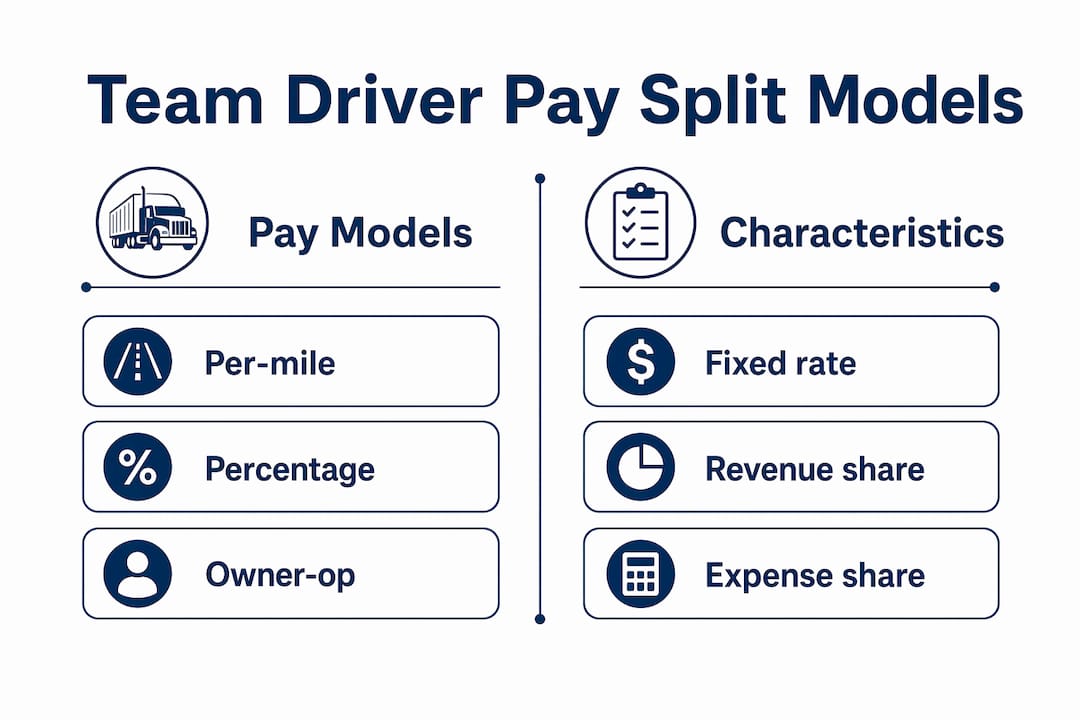
Three primary pay split structures apply to CDL-A team drivers: per-mile pay, percentage-of-revenue splits, and owner-operator style splits after expenses. Each structure carries different risk and reward levels depending on your role in the truck.
Per-mile pay split
Per-mile pay is the most straightforward model. The carrier assigns a cents-per-mile (CPM) rate, and both drivers receive pay based on total team miles. A team that runs 5,000 miles in a week at $0.50 CPM per driver each earns $2,500 for that week. The key word is "per driver." Some postings list a combined truck CPM that gets divided, which cuts that number in half. Always confirm whether the quoted rate is per driver or per truck before accepting an offer.
Percentage-of-revenue split
Percentage splits work differently. The carrier pays the team a share of gross load revenue, typically 60–70% to the team, and the two drivers divide that portion equally. On an $8,000 gross week with a 65% team share, the team receives $5,200 total. Each driver takes home $2,600. This model ties your pay directly to load revenue, so high-value freight weeks pay more.
Owner-operator expense-sharing split
Owner-operator partnerships add a layer of complexity. The truck owner typically keeps 60–70% of earnings, with the non-owner driver receiving 30–40% or a flat per-mile rate. The non-owner driver commonly earns $0.45–$0.65 per mile. The reason for this gap is simple: the owner carries fuel, maintenance, insurance, and truck payment costs. The split reflects financial responsibility, not just driving time.
Comparison of the three models
| Model | How pay is calculated | Who benefits most | Key risk |
|---|---|---|---|
| Per-mile (CPM) | Fixed rate × total team miles | Drivers on high-mileage runs | CPM may be per truck, not per driver |
| Percentage of revenue | % of gross load revenue ÷ 2 | Drivers hauling premium freight | Low-revenue weeks cut pay sharply |
| Owner-operator split | Net profit after expenses ÷ agreed ratio | Truck owner with low overhead | Non-owner driver absorbs owner's cost risk |
How is pay calculated and divided in practice?
Most carriers credit all team miles to each driver for payroll purposes, regardless of who drove which shift. This means a driver who slept through half the run still receives pay based on the full team mileage. Individual shift hours rarely affect the split unless the contract explicitly states otherwise.
This matters because it changes how you think about fairness in a team arrangement. The split is based on the truck's movement, not your personal effort behind the wheel. Team driver pay is almost always tied to total miles covered by the truck, not individual shift hours.
Real job postings make this concrete. An XPO dedicated team driver posting listed $0.974 per mile split evenly, giving each driver $0.487 per mile on total team miles. That posting removes ambiguity by stating the split explicitly. Not all postings do this, which is why you need to ask directly.
Hot loads change the math. Hot load pay typically runs $0.80–$1.00 per mile split between two drivers, compared to $0.60–$0.80 per mile on standard team runs. That premium reflects urgency and time-sensitive delivery requirements. Teams that specialize in expedited freight can earn meaningfully more per week than those on standard dedicated lanes.
- Standard team CPM (per driver): $0.25–$0.40
- Hot load CPM (per driver): $0.40–$0.50
- Percentage split example: 65% of $8,000 gross = $2,600 per driver
- XPO example: $0.974 truck CPM = $0.487 per driver
Pro Tip: Ask every carrier two questions before accepting a team offer: "Is this CPM per driver or per truck?" and "Does individual shift mileage affect my pay?" The answers will tell you exactly what you will earn.
What factors influence the distribution of pay within a team?
Pay split depends heavily on truck ownership and administrative responsibilities. Two drivers running the same miles can take home very different amounts based on who owns the truck and who handles dispatch, fuel management, and paperwork.
Truck ownership is the largest variable. A company driver arrangement means the carrier absorbs equipment costs, and both drivers split earnings on equal footing. An owner-operator arrangement means the truck owner deducts fuel, maintenance, insurance, and loan payments before splitting what remains. Expenses like fuel, maintenance, and truck payments significantly impact net pay, and splits based on profit after expenses can differ greatly from gross splits.
Role-based responsibilities also shift the balance. If one driver handles dispatch calls, load planning, or customer communication, that driver may negotiate a larger share. This is not standard practice at large carriers, but it is common in independent owner-operator partnerships. Document any role-based pay adjustments in writing before the first load.
Clear partnership agreements prevent disputes. Cover these points before you start:
- Who owns the truck, and what are the monthly fixed costs?
- Is the split based on gross revenue or net profit after expenses?
- How are fuel surcharges and accessorial pay handled?
- What happens if one driver misses time due to illness or a violation?
- How is the split adjusted if one driver takes on dispatch or admin duties?
Pro Tip: Get a full expense breakdown from any owner-operator partner before agreeing to a percentage split. A 50/50 gross split on a truck with high overhead can pay less than a 35% share on a well-maintained, low-cost rig.
What are the typical pay levels and earning potential for team drivers in 2026?
Company team drivers in 2026 earn $0.25–$0.40 CPM per driver depending on experience and carrier. Entry-level team drivers start at $0.25–$0.30 CPM. Experienced drivers with strong safety records reach $0.40 CPM or more. At high mileage weeks, those rates translate to strong annual income.
Annual earnings for company team drivers range from $65,000 to $104,000 per driver. Owner-operator team operations reach a different level entirely. Owner-operator team drivers can gross $175,000–$200,000 annually before taxes and expenses. One example shows gross revenue of $13,520 per week at $2.60 per mile, with net after expenses of roughly $7,679 per week split between both drivers.
For drivers considering team driving as a career path, the practical tips for team drivers at FedEx-contracted service providers offer useful context on what carriers expect and how pay is structured in those specific operations.
| Driver type | CPM range (per driver) | Weekly estimate | Annual estimate |
|---|---|---|---|
| Entry-level company team | $0.25–$0.30 | $1,250–$1,500 | $65,000–$78,000 |
| Experienced company team | $0.35–$0.40 | $1,750–$2,000 | $91,000–$104,000 |
| Hot load / expedited team | $0.40–$0.50 | $2,000–$2,500 | $104,000–$130,000 |
| Owner-operator team (net) | Varies | ~$3,840 net each | $175,000–$200,000 gross |
Expedited and hot load freight consistently pays more per mile. Teams willing to run time-sensitive loads on short notice access the top of the pay range. The trade-off is less predictable scheduling and higher pressure on delivery windows.
Key Takeaways
Team driver pay split is almost always based on total truck miles, not individual shift effort, making the agreed CPM rate and split model the most critical terms to clarify before accepting any team driving position.
| Point | Details |
|---|---|
| Three core split models | Per-mile, percentage-of-revenue, and owner-operator expense splits each produce different take-home amounts. |
| CPM clarity is critical | Always confirm whether a quoted CPM rate applies per driver or per truck before signing. |
| Expenses change net pay | Owner-operator splits based on profit after expenses can differ sharply from gross revenue splits. |
| Hot loads pay more | Expedited freight typically raises per-driver CPM above standard dedicated lane rates. |
| Document agreements | Written partnership terms covering expenses, roles, and contingencies prevent pay disputes. |
What I've learned about reading team pay offers correctly
Most drivers focus on the CPM number in a job posting and stop there. That is the wrong place to stop. A single quoted team CPM can represent the total truck rate or the per-driver rate, and that difference doubles or halves your actual income. I have seen experienced drivers accept offers assuming a per-driver rate, then discover on their first settlement that the number was for the truck. That mistake costs real money.
The second thing most drivers miss is the expense side of owner-operator splits. Gross revenue looks impressive. Net after fuel, insurance, maintenance, and a truck payment looks very different. Before agreeing to any percentage split with an owner-operator partner, ask for three months of actual settlement sheets. Real numbers tell you more than any verbal agreement.
The third issue is the lack of written contingency terms. What happens if your co-driver gets a ticket and loses their CDL for 90 days? What if one driver wants to exit the partnership? These scenarios are not rare, and teams that handle them without written terms usually end up in disputes. A one-page written agreement covering these points takes 30 minutes to draft and prevents months of conflict.
The drivers who earn the most in team operations are not always the ones with the highest CPM. They are the ones who understand exactly what they agreed to, verified the numbers before the first load, and chose partners whose financial situation matched their own expectations.
— Aaron
Finding team driving opportunities through Ucep
Ucep is a job board and recruiting platform built exclusively for Service Providers contracted with FedEx. It connects CDL-A team drivers with verified employers posting linehaul and team driving positions nationwide.
Before committing to a team driving arrangement, reading service provider reviews on Ucep gives you direct insight into how specific companies handle pay, settlements, and driver relations. You can also browse the Ucep network to find service providers actively hiring CDL-A team drivers. If you are ready to compare specific companies, the companies hiring drivers page lists current openings with pay details so you can evaluate split structures before applying.
FAQ
What is the most common team driver pay split?
The most common split is a 50/50 division of per-mile pay based on total team miles. Most carriers credit all team miles to each driver equally, regardless of individual shift time.
Is the CPM rate in a team driving job posting per driver or per truck?
It varies by carrier. Some postings list a per-driver rate, while others list a combined truck rate that gets divided. Always ask the recruiter to confirm which applies before accepting an offer.
How does truck ownership affect team driver pay distribution?
The truck owner typically retains 60–70% of earnings to cover expenses like fuel, insurance, and loan payments. The non-owner driver receives 30–40% or a flat per-mile rate, commonly $0.45–$0.65 CPM.
Do hot loads pay more in a team split arrangement?
Yes. Hot load and expedited freight typically pays $0.80–$1.00 per mile split between two drivers, compared to $0.60–$0.80 per mile on standard team runs.
How much can an experienced team driver earn annually in 2026?
Experienced company team drivers earn $91,000–$104,000 per year per driver. Owner-operator team operations can gross $175,000–$200,000 annually before expenses, with net take-home depending on overhead costs.