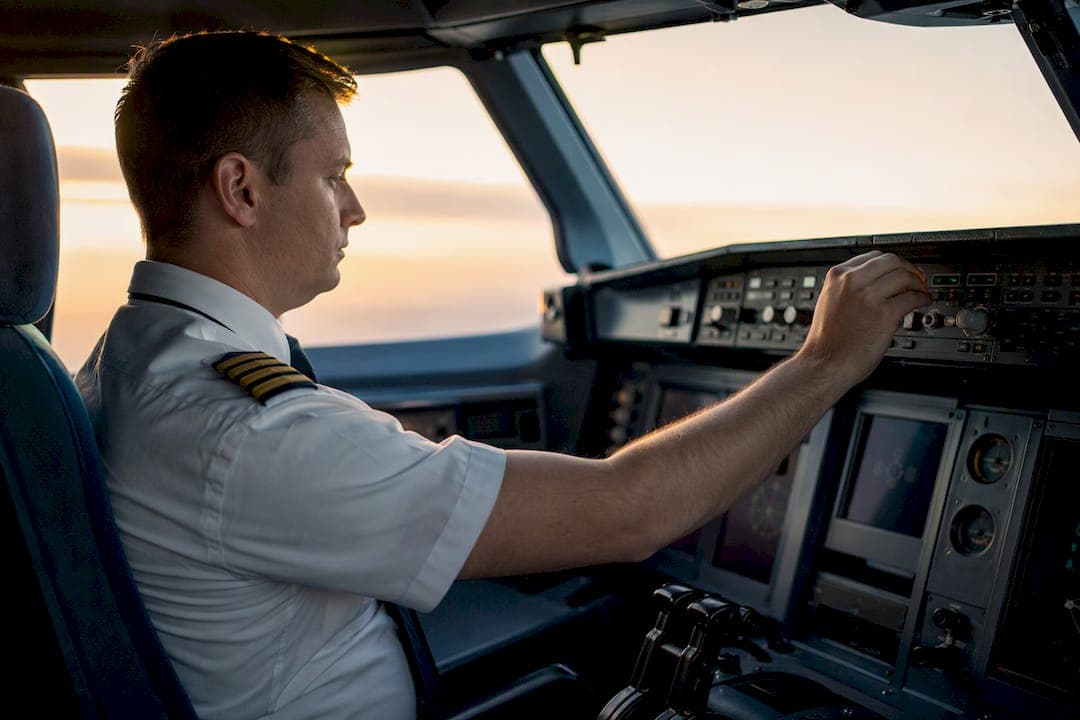
A first officer is the second-in-command pilot on a flight crew, sharing operational control with the captain and legally qualified to assume command if the captain becomes incapacitated. First officers alternate between two working roles on every leg: Pilot Flying (PF), who physically operates the aircraft, and Pilot Monitoring (PM), who handles communications, checklists, and systems oversight). These duties rotate, often leg by leg, so the same pilot is not always at the controls.
A few quick facts frame the role before you go further:
- Minimum flight-deck crew on most airliners is two pilots: a captain and a first officer.
- On fixed-wing aircraft, the first officer typically sits in the right seat.
- The FO is not a backup presence. Airlines and regulators treat the position as an active safety check on every decision made in the cockpit.
Key Takeaways
Becoming a first officer requires an ATP-level certification, roughly 1,500 hours of flight time, and multi-crew training, followed by a career path where seniority often matters as much as rank.
| Point | Details |
|---|---|
| Definition matters | A first officer is second-in-command, sharing PF/PM duties and assuming command if the captain is incapacitated. |
| Certification path | PPL, IR, CPL, multi-engine rating, and an ATP or frozen ATP typically precede airline hiring. |
| Hour minimums vary | Many airlines cite around 1,500 hours as a hiring benchmark, though preferred hours often run higher. |
| Seniority shapes career | Base, schedule, and layoff protection often depend more on seniority than on total flight hours. |
| Safety role is active | CRM makes first officers responsible for challenging unsafe decisions, not just following orders. |
Table of Contents
- What Does a First Officer Do During a Flight?
- How Do Pilot Flying and Pilot Monitoring Roles Work in the Cockpit?
- What Licenses and Certifications Does a First Officer Need?
- How Do You Become a First Officer?
- How Do First Officers Progress to Captain, and What Do They Earn?
- What Does a First Officer's Daily Schedule Look Like?
- Is a First Officer Just a Trainee? Debunking Common Myths
- What Do Experienced Pilots Say About the First Officer Role?
- Why This Career Deserves More Respect Than It Gets
- Frequently Asked Questions
- Sources
What Does a First Officer Do During a Flight?
First officer responsibilities span three distinct phases of every trip, and the workload does not let up once the wheels leave the ground.
During preflight, the first officer reviews weather reports and NOTAMs, verifies performance calculations, and cross-checks fuel and load figures with the captain. This is not a rubber-stamp exercise. Errors caught here prevent problems in the air.
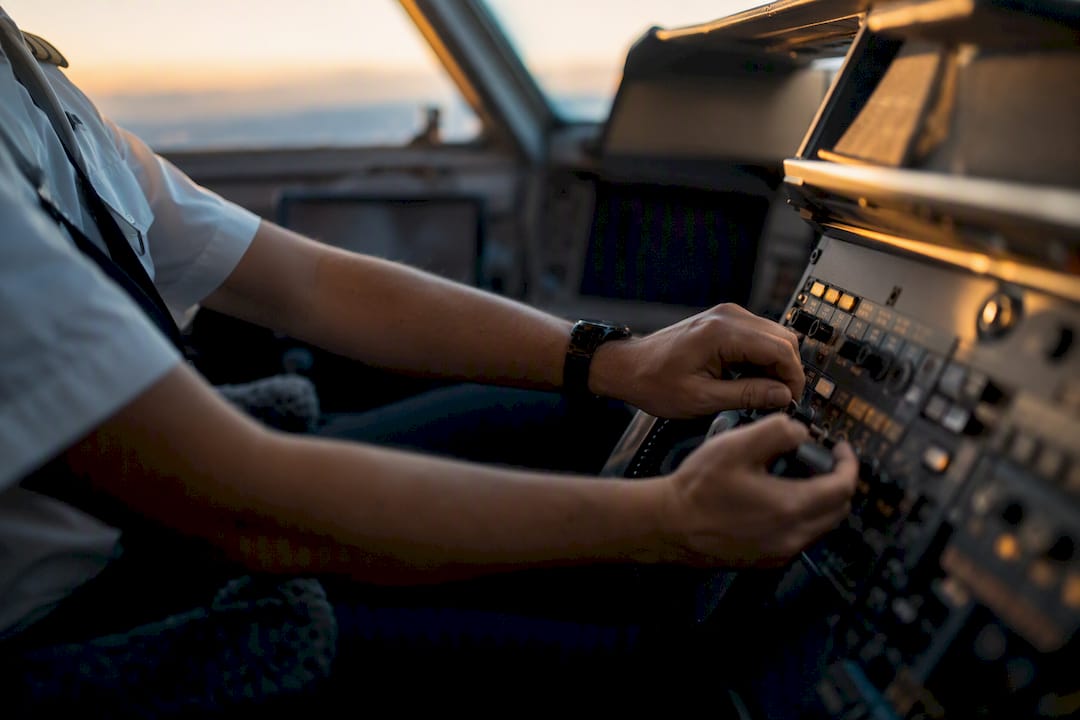
In flight, the FO's exact tasks depend on whether they are flying that leg. As Pilot Flying, they handle the controls while the captain monitors and communicates. As Pilot Monitoring, the first officer runs radio calls with air traffic control, works through checklists, and watches aircraft systems for anything abnormal. Both pilots stay engaged regardless of who has the controls, and routine FO duties include safety checks and assisting with navigation on every sector.
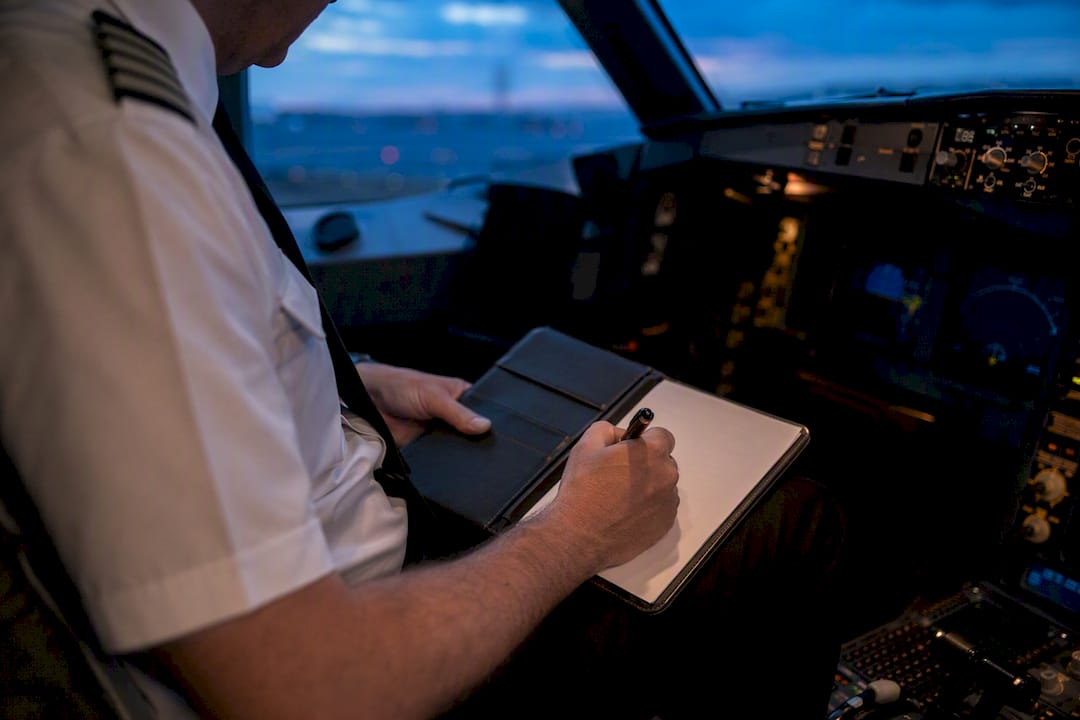
Postflight brings paperwork: flight logs, defect write-ups, maintenance reporting, and handover briefings for the next crew. This administrative load rarely gets discussed outside the industry, but it directly affects whether the aircraft turns around on schedule.
Pro Tip: If you're evaluating airlines during a job search, ask about turnaround times at their hub stations. Carriers with tight ground schedules often lean harder on first officers to clear paperwork fast, which tells you something about daily pace before you sign on.
Some responsibilities stay with the captain alone. Final go/no-go decisions, overall command authority, and legal accountability for the flight rest with the captain even when the first officer is flying the aircraft.
How Do Pilot Flying and Pilot Monitoring Roles Work in the Cockpit?
Control of the aircraft is shared, not split by rank. One pilot is designated Pilot Flying and the other Pilot Monitoring for a given leg, and these roles typically swap on the next sector, so a first officer might fly the outbound leg and monitor on the return.
Seating stays consistent regardless of who is flying. The captain occupies the left seat and the first officer the right seat on virtually all fixed-wing airliners, a convention tied to instrument placement and control layout rather than authority.
A few operational details matter here:
- First officers often log PICUS (Pilot In Command Under Supervision) time, which counts toward the experience airlines want to see before an upgrade to captain.
- Command authority does not shift just because the FO is flying. The captain retains ultimate responsibility unless legally incapacitated.
- On long-haul flights, airlines often schedule relief crews with an extra captain and first officer, allowing rest breaks during multi-leg or ultra-long-range trips. A senior first officer may occupy the left seat while the primary captain rests.
What Licenses and Certifications Does a First Officer Need?
Airlines hire first officers against a fairly consistent set of credentials, even though exact minimums vary by carrier and country.
The foundational path runs through a private pilot certificate, an instrument rating, a commercial pilot certificate, and a multi-engine rating. Most airline first officer roles then require an Airline Transport Pilot (ATP) certificate or a frozen ATP equivalent, depending on jurisdiction. Formal apprenticeship standards reinforce this: first officers must complete multi-crew cooperation and type conversion training before they're cleared for line operations, on top of complying with ICAO standards and their company's own operations manual.
Medical certification is non-negotiable. Major carriers generally require a first-class medical certificate, renewed on a recurring schedule. Add to that the administrative basics: a valid passport, right-to-work documentation, and often a background check tied to security clearance for airport access.
Hiring benchmark: United Airlines lists an ATP or equivalent, a first-class medical certificate, and total flight time minimums that commonly land around 1,500 hours for new-hire first officers, alongside other administrative prerequisites.
That 1,500-hour figure shows up repeatedly across the industry, but treat it as a floor, not a target. Regional carriers sometimes hire closer to that minimum during high-demand cycles, while major carriers often prefer candidates well above it. A few things to keep in mind:
- Minimums are set by regulation and by each airline's own hiring policy, and the two don't always match.
- "Preferred" hours on a job posting usually run higher than the legal minimum, sometimes by a wide margin.
- Multi-engine and turbine time carry more weight than single-engine hours when airlines screen applications.
How Do You Become a First Officer?
Getting from zero flight time to a first officer job description that actually gets you hired follows a fairly linear sequence, even though the paths that fill each step vary widely.
- Start with foundational training. Earn your private pilot license (PPL), then add an instrument rating (IR) and a commercial pilot certificate (CPL). Some candidates route through a Multi-Crew Pilot License (MPL) instead, which is built specifically for airline careers from day one.
- Add a multi-engine rating. Nearly every airline first officer job requires multi-engine (ME) experience, and recency matters. Gaps of more than a few months can trigger a checkride before hiring.
- Build flight hours. Flight instructing is the most common route, followed by charter flying, aerial survey work, or banner towing. Regional airline cadet and pipeline programs have also become a faster on-ramp in recent years.
- Complete type conversion and multi-crew training. Before line operations, airlines run new hires through simulator-based type training and multi-crew cooperation courses, exactly the kind of regulated training apprenticeship standards formalize.
- Apply and interview. Airline hiring typically includes a technical knowledge exam, a panel or behavioral interview, and a simulator assessment that tests both flying skill and how you communicate under pressure.
- Complete line training. New first officers fly supervised trips with a training captain before operating fully on their own.
Pro Tip: Recruiters notice recent multi-engine currency and consistent flight activity more than raw total hours. A candidate with 1,600 hours flown steadily over two years often reads better than one with 2,200 hours logged five years ago.
How Do First Officers Progress to Captain, and What Do They Earn?
The typical ladder runs from junior first officer to first officer, then senior first officer, and eventually an upgrade to captain. Airlines generally define a senior first officer as someone with roughly 1,500 hours or more of experience, though the exact threshold and title vary by carrier.
Seniority systems shape far more than pay. They influence which routes and bases a pilot gets, how much schedule flexibility they have, and who faces furlough risk first during downturns. That's a major reason some experienced first officers choose to stay in the role rather than upgrade immediately. The lifestyle tradeoffs of higher seniority as an FO can outweigh a captain's higher pay, at least for a while.
Captains hold final decision-making authority and typically earn more than first officers at the same carrier, but the gap and the pay itself vary enormously by airline size and route network.
| Career Stage | Typical Trigger to Advance |
|---|---|
| Junior first officer | Completes initial line training and probation period |
| First officer | Builds hours and maintains recurrent training and checks |
| Senior first officer | Reaches airline's seniority threshold, often near 1,500 hours |
| Captain upgrade | Passes command course, simulator checks, and leadership assessment |
Upgrade speed depends on airline growth, fleet size, and how many captains retire or move up in a given year, not just an individual pilot's hours.
- Command courses test decision-making under pressure, not just stick-and-rudder skill.
- Base and aircraft type both affect how fast a bid list moves.
- Some pilots deliberately bid to stay senior FO on a preferred aircraft rather than upgrade to captain on a less desirable one.
What Does a First Officer's Daily Schedule Look Like?
Duty days vary enormously by airline type. A regional first officer might fly four or five legs in a single duty period, while a long-haul FO might work one or two extended sectors with a scheduled rest break built in.
Roster patterns rarely follow a normal workweek. Layovers, early report times, and irregular days off are standard, and they shape family life and social planning more than most outside the industry realize.
Ground duties fill the gaps between flights: debriefs with the captain, log entries, defect reporting, and briefings for the incoming crew. Rest and duty-time rules limit how long a crew can fly without a break, though the practical experience of that limit differs by airline scheduling culture.
- Base assignment often determines commuting distance more than home address does.
- Many first officers commute by air to their base, adding hours to an already irregular day.
- Building a personal routine around unpredictable schedules is one of the most underrated skills in the job.
Pro Tip: Ask airline recruiters about typical layover length at your prospective base before you accept an offer. A 10-hour layover reads very differently on paper than it does after a 6 AM report time the next day.
Is a First Officer Just a Trainee? Debunking Common Myths
The idea that a first officer is a trainee waiting to become a "real" pilot is one of the most persistent misconceptions in aviation, and it's flatly wrong. First officers are fully licensed, fully qualified pilots who regularly fly the aircraft as Pilot Flying.
Crew Resource Management (CRM) gives the first officer an active, professional obligation to monitor and challenge any decision that threatens safety, including the captain's. Staying silent when something looks wrong is treated as a serious professional failure, not deference.
- FOs assume full command authority if the captain is incapacitated.
- CRM training exists specifically so rank never overrides safety judgment.
- The "co-pilot as backup" framing undersells a role built on shared, active responsibility.
What Do Experienced Pilots Say About the First Officer Role?
Plenty of pilots treat the first officer seat as a professional destination, not a waiting room. The technical demands don't shrink once someone becomes eligible for a captain upgrade, and many experienced FOs stay in the role by choice.
"First officer" implies second string to people outside the industry. Inside it, the job means active command readiness on every leg, with the training and CRM habits to back it up.
Moving to captain requires more than flight hours. Airlines look for demonstrated leadership and command-level decision-making, and upgrade processes are selective and airline-specific rather than automatic.
- Communication skill and CRM fluency weigh heavily in command course evaluations.
- Seniority, not just competence, often decides how quickly an upgrade opportunity appears.
- Choosing to remain a senior FO is frequently a lifestyle decision tied to base, schedule, or aircraft type, not a career plateau.
Why This Career Deserves More Respect Than It Gets
Most career guides treat the first officer seat as a stopover on the way to command. That framing misses something the data backs up: seniority, not rank, drives quality of life for a huge share of working pilots. A senior FO on a preferred aircraft type often has better schedule control than a junior captain starting over on seniority at a new base.
If you're weighing an upgrade offer, don't treat "captain" as the only measure of a successful career. Ask what you'd give up in base, route, and schedule stability first.
Frequently Asked Questions
What is the difference between a captain and a first officer? The captain holds final command authority and legal responsibility for the flight, while the first officer shares flying duties and typically earns less at the same carrier. Both are fully licensed pilots capable of flying the aircraft.
How many flight hours do you need to become a first officer? Requirements vary by airline and country, but many carriers set a benchmark near 1,500 total flight hours, alongside an ATP certificate and first-class medical.
Can a first officer become a captain? Yes. Progression typically runs through senior first officer status, followed by a command course and simulator assessment before an airline approves the upgrade.
Does a first officer actually fly the plane? Yes. First officers alternate as Pilot Flying and Pilot Monitoring, often swapping roles leg by leg, so they operate the controls on a large share of flights.
What qualifications does a first officer need? A private pilot certificate, instrument rating, commercial pilot certificate, multi-engine rating, and an ATP or equivalent, plus a first-class medical certificate for most major carriers.
Sources
- First officer pilot / Skills England
- How Do The Roles Of Captain & First Officer Differ?
- First Officer | United Airlines