
Contract drivers prefer flexible schedules for two core reasons: economic autonomy and real-time adaptability. Research consistently shows that flexibility functions as part of total compensation, not just a scheduling perk. Workers require a measurable premium to accept unpredictable or fixed hours, meaning schedule control has direct dollar value. For FedEx-contracted drivers, this plays out daily across pickup and delivery windows, linehaul blocks, and CDL-A runs.
The two primary drivers, backed by U.S. labor research from NBER, NIOSH, and IPSOS:
- Proactive economic autonomy: Choosing when to work to maximize earnings, manage secondary income, or align hours with personal priorities.
- Reactive adaptability: Adjusting schedules in real time to handle caregiving, health events, education, or sudden income gaps.
Ucep is the job board built exclusively for FedEx-contracted roles, where you can search listings filtered by role type, terminal, and schedule structure.
Table of Contents
- Why contract drivers prefer flexible schedules over fixed shifts
- What are the real trade-offs of schedule flexibility?
- What does flexibility look like in actual FedEx-contracted roles?
- How to evaluate a FedEx-contracted job's real flexibility
- How can you manage a flexible schedule without burning out?
- Where can you find flexible FedEx-contracted driver opportunities?
- Key Takeaways
- What most guides get wrong about flexible driving schedules
- Ucep connects you to flexible FedEx-contracted roles nationwide
- Useful sources and further reading
Why contract drivers prefer flexible schedules over fixed shifts
Independent contractors report the highest percentages for every flexibility indicator compared to all other work arrangements, including on-call, temporary, and standard employees. That gap matters because flexibility directly affects earnings strategy, not just convenience.
Economic autonomy in practice:
- Control over start and stop times lets you time your hours to higher-demand windows.
- No minimum-hours requirements mean you can scale up during financial pressure and scale back when other obligations take priority.
- Drivers generate a large surplus from real-time schedule control, roughly 40 percent of total expected pay, or more than $150 per week, according to NBER research on flexible driver labor supply.
Reactive adaptability in practice:
- A caregiver can stop mid-week without penalty and resume when coverage is arranged.
- A student can cluster shifts around class schedules rather than forcing a fixed-shift pattern.
- A driver rebuilding after a financial setback can ramp up hours quickly without renegotiating a contract.
Research from IPSOS confirms these two primary motivations drive workers to choose flexible arrangements: proactive autonomy and reactive adaptability to life shocks. Flexibility also broadens participation among caregivers, students, and workers managing chronic conditions.
Pro Tip: If you are using driving to supplement another income source, track your realized earnings per hour each week. That number tells you which windows are worth your time and which are not.
What are the real trade-offs of schedule flexibility?
Flexible schedules carry genuine costs. Understanding them helps you decide whether a given role actually fits your financial and personal situation.
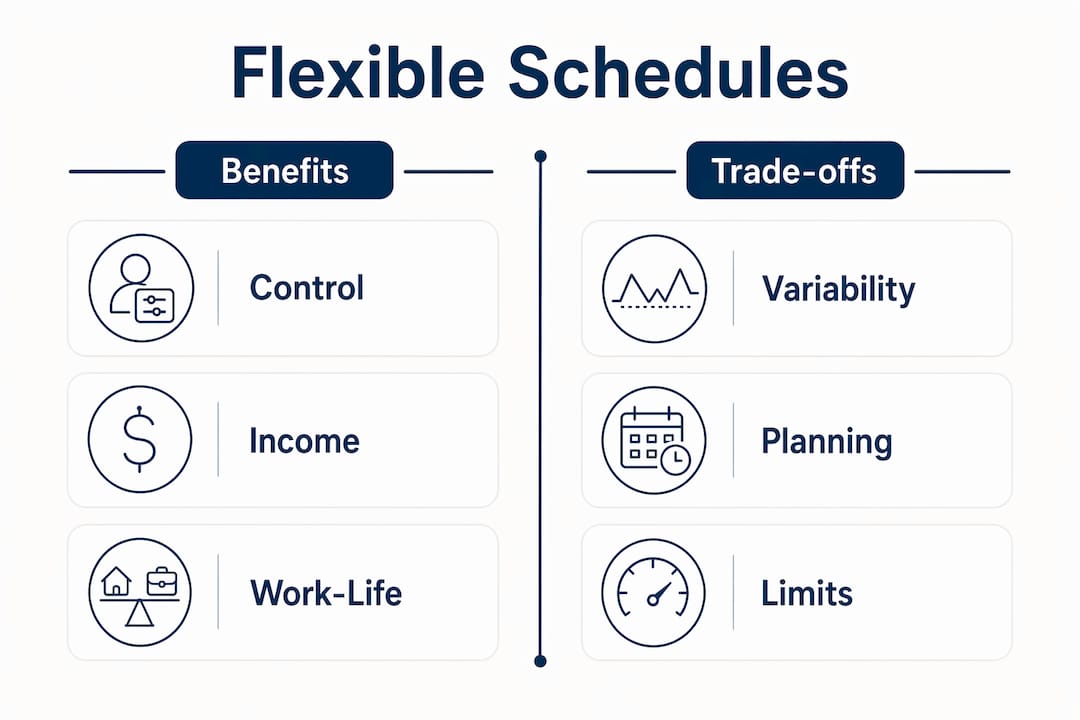
- Income variability: Piecework and per-stop pay models mean your weekly earnings fluctuate with volume, weather, and demand cycles. Guaranteed-hours contracts reduce this risk but may limit how much you can scale.
- Boundary blurring: Flexible arrangements can increase role blurring without clear personal boundaries, a pattern researchers call "job creep." Work expands into personal time when there is no firm log-off point.
- Terminal and operational constraints: On-call expectations, last-minute route reassignments, and terminal-specific swap rules can limit how much real-time control you actually have, regardless of what a job posting says.
- Benefits trade-offs: Workers who value flexibility often resist protections that require fixed hours, even when those protections include paid time off or minimum earnings guarantees. Protections must be designed to preserve open start/stop control to be worth accepting.
Pro Tip: Set a firm weekly minimum earnings target before you accept any flexible role. That number becomes your floor, and it prevents you from treating every slow week as a reason to overwork the next one.
What does flexibility look like in actual FedEx-contracted roles?
Flexibility is not uniform across FedEx-contracted work. Each role type offers a different form of schedule control.
Common schedule structures:
- Pickup and delivery (P&D): Window-based work with some start-time flexibility. Daily routines vary by terminal and volume, but drivers often have control over route pacing within the window.
- Linehaul: Block-based shifts, typically longer and more structured. Linehaul scheduling offers predictability but less day-to-day start-time control.
- CDL-A solo: More autonomy over pacing and rest decisions within federal hours-of-service rules.
- CDL-A team runs: Two drivers share a truck continuously. Schedule flexibility is shared, not individual.
- Floater/on-call: Maximum availability flexibility for the driver, but the least predictable income.
- Guaranteed-hours contracts: Reduce income variability but may cap your ability to scale up or down.
Signs of real flexibility in a listing or terminal:
- Swap rules that allow shift trades without penalty.
- Short notice periods (24–48 hours) for schedule changes.
- App or phone-based dispatch that lets you accept or decline runs in real time.
- No punitive structure for declining occasional assignments.
NBER research documents clusters of driver schedules across morning, evening, late-night, and weekend patterns, confirming that experienced drivers actively use flexible structures to build schedules that fit their lives.
How to evaluate a FedEx-contracted job's real flexibility

Job postings often claim flexibility without defining it. Use this checklist before you apply or accept an offer.
Checklist items to confirm:
- What is the guaranteed minimum hours or pay per week?
- What is the notice period required to change or skip a shift?
- Are shift swaps allowed, and is there a penalty for using them?
- Who controls route assignments: you, dispatch, or an algorithm?
- Is overtime or premium pay available, and how is it triggered?
- What happens if you miss a delivery window? Is there a financial penalty?
- Does the terminal use an app or phone-based system for real-time run acceptance?
- What do driver reviews say about actual day-to-day schedule control?
Use Ucep's service provider reviews to verify what drivers at a specific terminal actually experience. A listing that claims flexibility but has reviews describing mandatory overtime or no-swap policies is a red flag.
Red flags that "flexibility" may be marketing language:
- No guaranteed minimum with unpredictable weekly volume.
- Penalty clauses for declining runs above a low threshold.
- Reviews mentioning last-minute mandatory reassignments with no opt-out.
- No clear swap or schedule-change policy in the offer.
Pro Tip: Ask dispatch or service provider HR directly: "What is the process if I need to skip a shift with 24 hours' notice?" The specificity of the answer tells you more than any job description.
How can you manage a flexible schedule without burning out?
Flexibility requires self-discipline to stay productive and healthy. Without structure, the benefits of schedule control erode quickly.
- Set a weekly earnings floor and a block plan. Decide your minimum acceptable weekly income before you start. Then build a loose but consistent block schedule within your flexibility. This prevents both underwork and overwork.
- Batch similar shifts. Group morning runs together, or cluster your high-volume days. Consistent rhythm reduces decision fatigue.
- Track earnings per hour, not just total pay. Knowing which windows pay best helps you work smarter rather than longer. A simple spreadsheet or notes app is enough.
- Set firm log-off triggers. Decide in advance what ends your workday: a specific hour, a stop count, or an earnings target. Without a trigger, flexible schedules expand indefinitely.
- Schedule non-negotiable recovery time. Rest is not optional. Drivers managing mental health and home time report that unplanned rest days are less restorative than scheduled ones.
Pro Tip: Experienced drivers reduce income variability by combining a predictable block schedule with flexible fill-in windows. The block covers your minimum; the fill-in windows capture upside when demand is high.
Where can you find flexible FedEx-contracted driver opportunities?
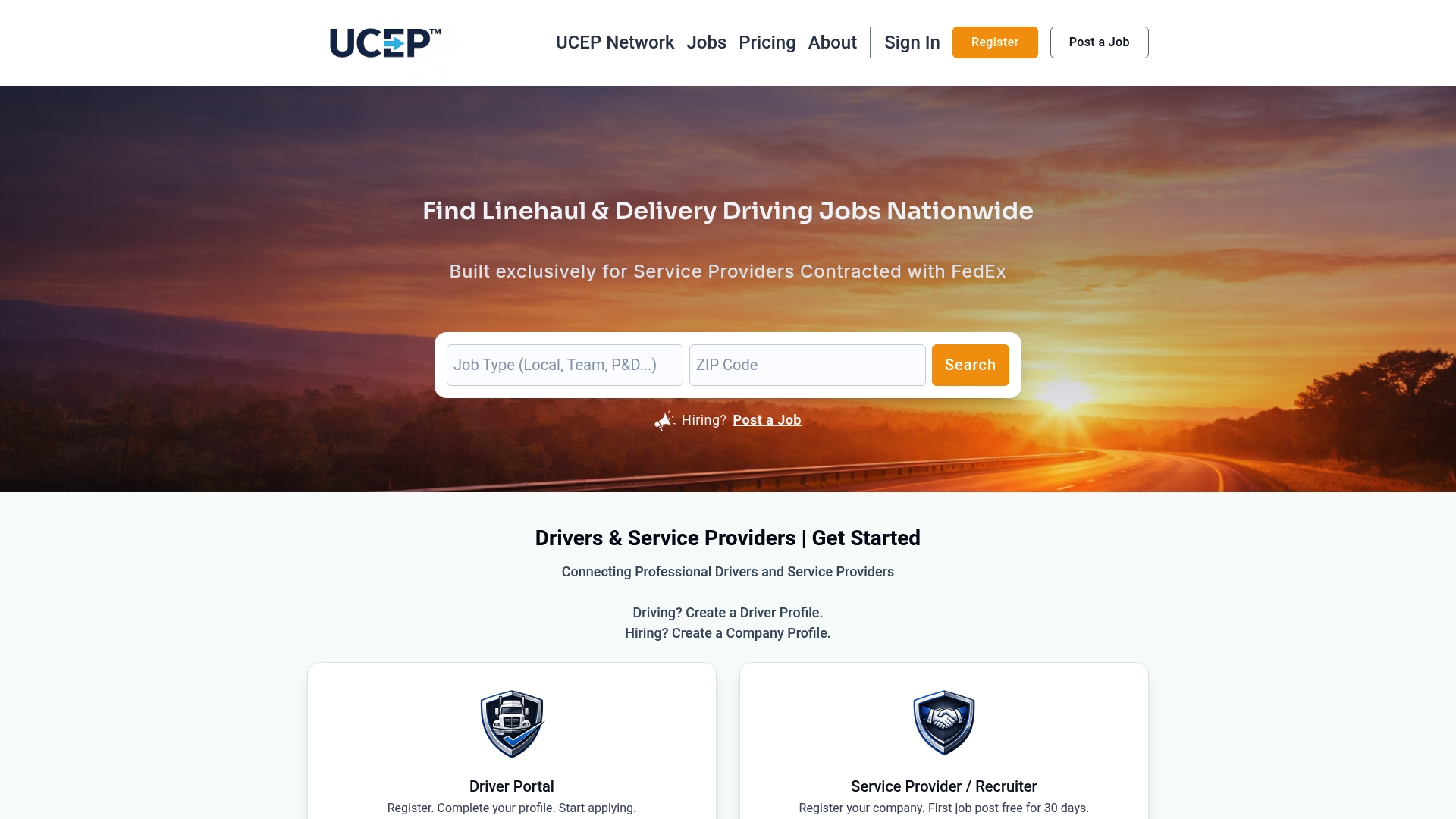
Ucep is the most direct channel for finding FedEx-contracted roles filtered by schedule type, terminal, and role category.
How to use Ucep effectively:
- Go to companies hiring drivers and filter by role type: P&D, linehaul, CDL-A solo, or CDL-A team.
- Review terminal directories to identify service providers in your area.
- Read employer and terminal reviews before applying to verify real schedule conditions.
- Set up targeted driver alerts so new listings matching your criteria reach you immediately.
What to look for in job posts:
- Explicit mention of guaranteed minimums or flexible window structures.
- Role type that matches your preferred schedule pattern (block vs. window vs. on-call).
- Terminal location and size, which affects how much schedule flexibility is operationally feasible.
Pro Tip: Filter for terminals with multiple recent reviews, not just a high average rating. Volume of reviews indicates an active driver community and gives you more reliable signal about real working conditions.
Key Takeaways
Contract drivers who understand both the value and the limits of flexible schedules are better positioned to choose roles that match their financial needs and personal commitments.
| Point | Details |
|---|---|
| Flexibility has dollar value | NBER research shows schedule control generates roughly 40% of total expected pay for flexible drivers. |
| Two core motivations | Economic autonomy and real-time adaptability drive why drivers choose contract work over fixed shifts. |
| Trade-offs are real | Income variability, boundary blurring, and terminal constraints can undercut flexibility if not evaluated carefully. |
| Use the checklist | Confirm guaranteed minimums, swap rules, notice periods, and penalty structures before accepting any role. |
| Ucep simplifies the search | Use Ucep's filters, terminal directories, and service provider reviews to verify real flexibility before applying. |
What most guides get wrong about flexible driving schedules
Most articles treat schedule flexibility as a simple benefit, something you either have or you don't. The reality for FedEx-contracted drivers is more specific. Flexibility is a form of compensation with a measurable value, and it comes with operational constraints that vary by terminal, role type, and service provider.
The drivers who get the most out of flexible arrangements are not the ones who work whenever they feel like it. They are the ones who treat their schedule like a business tool: set minimums, track performance, and use real-time control deliberately rather than reactively. The research on flexible working arrangements confirms that outcomes improve when drivers have both schedule control and clear personal boundaries, not just one or the other.
Ucep's terminal directories and employer reviews exist precisely because job postings rarely tell the full story. Reading what drivers at a specific terminal actually report is the fastest way to separate genuine flexibility from a marketing claim.
Ucep connects you to flexible FedEx-contracted roles nationwide
Ucep is the only job board built exclusively for FedEx-contracted driving opportunities. You get filtered search by role type, terminal, and schedule structure, plus employer directories and verified driver reviews that show you what working conditions actually look like before you apply.
Drivers looking for P&D windows, linehaul blocks, CDL-A solo runs, or on-call positions can search the full listing database, set up targeted alerts, and review service providers in the Ucep network to find roles that match their schedule needs. Start your search at ucep.co and use the filters to narrow by role type and terminal location.
Useful sources and further reading
Use these sources to verify claims, compare terminal conditions, and research the evidence behind flexible scheduling.
- The Value of Flexible Work: Evidence from Uber Drivers — NBER working paper on driver surplus and real-time schedule control.
- NIOSH Science Bulletin: Work Flexibility and Worker Well-Being — CDC/NIOSH data on flexibility indicators across work arrangements.
- IPSOS: Why Flexibility Matters — Qualitative and quantitative research on driver motivations and trade-offs.
- BMC Psychology / Springer: Flexible Working Arrangements Meta-Analysis — Systematic review of FWA outcomes including boundary management and burnout risk.
- NBER Working Paper 27807 — Dynamic labor supply model quantifying drivers' willingness to pay for schedule flexibility.
- Ucep Service Provider Reviews — Driver-submitted reviews of FedEx-contracted terminals and service providers.