
Per diem for truck drivers covers meals and incidental expenses only, never lodging, and it remains available in 2026 at $80 per day for travel inside the continental United States and $86 per day outside it. Owner-operators claim it directly as a Schedule C deduction, subject to an 80% deductible limit for drivers covered by DOT hours-of-service rules. Company drivers cannot deduct it personally; they benefit only when their employer runs a qualifying accountable plan.
TL;DR:
- Only trips requiring an overnight stay away from home qualify for the per diem, with full days at 100% and first/last days at 75%.
- Owner-operators can deduct up to 80% of the per diem as a Schedule C expense, while W-2 drivers benefit only through employer reimbursements under an accountable plan.
- Proper documentation, including trip logs, dispatch records, and payroll matching, is crucial to substantiate per diem claims and avoid IRS penalties.
- The flat 2026 IRS rates are $80 per day for continental US and $86 outside it, with prorating on travel or partial days.
- Fleets must implement written, transparent plans, limit per diem to IRS rates, and perform quarterly audits to prevent unqualified payments from becoming taxable wages.
Table of Contents
- What Are the 2026 IRS Per Diem Rates for Truckers?
- Which Drivers and Trips Actually Qualify?
- How Do You Claim Per Diem and What Records Do You Need?
- How Much Does Per Diem Actually Save You?
- Building a Compliant Fleet Per Diem Program
- How Do You Calculate Per Diem for a Real Trip?
- What Should Drivers Look for in Per Diem Job Postings?
- What Matters Most in All This
- Find FedEx-Related Driving Jobs With Transparent Pay Details
- Where to Verify These Rates and Rules
- Sources
What Are the 2026 IRS Per Diem Rates for Truckers?
The IRS sets a special transportation industry rate specifically because truckers rarely have receipts for every gas-station sandwich or truck-stop dinner. For the period running October 1, 2025 through September 30, 2026, IRS Notice 2025-54 sets the rate at $80 per day for CONUS travel and $86 per day for OCONUS travel (Alaska, Hawaii, and international stops).
That flat rate replaces the need to track every meal receipt, but it only applies fully on days you are away from home overnight for the entire 24-hour period. First and last travel days get prorated.
The 75% Rule: On the first and last day of a trip, you can only claim 75% of the full rate, not the full $80 or $86. Every full day in between counts at 100%.
Most other industries use the GSA's location-based high-low method, which varies by city. Truckers skip that complexity entirely:
- The transportation industry rate is flat nationwide, regardless of where you stop.
- DOT-regulated drivers deduct 80% of the per diem amount, not the general 50% meals limitation that applies to most other taxpayers.
- The rate applies per calendar day away from your tax home, not per meal.
Which Drivers and Trips Actually Qualify?
Not every mile on the odometer qualifies for per diem. The IRS applies a two-part test, detailed in Publication 463, before any deduction is valid.
First, your trip has to require you to be away from your tax home longer than a normal workday, and it has to include sleep or rest away from that home. A regional driver who runs a 500-mile loop and sleeps in their own bed that night does not qualify, even if the drive was exhausting. An OTR driver who takes a 10-hour DOT-mandated break at a truck stop three states away clearly does.
Second, you need a legitimate tax home. That generally means:
- You perform part of your work in the area you claim as home.
- You maintain a residence there and pay for it, creating duplicated living costs while on the road.
- You have not abandoned that home in favor of living permanently in your truck.
Edge cases trip people up constantly. Ride-along family members and non-CDL helpers cannot claim per diem in their own right. Drivers who complete a DOT-qualifying rest period but return home the same calendar day sometimes still qualify, depending on total hours logged. Fleets running mixed local and OTR routes need to track eligibility trip by trip, not driver by driver.
How Do You Claim Per Diem and What Records Do You Need?
Owner-operators and W-2 drivers follow completely different paths, and mixing them up is one of the most common costly mistakes in trucking taxes.
- Owner-operators report per diem as a business expense deduction on Schedule C. You choose per diem or the actual-expense method for meals at the start of the tax year and stick with it consistently for that year.
- W-2 company drivers cannot deduct unreimbursed per diem on their personal return under current tax law. The only way it benefits you is through your employer's accountable plan.
- Fleets and Service Providers must structure that accountable plan correctly: reimbursements have to be tied to substantiated business expenses, employees must return any excess above IRS rates, and the plan needs to exist in writing, as detailed by ATBS's per diem guide.
Documentation makes or breaks any per diem claim under audit. Keep ELD logs, dispatch records, and trip sheets that show departure and return times for every qualifying trip. Payroll documentation should tie each per diem payment to a specific trip ID, not a flat weekly estimate.
Pro Tip: Export your ELD trip data monthly and match it against per diem payments while the details are fresh. Reconstructing six months of trip history during an audit is far harder than filing it as you go.
Retain all of it for at least three years from the date you file, since that is the IRS's standard look back window for most audits.
How Much Does Per Diem Actually Save You?
The dollar impact depends heavily on whether you're self-employed or drawing a W-2, and the gap surprises a lot of drivers who assume per diem works the same way for everyone.
Owner-operators deduct per diem on Schedule C, and that deduction is subject to the 80% rule for DOT-covered drivers rather than the standard 50% meals limitation everyone else uses. That difference alone can be worth hundreds of dollars a year depending on how many nights you're on the road.
W-2 drivers, by contrast, generally cannot deduct unreimbursed per diem on their own return at all. Their only real benefit comes when the carrier pays it through a properly structured accountable plan, which arrives tax-free rather than as taxable wages.
On a 7-day OTR trip (5 full days at 100%, 2 partial days at 75%) using the $80 CONUS rate: an owner-operator's deductible per diem totals $520, and 80% of that ($416) reduces taxable income. A company driver receiving the same $520 as non-taxable employer per diem sees no deduction on their return, but also owes no tax on that amount, since it never counted as income in the first place.
Actual road-expense data backs up why this matters: meals and incidentals are often the largest controllable expense on the road, and drivers who cook in-cab or use fuel-loyalty programs can shrink that gap significantly compared to relying on per diem alone.
Building a Compliant Fleet Per Diem Program
Fleet managers who get per diem wrong usually don't get caught applying the wrong rate. They get caught applying per diem to the wrong drivers or skipping the paperwork that proves eligibility.
- Draft a written accountable plan that spells out eligibility, rates, and the substantiation drivers must provide.
- Cap non-taxable per diem at the IRS rate ($80 CONUS / $86 OCONUS) and automatically route any excess into taxable wages rather than letting it ride as a tax-free bonus.
- Tie every per diem payment to an ELD or dispatch trip record before it hits payroll.
- Audit payroll exports quarterly to confirm local drivers without qualifying overnight rest aren't receiving per diem by default.
The most common trap, according to Bowes & Sullivan's 2026 per diem guide, is blanket application: paying every driver the same per diem regardless of whether their trips actually meet the overnight, away-from-home test. That single error converts tax-advantaged pay into taxable wages and creates payroll tax exposure the fleet didn't know it had. Fleets that already struggle with documentation gaps in hiring tend to see the same weak-substantiation pattern show up in per diem audits.
Pro Tip: Run a quarterly spot-check comparing 10 random per diem payments against ELD trip logs. If even one doesn't match, your payroll export process needs a fix before the IRS finds it for you.
How Do You Calculate Per Diem for a Real Trip?
Here's the formula in plain terms: total per diem equals (full qualifying days × daily rate) plus (partial days × 75% of daily rate).
- Pull your trip data. Convert ELD and dispatch timestamps into a day-by-day breakdown, marking each calendar day as a full day away from home or a partial (first/last) travel day.
- Apply the rate. Using the CONUS rate of $80, a 7-day OTR trip with 5 full days and 2 partial travel days breaks down as shown below.
- Apply the 80% deductible limit if you're an owner-operator filing Schedule C. If you're a W-2 driver receiving employer per diem under an accountable plan, this step doesn't apply. The reimbursement is simply non-taxable up to the IRS rate.
Drivewyze's per diem calculator uses this same full-day-plus-partial-day logic, which makes it a useful gut-check against your own manual math before you file.
What Should Drivers Look for in Per Diem Job Postings?
A job posting that lists per diem without specifying whether it's paid under a written accountable plan is telling you less than it seems to. Ask directly: is the per diem amount capped at the IRS rate, and is it structured to avoid becoming taxable wages? Clear answers protect your paycheck.
For Service Providers writing those postings, spelling out per diem terms upfront cuts down on disputes down the road and helps you set competitive driver compensation that candidates can actually evaluate. Vague pay language is one of the fastest ways to lose a qualified applicant to a competing posting that shows real numbers.
Drivers comparing offers should also weigh how per diem interacts with team driver pay splits, since reimbursement structures sometimes differ between solo and team assignments.
What Matters Most in All This
The rate numbers get all the attention, but they're the easy part. Anyone can look up $80 versus $86. What actually separates drivers and fleets that benefit from per diem from those who create audit exposure is the boring stuff: written plans, trip-level documentation, and the discipline to apply eligibility rules trip by trip instead of driver by driver.
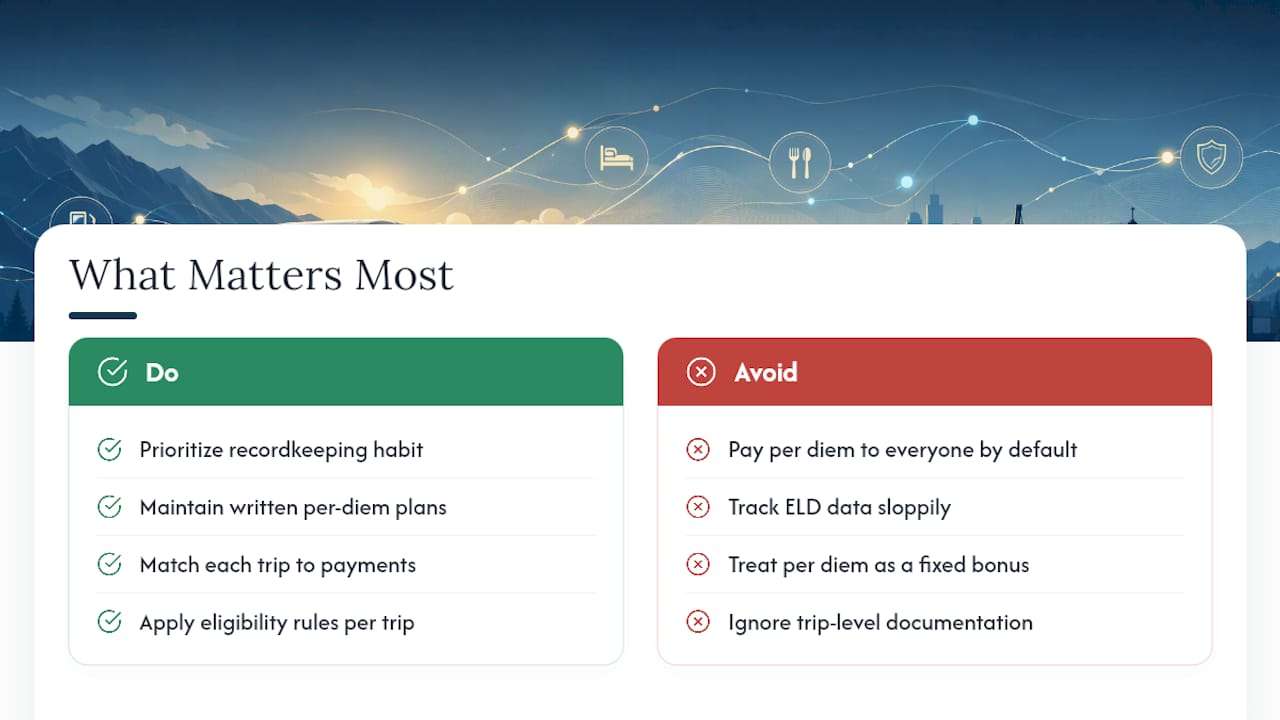
Conventional advice treats per diem like a fixed bonus you either get or don't. That framing undersells how much control drivers and fleet managers actually have over the outcome. An owner-operator who tracks ELD data sloppily leaves real deduction dollars on the table every single trip. A fleet that pays per diem by default to every driver, local or OTR, is quietly building a payroll tax liability it won't discover until an audit letter arrives.
If you take one thing from this, prioritize the recordkeeping habit over memorizing the rate. Rates change every fiscal year. A clean system for matching trips to payments doesn't, and it's the difference between per diem as a genuine tax advantage and per diem as a liability wearing a friendly name.
— Aaron
Find FedEx-Related Driving Jobs With Transparent Pay Details
Reading a job posting shouldn't require a tax attorney to figure out what you're actually being paid. Ucep lists FedEx-related driving opportunities, including CDL-A team, CDL-A solo, linehaul, and pickup and delivery roles, with employer profiles and driver reviews that help you see how a Service Provider actually structures pay before you apply.
Search filters let you narrow listings by role type and location, and employer directories give you a way to check a Service Provider's track record straight from other drivers who've worked there. If per diem transparency and clear pay terms matter to your next move, browse open driving positions on Ucep and see what's listed near you today.
Where to Verify These Rates and Rules
- IRS Notice 2025-54: the official 2026 CONUS/OCONUS per diem rate announcement.
- IRS Publication 463: full rules on travel-away-from-home tests and substantiation.
- DOT compliance guide: explains hours-of-service rules tied to per diem eligibility.
- ATBS and Bowes & Sullivan: industry-specific per diem breakdowns and compliance traps.