
Use these prioritized, ready-to-copy driver interview questions to hire safer, more reliable drivers faster. This guide gives you categorized questions, sample answers, red flags, and verification steps for CDL and non-CDL driving roles. Questions are ordered by hiring priority, starting with safety and regulatory compliance, so you can screen out risk before you dig into logistics or personality fit.
TL;DR:
- Focusing on safety questions during interviews is crucial, as understanding hours-of-service rules and willingness to report safety concerns distinguish dependable drivers from liabilities.
- Verification of driving records should include checking motor vehicle records, endorsements, drug tests, and employer references, with attention to patterns and honesty during interviews.
- Candidates should demonstrate specific experiences, ownership of past incidents, and detailed storytelling in safety, accident, and load inspection scenarios to prove reliability.
- Familiarity with digital tools, route planning apps, and proper communication habits are strong indicators of a driver's compliance and problem-solving skills.
- Using structured, safety-first interview questions and verifying responses with documented records significantly reduces operational risks and compliance failures.
Table of Contents
- Driver Interview Questions by Category
- How to Turn Answers Into Evidence
- Red Flags and a Verification Checklist
- Sample Answers and Scoring Cues
- Tech and ELD Proficiency Questions
- UCEP's Hiring Perspective on Driver Screening
- How to Verify Driving Records and Run Background Checks
- Behavioral and Situational Judgment Questions
- Problem-Solving and Decision-Making Questions
- Communication and Teamwork Questions
- Company Policy and Culture Questions
- Physical Fitness and Health Requirements
- A Hiring Manager's Take on Speed vs. Thoroughness
- How Ucep Helps You Hire Drivers Faster
- Sources
Driver Interview Questions by Category
Every category below targets a different part of the job. Some questions work best on a phone screen, where you're filtering a large applicant pool quickly. Others need an in-person conversation, where you can watch body language and push for detail. We've labeled each accordingly.
Safety and regulatory compliance (all roles, especially CDL-A)
Safety questions come first because they carry the highest cost when answered wrong. A driver who doesn't understand Hours-of-Service (HOS) rules is a liability the moment they're on the road.
- Walk me through how you log your hours using an Electronic Logging Device. (Phone screen)
- What would you do if your ELD showed a violation you didn't cause? (In-person)
- How do you stay current on FMCSA regulation changes? (Phone screen)
- Describe a time you had to refuse a load or route because of a safety concern. (In-person)
- What's your understanding of the 11-hour driving limit and 14-hour on-duty window? (Phone screen)
- Have you ever been cited for an HOS violation? What happened? (In-person)
These questions matter because knowing FMCSA protocols and being willing to flag safety issues, rather than push through them, separates dependable drivers from liability risks, according to guidance on DOT and FMCSA compliance.
Experience, licenses, and endorsements (CDL-A team, CDL-A solo, HazMat, tanker)
- What CDL class and endorsements do you currently hold? (Phone screen)
- Have you hauled HazMat or tanker loads? How recently? (Phone screen)
- What's the largest combination vehicle you've operated regularly? (Phone screen)
- Tell me about a route or freight type that stretched your skills. (In-person)
- Do you have team-driving experience, and how did you split shifts? (In-person, CDL-A team roles)
Pre-trip and post-trip inspection routine (all roles)
- Walk me through your pre-trip inspection, step by step. (In-person)
- Describe a specific inspection where you caught a real problem before the trip started. (In-person)
Candidates who give a story with dates, specific parts, and next steps are more trustworthy than those who recite a checklist from memory, according to CDL interview guidance.
Handling accidents, breakdowns, and emergencies
- Tell me about a breakdown you've experienced on the road. What did you do first? (In-person)
- How would you handle a minor collision with no injuries? (In-person)
- What's your process for documenting an accident scene? (Phone screen)
Fatigue and long-haul alertness (CDL-A solo, linehaul)
- What's your personal strategy for staying alert on long hauls? (In-person)
- Have you ever felt too tired to keep driving? What did you do? (In-person)
Customer service and delivery issues (pickup and delivery, CDL-A)
- How do you handle an upset customer at a delivery stop? (In-person)
- Describe a time a delivery went wrong and how you resolved it. (In-person)
Route planning, GPS, and technology
- What route-planning apps or GPS systems have you used? (Phone screen)
- How do you handle a route change mid-trip? (In-person)
Availability, shift flexibility, and attendance
- What days and hours are you available to work? (Phone screen)
- Are you open to weekend or overnight shifts if the role requires it? (Phone screen)
How to Turn Answers Into Evidence
A confident answer isn't the same as a true one. The real work happens in the follow-up, where you push past the rehearsed response and ask for specifics a scripted candidate can't fake.
Use STAR-style prompts: ask for the Situation, Task, Action, and Result behind every claim. If a candidate says "I always report safety issues," don't accept it at face value.
- Ask: "What was the last safety issue you reported, and to whom?"
- Ask: "What date did that happen, and what paperwork did you file?"
- Ask: "What changed after you reported it?"
- Ask: "Who else was involved, and can I contact them?"
For a breakdown story, push further: "Where exactly were you parked? Who did you call first, dispatch or roadside assistance? How long until you were moving again?" For a customer complaint, ask: "What exactly did the customer say, and what were your exact words back?"
Pro Tip: If a candidate can't name a date, a location, or a person involved in their story, treat the answer as unverified. Real experiences carry real details; invented ones stay vague on purpose.
Move a candidate to formal verification when their answers hold up under this pressure. Reject or flag for further review when they grow defensive, change their story, or repeatedly answer a different question than the one you asked.
Red Flags and a Verification Checklist
Interview answers only tell half the story. The other half comes from records that don't lie: the motor vehicle record (MVR), drug test results, and past employers.
- MVR review: Look for patterns, not single incidents. Multiple speeding tickets in 12 months matters more than one moving violation three years ago.
- License and endorsement verification: Confirm CDL class and endorsements match what the candidate claimed, and check expiration dates.
- DOT drug testing: Required before placing any CDL driver behind the wheel; treat refusal or a positive result as an automatic disqualifier.
- FMCSA Clearinghouse query: Check for prior drug and alcohol program violations tied to the candidate's CDL.
- Past-employer references: Ask specifically about attendance, safety incidents, and reason for leaving, not just "would you rehire."
Hiring guides for CDL roles consistently point to an early phone screen covering license class, driving history, and availability, followed by MVR checks and DOT drug tests before a driver gets placed, according to interview guidance for CDL truck drivers.
Watch for operational red flags during the conversation itself: vague timelines ("a while back"), shifting blame onto dispatch or other drivers, or hesitation when you ask whether they've ever reported a safety concern. A driver unwilling to admit a past mistake is often more dangerous than one who owns it.
Sample Answers and Scoring Cues
Strong answers share a pattern: specific details, ownership of outcomes, and a clear sequence of actions as recommended for safe driving in heavy rain. Here's what that sounds like across common scenarios.
- Pre-trip inspection: "Last winter I found a cracked air line during my walk-around. I flagged it to my shop, got it replaced, and logged the delay before departure." Listen for a concrete part, a specific action, and documentation.
- Accident response: "I secured the scene, checked for injuries, called dispatch and the police, then photographed everything before moving my truck." Listen for a sequence, not a single step.
- Fatigue management: "I plan naps at rest areas before I hit the wall, not after. I also do a sleep check the night before a long run." Structured, planned answers about rest protocols predict safer long-haul performance more reliably than a vague mention of coffee, based on wellness research for long-haul drivers.
- Customer complaint: "I apologized for the delay, explained the traffic issue honestly, and offered to call ahead next time." Listen for empathy plus a concrete fix, not just an apology.
| Signal | Accept | Verify Further | Reject |
|---|---|---|---|
| Specificity | Names dates, parts, people | Partial detail, some vagueness | No details, generic statements |
| Ownership | Admits mistakes, explains fix | Deflects slightly | Blames others entirely |
| Consistency | Story holds under follow-up | Minor inconsistencies | Story changes or contradicts itself |
Tech and ELD Proficiency Questions
Digital tools now sit at the center of daily compliance, which makes platform familiarity a real hiring signal rather than a nice-to-have.
- "Which ELD system have you used most recently, and how do you correct a logging error on it?"
- "How do you export your logs when a roadside inspector asks for them?"
- "What route-optimization app do you rely on, and how do you handle it rerouting you into a low bridge or restricted road?"
- "How do you communicate with dispatch when you hit a delay: text, app, or call?"
Vague answers ("I just use whatever they give me") suggest limited hands-on experience. Specific answers, naming the exact platform and describing a real error they fixed, indicate a candidate who will onboard faster and generate fewer compliance mistakes, a pattern noted in driver interview guidance focused on digital proficiency.
UCEP's Hiring Perspective on Driver Screening
Ucep works exclusively with Service Providers contracted with FedEx, so screening priorities differ by role. CDL-A team roles need compatibility and shift-splitting clarity. CDL-A solo and linehaul roles need proven fatigue management. Pickup and delivery roles need customer-facing judgment above all else.
Service Providers using structured, safety-first questions during screening tend to catch compliance gaps before onboarding, not after a violation. If you want candidates to walk in prepared, point them to Ucep's guide on preparing for a CDL job interview beforehand, and review drug testing requirements so your verification steps stay compliant from day one.
How to Verify Driving Records and Run Background Checks
Verification happens in a specific order, and skipping a step usually costs you more time later than doing it right the first time.
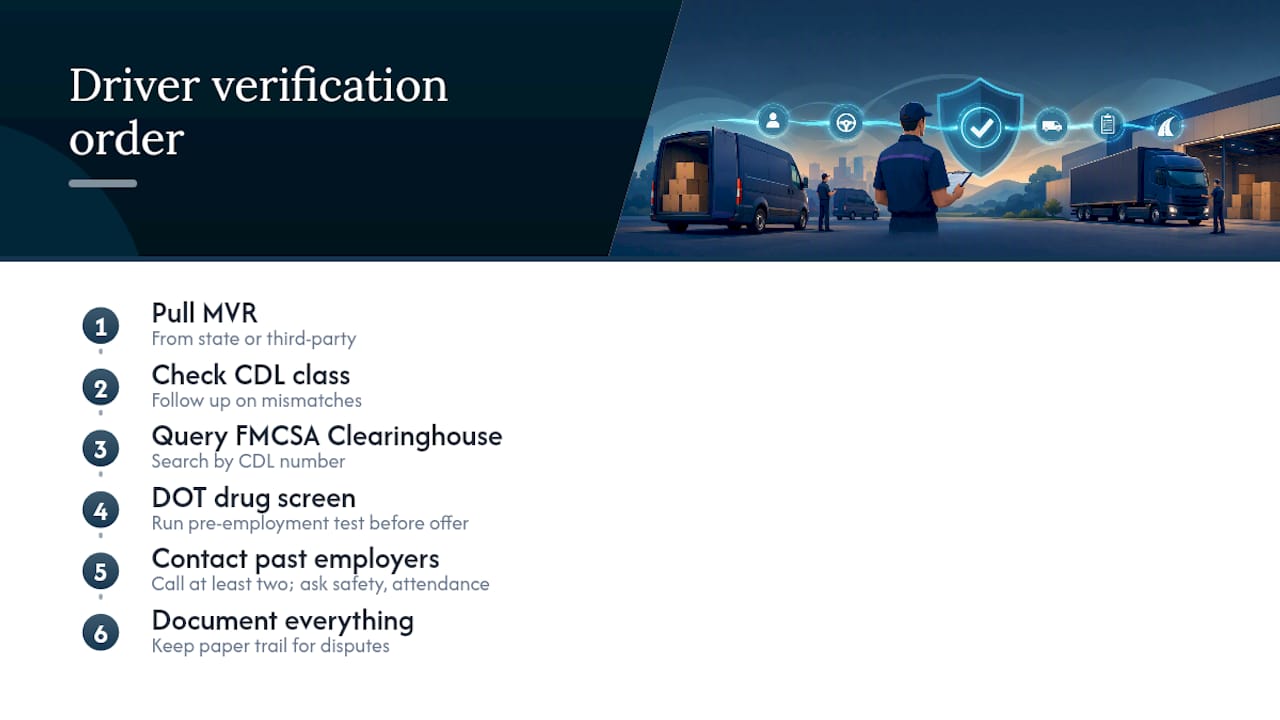
Start with the MVR pull through your state's licensing authority or a third-party provider. Look at the full history, not just the last violation. Cross-check the CDL class and endorsements against what the candidate told you in the interview; mismatches are common and worth a direct follow-up question.
Next, query the FMCSA Drug and Alcohol Clearinghouse for any prior violations tied to the applicant's CDL number. Run the required pre-employment DOT drug screen before finalizing an offer, not after. Contact at least two past employers directly, and ask about safety record and attendance specifically, since general references rarely volunteer that information unprompted.
Document every step. If a violation surfaces after hire, your paper trail on pre-employment screening is what protects your operation.
Behavioral and Situational Judgment Questions
Behavioral questions reveal how a candidate actually behaves under pressure, not how they describe themselves in the abstract.
Ask: "Tell me about a time dispatch gave you conflicting instructions. What did you do?" or "Describe a situation where you had to choose between an on-time delivery and a safety concern." These force the candidate into a real decision rather than a hypothetical ideal.
Situational versions work well too: "You're 30 minutes from a delivery window and traffic just added an hour. What do you do?" Listen for whether they mention notifying dispatch and the customer early, rather than just pushing harder to make up time.
The strongest answers show a clear decision process: assess the situation, communicate the problem, and choose the safer path even when it costs time.
Problem-Solving and Decision-Making Questions
Problem-solving questions separate drivers who think independently from those who wait for instructions on every issue.
Try: "Your GPS reroutes you onto a road with a low bridge clearance you can't confirm. What's your next move?" or "You arrive at a delivery dock that's closed for the day. Walk me through your options."
Good answers show layered thinking: check the truck's clearance data, call dispatch if uncertain, and have a backup plan already in mind before the problem happens. Weak answers stop at "I'd call someone," without any sense of what they'd do while waiting for a callback.
Communication and Teamwork Questions
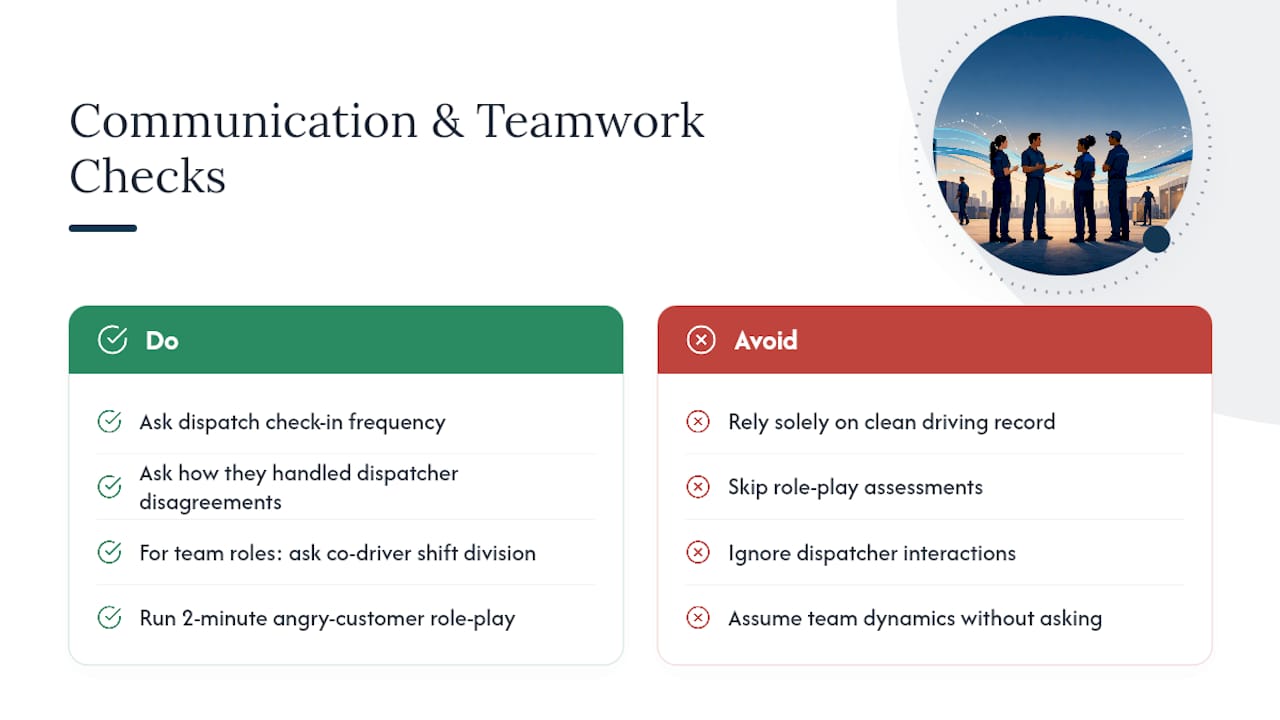
Communication quality often predicts reliability better than a clean driving record alone, since dispatch and customer interactions expose problem-solving skills a quiet drive never will, based on insight from customer service guidance for truck drivers.
Ask: "How often do you check in with dispatch during a long haul?" and "Describe a time you disagreed with a dispatcher's instructions. How did you handle it?"
For team-driving roles, ask directly: "How do you and a co-driver typically divide shifts and handle disagreements about breaks or route choices?" For all roles, consider a short two-minute role-play: have the candidate respond to a scripted angry customer, then score them on empathy, de-escalation, and whether they stayed within company policy, a technique used in customer-facing driver assessments.
Company Policy and Culture Questions
These questions confirm the candidate has actually read what they're signing up for, not just skimmed the job posting.
Ask: "What do you know about our attendance policy and how it applies to missed shifts?" or "How do you feel about our HOS logging requirements compared to places you've worked before?" A candidate who asks clarifying questions back shows more engagement than one who nods along to everything.
For roles tied to a specific Service Provider, ask how they'd handle a policy that's stricter than what they're used to. Answers that show adaptability rank higher than answers that just agree to avoid conflict.
Physical Fitness and Health Requirements
Driving is physically demanding in ways many candidates underestimate: long sitting periods, repetitive loading and unloading, and irregular sleep schedules all take a toll.
Ask: "Do you currently hold a valid DOT medical certificate, and when does it expire?" and "How do you manage the physical demands of loading or securing freight during a shift?"
For roles involving hand-loading or pickup and delivery, ask directly about lifting capacity and any physical restrictions. Occupational data on heavy and tractor-trailer truck drivers confirms the role involves long hours of sitting combined with physically demanding loading tasks, which makes this category worth more than a checkbox question.
A Hiring Manager's Take on Speed vs. Thoroughness
Every hiring manager feels the tension between verifying everything and filling a seat before a route goes uncovered. Cutting corners on safety and compliance questions is the trade-off that costs the most later, in incidents, turnover, or FMCSA violations tied back to your operation. The compromise that works: run your full safety and compliance screen on every candidate, no exceptions, and save the deeper behavioral and culture questions for candidates who already clear that bar.
If you implement one thing today, make it this: require a dated, specific example for every safety-related answer before you move a candidate forward.
— Aaron
How Ucep Helps You Hire Drivers Faster
Ucep is the job board built specifically for Service Providers contracted with FedEx, which means every listing and every applicant on the platform already understands the environment you're hiring for. Instead of sorting through generic driving applicants, you get candidates searching specifically for linehaul, CDL-A team, CDL-A solo, and pickup and delivery roles tied to FedEx operations.
Targeted driver alerts and an employer directory mean fewer unqualified applications reaching your inbox in the first place, which cuts down the screening time you'd otherwise spend filtering resumes that don't fit. The built-in applicant tracking system lets you move candidates from application to interview to verification without juggling spreadsheets, and driver and Service Provider reviews give you a read on reputation before you make an offer or accept one.
Browse companies currently hiring drivers to see how targeted listings work, or check Service Provider reviews before you post your next opening.
Sources
- Federal Motor Carrier Safety Administration (FMCSA)
- Heavy and tractor-trailer truck drivers - Occupational Outlook Handbook