
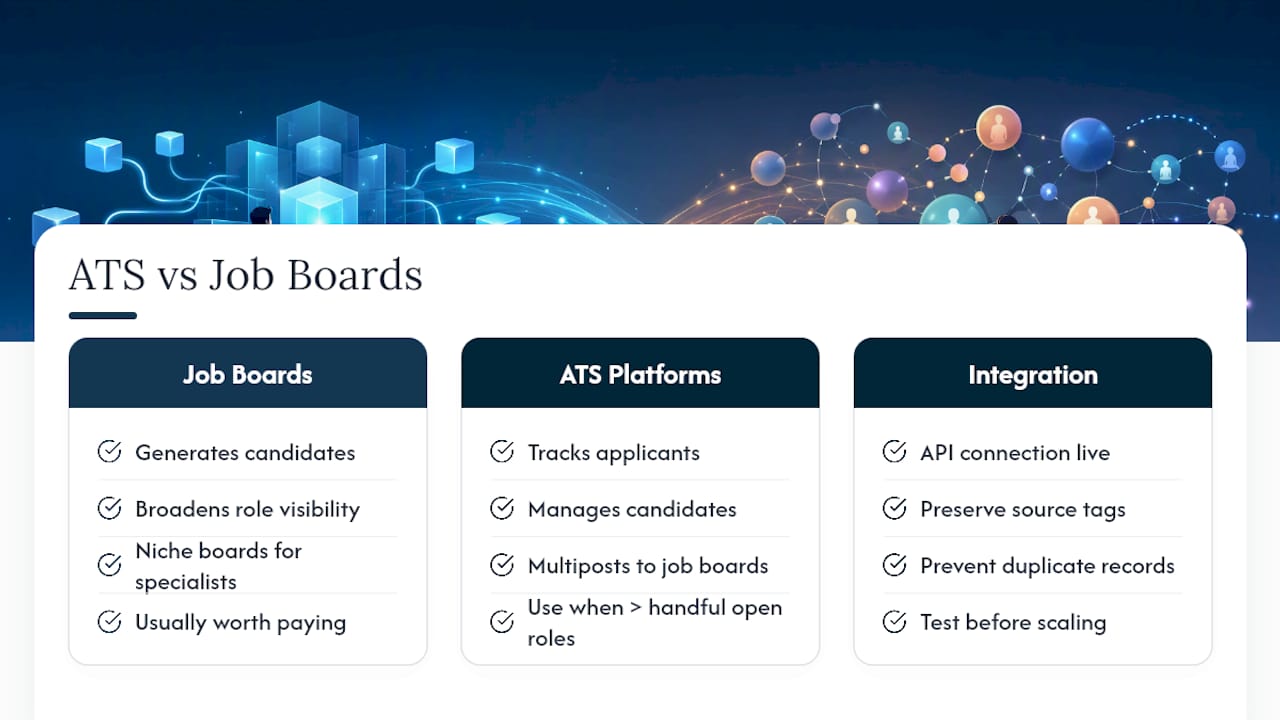
Use a job board when you need candidate volume fast. Use an applicant tracking system (ATS) when you need to manage, screen, and track those candidates without losing them in a spreadsheet. Most hiring teams get the best results running both together: job boards feed the top of the funnel, and the ATS manages everything from application to offer.
Here's how that plays out in practice:
- Rely on job boards when you're filling a straightforward, high-volume role and want maximum visibility fast, such as posting open CDL-A positions across multiple markets.
- Rely on an ATS when you're managing multiple requisitions at once, need compliance documentation, or want to stop losing candidates to disorganized email threads.
- Use both when you're running an ongoing hiring program. Job boards drive applicants in; the ATS keeps every one of them organized, screened, and moving.
The rest of this guide breaks down what each tool actually does, where they overlap, and how to decide which one deserves your budget this quarter.
Key Takeaways
Recruiters who treat ATS and job board investments as a single hybrid system fill roles faster and lose fewer candidates than teams relying on either tool alone.
| Point | Details |
|---|---|
| Match the tool to the problem | Use job boards for reach, an ATS for process; most roles need both working together. |
| Reach problems need boards | If nobody sees your posting, more process tools won't fix a visibility gap. |
| Process problems need an ATS | Unread resumes and lost candidates signal you need centralized tracking, not more postings. |
| Test integrations before full rollout | Verify source tags and duplicate handling with a small pilot before scaling. |
| Specialized hiring favors niche boards | Platforms like UCEP concentrate qualified drivers for FedEx-contracted roles, improving match rates over general boards. |
Table of Contents
- Job Boards vs ATS: What a Job Board Actually Does
- ATS vs Recruitment Software: What an Applicant Tracking System Does
- ATS vs Job Board: Head-to-Head Differences
- Job Board Pros and Cons vs ATS Pros and Cons
- How to Choose: Job Board, ATS, or Both
- How ATS and Job Board Integrations Work
- What Job Boards and ATS Platforms Cost, and How to Measure ROI
- Common Rollout Problems With ATS and Job Board Strategies
- Why Specialized Driver Job Boards Behave Differently
- A Note From the UCEP Team
- If You Hire Drivers, Here's How UCEP Supports the Process
- Frequently Asked Questions
- Sources
Job Boards vs ATS: What a Job Board Actually Does
A job board is a platform where employers post open positions and job seekers search for them. Think of it as a marketplace for job listings. It doesn't manage your hiring process. It generates candidates and hands them to you, usually as a resume and a contact email.
Job boards serve three core functions for recruiters. First, they post your role to a searchable database candidates actively browse. Second, they offer search visibility tools, like keyword tagging and filters, that help the right candidates find your listing. Third, many offer sponsored or featured placements that push your posting above competitors for an extra fee.
General job boards cast a wide net across every industry and job type. Niche boards concentrate on one sector, which matters more than it sounds. For sector-specific hiring like trucking, job boards remain valuable because they let employers and drivers compare pay, bonuses, and route types quickly without wading through unrelated listings. A general board buries a CDL-A team driving role between retail and tech postings. A trucking-focused board puts it in front of drivers already looking for exactly that.
Job board pricing generally falls into a few structures:
- Per-post fees: a flat rate to publish one listing for a set duration.
- Pay-per-click: you pay only when a candidate clicks through to your posting.
- Subscription plans: unlimited or bulk postings for a monthly or annual fee.
- Sponsored/featured upgrades: added visibility for an extra charge on top of a base post.
Job boards typically deliver volume and lower upfront costs, and City Personnel's pricing breakdown shows sponsored budgets can range from modest daily spends to more substantial ones depending on how aggressively you want a listing promoted. That flexibility makes job boards a low-commitment way to test demand for a role before investing more time or money elsewhere.
ATS vs Recruitment Software: What an Applicant Tracking System Does
An ATS manages the hiring process itself, from the moment a requisition opens to the moment someone signs an offer letter. Where a job board's job ends at "candidate applied," an ATS's job is just beginning.
Most ATS platforms share a common feature set:
- Resume parsing: automatically extracts candidate data from resumes into searchable fields.
- Multiposting: pushes one job listing out to several job boards simultaneously.
- Workflow automation: moves candidates through defined stages (applied, screened, interviewed, offered).
- Interview scheduling: coordinates calendars between candidates and hiring managers.
- Team collaboration tools: lets multiple people leave notes, ratings, and feedback on the same candidate.
- Analytics and reporting: tracks time-to-fill, source of hire, and pipeline conversion.
- Compliance recordkeeping: stores documentation needed for equal opportunity and audit purposes.
Picture a typical flow: a hiring manager opens a requisition for a linehaul driver. The ATS pushes that posting to several job boards at once. Applications flow back into one dashboard instead of five separate inboxes. A recruiter screens resumes using saved filters, schedules interviews without a single back-and-forth email, and leaves shared notes for the hiring manager to review before the offer stage.
An ATS centralizes candidate data, automates screening and scheduling tasks, and provides analytics that most recruiters say meaningfully changed how their team hires. Newer platforms increasingly build AI into that automation layer, using it to rank resumes against a job description or flag likely no-shows based on past scheduling behavior. That's an efficiency layer on top of the same core job: tracking people through a process, not finding them in the first place.
ATS vs Job Board: Head-to-Head Differences
The two tools solve different problems, and the gap between them shows up clearly once you line up the dimensions recruiters actually care about.
| Dimension | Job Board | ATS |
|---|---|---|
| Reach / candidate volume | High. Built for visibility and search traffic. | Low on its own; depends on where it posts. |
| Time & efficiency | Fast to post, slow to manage responses manually. | Slower to set up, much faster once running. |
| Candidate data / centralized management | Minimal. Data stays scattered across applications. | Strong. One record per candidate, one source of truth. |
| Analytics & reporting | Basic, usually limited to click or view counts. | Detailed: time-to-fill, source tracking, pipeline stages. |
| Collaboration / hiring team workflows | None built in. | Shared notes, ratings, and stage visibility. |
| Compliance & consistency | Not addressed. | Structured recordkeeping and consistent process steps. |
| Cost model / ROI | Lower upfront, scales with volume and boosts. | Higher upfront, scales with process efficiency. |
| Candidate experience | Quick to apply, but often a black hole afterward. | Depends on setup; can automate updates and reduce silence. |
A few of these differences matter more than the rest when you're deciding where to spend limited budget. Job boards win on raw exposure. If nobody sees your posting, nothing downstream matters. ATS platforms win on what happens after someone applies, which is where most hiring actually falls apart. LinkedIn's own breakdown of the role separation between the two puts it plainly: job boards find applicants, ATS platforms move them through a process.
Here's where each dimension should tip your decision:
- If your open role gets zero applicants after a week, that's a reach problem. Fix it with a job board, not an ATS.
- If you have 40 resumes sitting unread in an inbox, that's a process problem. No amount of extra job board spend fixes it.
- If a hiring manager asks "where are we on the driver requisition from three weeks ago" and nobody has a clear answer, you need centralized tracking more than you need more traffic.
Job Board Pros and Cons vs ATS Pros and Cons
Neither tool is universally better. Each carries trade-offs recruiters should weigh against their specific hiring constraints.
Job boards: pros
- Fast to set up and post, often within minutes.
- Wide candidate reach, especially for common roles.
- Lower upfront cost, particularly for per-post pricing.
- No implementation or training curve.
Job boards: cons
- No built-in way to track, screen, or organize applicants.
- Application quality varies widely without filtering tools.
- Candidates can vanish into a pile of unopened emails.
- Costs climb quickly with sponsored boosts on competitive roles.
ATS: pros
- Centralizes every candidate and every interaction in one place.
- Automates repetitive tasks like scheduling and status updates.
- Gives hiring managers and recruiters shared visibility.
- Produces real reporting on where hires actually come from.
ATS: cons
- Requires setup time and a learning curve for new users.
- Doesn't generate candidates on its own; it needs a source.
- Underused features waste the subscription cost.
- Poor configuration creates more friction than it removes.
Pro Tip: Post through your ATS's multiposting feature rather than logging into five separate job board accounts. It cuts posting time down to minutes and keeps source data intact for later reporting.
Recruitment-agency comparisons echo the same pattern from a different angle. Job boards win on volume and price, while dedicated screening tools or agencies win on speed and candidate quality, which reinforces why a hybrid setup tends to outperform either approach alone.
How to Choose: Job Board, ATS, or Both
Five questions settle most of the job board vs recruitment software debate for a given role or hiring campaign.
- How urgent is this hire? If you need someone in the seat next week, a job board's speed matters more than an ATS's process controls.
- How specialized is the role? Niche skill sets (CDL-A, hazmat endorsements, specific route experience) do better on boards built for that audience than on general platforms.
- What's your candidate volume? One or two open roles rarely justify a full ATS rollout. Ten or more open roles running simultaneously almost always do.
- What's your budget, and over what timeframe? Job board spend is easier to turn on and off. ATS subscriptions pay off over months, not days.
- Do you have internal capacity to manage responses? If nobody on your team has time to sort resumes, an ATS's automation isn't optional. It's the only way the volume stays manageable.
A few red flags tell you an ATS has become mandatory rather than optional: multiple people are hiring for the same role without visibility into each other's pipelines, candidates are falling through the cracks between email and text, or you can't answer "where did our last five hires come from" without guessing.
On the flip side, a job board is unlikely to work alone when the role is highly specialized and low-volume, or when your team has no process to handle whatever response volume the board generates.
Once you've answered those five questions, the next steps tend to follow a pattern:
- Low urgency, high specialization, low volume: use a niche job board and manage responses manually.
- High urgency, high volume: use both, with the ATS multiposting to several boards simultaneously.
- Ongoing hiring program regardless of volume: an ATS is worth the investment on its own.
Loop in IT early if the ATS needs to integrate with existing HR software, and loop in legal or compliance if the role requires specific recordkeeping, since drug testing and other regulatory requirements for driver hiring often need to be documented inside whatever system tracks the candidate.
How ATS and Job Board Integrations Work
Multiposting is the mechanism that connects the two tools. Instead of logging into each job board separately, you post once from inside the ATS, and it distributes that listing to every connected board automatically. Applications flow back into the same dashboard no matter which board they came from.
The workflow looks like this in practice:
- Post: create the job listing once inside the ATS.
- Collect: applications from every connected board land in one inbox.
- Parse: resume data gets extracted automatically into searchable candidate profiles.
- Screen: recruiters filter and rank candidates using saved criteria.
- Schedule: interviews get booked without manual email back-and-forth.
Before rolling out a new integration across your team, check these items:
- API connections: confirm the ATS actually has a live integration with each board you use, not just a manual export option.
- CSV import fallback: verify you can bulk-upload candidate data if an API connection breaks.
- Source tags: make sure every application carries a tag showing which board it came from.
- Webhook delivery: test that new applications trigger real-time notifications instead of batch delays.
- Duplicate prevention: check that the same candidate applying through two boards doesn't create two separate records.
Run a short pilot before committing fully. Post two or three real roles through the integration, then check whether source tags survived the trip and whether duplicate candidates got merged correctly. Missing that step before a full rollout leads to poor attribution and inflated source metrics, since a board that looks like it's driving strong results might just be double counting the same applicants who also applied elsewhere. Trucking-specific software platforms, including tools covered in Haullytics' guide for owner-operators and fleets, increasingly build these same integration principles into fleet management tools, which is worth checking if your hiring stack needs to talk to dispatch or compliance software too.
What Job Boards and ATS Platforms Cost, and How to Measure ROI
Pricing for both tools breaks down into a handful of predictable models:
- Per-post (job boards): a flat fee per listing, per duration.
- Pay-per-click (job boards): charged only when a candidate clicks the posting.
- Subscription (both): flat monthly or annual fee for a set volume of postings or seats.
- Seat-based (ATS): pricing scales with the number of recruiters or hiring managers using the system.
- Per-hire or agency fees (alternative to both): a percentage of first-year salary, common with staffing agencies rather than boards or ATS platforms.
- Implementation costs (ATS): one-time setup, data migration, or training fees.
| Cost Type | Typical Structure | Notes |
|---|---|---|
| Job board sponsored budget | Daily or weekly spend | Ranges from modest test budgets to larger sustained campaigns |
| Job board subscription | Monthly or annual flat fee | Often includes a set number of postings |
| ATS seat-based pricing | Per recruiter/month | Scales with team size, not job volume |
| ATS implementation | One-time fee | Covers setup, data import, and training |
City Personnel's cost breakdown for job board spend shows that budget ranges vary widely depending on how aggressively you want a posting boosted, which makes job boards a flexible test bed before locking into a bigger commitment.
Three metrics matter most when calculating whether either tool is earning its cost:
- Cost-per-hire: total spend (job board fees, ATS subscription, internal labor) divided by number of hires.
- Time-to-fill: days from requisition open to accepted offer.
- Quality-of-hire proxies: 90-day retention rate, hiring manager satisfaction scores, or early performance reviews.
Don't forget to fold internal labor and vacancy cost into that math. A recruiter spending ten hours a week manually sorting resumes from five separate job board inboxes has a real cost, even if it never shows up on an invoice. An open seat sitting unfilled for an extra three weeks has a cost too, usually larger than either tool's subscription fee.
Common Rollout Problems With ATS and Job Board Strategies
Most implementation failures trace back to a handful of predictable mistakes, all fixable with a bit of planning up front.
Poor data hygiene shows up when candidate records get duplicated, tagged inconsistently, or left incomplete because nobody owns data quality. Fix it with a short cleanup pass before go-live and a clear rule about who updates candidate status and when.
Misconfigured workflows happen when a hiring stage gets skipped or automated emails go out with the wrong template. Run a pilot with two or three real requisitions before rolling the system out to the whole team, and watch for candidates who unexpectedly jump stages.
Poor candidate experience creeps in when automation replaces communication instead of supporting it. A candidate who gets an automated rejection three months after applying, with no update in between, remembers that experience. Set expectations early and keep status updates timely, even when they're automated.
Low adoption kills more ATS rollouts than any technical problem. If recruiters keep working out of personal email because the new system feels slower, the investment is wasted. Short, role-specific training sessions in the first two weeks tend to fix this faster than a single long onboarding session ever does. Common hiring mistakes with CDL drivers often trace back to exactly this kind of inconsistency between what a system is supposed to do and what recruiters actually use it for.
Early signs of successful adoption look like recruiters logging in daily without prompting, hiring managers checking pipeline status themselves instead of asking for updates, and a shrinking pile of candidates stuck in "new application" status for more than 48 hours.
Why Specialized Driver Job Boards Behave Differently
General job boards spread candidates across every industry imaginable. A specialized board concentrates them in one place, and that concentration changes the math on match rate and time-to-hire in ways general platforms can't replicate.
Specialized boards surface role-specific signals that general boards typically strip away or bury: CDL endorsements, route preferences (regional, OTR, linehaul), shift types, and team versus solo driving history. A general board treats a CDL-A team driver application the same as a warehouse application. A driver-focused board puts that information front and center, which means recruiters spend less time filtering out candidates who were never a fit to begin with.
That's the model UCEP was built around. Because the platform focuses exclusively on FedEx-contracted Service Provider hiring, listings for linehaul, CDL-A team, CDL-A solo, and pickup and delivery roles reach drivers who are already searching for exactly that kind of work, rather than competing for attention against unrelated job categories. The result tends to be a shorter distance between "post a job" and "hire a qualified driver" than a general board delivers for the same role. Dedicated trucking job boards built around a single carrier network carry that same concentration effect.

Pro Tip: Pair a niche job board with your ATS instead of choosing one over the other. Post through the niche board for concentrated reach, then let the ATS handle screening, scheduling, and recordkeeping once applications start coming in. You get both the audience and the process.
A Note From the UCEP Team
We built UCEP because general job boards weren't cutting it for FedEx-contracted Service Providers trying to fill linehaul, CDL-A, and pickup and delivery roles. Every listing on the platform speaks to drivers who are already looking for FedEx-related work, and every feature, from employer directories to the built-in applicant tracking tools, exists because Service Providers told us what was missing from the general boards they'd been using. That focus is the whole point of the platform, and it's why the case studies and metrics we track center specifically on driver hiring outcomes rather than hiring in general.
If You Hire Drivers, Here's How UCEP Supports the Process
UCEP is built specifically for FedEx-contracted Service Providers who need qualified drivers without sorting through applicants who were never a fit. Instead of posting a linehaul or CDL-A role on a general board and hoping the right person sees it, you're posting directly to drivers already searching for FedEx-related work.
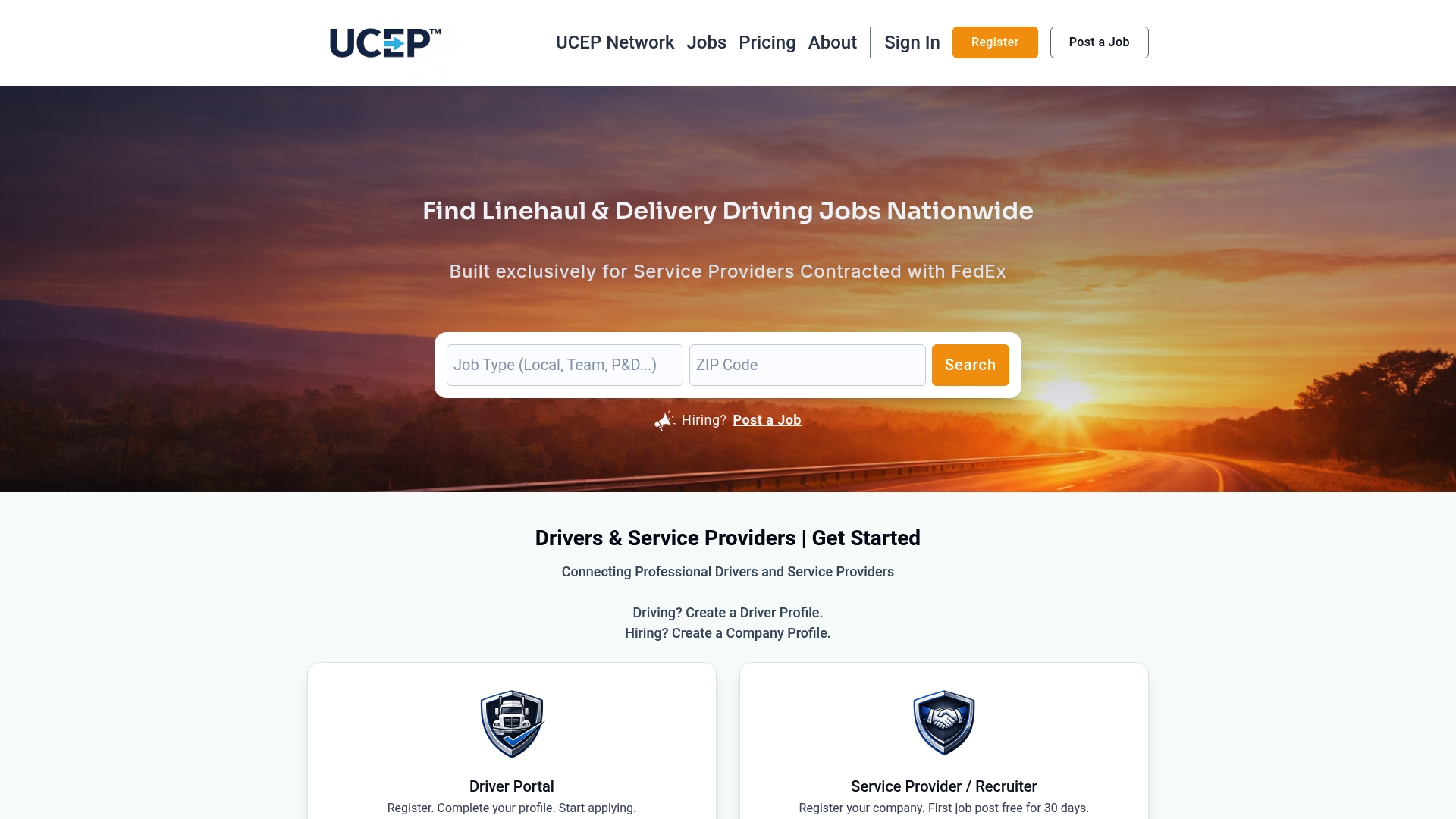
The platform combines the reach of a specialized job board with process tools recruiters usually only get from a full ATS. That means targeted driver alerts that reach candidates matching your specific role, employer and terminal directories that help drivers vet your company before applying, and a built-in applicant tracking system so applications don't scatter across five inboxes. Service Providers posting multiple roles at once can also access bulk posting discounts, which matters when you're filling several routes simultaneously rather than one position at a time.
You can see how employer profiles look in practice by browsing companies currently hiring drivers on the platform, and check service provider reviews to see how other carriers describe their hiring experience before you post your first listing.
Frequently Asked Questions
Do companies still use ATS platforms, or have job boards made them unnecessary? Companies use both, and adoption has grown rather than declined. Job boards generate candidates; an ATS is what most hiring teams use to keep track of them once they apply. The two solve different problems, so one doesn't replace the other.
Is paying for a job board worth it if I already have an ATS? Usually, yes, especially for roles that need broader visibility. An ATS manages candidates well but doesn't generate them on its own. Most ATS platforms multipost directly to job boards, so you get both without duplicating your posting effort.
What are some well-known ATS examples? Vendor comparison sites like Capterra list dozens of ATS platforms with varying feature sets, from simple applicant tracking to full recruitment suites with built-in analytics and compliance tools. Feature checklists matter more than brand name when comparing options.
Is a general job board or a niche job board better for specialized roles like CDL driving? Niche boards typically outperform general ones for specialized roles because they concentrate candidates who already have the relevant license, endorsement, or route experience. A driver-focused platform surfaces those details upfront, cutting down on unqualified applications compared to a general board where trucking roles compete for attention against every other industry.
How do I know if my hiring volume justifies an ATS? If you're managing more than a handful of open roles at once, or if candidates are getting lost between emails and spreadsheets, the volume already justifies it. Teams hiring for a single role occasionally can usually get by with a job board and manual tracking.
What should I check before rolling out a job board integration with my ATS? Confirm the API connection is live (not just a manual export), test that source tags survive the transfer, and check for duplicate candidate records before scaling the integration across your whole team.
Sources
Recruiters looking to go deeper on pricing comparisons and vendor research have a few solid starting points.
- ATS vs. Job Boards: What Are the Differences? | ClearCo
- Staffing Agency Vs. Indeed And Other Job Boards: Which Is Better? - City Personnel
- How to Choose the Right Job Recruiter for Your Industry? | Lifelineon
For pricing specifics, start with the staffing agency and job board comparisons. For implementation templates and integration checklists, vendor pages and ATS marketplaces like Capterra tend to offer the most current, practical detail.